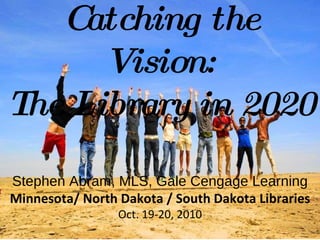
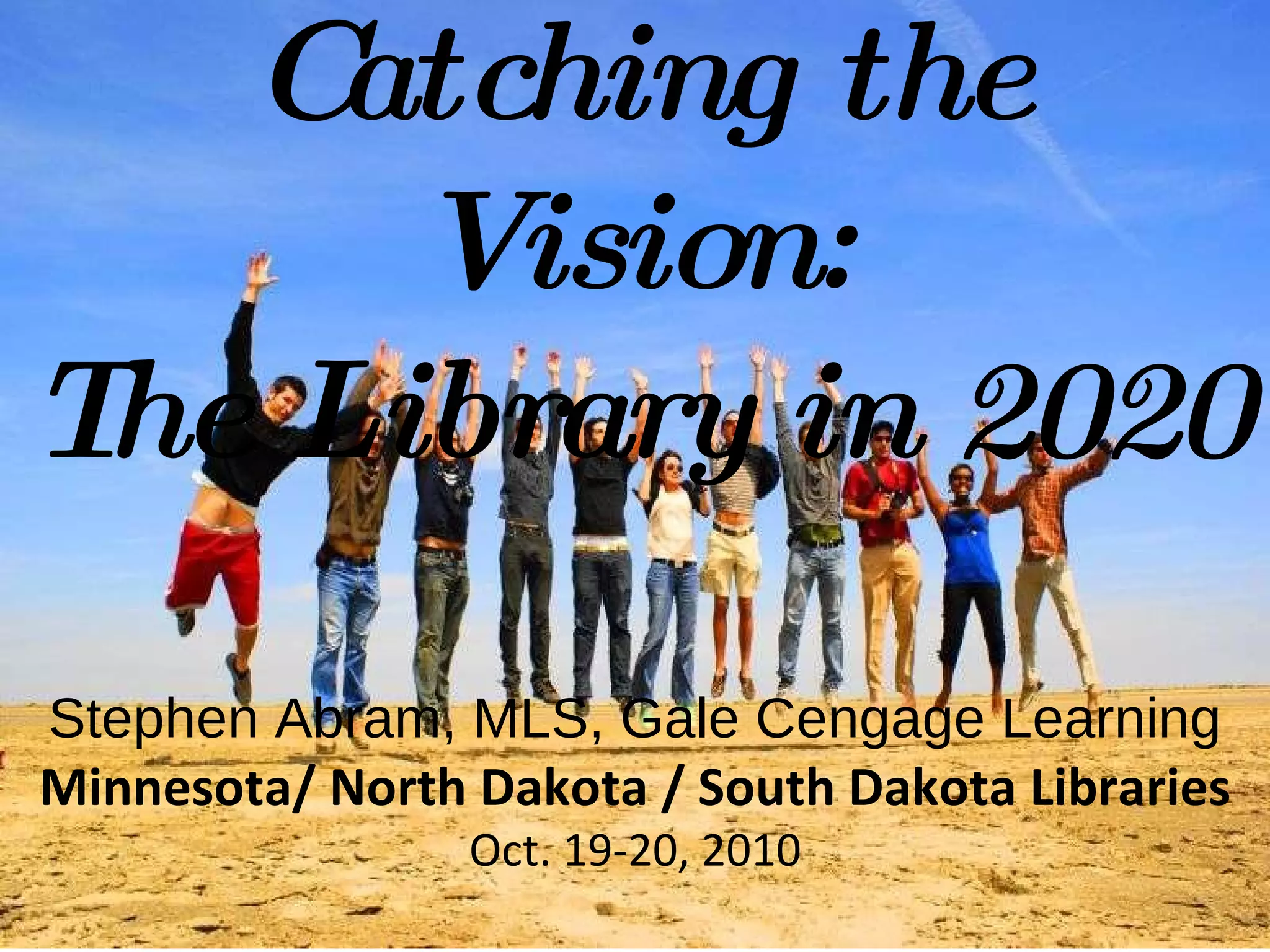
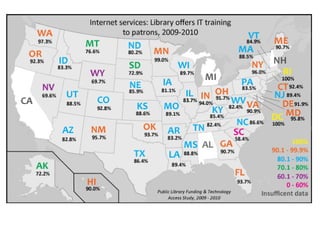
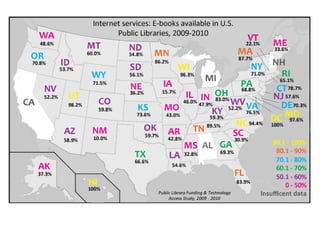
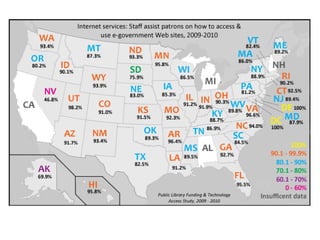
Leah Krevit Rice University The Rest of Us Stephen Abram, MLS, Gale Cengage Learning Minnesota/ North Dakota / South Dakota Libraries Oct. 19-20, 2010 Catching the Vision: The Library in 2020
Thank you for inviting me! I want to  share : Major upcoming trends and challenges in Technology, Communities and Librarians Special Surveys of Library Use New National Data on Database Use And I want to meet you.
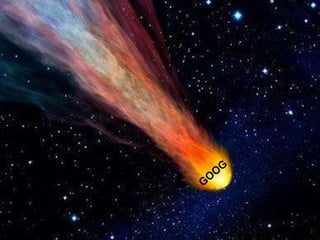
GOOG
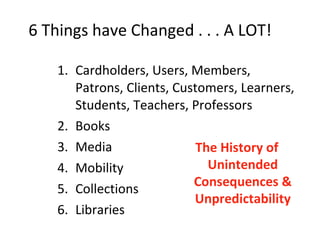
6 Things have Changed . . . A LOT!  Cardholders, Users, Members, Patrons, Clients, Customers, Learners, Students, Teachers, Professors Books Media Mobility Collections Libraries The History of Unintended Consequences & Unpredictability
“ The Internet has now progressed to its infancy”


How can I lead my library and my community or institution to be ready for the next 10 years?
People
 
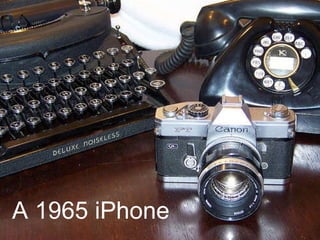
A 1965 iPhone
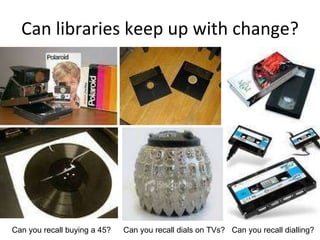
Can libraries keep up with change? Can you recall buying a 45? Can you recall dials on TVs? Can you recall dialling?
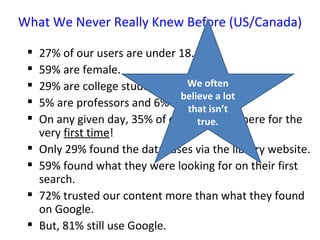
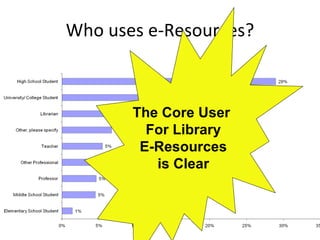
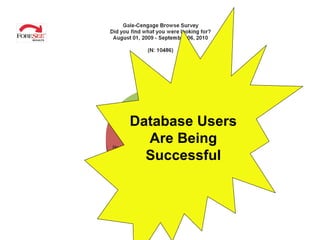
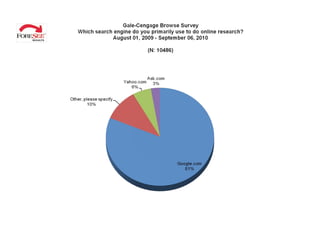
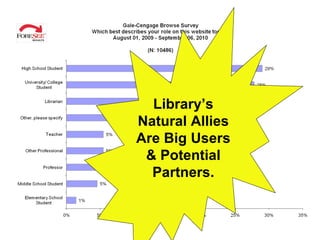
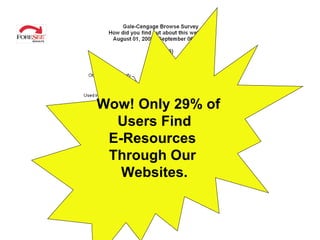
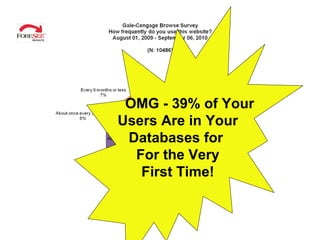
What We Never Really Knew Before (US/Canada) 27% of our users are under 18. 59% are female. 29% are college students. 5% are professors and 6% are teachers. On any given day, 35% of our users are there for the very  first time ! Only 29% found the databases via the library website. 59% found what they were looking for on their first search. 72% trusted our content more than what they found on Google. But, 81% still use Google. We often believe a lot that isn’t true.
People are Changing Demographic– south, Millennial, Boomer,+ IQ Increases Increased educational attainment & engagement eBooks outsell hard cover books, and will outsell paperbacks soon (2011) Some libraries are crediting most cardholder growth to e-book accessibility eBooks usage is largely middle-aged. Some sectors are slyly very tech-dominated (farming, cattle, trucking, natural resources…)
People Have Changed Twitter & Facebook are dominated by the middle aged Gaming too. . . Mothers in their 30’s Social networks fastest growing populations are seniors and will be more international and less urban and English. Personal device proliferation Mobile data usage is growing beyond youth very quickly, workplace use is huge
Have Students Changed?
 
Me
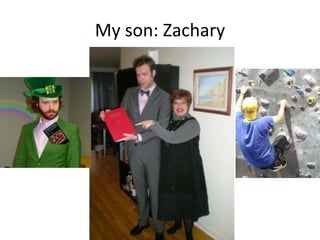
My son: Zachary
My daughter: Sydney


NextGen Differences Increase in IQ - 15-20 Points Brain & Developmental Changes Eye Movement Changes Massive Behavioural Changes Major Decline in Crime Rates – 65%+ But still a 70%  behavior overlap with Boomers (see my book chapter)
Discovery & Ideas
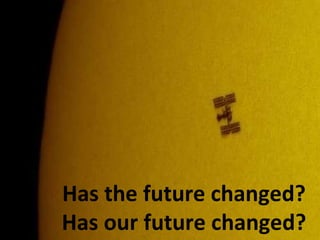
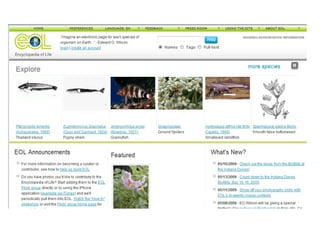
Has the future changed? Has our future changed?
 
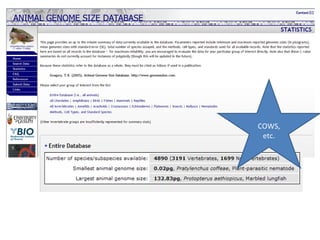
COWS, etc.


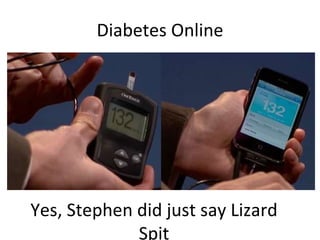
Diabetes Online Yes, Stephen did just say Lizard Spit

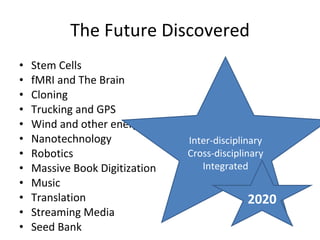
The Future Discovered Stem Cells fMRI and The Brain Cloning Trucking and GPS Wind and other energy Nanotechnology Robotics Massive Book Digitization Music Translation Streaming Media Seed Bank Inter-disciplinary Cross-disciplinary Integrated 2020
Books
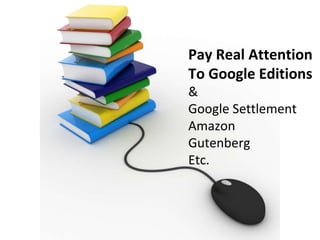
Pay Real Attention To Google Editions & Google Settlement Amazon Gutenberg Etc.
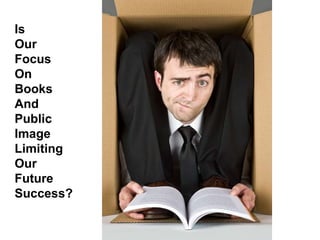
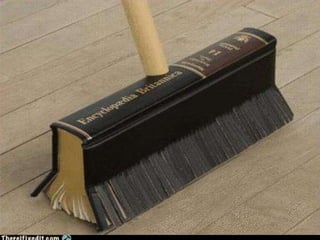
Is  Our  Focus On  Books And  Public Image  Limiting  Our Future  Success?
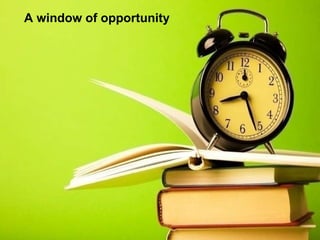
A window of opportunity


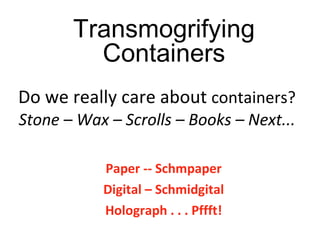
Do we really care about  containers? Stone – Wax – Scrolls – Books – Next... Paper -- Schmpaper Digital – Schmidgital Holograph . . . Pffft! Transmogrifying Containers
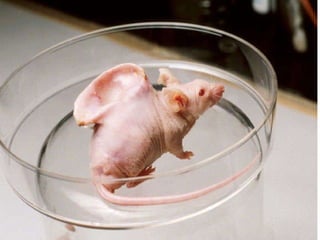
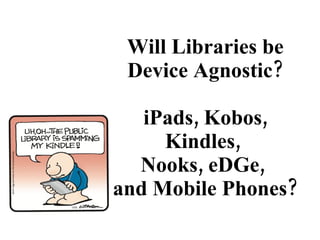
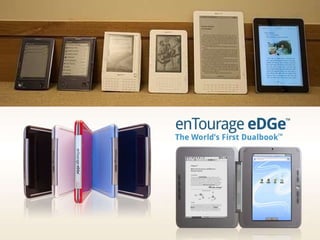
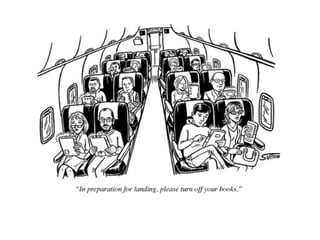
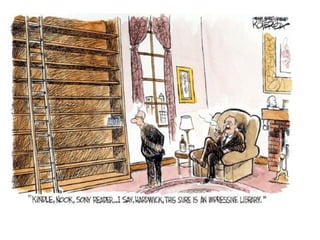
Will Libraries be Device Agnostic?   iPads, Kobos, Kindles,  Nooks, eDGe,  and Mobile Phones?

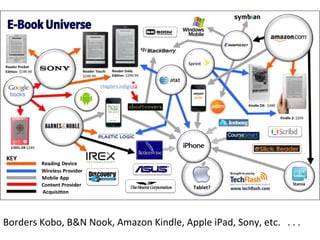
Borders Kobo, B&N Nook, Amazon Kindle, Apple iPad, Sony, etc.  . . .
 
 
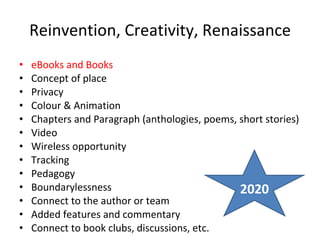
Reinvention, Creativity, Renaissance eBooks and Books Concept of place Privacy Colour & Animation Chapters and Paragraph (anthologies, poems, short stories) Video Wireless opportunity Tracking Pedagogy Boundarylessness Connect to the author or team Added features and commentary Connect to book clubs, discussions, etc. 2020
Media
 
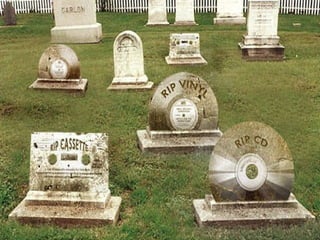
The Move to Streaming Like wax, vinyl and tape before it CD and DVD will decline to very small niche markets Blockbuster’s bankruptcy and the decline of local independent rental stores is a canary in the mine Many PL’s confuse the current uptick with a LT trend. Music and Video entertainment vs. programs related to hobbies, children, etc. Educational video is an emerging sector integrated very tightly into content
Reinvention, Creativity, Renaissance Streaming Media on demand Definition of  ‘use’. Concept of place Concept of News and Entertainment End of physical format (DVD, tape, etc.) Self published animation & video Commentary, Reviews and Collectors Wireless opportunity Tracking Pedagogy Boundarylessness End of collections as we know them  Beginning of media bibliography
Mobility
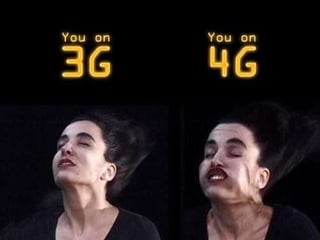
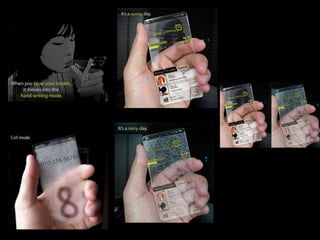
Broadband You must clearly understand the latest FCC  Whitespace Broadband Decision – THIS IS TRANSFORMATIONAL Local wired To the Home and workplace Wireless as a business strategy (Starbucks) Mobile dominates Largest generation


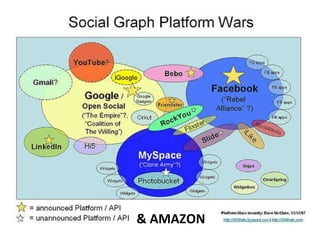
& AMAZON
Reinvention, Creativity, Renaissance Mobility Concept of place – Adopt a hybrid mindset Social animation and Sharing Convergence on steroids Wireless opportunity Tracking Pedagogy and Learning Extreme demand
Collections
An New Merging Model Just in case, Just in time, just for me models are now ripe for replacement with Fit for Purpose  Community Learning Entertainment Social / Clubs Research Beginning of the end for the dominance of out-of-context Megadatabases –  Think meals vs. grocery stores


Growing Online and Virtual Use Experience Models Widgets API’s SEO Google Analytics Geo-IP ForeSee Satisfaction data AND Statistics – Measure too
Driving User to the Library Encyclopedia.com HighBeam & Questia WorldCat AccessMyLibrary iPhone App for public, school and higher ed – iPhone and Droid! Geo-IP features and measures Watch for more . . .?
Reinvention, Creativity, Renaissance Collections Concept of place Ownership mutates Personal curation and celebrity curators Wireless opportunity Tracking Targeting collections  Portalization: Knowledge Portals, Learning portals 2020
Libraries Approaching the End Game The Matrix Build it or buy it?
 
 
I   my customers
NOT ENOUGH


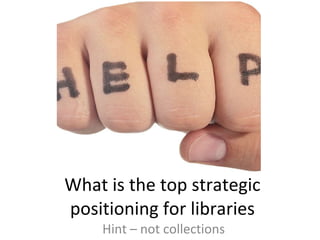
What is the top strategic positioning for libraries Hint – not collections
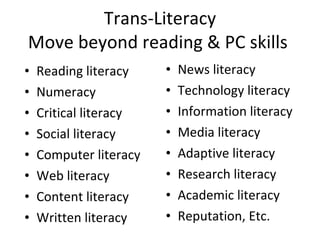
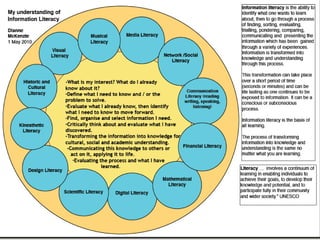
Trans-Literacy Move beyond reading & PC skills  Reading literacy Numeracy Critical literacy Social literacy Computer literacy Web literacy Content literacy Written literacy News literacy Technology literacy Information literacy Media literacy Adaptive literacy Research literacy Academic literacy Reputation, Etc.
 
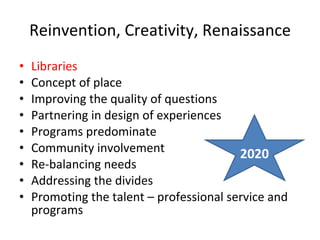
Reinvention, Creativity, Renaissance Libraries Concept of place Improving the quality of questions Partnering in design of experiences Programs predominate Community involvement Re-balancing needs Addressing the divides Promoting the talent – professional service and programs 2020
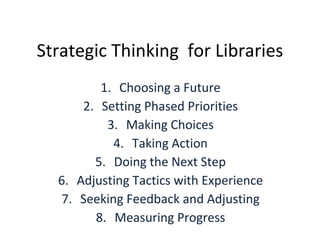
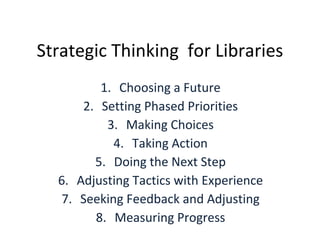
Strategic Thinking  for Libraries Choosing a Future Setting Phased Priorities Making Choices Taking Action Doing the Next Step Adjusting Tactics with Experience Seeking Feedback and Adjusting Measuring Progress
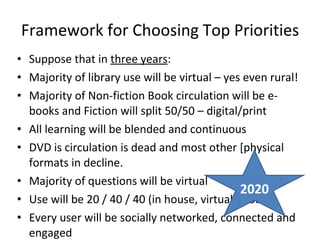
Framework for Choosing Top Priorities  Suppose that in  three years : Majority of library use will be virtual – yes even rural! Majority of Non-fiction Book circulation will be e-books and Fiction will split 50/50 – digital/print All learning will be blended and continuous DVD is circulation is dead and most other [physical formats in decline. Majority of questions will be virtual Use will be 20 / 40 / 40 (in house, virtual, mobile) Every user will be socially networked, connected and engaged 2020
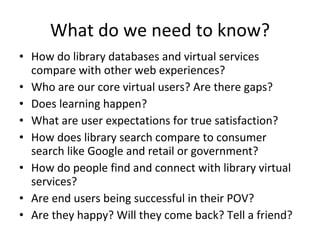
What do we need to know? How do library databases and virtual services compare with other web experiences? Who are our core virtual users? Are there gaps? Does learning happen? What are user expectations for true satisfaction? How does library search compare to consumer search like Google and retail or government? How do people find and connect with library virtual services? Are end users being successful in their POV? Are they happy? Will they come back? Tell a friend?
Strategic Thinking  for Libraries Choosing a Future Setting Phased Priorities Making Choices Taking Action Doing the Next Step Adjusting Tactics with Experience Seeking Feedback and Adjusting Measuring Progress
The Boomers  launched most of these digital initiatives.  Now what are  we/you going  to do next?
Advance Survey Data for the Library of Virginia Prepared by Stephen Abram and the Gale, Cengage Learning Statistical Analysis Research Team
Reference Facet of the  Library of Virginia Story September 2010 Survey   Data 62 of 91 LVA library systems (68%) I am happy to do this same survey for you at no charge
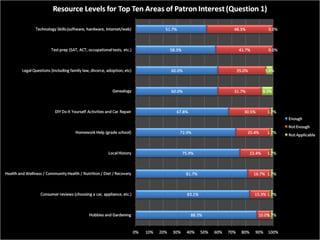
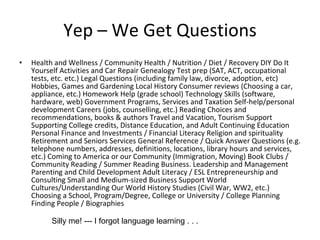
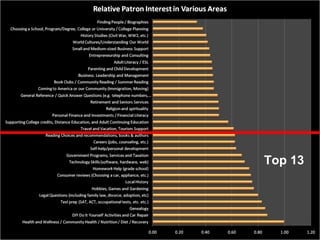
Yep – We Get Questions Health and Wellness / Community Health / Nutrition / Diet / Recovery DIY Do It Yourself Activities and Car Repair Genealogy Test prep (SAT, ACT, occupational tests, etc. etc.) Legal Questions (including family law, divorce, adoption, etc) Hobbies, Games and Gardening Local History Consumer reviews (Choosing a car, appliance, etc.) Homework Help (grade school) Technology Skills (software, hardware, web) Government Programs, Services and Taxation Self-help/personal development Careers (jobs, counselling, etc.) Reading Choices and recommendations, books & authors Travel and Vacation, Tourism Support Supporting College credits, Distance Education, and Adult Continuing Education Personal Finance and Investments / Financial Literacy Religion and spirituality Retirement and Seniors Services General Reference / Quick Answer Questions (e.g. telephone numbers, addresses, definitions, locations, library hours and services, etc.) Coming to America or our Community (Immigration, Moving) Book Clubs / Community Reading / Summer Reading Business. Leadership and Management Parenting and Child Development Adult Literacy / ESL Entrepreneurship and Consulting Small and Medium-sized Business Support World Cultures/Understanding Our World History Studies (Civil War, WW2, etc.) Choosing a School, Program/Degree, College or University / College Planning Finding People / Biographies  Silly me! --- I forgot language learning . . .
Top 13
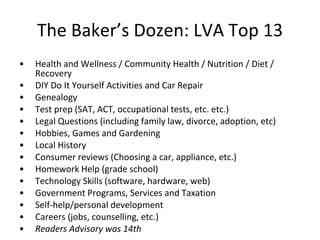
The Baker’s Dozen: LVA Top 13 Health and Wellness / Community Health / Nutrition / Diet / Recovery  DIY Do It Yourself Activities and Car Repair  Genealogy  Test prep (SAT, ACT, occupational tests, etc. etc.)  Legal Questions (including family law, divorce, adoption, etc)  Hobbies, Games and Gardening  Local History  Consumer reviews (Choosing a car, appliance, etc.)  Homework Help (grade school)  Technology Skills (software, hardware, web)  Government Programs, Services and Taxation  Self-help/personal development  Careers (jobs, counselling, etc.)  Readers Advisory was 14th


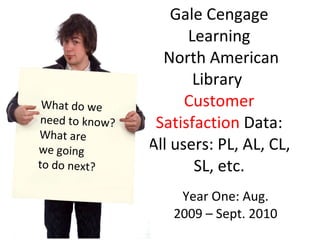
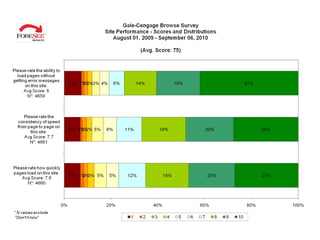
Gale Cengage Learning  North American Library  Customer Satisfaction  Data: All users: PL, AL, CL, SL, etc. Year One: Aug. 2009 – Sept. 2010 What do we  need to know? What are  we going  to do next?
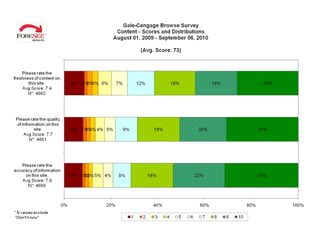
What do we need to know? How do library databases compare with other web experiences and expectations? Who are our core virtual users? What are user expectations for satisfaction? How does library search compare to consumer search like Google? How do people find and connect with library virtual services? What should we ‘fix’ as a first priority? Are end users being successful in their POV? Are they happy? Will they come back? Tell a friend?
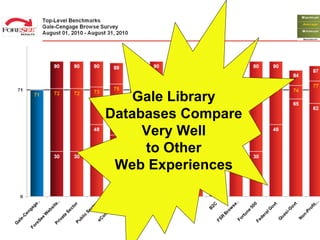
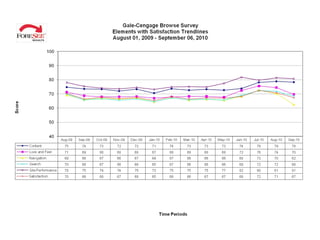
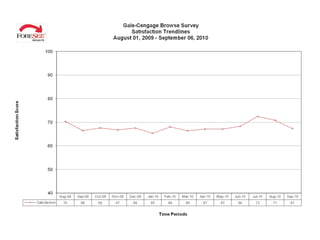
Gale Library  Databases Compare  Very Well  to Other  Web Experiences
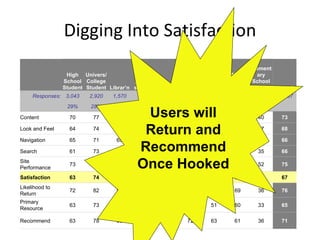
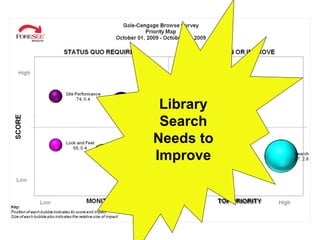
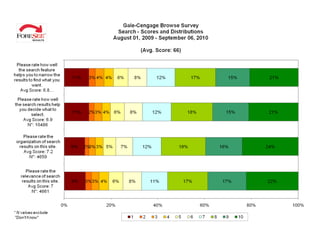
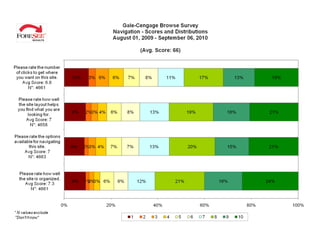
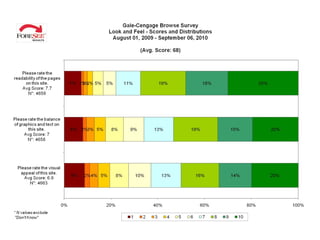
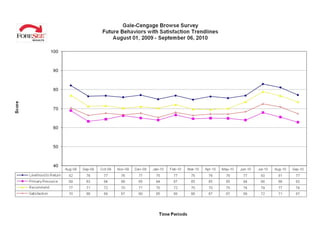
Digging Into Satisfaction Users will Return and Recommend Once Hooked   3 4 5 9 6 8 7 2 1         High School Student Univers/ College Student Librar’n Other, please specify Teacher Other Profess-ional Profess-or Middle School Student Elementary School Student Overall     Responses: 3,043 2,920 1,570 709 576 576 488 477 148 10,507       29% 28% 15% 7% 5% 5% 5% 5% 1%     Content 70 77 79 69 77 74 67 68 40 73 Look and Feel 64 74 74 64 72 70 61 63 37 68 Navigation 65 71 69 60 69 66 60 63 45 66 Search 61 73 73 60 71 67 59 59 35 66 Site Performance 73 79 77 72 77 76 68 72 52 75 Satisfaction 63 74 72 60 72 66 59 62 35 67 Likelihood to Return 72 82 85 71 82 78 66 69 36 76 Primary Resource 63 73 68 56 70 60 51 60 33 65 Recommend 63 78 83 66 80 72 63 61 36 71    
Library Search Needs to Improve
Who uses e-Resources? The Core User  For Library E-Resources is Clear
Database Users Are Being Successful
 
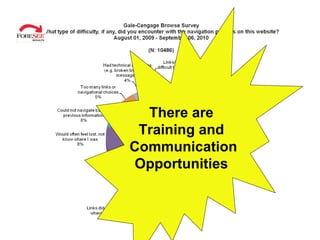
There are  Training and  Communication Opportunities
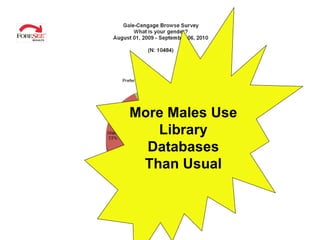
More Males Use Library Databases Than Usual
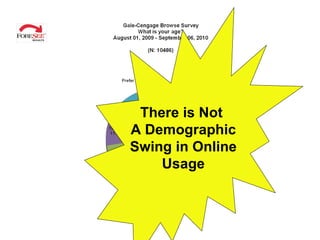
There is Not  A Demographic Swing in Online Usage
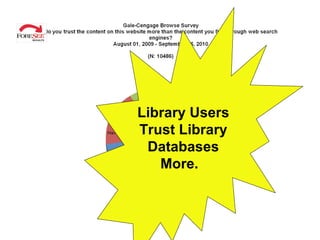
Library Users Trust Library Databases More.
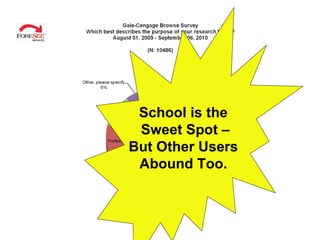
School is the Sweet Spot – But Other Users Abound Too.
Library’s Natural Allies  Are Big Users & Potential Partners.
Wow! Only 29% of Users Find E-Resources  Through Our  Websites.
OMG - 39% of Your Users Are in Your Databases for  For the Very First Time!
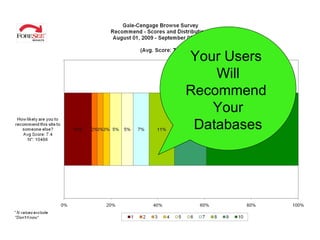
Your Users  Will Recommend  Your Databases Your Users  Will Recommend  Your Databases
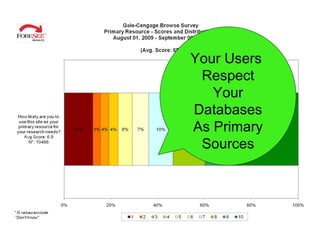
Your Users  Respect Your Databases As Primary Sources
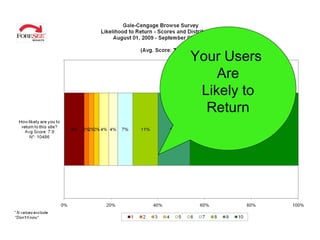
Your Users  Are Likely to Return
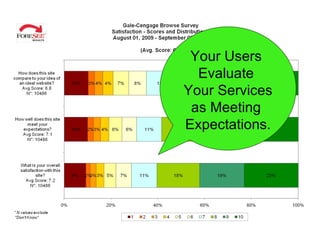
Your Users  Evaluate  Your Services as Meeting  Expectations.


There’s Great News! We have Room for Improvement BUT  Library Databases Compete  Very Well  with User Expectations and  Needs Fulfillment.


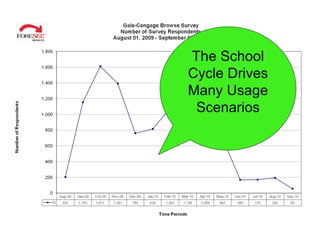
The School Cycle Drives Many Usage Scenarios
Upcoming Gale Surveys CATS DOGS CATS &  DOGS


Strategic Implications Program(s) Planning Models Tying Collections and Programs more Tightly Together to Enhance and Protect Both Priority Setting for 5 Years Developing Collaborative Communication and Promotion Plans  Developing Collaborative and Shared Staff and User Training Models Holding Your Heads High
 
 
Community Stories
Relationships Stories
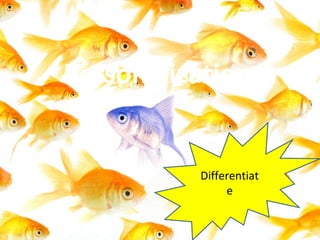
Personalization Differentiate
Comfort
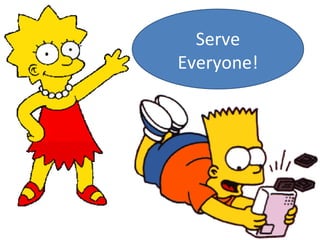
Serve Everyone!
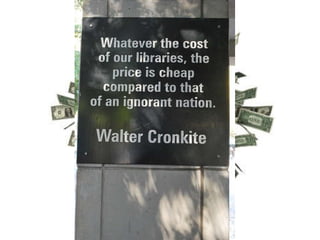
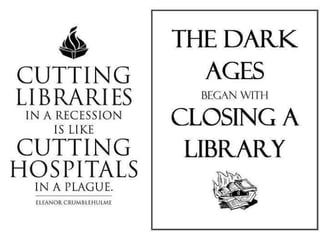
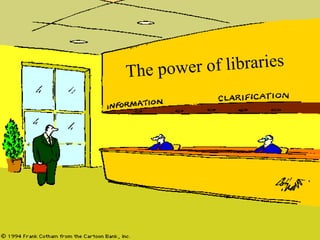
The power of libraries
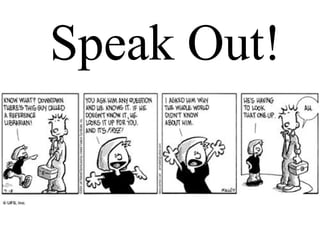
Speak Out!
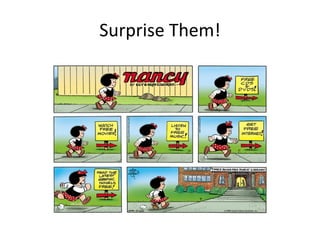
Surprise Them!
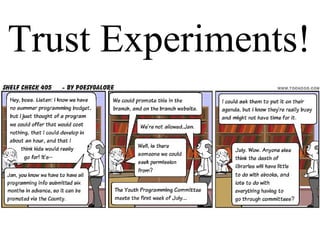
Trust Experiments!
It Takes A Team: Work Together  & Pick Each Other Up
 
Stephen Abram , MLS, FSLA VP strategic partnerships and markets Cengage Learning (Gale) Cel: 416-669-4855 [email_address] Stephen’s Lighthouse  Blog http://stephenslighthouse.com Facebook: Stephen Abram LinkedIn / Plaxo: Stephen Abram Twitter: sabram SlideShare: StephenAbram1

North dakotafinal

  • 1.
    Leah Krevit RiceUniversity The Rest of Us Stephen Abram, MLS, Gale Cengage Learning Minnesota/ North Dakota / South Dakota Libraries Oct. 19-20, 2010 Catching the Vision: The Library in 2020
  • 2.
    Thank you forinviting me! I want to share : Major upcoming trends and challenges in Technology, Communities and Librarians Special Surveys of Library Use New National Data on Database Use And I want to meet you.
  • 3.
  • 4.
    6 Things haveChanged . . . A LOT! Cardholders, Users, Members, Patrons, Clients, Customers, Learners, Students, Teachers, Professors Books Media Mobility Collections Libraries The History of Unintended Consequences & Unpredictability
  • 5.
    “ The Internethas now progressed to its infancy”
  • 6.
  • 7.
  • 8.
  • 9.
    How can Ilead my library and my community or institution to be ready for the next 10 years?
  • 10.
  • 11.
  • 12.
  • 13.
    Can libraries keepup with change? Can you recall buying a 45? Can you recall dials on TVs? Can you recall dialling?
  • 14.
    What We NeverReally Knew Before (US/Canada) 27% of our users are under 18. 59% are female. 29% are college students. 5% are professors and 6% are teachers. On any given day, 35% of our users are there for the very first time ! Only 29% found the databases via the library website. 59% found what they were looking for on their first search. 72% trusted our content more than what they found on Google. But, 81% still use Google. We often believe a lot that isn’t true.
  • 15.
    People are ChangingDemographic– south, Millennial, Boomer,+ IQ Increases Increased educational attainment & engagement eBooks outsell hard cover books, and will outsell paperbacks soon (2011) Some libraries are crediting most cardholder growth to e-book accessibility eBooks usage is largely middle-aged. Some sectors are slyly very tech-dominated (farming, cattle, trucking, natural resources…)
  • 16.
    People Have ChangedTwitter & Facebook are dominated by the middle aged Gaming too. . . Mothers in their 30’s Social networks fastest growing populations are seniors and will be more international and less urban and English. Personal device proliferation Mobile data usage is growing beyond youth very quickly, workplace use is huge
  • 17.
  • 18.
  • 19.
  • 20.
  • 21.
  • 22.
  • 23.
  • 24.
  • 25.
  • 26.
  • 27.
  • 28.
  • 29.
    NextGen Differences Increasein IQ - 15-20 Points Brain & Developmental Changes Eye Movement Changes Massive Behavioural Changes Major Decline in Crime Rates – 65%+ But still a 70% behavior overlap with Boomers (see my book chapter)
  • 30.
  • 31.
    Has the futurechanged? Has our future changed?
  • 32.
  • 33.
  • 34.
  • 35.
  • 36.
  • 37.
  • 38.
  • 39.
    Diabetes Online Yes,Stephen did just say Lizard Spit
  • 40.
    The Future DiscoveredStem Cells fMRI and The Brain Cloning Trucking and GPS Wind and other energy Nanotechnology Robotics Massive Book Digitization Music Translation Streaming Media Seed Bank Inter-disciplinary Cross-disciplinary Integrated 2020
  • 41.
  • 42.
    Pay Real AttentionTo Google Editions & Google Settlement Amazon Gutenberg Etc.
  • 43.
    Is Our Focus On Books And Public Image Limiting Our Future Success?
  • 44.
    A window ofopportunity
  • 45.
  • 46.
  • 47.
  • 48.
  • 49.
    Do we reallycare about containers? Stone – Wax – Scrolls – Books – Next... Paper -- Schmpaper Digital – Schmidgital Holograph . . . Pffft! Transmogrifying Containers
  • 50.
    Will Libraries beDevice Agnostic? iPads, Kobos, Kindles, Nooks, eDGe, and Mobile Phones?
  • 51.
    Borders Kobo, B&NNook, Amazon Kindle, Apple iPad, Sony, etc. . . .
  • 52.
  • 53.
  • 54.
    Reinvention, Creativity, RenaissanceeBooks and Books Concept of place Privacy Colour & Animation Chapters and Paragraph (anthologies, poems, short stories) Video Wireless opportunity Tracking Pedagogy Boundarylessness Connect to the author or team Added features and commentary Connect to book clubs, discussions, etc. 2020
  • 55.
  • 56.
  • 57.
    The Move toStreaming Like wax, vinyl and tape before it CD and DVD will decline to very small niche markets Blockbuster’s bankruptcy and the decline of local independent rental stores is a canary in the mine Many PL’s confuse the current uptick with a LT trend. Music and Video entertainment vs. programs related to hobbies, children, etc. Educational video is an emerging sector integrated very tightly into content
  • 58.
    Reinvention, Creativity, RenaissanceStreaming Media on demand Definition of ‘use’. Concept of place Concept of News and Entertainment End of physical format (DVD, tape, etc.) Self published animation & video Commentary, Reviews and Collectors Wireless opportunity Tracking Pedagogy Boundarylessness End of collections as we know them Beginning of media bibliography
  • 59.
  • 60.
    Broadband You mustclearly understand the latest FCC Whitespace Broadband Decision – THIS IS TRANSFORMATIONAL Local wired To the Home and workplace Wireless as a business strategy (Starbucks) Mobile dominates Largest generation
  • 61.
  • 62.
  • 63.
  • 64.
  • 65.
  • 66.
    Reinvention, Creativity, RenaissanceMobility Concept of place – Adopt a hybrid mindset Social animation and Sharing Convergence on steroids Wireless opportunity Tracking Pedagogy and Learning Extreme demand
  • 67.
  • 68.
    An New MergingModel Just in case, Just in time, just for me models are now ripe for replacement with Fit for Purpose Community Learning Entertainment Social / Clubs Research Beginning of the end for the dominance of out-of-context Megadatabases – Think meals vs. grocery stores
  • 69.
  • 70.
  • 71.
  • 72.
    Growing Online andVirtual Use Experience Models Widgets API’s SEO Google Analytics Geo-IP ForeSee Satisfaction data AND Statistics – Measure too
  • 73.
    Driving User tothe Library Encyclopedia.com HighBeam & Questia WorldCat AccessMyLibrary iPhone App for public, school and higher ed – iPhone and Droid! Geo-IP features and measures Watch for more . . .?
  • 74.
    Reinvention, Creativity, RenaissanceCollections Concept of place Ownership mutates Personal curation and celebrity curators Wireless opportunity Tracking Targeting collections Portalization: Knowledge Portals, Learning portals 2020
  • 75.
    Libraries Approaching theEnd Game The Matrix Build it or buy it?
  • 76.
  • 77.
  • 78.
    I my customers
  • 79.
  • 80.
  • 81.
  • 82.
  • 83.
  • 84.
  • 85.
    What is thetop strategic positioning for libraries Hint – not collections
  • 86.
    Trans-Literacy Move beyondreading & PC skills Reading literacy Numeracy Critical literacy Social literacy Computer literacy Web literacy Content literacy Written literacy News literacy Technology literacy Information literacy Media literacy Adaptive literacy Research literacy Academic literacy Reputation, Etc.
  • 87.
  • 88.
    Reinvention, Creativity, RenaissanceLibraries Concept of place Improving the quality of questions Partnering in design of experiences Programs predominate Community involvement Re-balancing needs Addressing the divides Promoting the talent – professional service and programs 2020
  • 89.
    Strategic Thinking for Libraries Choosing a Future Setting Phased Priorities Making Choices Taking Action Doing the Next Step Adjusting Tactics with Experience Seeking Feedback and Adjusting Measuring Progress
  • 90.
    Framework for ChoosingTop Priorities Suppose that in three years : Majority of library use will be virtual – yes even rural! Majority of Non-fiction Book circulation will be e-books and Fiction will split 50/50 – digital/print All learning will be blended and continuous DVD is circulation is dead and most other [physical formats in decline. Majority of questions will be virtual Use will be 20 / 40 / 40 (in house, virtual, mobile) Every user will be socially networked, connected and engaged 2020
  • 91.
    What do weneed to know? How do library databases and virtual services compare with other web experiences? Who are our core virtual users? Are there gaps? Does learning happen? What are user expectations for true satisfaction? How does library search compare to consumer search like Google and retail or government? How do people find and connect with library virtual services? Are end users being successful in their POV? Are they happy? Will they come back? Tell a friend?
  • 92.
    Strategic Thinking for Libraries Choosing a Future Setting Phased Priorities Making Choices Taking Action Doing the Next Step Adjusting Tactics with Experience Seeking Feedback and Adjusting Measuring Progress
  • 93.
    The Boomers launched most of these digital initiatives. Now what are we/you going to do next?
  • 94.
    Advance Survey Datafor the Library of Virginia Prepared by Stephen Abram and the Gale, Cengage Learning Statistical Analysis Research Team
  • 95.
    Reference Facet ofthe Library of Virginia Story September 2010 Survey Data 62 of 91 LVA library systems (68%) I am happy to do this same survey for you at no charge
  • 96.
    Yep – WeGet Questions Health and Wellness / Community Health / Nutrition / Diet / Recovery DIY Do It Yourself Activities and Car Repair Genealogy Test prep (SAT, ACT, occupational tests, etc. etc.) Legal Questions (including family law, divorce, adoption, etc) Hobbies, Games and Gardening Local History Consumer reviews (Choosing a car, appliance, etc.) Homework Help (grade school) Technology Skills (software, hardware, web) Government Programs, Services and Taxation Self-help/personal development Careers (jobs, counselling, etc.) Reading Choices and recommendations, books & authors Travel and Vacation, Tourism Support Supporting College credits, Distance Education, and Adult Continuing Education Personal Finance and Investments / Financial Literacy Religion and spirituality Retirement and Seniors Services General Reference / Quick Answer Questions (e.g. telephone numbers, addresses, definitions, locations, library hours and services, etc.) Coming to America or our Community (Immigration, Moving) Book Clubs / Community Reading / Summer Reading Business. Leadership and Management Parenting and Child Development Adult Literacy / ESL Entrepreneurship and Consulting Small and Medium-sized Business Support World Cultures/Understanding Our World History Studies (Civil War, WW2, etc.) Choosing a School, Program/Degree, College or University / College Planning Finding People / Biographies Silly me! --- I forgot language learning . . .
  • 97.
  • 98.
    The Baker’s Dozen:LVA Top 13 Health and Wellness / Community Health / Nutrition / Diet / Recovery DIY Do It Yourself Activities and Car Repair Genealogy Test prep (SAT, ACT, occupational tests, etc. etc.) Legal Questions (including family law, divorce, adoption, etc) Hobbies, Games and Gardening Local History Consumer reviews (Choosing a car, appliance, etc.) Homework Help (grade school) Technology Skills (software, hardware, web) Government Programs, Services and Taxation Self-help/personal development Careers (jobs, counselling, etc.) Readers Advisory was 14th
  • 99.
  • 100.
  • 101.
  • 102.
    Gale Cengage Learning North American Library Customer Satisfaction Data: All users: PL, AL, CL, SL, etc. Year One: Aug. 2009 – Sept. 2010 What do we need to know? What are we going to do next?
  • 103.
    What do weneed to know? How do library databases compare with other web experiences and expectations? Who are our core virtual users? What are user expectations for satisfaction? How does library search compare to consumer search like Google? How do people find and connect with library virtual services? What should we ‘fix’ as a first priority? Are end users being successful in their POV? Are they happy? Will they come back? Tell a friend?
  • 104.
    Gale Library Databases Compare Very Well to Other Web Experiences
  • 105.
    Digging Into SatisfactionUsers will Return and Recommend Once Hooked   3 4 5 9 6 8 7 2 1         High School Student Univers/ College Student Librar’n Other, please specify Teacher Other Profess-ional Profess-or Middle School Student Elementary School Student Overall     Responses: 3,043 2,920 1,570 709 576 576 488 477 148 10,507       29% 28% 15% 7% 5% 5% 5% 5% 1%     Content 70 77 79 69 77 74 67 68 40 73 Look and Feel 64 74 74 64 72 70 61 63 37 68 Navigation 65 71 69 60 69 66 60 63 45 66 Search 61 73 73 60 71 67 59 59 35 66 Site Performance 73 79 77 72 77 76 68 72 52 75 Satisfaction 63 74 72 60 72 66 59 62 35 67 Likelihood to Return 72 82 85 71 82 78 66 69 36 76 Primary Resource 63 73 68 56 70 60 51 60 33 65 Recommend 63 78 83 66 80 72 63 61 36 71    
  • 106.
  • 107.
    Who uses e-Resources?The Core User For Library E-Resources is Clear
  • 108.
    Database Users AreBeing Successful
  • 109.
  • 110.
    There are Training and Communication Opportunities
  • 111.
    More Males UseLibrary Databases Than Usual
  • 112.
    There is Not A Demographic Swing in Online Usage
  • 113.
    Library Users TrustLibrary Databases More.
  • 114.
    School is theSweet Spot – But Other Users Abound Too.
  • 115.
    Library’s Natural Allies Are Big Users & Potential Partners.
  • 116.
    Wow! Only 29%of Users Find E-Resources Through Our Websites.
  • 117.
    OMG - 39%of Your Users Are in Your Databases for For the Very First Time!
  • 118.
    Your Users Will Recommend Your Databases Your Users Will Recommend Your Databases
  • 119.
    Your Users Respect Your Databases As Primary Sources
  • 120.
    Your Users Are Likely to Return
  • 121.
    Your Users Evaluate Your Services as Meeting Expectations.
  • 122.
  • 123.
  • 124.
  • 125.
  • 126.
  • 127.
    There’s Great News!We have Room for Improvement BUT Library Databases Compete Very Well with User Expectations and Needs Fulfillment.
  • 128.
  • 129.
  • 130.
  • 131.
    The School CycleDrives Many Usage Scenarios
  • 132.
    Upcoming Gale SurveysCATS DOGS CATS & DOGS
  • 133.
  • 134.
  • 135.
  • 136.
    Strategic Implications Program(s)Planning Models Tying Collections and Programs more Tightly Together to Enhance and Protect Both Priority Setting for 5 Years Developing Collaborative Communication and Promotion Plans Developing Collaborative and Shared Staff and User Training Models Holding Your Heads High
  • 137.
  • 138.
  • 139.
  • 140.
  • 141.
  • 142.
  • 143.
  • 144.
    The power oflibraries
  • 145.
  • 146.
  • 147.
  • 148.
    It Takes ATeam: Work Together & Pick Each Other Up
  • 149.
  • 150.
    Stephen Abram ,MLS, FSLA VP strategic partnerships and markets Cengage Learning (Gale) Cel: 416-669-4855 [email_address] Stephen’s Lighthouse Blog http://stephenslighthouse.com Facebook: Stephen Abram LinkedIn / Plaxo: Stephen Abram Twitter: sabram SlideShare: StephenAbram1