Constrained Model Predictive Control Based on
Reduced-Order Models
Pantelis Sopasakis, Daniele Bernardini, and
Alberto Bemporad
IMT Institute for Advanced Studies Lucca

December 13, 2013

52nd IEEE Conf. Decision & Control,
Florence, Italy, 2013.

CDC 2013

Reduced-Order MPC

1 / 21
Model Reduction: Motivation

Challenge:
A lot of systems are modelled
with (∞-dimensional) PDEs
and whose approximations comprise tens of thousands of states.
MPC faces its limitations as the
state dimension goes into such
orders of magnitude.

CDC 2013

Reduced-Order MPC

2 / 21
Model Reduction: Motivation
Examples:
1. Sloshing of liquids (Ardakani & Bridges, 2011)
2. Distribution of anti-tumour drugs (Jackson & Byrne, 2000)
3. HVAC systems (Moukalled et al., 2011)
4. Seismic excitation of buildings (Banerji & Samanta, 2011)
5. Control of Flexible Structures (Rao et al., 1990)

CDC 2013

Reduced-Order MPC

3 / 21
Model Reduction

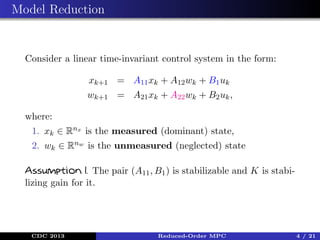
Consider a linear time-invariant control system in the form:
xk+1 = A11 xk + A12 wk + B1 uk
wk+1 = A21 xk + A22 wk + B2 uk ,
where:
1. xk ∈ Rnx is the measured (dominant) state,
2. wk ∈ Rnw is the unmeasured (neglected) state
Assumption 1. The pair (A11 , B1 ) is stabilizable and K is stabilizing gain for it.

CDC 2013

Reduced-Order MPC

4 / 21
Model Reduction

We impose the following state and input constraints:
xk ∈ X , uk ∈ U, ∀k ∈ N,
and we assume that we have some information about the position
of the initial value of the neglected variables:
w0 ∈ W

{w ∈ Rnw |w W −1 w ≤ 1}.

Assumption 2 (Reduced Model). There exists an ε ∈ (0, 1) so
that A22 W ⊆ εW (can be written as ε2 W − A22 W A22 0).

CDC 2013

Reduced-Order MPC

5 / 21
The Nominal System
We consider the following nominal system:
zk+1 = A11 zk + B1 vk ,
with zk ∈ Rnx , v ∈ Rnu . Define AK
and apply the feedback
uk =

vk

A11 + B1 K and e

+

MPC control action

Kek

x−z

.

Error feedback

The error dynamics is given by:
ek+1 = AK ek + A12 wk
Stable

CDC 2013

Disturbance

Reduced-Order MPC

6 / 21
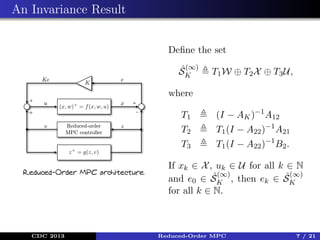
An Invariance Result
Define the set
ˆ(∞)
SK

T1 W ⊕ T2 X ⊕ T3 U,

where
T1
T2

CDC 2013

T1 (I − A22 )−1 A21

T3
Reduced-Order MPC architecture.

(I − AK )−1 A12
T1 (I − A22 )−1 B2 .

If xk ∈ X , uk ∈ U for all k ∈ N
ˆ(∞)
ˆ(∞)
and e0 ∈ SK , then ek ∈ SK
for all k ∈ N.

Reduced-Order MPC

7 / 21
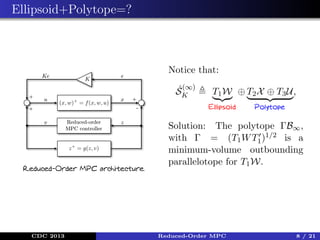
Ellipsoid+Polytope=?

Notice that:
ˆ(∞)
SK

T1 W ⊕ T2 X ⊕ T3 U ,
Ellipsoid

Reduced-Order MPC architecture.

CDC 2013

Polytope

Solution: The polytope ΓB∞ ,
with Γ = (T1 W T1 )1/2 is a
minimum-volume outbounding
parallelotope for T1 W.

Reduced-Order MPC

8 / 21
The MPC formulation
Let us introduce the sets
Z

X

ˆ(∞)
SK

V

U

ˆ(∞)
K SK ,

Along the prediction horizon N we impose the constraints:
zk ∈ Z, ∀k ∈ N[1,N −1]
vk ∈ V, ∀k ∈ N[0,N −1]
and the terminal constraint
zN ∈ Zf .

CDC 2013

Reduced-Order MPC

9 / 21
The MPC optimization problem is:
PN (z) : VN (z) = min VN (z, v),
v∈V(z)

where the cost function is given by:
N −1

VN (z, v)

zN P zN +

zk QzK + vk Rvk ,
k=0

and V(z) is the following multi-valued mapping:

z0 =z,



z =A11 zk +B1 vk , ∀k∈N[1,N −1] ,
V(z)
v k+1
zk ∈ Z, ∀k∈N[1,N −1] ,



vk ∈ V, ∀k∈N[0,N −1] , zN ∈ Zf

CDC 2013

Reduced-Order MPC






.





10 / 21
Exponential Robust Stability

Let κN be the MPC control action and
κN (z, x) = K(x − z) + κN (z).
˜
ˆ(∞)
The set SK × {0} is exponentially stable for the system
xk+1 = A11 xk + B1 (˜ N (zk , xk )) + A12 wk
κ
zk+1 = A11 zk + B1 κN (zk ),
(with state variable [ x ]) over the domain of attraction
z
(∞)

ˆ
(ZN ⊕ SK ) × ZN .

CDC 2013

Reduced-Order MPC

11 / 21
Can we do better?

1. The estimation wk ∈ W for all k ∈ N can be very
conservative for k = 0,
2. Online measurements of xk and uk can be used to estimate
the whereabouts of wk+i|k by sets Wk+i|k – then:
j

Ai A12 Wk+i|k .
K

ek+j|k ∈ Sk+j|k =
i=0

3. All online operations must be carried out in low
dimensional spaces.

CDC 2013

Reduced-Order MPC

12 / 21
Set Membership Estimator
A set membership estimator for wk consists of a correction and
a prediction step concisely written as:
Wk−1|k =

w ∈ Wk−1|k−1 |A12 w=xk −A11 xk−1 −B1 uk−1

Wk|k = A21 xk−1 + B2 uk−1 ⊕ A22 Wk−1|k ,
while along the prediction horizon we have:
Wk+j|k = A21 Xk+j−1|k ⊕ B2 U ⊕ A22 Wk+j−1|k ,
where
Xk+j|k = X ∩ (A11 Xk+j−1|k ⊕ B1 U ⊕ A12 Wk+j−1|k ).

CDC 2013

Reduced-Order MPC

13 / 21
Lightweight Set Membership Estimator
We compute sets Hk+j|k so that
hk+j|k

A12 wk ∈ Hk+j|k ,

with
H0|0 = A12 W0|0
¯
W0|0 = W ←

Polytopic
Overapprox. of W.

The set membership estimator is given by:
k−1

Hk|k =

A12 Ak W
22

A2 (A21 xj + B2 uj )
22

⊕ A12
j=0
k−1

¯
⊆ εk A12 W ⊕ A12

T (xj , uj , εj )B∞
j=0

CDC 2013

Reduced-Order MPC

14 / 21
Lightweight Set Membership Estimator

Along the prediction horizon we have:
Hk+j|k = A12 A21 Xk+j−1|k ⊕A12 B2 U⊕εHk+j−1|k ,
Xk+j|k = X ∩ (A11 Xk+j−1|k ⊕ Hk+j−1|k ⊕ B1 U).
The error is then bound in
j

Ai Hk+i|k
K

Sk+j|k =
i=0

CDC 2013

Reduced-Order MPC

15 / 21
Model Predictive Control

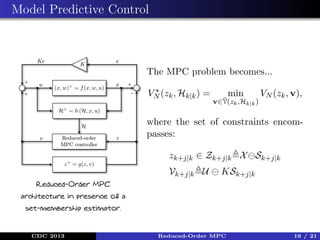
The MPC problem becomes...
VN (zk , Hk|k ) =

min

¯
v∈V(zk ,Hk|k )

VN (zk , v),

where the set of constraints encompasses:
zk+j|k ∈ Zk+j|k X Sk+j|k
Vk+j|k U

KSk+j|k

Reduced-Order MPC
architecture in presence of a
set-membership estimator.

CDC 2013

Reduced-Order MPC

16 / 21
Exponential Robust Stability

Stability Result:

Assume that Hk|k → H and let S
(I − AK )−1 H . The set
S × {0}
is exponentially stable for the dynamics of [ x ].
z
Reduced-Order MPC
architecture in presence of a
set-membership estimator.

CDC 2013

Reduced-Order MPC

17 / 21
Simulation Example

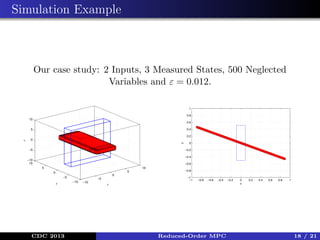
Our case study: 2 Inputs, 3 Measured States, 500 Neglected
Variables and ε = 0.012.
1
0.8

10
0.6
0.4

5

y

z

0.2

0

−5

0
−0.2
−0.4

−10
10

−0.6

5

10
5

0
−5
y

CDC 2013

−0.8

0
−1
−1

−5
−10

−10

−0.8

−0.6

−0.4

x

Reduced-Order MPC

−0.2

0
x

0.2

0.4

0.6

0.8

1

18 / 21
Simulation Example

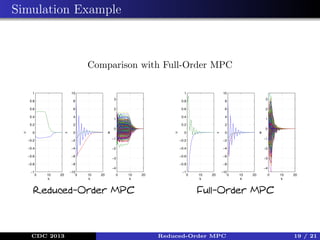
Comparison with Full-Order MPC
1

10

0.8

8

0.6

6

0.4

4

0.2

2

0

1

0

6

0.4

4

0.2

1

8

0.6

2

10

0.8

3

2

0

0

3
2
1

−0.2

−4

−0.6

−6

−0.8

−8

−0.2

−4

−0.6

−6

−0.8

−3

−1

−2

−0.4

−2

w

x

u
−1

−2

−0.4

0

w

x

u

0

−8

−2
−3

−4
−1

−4

−10
0

10
k

20

−1
0

10
k

20

0

10
k

Reduced-Order MPC

CDC 2013

20

−10
0

10
k

20

0

10
k

20

0

10
k

20

Full-Order MPC

Reduced-Order MPC

19 / 21
Simulation Example

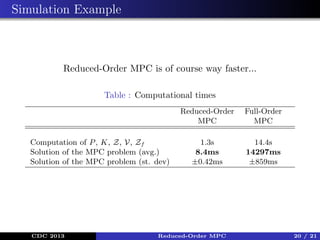
Reduced-Order MPC is of course way faster...
Table : Computational times
Reduced-Order
MPC
Computation of P , K, Z, V, Zf
Solution of the MPC problem (avg.)
Solution of the MPC problem (st. dev)

CDC 2013

Full-Order
MPC

1.3s
8.4ms
±0.42ms

14.4s
14297ms
±859ms

Reduced-Order MPC

20 / 21
Thank you for your attention!

CDC 2013

Reduced-Order MPC

21 / 21
References

1. H. A. Ardakani and T. J. Bridges, “Shallow-water sloshing in vessels
undergoing prescribed rigid-body motion in three dimensions,” J.
Fluid Mechanics, vol. 667, pp. 474519, 2011.
2. T. L. Jackson and H. M. Byrne, “A mathematical model to study the
effects of drug resistance and vasculature on the response of solid
tumors to chemotherapy,” Math. Biosc., vol. 164, no. 1, pp. 17 38,
2000.
3. F. Moukalled, S. Verma, and M. Darwish, “The use of CFD for
predicting and optimizing the performance of air conditioning
equipment,” Int. J. Heat and Mass Transfer, vol. 54, no. 13, pp. 549
563, 2011.
4. P. Banerji and A. Samanta, “Earthquake vibration control of
structures using hybrid mass liquid damper,” Engineering Structures,
vol. 33, no. 4, pp. 1291 1301, 2011.

CDC 2013

Reduced-Order MPC

21 / 21
References

5. S. Rao, T. Pan, and V. Venkayya, “Modeling, control, and design of
flexible structures: A survey,” Appl. Mech. Rev., vol. 43, no. 5, 1990.
6. T.Bui-Thanh,K.Willcox,O.Ghattas,andB.vanBloemenWaanders,
Goal-oriented, model-constrained optimization for reduction of largescale systems, Journal of Computational Physics, vol. 224, no. 2, pp.
880 896, 2007.
7. T. L. Jackson and H. M. Byrne, “A mathematical model to study the
effects of drug resistance and vasculature on the response of solid
tumors to chemotherapy,” Math. Biosc., vol. 164, no. 1, pp. 17 38,
2000.

CDC 2013

Reduced-Order MPC

21 / 21

Model Predictive Control based on Reduced-Order Models

  • 1.
    Constrained Model PredictiveControl Based on Reduced-Order Models Pantelis Sopasakis, Daniele Bernardini, and Alberto Bemporad IMT Institute for Advanced Studies Lucca December 13, 2013 52nd IEEE Conf. Decision & Control, Florence, Italy, 2013. CDC 2013 Reduced-Order MPC 1 / 21
  • 2.
    Model Reduction: Motivation Challenge: Alot of systems are modelled with (∞-dimensional) PDEs and whose approximations comprise tens of thousands of states. MPC faces its limitations as the state dimension goes into such orders of magnitude. CDC 2013 Reduced-Order MPC 2 / 21
  • 3.
    Model Reduction: Motivation Examples: 1.Sloshing of liquids (Ardakani & Bridges, 2011) 2. Distribution of anti-tumour drugs (Jackson & Byrne, 2000) 3. HVAC systems (Moukalled et al., 2011) 4. Seismic excitation of buildings (Banerji & Samanta, 2011) 5. Control of Flexible Structures (Rao et al., 1990) CDC 2013 Reduced-Order MPC 3 / 21
  • 4.
    Model Reduction Consider alinear time-invariant control system in the form: xk+1 = A11 xk + A12 wk + B1 uk wk+1 = A21 xk + A22 wk + B2 uk , where: 1. xk ∈ Rnx is the measured (dominant) state, 2. wk ∈ Rnw is the unmeasured (neglected) state Assumption 1. The pair (A11 , B1 ) is stabilizable and K is stabilizing gain for it. CDC 2013 Reduced-Order MPC 4 / 21
  • 5.
    Model Reduction We imposethe following state and input constraints: xk ∈ X , uk ∈ U, ∀k ∈ N, and we assume that we have some information about the position of the initial value of the neglected variables: w0 ∈ W {w ∈ Rnw |w W −1 w ≤ 1}. Assumption 2 (Reduced Model). There exists an ε ∈ (0, 1) so that A22 W ⊆ εW (can be written as ε2 W − A22 W A22 0). CDC 2013 Reduced-Order MPC 5 / 21
  • 6.
    The Nominal System Weconsider the following nominal system: zk+1 = A11 zk + B1 vk , with zk ∈ Rnx , v ∈ Rnu . Define AK and apply the feedback uk = vk A11 + B1 K and e + MPC control action Kek x−z . Error feedback The error dynamics is given by: ek+1 = AK ek + A12 wk Stable CDC 2013 Disturbance Reduced-Order MPC 6 / 21
  • 7.
    An Invariance Result Definethe set ˆ(∞) SK T1 W ⊕ T2 X ⊕ T3 U, where T1 T2 CDC 2013 T1 (I − A22 )−1 A21 T3 Reduced-Order MPC architecture. (I − AK )−1 A12 T1 (I − A22 )−1 B2 . If xk ∈ X , uk ∈ U for all k ∈ N ˆ(∞) ˆ(∞) and e0 ∈ SK , then ek ∈ SK for all k ∈ N. Reduced-Order MPC 7 / 21
  • 8.
    Ellipsoid+Polytope=? Notice that: ˆ(∞) SK T1 W⊕ T2 X ⊕ T3 U , Ellipsoid Reduced-Order MPC architecture. CDC 2013 Polytope Solution: The polytope ΓB∞ , with Γ = (T1 W T1 )1/2 is a minimum-volume outbounding parallelotope for T1 W. Reduced-Order MPC 8 / 21
  • 9.
    The MPC formulation Letus introduce the sets Z X ˆ(∞) SK V U ˆ(∞) K SK , Along the prediction horizon N we impose the constraints: zk ∈ Z, ∀k ∈ N[1,N −1] vk ∈ V, ∀k ∈ N[0,N −1] and the terminal constraint zN ∈ Zf . CDC 2013 Reduced-Order MPC 9 / 21
  • 10.
    The MPC optimizationproblem is: PN (z) : VN (z) = min VN (z, v), v∈V(z) where the cost function is given by: N −1 VN (z, v) zN P zN + zk QzK + vk Rvk , k=0 and V(z) is the following multi-valued mapping:  z0 =z,    z =A11 zk +B1 vk , ∀k∈N[1,N −1] , V(z) v k+1 zk ∈ Z, ∀k∈N[1,N −1] ,    vk ∈ V, ∀k∈N[0,N −1] , zN ∈ Zf CDC 2013 Reduced-Order MPC     .    10 / 21
  • 11.
    Exponential Robust Stability LetκN be the MPC control action and κN (z, x) = K(x − z) + κN (z). ˜ ˆ(∞) The set SK × {0} is exponentially stable for the system xk+1 = A11 xk + B1 (˜ N (zk , xk )) + A12 wk κ zk+1 = A11 zk + B1 κN (zk ), (with state variable [ x ]) over the domain of attraction z (∞) ˆ (ZN ⊕ SK ) × ZN . CDC 2013 Reduced-Order MPC 11 / 21
  • 12.
    Can we dobetter? 1. The estimation wk ∈ W for all k ∈ N can be very conservative for k = 0, 2. Online measurements of xk and uk can be used to estimate the whereabouts of wk+i|k by sets Wk+i|k – then: j Ai A12 Wk+i|k . K ek+j|k ∈ Sk+j|k = i=0 3. All online operations must be carried out in low dimensional spaces. CDC 2013 Reduced-Order MPC 12 / 21
  • 13.
    Set Membership Estimator Aset membership estimator for wk consists of a correction and a prediction step concisely written as: Wk−1|k = w ∈ Wk−1|k−1 |A12 w=xk −A11 xk−1 −B1 uk−1 Wk|k = A21 xk−1 + B2 uk−1 ⊕ A22 Wk−1|k , while along the prediction horizon we have: Wk+j|k = A21 Xk+j−1|k ⊕ B2 U ⊕ A22 Wk+j−1|k , where Xk+j|k = X ∩ (A11 Xk+j−1|k ⊕ B1 U ⊕ A12 Wk+j−1|k ). CDC 2013 Reduced-Order MPC 13 / 21
  • 14.
    Lightweight Set MembershipEstimator We compute sets Hk+j|k so that hk+j|k A12 wk ∈ Hk+j|k , with H0|0 = A12 W0|0 ¯ W0|0 = W ← Polytopic Overapprox. of W. The set membership estimator is given by: k−1 Hk|k = A12 Ak W 22 A2 (A21 xj + B2 uj ) 22 ⊕ A12 j=0 k−1 ¯ ⊆ εk A12 W ⊕ A12 T (xj , uj , εj )B∞ j=0 CDC 2013 Reduced-Order MPC 14 / 21
  • 15.
    Lightweight Set MembershipEstimator Along the prediction horizon we have: Hk+j|k = A12 A21 Xk+j−1|k ⊕A12 B2 U⊕εHk+j−1|k , Xk+j|k = X ∩ (A11 Xk+j−1|k ⊕ Hk+j−1|k ⊕ B1 U). The error is then bound in j Ai Hk+i|k K Sk+j|k = i=0 CDC 2013 Reduced-Order MPC 15 / 21
  • 16.
    Model Predictive Control TheMPC problem becomes... VN (zk , Hk|k ) = min ¯ v∈V(zk ,Hk|k ) VN (zk , v), where the set of constraints encompasses: zk+j|k ∈ Zk+j|k X Sk+j|k Vk+j|k U KSk+j|k Reduced-Order MPC architecture in presence of a set-membership estimator. CDC 2013 Reduced-Order MPC 16 / 21
  • 17.
    Exponential Robust Stability StabilityResult: Assume that Hk|k → H and let S (I − AK )−1 H . The set S × {0} is exponentially stable for the dynamics of [ x ]. z Reduced-Order MPC architecture in presence of a set-membership estimator. CDC 2013 Reduced-Order MPC 17 / 21
  • 18.
    Simulation Example Our casestudy: 2 Inputs, 3 Measured States, 500 Neglected Variables and ε = 0.012. 1 0.8 10 0.6 0.4 5 y z 0.2 0 −5 0 −0.2 −0.4 −10 10 −0.6 5 10 5 0 −5 y CDC 2013 −0.8 0 −1 −1 −5 −10 −10 −0.8 −0.6 −0.4 x Reduced-Order MPC −0.2 0 x 0.2 0.4 0.6 0.8 1 18 / 21
  • 19.
    Simulation Example Comparison withFull-Order MPC 1 10 0.8 8 0.6 6 0.4 4 0.2 2 0 1 0 6 0.4 4 0.2 1 8 0.6 2 10 0.8 3 2 0 0 3 2 1 −0.2 −4 −0.6 −6 −0.8 −8 −0.2 −4 −0.6 −6 −0.8 −3 −1 −2 −0.4 −2 w x u −1 −2 −0.4 0 w x u 0 −8 −2 −3 −4 −1 −4 −10 0 10 k 20 −1 0 10 k 20 0 10 k Reduced-Order MPC CDC 2013 20 −10 0 10 k 20 0 10 k 20 0 10 k 20 Full-Order MPC Reduced-Order MPC 19 / 21
  • 20.
    Simulation Example Reduced-Order MPCis of course way faster... Table : Computational times Reduced-Order MPC Computation of P , K, Z, V, Zf Solution of the MPC problem (avg.) Solution of the MPC problem (st. dev) CDC 2013 Full-Order MPC 1.3s 8.4ms ±0.42ms 14.4s 14297ms ±859ms Reduced-Order MPC 20 / 21
  • 21.
    Thank you foryour attention! CDC 2013 Reduced-Order MPC 21 / 21
  • 22.
    References 1. H. A.Ardakani and T. J. Bridges, “Shallow-water sloshing in vessels undergoing prescribed rigid-body motion in three dimensions,” J. Fluid Mechanics, vol. 667, pp. 474519, 2011. 2. T. L. Jackson and H. M. Byrne, “A mathematical model to study the effects of drug resistance and vasculature on the response of solid tumors to chemotherapy,” Math. Biosc., vol. 164, no. 1, pp. 17 38, 2000. 3. F. Moukalled, S. Verma, and M. Darwish, “The use of CFD for predicting and optimizing the performance of air conditioning equipment,” Int. J. Heat and Mass Transfer, vol. 54, no. 13, pp. 549 563, 2011. 4. P. Banerji and A. Samanta, “Earthquake vibration control of structures using hybrid mass liquid damper,” Engineering Structures, vol. 33, no. 4, pp. 1291 1301, 2011. CDC 2013 Reduced-Order MPC 21 / 21
  • 23.
    References 5. S. Rao,T. Pan, and V. Venkayya, “Modeling, control, and design of flexible structures: A survey,” Appl. Mech. Rev., vol. 43, no. 5, 1990. 6. T.Bui-Thanh,K.Willcox,O.Ghattas,andB.vanBloemenWaanders, Goal-oriented, model-constrained optimization for reduction of largescale systems, Journal of Computational Physics, vol. 224, no. 2, pp. 880 896, 2007. 7. T. L. Jackson and H. M. Byrne, “A mathematical model to study the effects of drug resistance and vasculature on the response of solid tumors to chemotherapy,” Math. Biosc., vol. 164, no. 1, pp. 17 38, 2000. CDC 2013 Reduced-Order MPC 21 / 21