The Six Big Losses of OEE
www.optimumfx.com
What is Six Loss?
It would feel odd to drive a car without a dashboard…
6 loss Analysis is like the dashboard, providing useful information for making
decisions at different times in your journey.
Example:
– When there is an indication that you are low on fuel – you will fill it up
– When the Revs are too high – you will change gear
Why use Six Loss?
• Six Loss allows you to accurately pinpoint the area of focus that will impact
on the performance of the equipment’s output.
• To reduce each loss there is an improvement tool.
• All the Six Loss is doing is breaking down the equipment’s overall loss into
six clear categories, to which, you can apply certain techniques to improve.
It is what you do with this information makes the difference.
• Speed of Execution and intervention followed by monitoring is critical.
Combine Six Loss data with using the right tools on the biggest loss and
accelerate the speed of execution - This WILL improve the performance of
your equipment.
• Many manufacturing plants spend a lot of time in measuring and recording
data and don’t use most of it. Sometimes less is more!!!
This is a key part of your Manufacturing Strategy
Set Up/Planned downtime Losses
Planned Downtime
This is the period of time between the last piece from one product run and the first piece of the next
product run.
That is: All time for flavour changes, CIP’s , hygiene’s etc. that are necessary to fulfill the production plan.
The way we can reduce the impact on output is to get smarter in the operation to reduce the time taken.
Calculation to work out impact is: - Planned Downtime/(Paid time-NRFP)
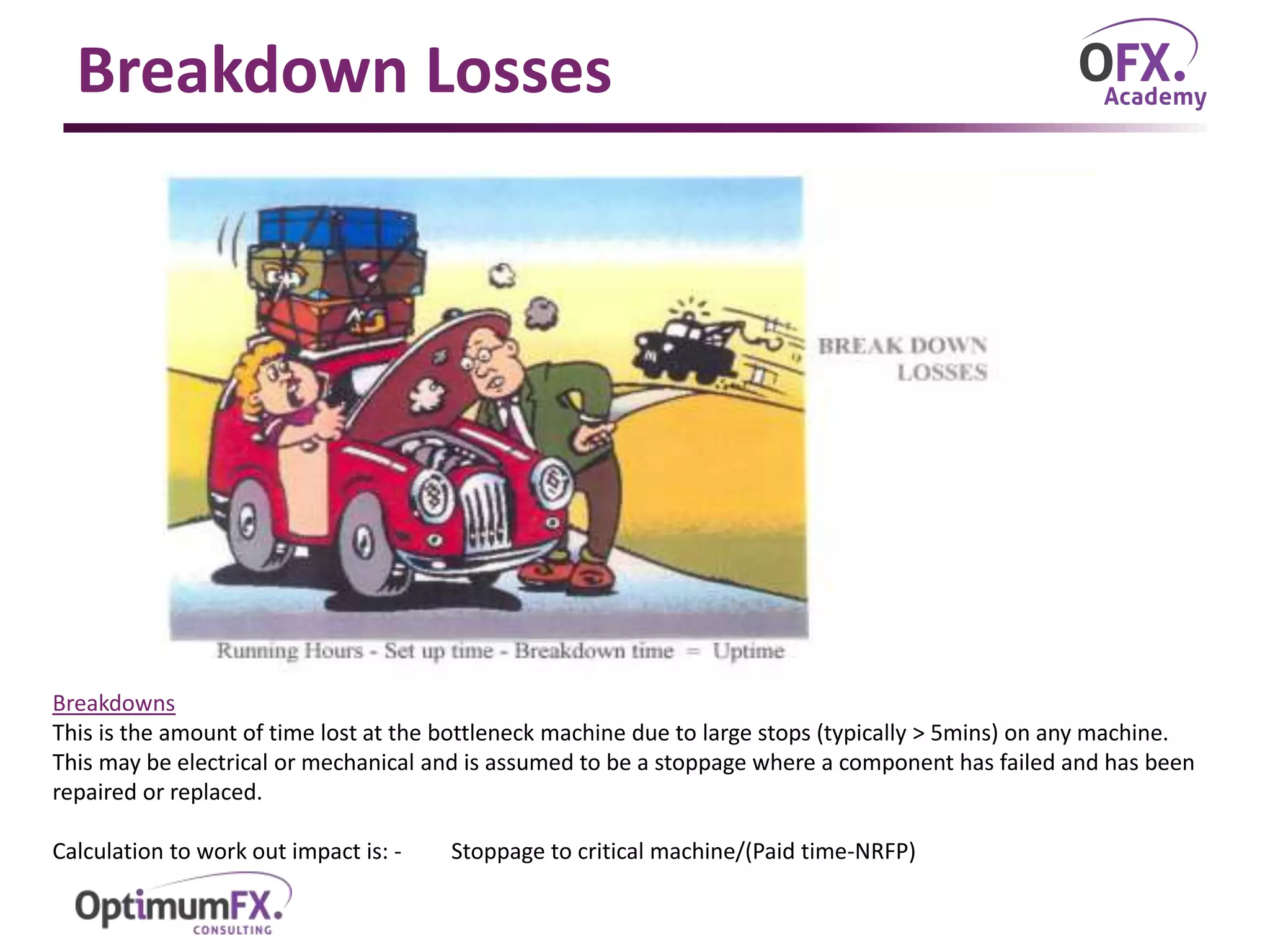
Breakdown Losses
Breakdowns
This is the amount of time lost at the bottleneck machine due to large stops (typically > 5mins) on any machine.
This may be electrical or mechanical and is assumed to be a stoppage where a component has failed and has been
repaired or replaced.
Calculation to work out impact is: - Stoppage to critical machine/(Paid time-NRFP)
Minor Stops
Minor Stops
This is the amount of time lost at the bottleneck machine due to small stops (typically < 5mins ) on any
machine with an assumption that these events would not normally be a component failure, it is more likely to
be an adjustment or a jam up, etc.
Speed Loss
Speed loss
This is the amount of time lost between the start and finish of a production run due to the bottleneck machine /
Critical machine running below its rated speed.
The formula for calculating this loss is: -
Quality loss on start up
This is the run up period after a changeover when settings need final adjustments to bring the product into exact
specification to enable running.
That is: Alterations to saturation pressures or brix adjustments etc. that ensure product specification.
As this is an exceptionally hard area to calculate automatically it is split out into the other areas of loss.
Quality loss during running
Quality Loss in Process
This is a loss of product during a production run where quality does not meet specification. All non re-workable
rejects.
That is: A low filled bottle, a poorly fitted cap etc.
The Six Loss Tool Kit
Six loss category OEE measure Reason for Loss Countermeasures
Planned downtime
or external
unplanned event
Availability
 Changeovers
 Planned maintenance
 Material shortages
 Labour shortages
 Planned Downtime Management
 5S Workplace Organisation
 ABC Planning
Breakdowns Availability
 Equipment failure
 Major component failure
 Unplanned maintenance
 Kaizen Blitz
 ProACT
 Root cause analysis
 Asset Care
Minor stops Performance
 Fallen product
 Obstruction
 Blockages
 Misalignment
 Cleaning
 5S Workplace Organisation
 Adjustments
 Line Minor stop audits
Speed loss Performance
 Running lower than rated speed
 Untrained operator not able to run at
nominal speed
 Line Balance Optimisation
 Adjustments
Production rejects Quality
 Product out of specification
 Damaged product
 scrap
 Six Sigma
 Error proofing
 Root Cause Analysis
Rejects on start up Quality
 Product out of specification at start of run
 Scrap created before nominal running
after changeover
 Damaged product after planned
maintenance activity
 Planned Downtime Management
 5S Workplace Organisation
 Standard Operating Procedures
 Precision settings
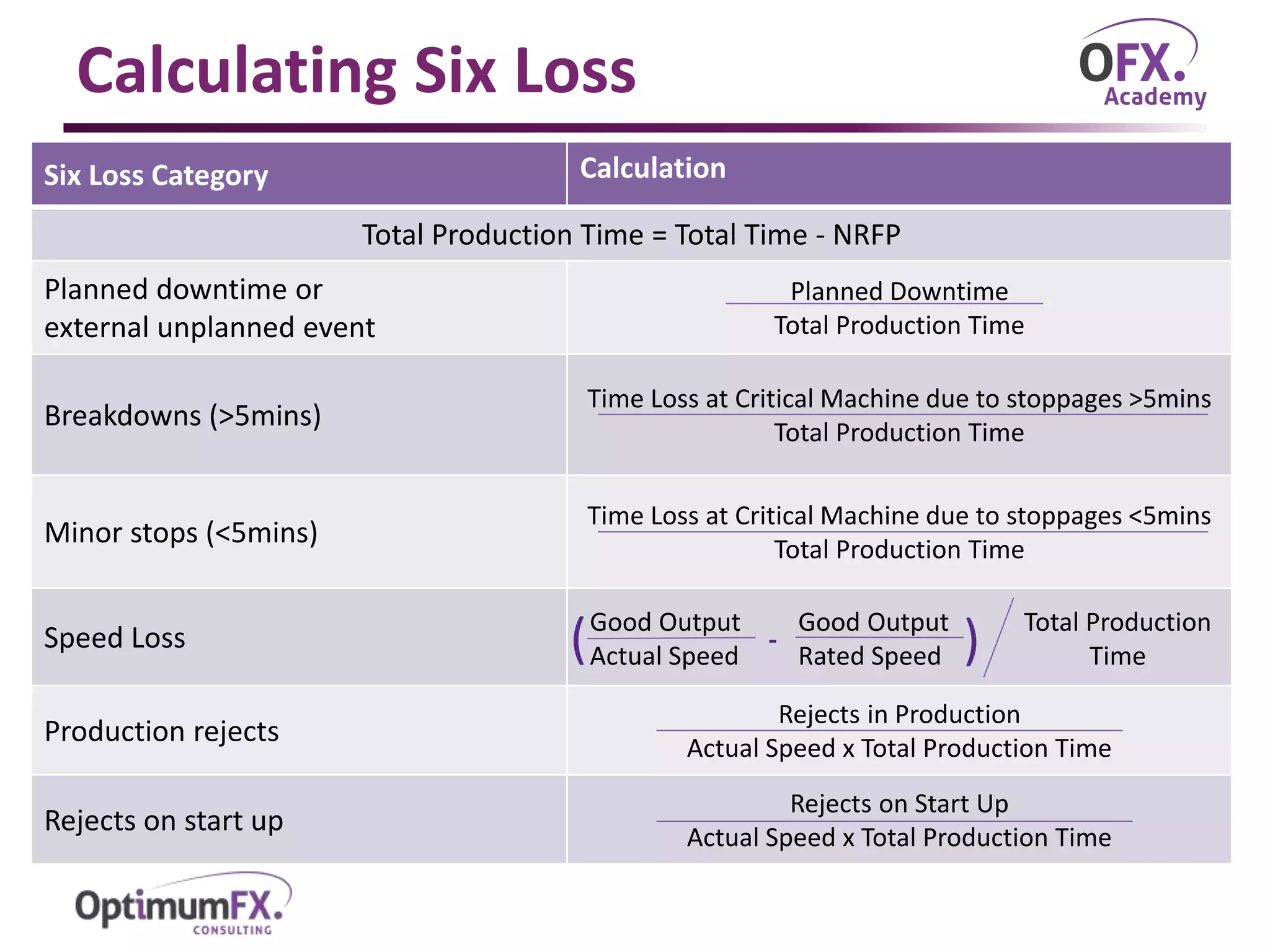
Calculating Six Loss
Six Loss Category Calculation
Total Production Time = Total Time - NRFP
Planned downtime or
external unplanned event
Planned Downtime
Total Production Time
Breakdowns (>5mins)
Time Loss at Critical Machine due to stoppages >5mins
Total Production Time
Minor stops (<5mins)
Time Loss at Critical Machine due to stoppages <5mins
Total Production Time
Speed Loss
Production rejects
Rejects in Production
Actual Speed x Total Production Time
Rejects on start up
Rejects on Start Up
Actual Speed x Total Production Time
Good Output
Actual Speed
Good Output
Rated Speed
-
Total Production
Time( )
OEE and Six Loss Analysis Example
In a 480 minute shift :-
On a machine rated at 100 products output per minute
Maximum output = 480 mins x 100 units = 48000 units
Shift info: Output (Good Production) = 32000 units
Speed = 98 units per minute
Planned downtime = 82 mins
Bottleneck loss due to B/down = 30 mins
Rejects (in process) = 1255 in 8 hr shift
Output (OEE) = 32000 / 48000 = 66.7%
480mins x 66.67% = 320 mins, therefore Total Loss = 160 mins
Six Loss Calculations:
Speed loss
Max theoretical units possible at actual speed = 98 x 480 = 47040
= (32000/47040) – (32000/48000) =
68.03% - 66.67% = 1.36%
480 x 1.36% = 6.53 mins / 480 = (1.36%)
Planned downtime = 82 mins / 480 = (17.08%)
Breakdown = 30 mins / 480 = (6.25%)
Rejects = 1255 / 98 (actual running speed) = 12.81 mins / 480 = (2.67%)
Minor stops = 480-320-6.53-82-30-12.81 = 28.66 mins / 480 = (5.97%)
Total loss = 160 mins = (33.33%)
OEE Calculations (Time in mins):
Production time = 480 Time less availability loss = 368 Time less performance loss = 333
Availability Loss Performance Loss Quality Loss
Planned downtime =82 Speed loss =6.53 Rejects on start up =0
Breakdowns =30 Minor stops (<5mins) =28.66 Rejects in process =12.81
Total =112 Total =35.19 Total =12.81
Availability ( 368/480) = 77% Performance (333/368) = 90% Quality (320/333) = 96%
OEE = 0.77x0.9x0.96 = 66.7%
Results of using Six loss information
• Always keeps the focus on the biggest area of opportunity
– Tactically
– Strategically
• Allows leaders to formulate medium to long term strategic
plan
• Provides feedback – keeping track of progress

The Six Big Losses of OEE

  • 1.
    The Six BigLosses of OEE www.optimumfx.com
  • 2.
    What is SixLoss? It would feel odd to drive a car without a dashboard… 6 loss Analysis is like the dashboard, providing useful information for making decisions at different times in your journey. Example: – When there is an indication that you are low on fuel – you will fill it up – When the Revs are too high – you will change gear
  • 3.
    Why use SixLoss? • Six Loss allows you to accurately pinpoint the area of focus that will impact on the performance of the equipment’s output. • To reduce each loss there is an improvement tool. • All the Six Loss is doing is breaking down the equipment’s overall loss into six clear categories, to which, you can apply certain techniques to improve. It is what you do with this information makes the difference. • Speed of Execution and intervention followed by monitoring is critical. Combine Six Loss data with using the right tools on the biggest loss and accelerate the speed of execution - This WILL improve the performance of your equipment. • Many manufacturing plants spend a lot of time in measuring and recording data and don’t use most of it. Sometimes less is more!!! This is a key part of your Manufacturing Strategy
  • 4.
    Set Up/Planned downtimeLosses Planned Downtime This is the period of time between the last piece from one product run and the first piece of the next product run. That is: All time for flavour changes, CIP’s , hygiene’s etc. that are necessary to fulfill the production plan. The way we can reduce the impact on output is to get smarter in the operation to reduce the time taken. Calculation to work out impact is: - Planned Downtime/(Paid time-NRFP)
  • 5.
    Breakdown Losses Breakdowns This isthe amount of time lost at the bottleneck machine due to large stops (typically > 5mins) on any machine. This may be electrical or mechanical and is assumed to be a stoppage where a component has failed and has been repaired or replaced. Calculation to work out impact is: - Stoppage to critical machine/(Paid time-NRFP)
  • 6.
    Minor Stops Minor Stops Thisis the amount of time lost at the bottleneck machine due to small stops (typically < 5mins ) on any machine with an assumption that these events would not normally be a component failure, it is more likely to be an adjustment or a jam up, etc.
  • 7.
    Speed Loss Speed loss Thisis the amount of time lost between the start and finish of a production run due to the bottleneck machine / Critical machine running below its rated speed. The formula for calculating this loss is: -
  • 8.
    Quality loss onstart up Quality loss on start up This is the run up period after a changeover when settings need final adjustments to bring the product into exact specification to enable running. That is: Alterations to saturation pressures or brix adjustments etc. that ensure product specification. As this is an exceptionally hard area to calculate automatically it is split out into the other areas of loss.
  • 9.
    Quality loss duringrunning Quality Loss in Process This is a loss of product during a production run where quality does not meet specification. All non re-workable rejects. That is: A low filled bottle, a poorly fitted cap etc.
  • 10.
    The Six LossTool Kit Six loss category OEE measure Reason for Loss Countermeasures Planned downtime or external unplanned event Availability  Changeovers  Planned maintenance  Material shortages  Labour shortages  Planned Downtime Management  5S Workplace Organisation  ABC Planning Breakdowns Availability  Equipment failure  Major component failure  Unplanned maintenance  Kaizen Blitz  ProACT  Root cause analysis  Asset Care Minor stops Performance  Fallen product  Obstruction  Blockages  Misalignment  Cleaning  5S Workplace Organisation  Adjustments  Line Minor stop audits Speed loss Performance  Running lower than rated speed  Untrained operator not able to run at nominal speed  Line Balance Optimisation  Adjustments Production rejects Quality  Product out of specification  Damaged product  scrap  Six Sigma  Error proofing  Root Cause Analysis Rejects on start up Quality  Product out of specification at start of run  Scrap created before nominal running after changeover  Damaged product after planned maintenance activity  Planned Downtime Management  5S Workplace Organisation  Standard Operating Procedures  Precision settings
  • 11.
    Calculating Six Loss SixLoss Category Calculation Total Production Time = Total Time - NRFP Planned downtime or external unplanned event Planned Downtime Total Production Time Breakdowns (>5mins) Time Loss at Critical Machine due to stoppages >5mins Total Production Time Minor stops (<5mins) Time Loss at Critical Machine due to stoppages <5mins Total Production Time Speed Loss Production rejects Rejects in Production Actual Speed x Total Production Time Rejects on start up Rejects on Start Up Actual Speed x Total Production Time Good Output Actual Speed Good Output Rated Speed - Total Production Time( )
  • 12.
    OEE and SixLoss Analysis Example In a 480 minute shift :- On a machine rated at 100 products output per minute Maximum output = 480 mins x 100 units = 48000 units Shift info: Output (Good Production) = 32000 units Speed = 98 units per minute Planned downtime = 82 mins Bottleneck loss due to B/down = 30 mins Rejects (in process) = 1255 in 8 hr shift Output (OEE) = 32000 / 48000 = 66.7% 480mins x 66.67% = 320 mins, therefore Total Loss = 160 mins Six Loss Calculations: Speed loss Max theoretical units possible at actual speed = 98 x 480 = 47040 = (32000/47040) – (32000/48000) = 68.03% - 66.67% = 1.36% 480 x 1.36% = 6.53 mins / 480 = (1.36%) Planned downtime = 82 mins / 480 = (17.08%) Breakdown = 30 mins / 480 = (6.25%) Rejects = 1255 / 98 (actual running speed) = 12.81 mins / 480 = (2.67%) Minor stops = 480-320-6.53-82-30-12.81 = 28.66 mins / 480 = (5.97%) Total loss = 160 mins = (33.33%) OEE Calculations (Time in mins): Production time = 480 Time less availability loss = 368 Time less performance loss = 333 Availability Loss Performance Loss Quality Loss Planned downtime =82 Speed loss =6.53 Rejects on start up =0 Breakdowns =30 Minor stops (<5mins) =28.66 Rejects in process =12.81 Total =112 Total =35.19 Total =12.81 Availability ( 368/480) = 77% Performance (333/368) = 90% Quality (320/333) = 96% OEE = 0.77x0.9x0.96 = 66.7%
  • 13.
    Results of usingSix loss information • Always keeps the focus on the biggest area of opportunity – Tactically – Strategically • Allows leaders to formulate medium to long term strategic plan • Provides feedback – keeping track of progress