Classification of the sensors
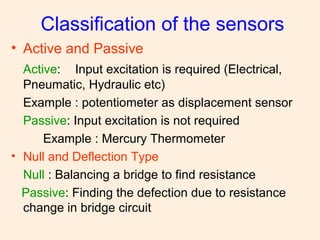
• Active and Passive
Active: Input excitation is required (Electrical,
Pneumatic, Hydraulic etc)
Example : potentiometer as displacement sensor
Passive: Input excitation is not required
Example : Mercury Thermometer
• Null and Deflection Type
Null : Balancing a bridge to find resistance
Passive: Finding the defection due to resistance
change in bridge circuit
Classification of the sensors
• Analog and Digital Type
Analog: Output varies continuously, infinite
position for the pointer
Digital: Output varies in discrete form. Finite
number of positions
Static Characteristics of Instruments
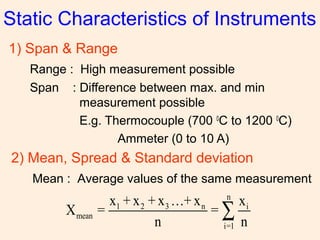
1) Span & Range
Range : High measurement possible
Span : Difference between max. and min
measurement possible
E.g. Thermocouple (700 0
C to 1200 0
C)
Ammeter (0 to 10 A)
2) Mean, Spread & Standard deviation
Mean : Average values of the same measurement
n
1 2 3 n i
mean
i=1
x + x + x …+ x x
X = =
n n
∑
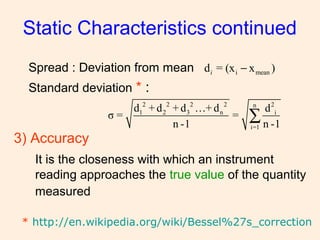
Spread : Deviation from mean
Standard deviation * :
Static Characteristics continued
i meand = (x x )i −
2 2 2 2 2n
1 2 3 n i
i=1
d + d + d …+ d d
σ = =
n -1 n -1
∑
* http://en.wikipedia.org/wiki/Bessel%27s_correction
3) Accuracy
It is the closeness with which an instrument
reading approaches the true value of the quantity
measured
Static Characteristics continued
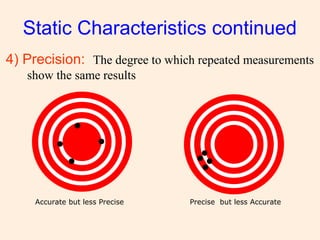
4) Precision: The degree to which repeated measurements
show the same results
Accurate but less Precise Precise but less Accurate
Resolution and Sensitivity
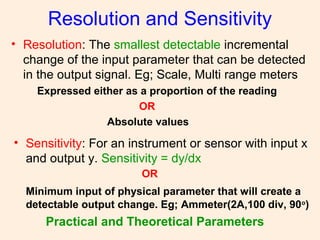
• Resolution: The smallest detectable incremental
change of the input parameter that can be detected
in the output signal. Eg; Scale, Multi range meters
Expressed either as a proportion of the reading
OR
Absolute values
• Sensitivity: For an instrument or sensor with input x
and output y. Sensitivity = dy/dx
OR
Minimum input of physical parameter that will create a
detectable output change. Eg; Ammeter(2A,100 div, 90o
)
Practical and Theoretical Parameters
7
Dead zone/space and Dead time
Dead space: The largest of a measured variable
for which the instrument does not respond
Cause: friction in mechanical measurement
system
Dead time: The time before the instrument
begins to respond after the measured
quantity has been changed.
E.g: Camera, Data acquisition card, Ammeter
8
Hysteresis
It refers to the difference
between upscale sequence
of calibration and downscale
sequence of calibration
he=({y}upscale-{y}downscale)x=x1
Hysteresis error = [he(max)/FSOR] ×100
FSOR : Full Scale Output Reading
Fig. Internal force verses extension
of a rubber band follows
hysteresis. External force is in
opposition to internal force
E.g. Potentiometer used as
displacement sensor with
significant losses
9
Linearity
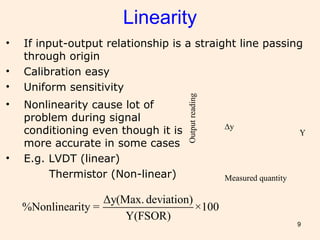
• If input-output relationship is a straight line passing
through origin
• Calibration easy
• Uniform sensitivity
Y
∆y
Measured quantity
Outputreading
• Nonlinearity cause lot of
problem during signal
conditioning even though it is
more accurate in some cases
• E.g. LVDT (linear)
Thermistor (Non-linear)
Δy(Max. deviation)
%Nonlinearity = ×100
Y(FSOR)
Tolerance
Maximum deviation of a manufactured
component from some specified value.
Tolerance Color
±1% brown
±2% red
±5% gold
±10% silver
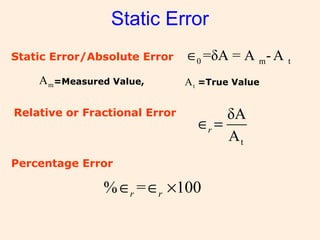
Static Error
0 m t=δA = A -A∈Static Error/Absolute Error
=Measured Value,mA tA =True Value
Relative or Fractional Error
Percentage Error
t
δA
A
r∈ =
% = 100r r∈ ∈ ×
Electromagnetic-Electromechanical
Indicating Instruments
Electromechanical Indicating Instruments
Input is electrical signal
Output is mechanical force
Analog (Output is a continuous
function of time)
Example: PMMC Instruments
Permanent Magnet Moving Coil
(PMMC) Instruments
• To measure DC current or DC voltage
• Can be used for measuring AC
currents and voltages by introducing
additional circuit and proper calibration
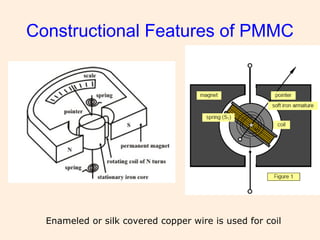
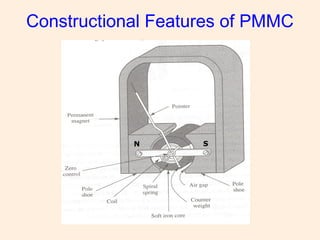
Constructional Features of PMMC
Enameled or silk covered copper wire is used for coil
Constructional Features of PMMC
N S
16
Various Forces/ Torques in
Measuring Instruments
• The movement of the pointer in
PPMC is governed by three different
torques
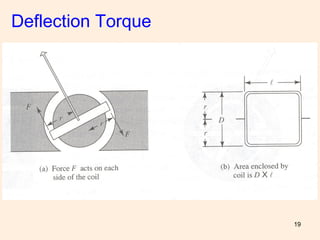
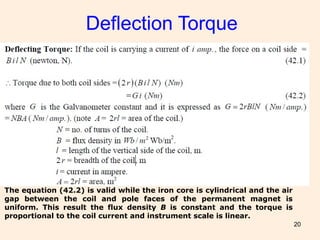
1) Deflection Torque
2) Control Torque
3) Damping Torque
17
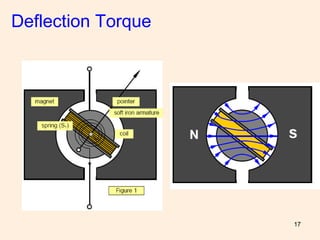
Deflection Torque
18
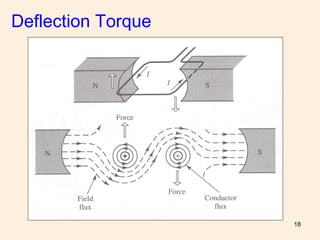
Deflection Torque
19
Deflection Torque
Deflection Torque
20
The equation (42.2) is valid while the iron core is cylindrical and the air
gap between the coil and pole faces of the permanent magnet is
uniform. This result the flux density B is constant and the torque is
proportional to the coil current and instrument scale is linear.
21
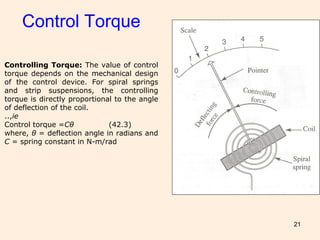
Control Torque
Controlling Torque: The value of control
torque depends on the mechanical design
of the control device. For spiral springs
and strip suspensions, the controlling
torque is directly proportional to the angle
of deflection of the coil.
..,ie
Control torque =Cθ (42.3)
where, θ = deflection angle in radians and
C = spring constant in N-m/rad
22
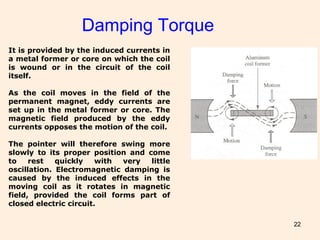
Damping Torque
It is provided by the induced currents in
a metal former or core on which the coil
is wound or in the circuit of the coil
itself.
As the coil moves in the field of the
permanent magnet, eddy currents are
set up in the metal former or core. The
magnetic field produced by the eddy
currents opposes the motion of the coil.
The pointer will therefore swing more
slowly to its proper position and come
to rest quickly with very little
oscillation. Electromagnetic damping is
caused by the induced effects in the
moving coil as it rotates in magnetic
field, provided the coil forms part of
closed electric circuit.
23
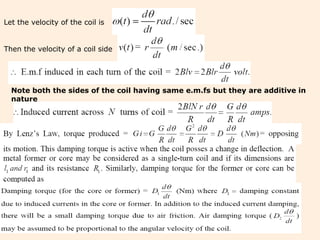
Let the velocity of the coil is
Then the velocity of a coil side
Note both the sides of the coil having same e.m.fs but they are additive in
nature
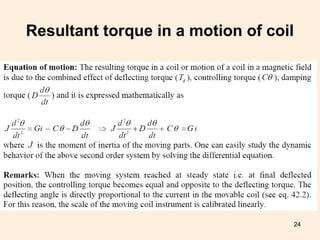
Resultant torque in a motion of coil
24
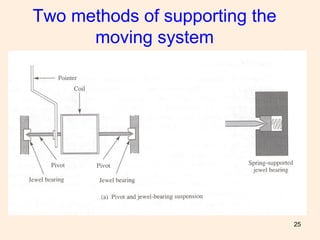
25
Two methods of supporting the
moving system
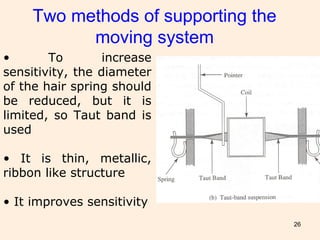
26
Two methods of supporting the
moving system
• To increase
sensitivity, the diameter
of the hair spring should
be reduced, but it is
limited, so Taut band is
used
• It is thin, metallic,
ribbon like structure
• It improves sensitivity
27
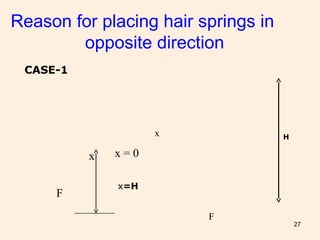
Reason for placing hair springs in
opposite direction
F
x = 0x
F
x
CASE-1
H
x=H
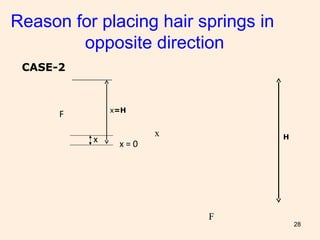
28
Reason for placing hair springs in
opposite direction
F
x = 0x
F
x
CASE-2
x=H
H
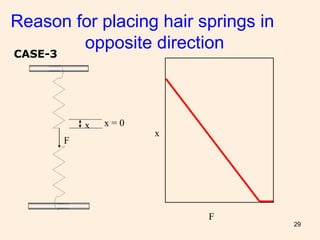
29
Reason for placing hair springs in
opposite direction
F
x
F
x = 0x
CASE-3
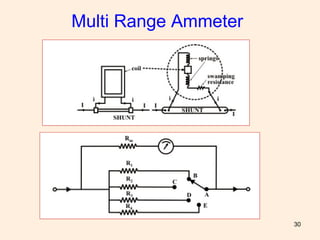
30
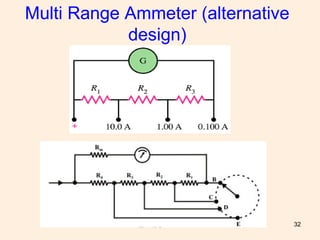
Multi Range Ammeter
31
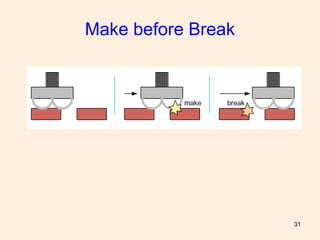
Make before Break
32
Multi Range Ammeter (alternative
design)
33
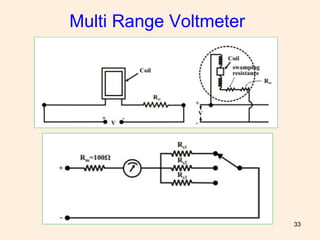
Multi Range Voltmeter
34
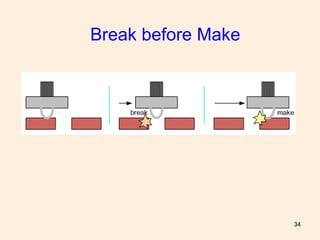
Break before Make
35
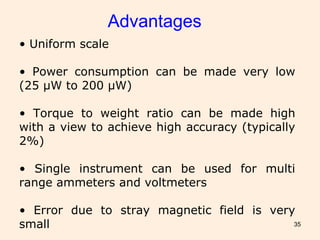
Advantages
• Uniform scale
• Power consumption can be made very low
(25 µW to 200 µW)
• Torque to weight ratio can be made high
with a view to achieve high accuracy (typically
2%)
• Single instrument can be used for multi
range ammeters and voltmeters
• Error due to stray magnetic field is very
small
36
Limitations
• They are suitable for direct current only
• The instrument cost is high
• Variation of magnet strength with time
37
Errors can be reduced by
• Proper pivoting and balancing weight may
reduce the frictional error
• Considering the aging can reduce errors due
to magnetic decay
• Manganin in series with coil reduces
temperature effects
• Maintaining nominal temperature. The
stiffness of spring, permeability of magnetic
core decreases with increase in temperature
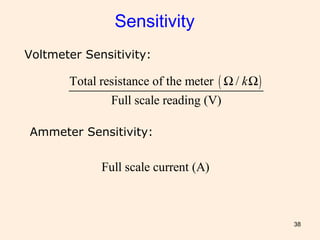
38
Sensitivity
Ammeter Sensitivity:
Full scale current (A)
Voltmeter Sensitivity:
( )Total resistance of the meter /
Full scale reading (V)
kΩ Ω
39
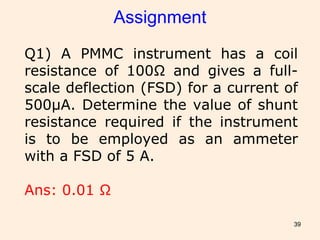
Assignment
Q1) A PMMC instrument has a coil
resistance of 100Ω and gives a full-
scale deflection (FSD) for a current of
500μA. Determine the value of shunt
resistance required if the instrument
is to be employed as an ammeter
with a FSD of 5 A.
Ans: 0.01 Ω
40
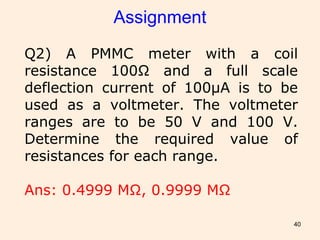
Assignment
Q2) A PMMC meter with a coil
resistance 100Ω and a full scale
deflection current of 100μA is to be
used as a voltmeter. The voltmeter
ranges are to be 50 V and 100 V.
Determine the required value of
resistances for each range.
Ans: 0.4999 MΩ, 0.9999 MΩ
41
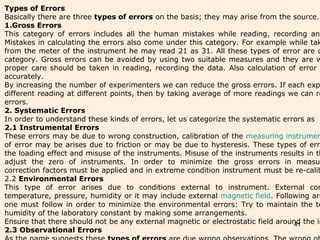
Types of Errors
Basically there are three types of errors on the basis; they may arise from the source.
1.Gross Errors
This category of errors includes all the human mistakes while reading, recording and
Mistakes in calculating the errors also come under this category. For example while tak
from the meter of the instrument he may read 21 as 31. All these types of error are c
category. Gross errors can be avoided by using two suitable measures and they are w
proper care should be taken in reading, recording the data. Also calculation of error
accurately.
By increasing the number of experimenters we can reduce the gross errors. If each exp
different reading at different points, then by taking average of more readings we can re
errors.
2. Systematic Errors
In order to understand these kinds of errors, let us categorize the systematic errors as
2.1 Instrumental Errors
These errors may be due to wrong construction, calibration of the measuring instrumen
of error may be arises due to friction or may be due to hysteresis. These types of erro
the loading effect and misuse of the instruments. Misuse of the instruments results in th
adjust the zero of instruments. In order to minimize the gross errors in measur
correction factors must be applied and in extreme condition instrument must be re-calib
2.2 Environmental Errors
This type of error arises due to conditions external to instrument. External con
temperature, pressure, humidity or it may include external magnetic field. Following are
one must follow in order to minimize the environmental errors: Try to maintain the te
humidity of the laboratory constant by making some arrangements.
Ensure that there should not be any external magnetic or electrostatic field around the in
2.3 Observational Errors

Electrical Measurement & Instruments

  • 1.
    Classification of thesensors • Active and Passive Active: Input excitation is required (Electrical, Pneumatic, Hydraulic etc) Example : potentiometer as displacement sensor Passive: Input excitation is not required Example : Mercury Thermometer • Null and Deflection Type Null : Balancing a bridge to find resistance Passive: Finding the defection due to resistance change in bridge circuit
  • 2.
    Classification of thesensors • Analog and Digital Type Analog: Output varies continuously, infinite position for the pointer Digital: Output varies in discrete form. Finite number of positions
  • 3.
    Static Characteristics ofInstruments 1) Span & Range Range : High measurement possible Span : Difference between max. and min measurement possible E.g. Thermocouple (700 0 C to 1200 0 C) Ammeter (0 to 10 A) 2) Mean, Spread & Standard deviation Mean : Average values of the same measurement n 1 2 3 n i mean i=1 x + x + x …+ x x X = = n n ∑
  • 4.
    Spread : Deviationfrom mean Standard deviation * : Static Characteristics continued i meand = (x x )i − 2 2 2 2 2n 1 2 3 n i i=1 d + d + d …+ d d σ = = n -1 n -1 ∑ * http://en.wikipedia.org/wiki/Bessel%27s_correction 3) Accuracy It is the closeness with which an instrument reading approaches the true value of the quantity measured
  • 5.
    Static Characteristics continued 4)Precision: The degree to which repeated measurements show the same results Accurate but less Precise Precise but less Accurate
  • 6.
    Resolution and Sensitivity •Resolution: The smallest detectable incremental change of the input parameter that can be detected in the output signal. Eg; Scale, Multi range meters Expressed either as a proportion of the reading OR Absolute values • Sensitivity: For an instrument or sensor with input x and output y. Sensitivity = dy/dx OR Minimum input of physical parameter that will create a detectable output change. Eg; Ammeter(2A,100 div, 90o ) Practical and Theoretical Parameters
  • 7.
    7 Dead zone/space andDead time Dead space: The largest of a measured variable for which the instrument does not respond Cause: friction in mechanical measurement system Dead time: The time before the instrument begins to respond after the measured quantity has been changed. E.g: Camera, Data acquisition card, Ammeter
  • 8.
    8 Hysteresis It refers tothe difference between upscale sequence of calibration and downscale sequence of calibration he=({y}upscale-{y}downscale)x=x1 Hysteresis error = [he(max)/FSOR] ×100 FSOR : Full Scale Output Reading Fig. Internal force verses extension of a rubber band follows hysteresis. External force is in opposition to internal force E.g. Potentiometer used as displacement sensor with significant losses
  • 9.
    9 Linearity • If input-outputrelationship is a straight line passing through origin • Calibration easy • Uniform sensitivity Y ∆y Measured quantity Outputreading • Nonlinearity cause lot of problem during signal conditioning even though it is more accurate in some cases • E.g. LVDT (linear) Thermistor (Non-linear) Δy(Max. deviation) %Nonlinearity = ×100 Y(FSOR)
  • 10.
    Tolerance Maximum deviation ofa manufactured component from some specified value. Tolerance Color ±1% brown ±2% red ±5% gold ±10% silver
  • 11.
    Static Error 0 mt=δA = A -A∈Static Error/Absolute Error =Measured Value,mA tA =True Value Relative or Fractional Error Percentage Error t δA A r∈ = % = 100r r∈ ∈ ×
  • 12.
    Electromagnetic-Electromechanical Indicating Instruments Electromechanical IndicatingInstruments Input is electrical signal Output is mechanical force Analog (Output is a continuous function of time) Example: PMMC Instruments
  • 13.
    Permanent Magnet MovingCoil (PMMC) Instruments • To measure DC current or DC voltage • Can be used for measuring AC currents and voltages by introducing additional circuit and proper calibration
  • 14.
    Constructional Features ofPMMC Enameled or silk covered copper wire is used for coil
  • 15.
  • 16.
    16 Various Forces/ Torquesin Measuring Instruments • The movement of the pointer in PPMC is governed by three different torques 1) Deflection Torque 2) Control Torque 3) Damping Torque
  • 17.
  • 18.
  • 19.
  • 20.
    Deflection Torque 20 The equation(42.2) is valid while the iron core is cylindrical and the air gap between the coil and pole faces of the permanent magnet is uniform. This result the flux density B is constant and the torque is proportional to the coil current and instrument scale is linear.
  • 21.
    21 Control Torque Controlling Torque:The value of control torque depends on the mechanical design of the control device. For spiral springs and strip suspensions, the controlling torque is directly proportional to the angle of deflection of the coil. ..,ie Control torque =Cθ (42.3) where, θ = deflection angle in radians and C = spring constant in N-m/rad
  • 22.
    22 Damping Torque It isprovided by the induced currents in a metal former or core on which the coil is wound or in the circuit of the coil itself. As the coil moves in the field of the permanent magnet, eddy currents are set up in the metal former or core. The magnetic field produced by the eddy currents opposes the motion of the coil. The pointer will therefore swing more slowly to its proper position and come to rest quickly with very little oscillation. Electromagnetic damping is caused by the induced effects in the moving coil as it rotates in magnetic field, provided the coil forms part of closed electric circuit.
  • 23.
    23 Let the velocityof the coil is Then the velocity of a coil side Note both the sides of the coil having same e.m.fs but they are additive in nature
  • 24.
    Resultant torque ina motion of coil 24
  • 25.
    25 Two methods ofsupporting the moving system
  • 26.
    26 Two methods ofsupporting the moving system • To increase sensitivity, the diameter of the hair spring should be reduced, but it is limited, so Taut band is used • It is thin, metallic, ribbon like structure • It improves sensitivity
  • 27.
    27 Reason for placinghair springs in opposite direction F x = 0x F x CASE-1 H x=H
  • 28.
    28 Reason for placinghair springs in opposite direction F x = 0x F x CASE-2 x=H H
  • 29.
    29 Reason for placinghair springs in opposite direction F x F x = 0x CASE-3
  • 30.
  • 31.
  • 32.
    32 Multi Range Ammeter(alternative design)
  • 33.
  • 34.
  • 35.
    35 Advantages • Uniform scale •Power consumption can be made very low (25 µW to 200 µW) • Torque to weight ratio can be made high with a view to achieve high accuracy (typically 2%) • Single instrument can be used for multi range ammeters and voltmeters • Error due to stray magnetic field is very small
  • 36.
    36 Limitations • They aresuitable for direct current only • The instrument cost is high • Variation of magnet strength with time
  • 37.
    37 Errors can bereduced by • Proper pivoting and balancing weight may reduce the frictional error • Considering the aging can reduce errors due to magnetic decay • Manganin in series with coil reduces temperature effects • Maintaining nominal temperature. The stiffness of spring, permeability of magnetic core decreases with increase in temperature
  • 38.
    38 Sensitivity Ammeter Sensitivity: Full scalecurrent (A) Voltmeter Sensitivity: ( )Total resistance of the meter / Full scale reading (V) kΩ Ω
  • 39.
    39 Assignment Q1) A PMMCinstrument has a coil resistance of 100Ω and gives a full- scale deflection (FSD) for a current of 500μA. Determine the value of shunt resistance required if the instrument is to be employed as an ammeter with a FSD of 5 A. Ans: 0.01 Ω
  • 40.
    40 Assignment Q2) A PMMCmeter with a coil resistance 100Ω and a full scale deflection current of 100μA is to be used as a voltmeter. The voltmeter ranges are to be 50 V and 100 V. Determine the required value of resistances for each range. Ans: 0.4999 MΩ, 0.9999 MΩ
  • 41.
    41 Types of Errors Basicallythere are three types of errors on the basis; they may arise from the source. 1.Gross Errors This category of errors includes all the human mistakes while reading, recording and Mistakes in calculating the errors also come under this category. For example while tak from the meter of the instrument he may read 21 as 31. All these types of error are c category. Gross errors can be avoided by using two suitable measures and they are w proper care should be taken in reading, recording the data. Also calculation of error accurately. By increasing the number of experimenters we can reduce the gross errors. If each exp different reading at different points, then by taking average of more readings we can re errors. 2. Systematic Errors In order to understand these kinds of errors, let us categorize the systematic errors as 2.1 Instrumental Errors These errors may be due to wrong construction, calibration of the measuring instrumen of error may be arises due to friction or may be due to hysteresis. These types of erro the loading effect and misuse of the instruments. Misuse of the instruments results in th adjust the zero of instruments. In order to minimize the gross errors in measur correction factors must be applied and in extreme condition instrument must be re-calib 2.2 Environmental Errors This type of error arises due to conditions external to instrument. External con temperature, pressure, humidity or it may include external magnetic field. Following are one must follow in order to minimize the environmental errors: Try to maintain the te humidity of the laboratory constant by making some arrangements. Ensure that there should not be any external magnetic or electrostatic field around the in 2.3 Observational Errors