Managing Global Human
Resource Administration

HUMAN RESOURCE
ADMINISTRATION &
DEVELOPMENT
(MAEd GS-644)

Presenter :
Malyn C. Singson
T
T

o
o

p ii c
p
c

s
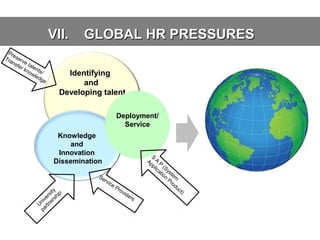
s

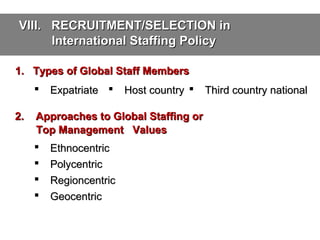
I. Definition of Human Resource Management vs.
Global Human Resource Management
II. Core Activities of Human Resource Management
III. The Differences/Similarities of Global HR
IV. Employers in the Global Marketplace
V. Factors Affecting Global HR
VI. G.Hofstede’s Cultural Dimension
VII. Global HR Pressures
VIII. Recruitment/Selection in International Staffing
a. Types of Global Staff Members
b. Approaches of Global Staffing
IX. Criteria for Selection of Employees for foreign
assignment
X.

Stages in Expatriation selection

XI. Expatriate preparation and Development Program
XII. Compensating Expatriates
XIII. Compensating Host Country Nationals
XIV. Global Human Resources Development
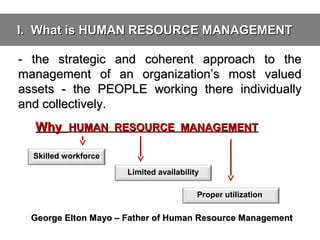
I. What is HUMAN RESOURCE MANAGEMENT
- the strategic and coherent approach to the
management of an organization’s most valued
assets - the PEOPLE working there individually
and collectively.
Why HUMAN RESOURCE MANAGEMENT
Skilled workforce
Limited availability
Proper utilization

George Elton Mayo – Father of Human Resource Management
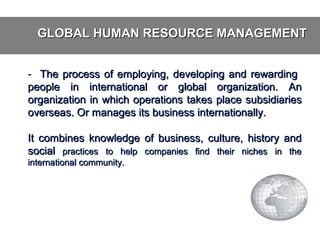
GLOBAL HUMAN RESOURCE MANAGEMENT
- The process of employing, developing and rewarding
people in international or global organization. An
organization in which operations takes place subsidiaries
overseas. Or manages its business internationally.
It combines knowledge of business, culture, history and
social practices to help companies find their niches in the
international community.
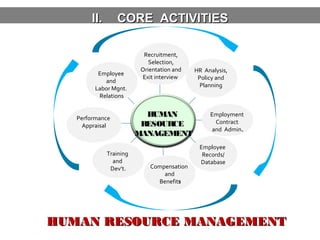
II.

CORE ACTIVITIES

Employee
and
Labor Mgnt.
Relations
Performance
Appraisal

Training
and
Dev’t.

Recruitment,
Selection,
Orientation and
Exit interview

HUMAN
RESOURCE
MANAGEMENT

Compensation
and
Benefits

HR Analysis,
Policy and
Planning

Employment
Contract
and Admin.
Employee
Records/
Database

HUMAN RESOURCE MANAGEMENT
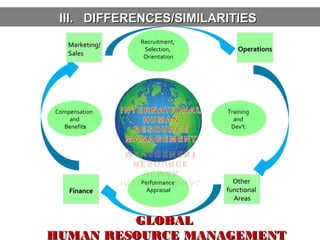
III. DIFFERENCES/SIMILARITIES
Marketing/
Sales

Recruitment,
Selection,
Orientation

Compensation
and
Benefits

Finance

Operations

Training
and
Dev’t.

Performance
Appraisal

Other
functional
Areas

GLOBAL
HUMAN RESOURCE MANAGEMENT
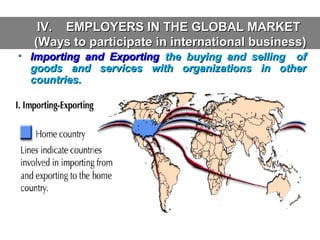
IV. EMPLOYERS IN THE GLOBAL MARKET
(Ways to participate in international business)
• Importing and Exporting the buying and selling of
goods and services with organizations in other
countries.
Employers in the Global Market
rket

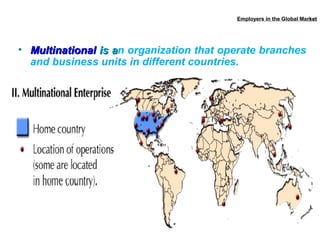
• Multinational is an organization that operate branches
a
and business units in different countries.
Employers in the Global Market
rket

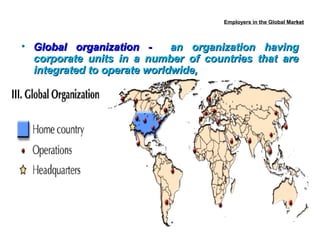
• Global organization an organization having
corporate units in a number of countries that are
integrated to operate worldwide,
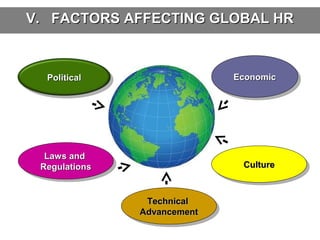
V. FACTORS AFFECTING GLOBAL HR

Economic
Economic

Political

Laws and
Laws and
Regulations
Regulations

Culture
Culture

Technical
Technical
Advancement
Advancement
VI. Geert HOFSTEDE’S CULTURAL DIMENSION THEORY
Is a framework for cross-cultural communication.
It describes the effects of a society’s culture on the values of
its members and how these values relate to behavior.
Geert Hofstede’s Cultural Dimensions Theory

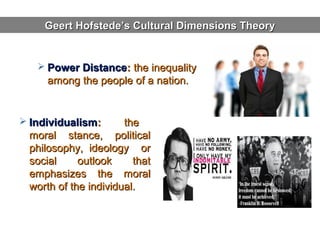
 Power Distance: the inequality

among the people of a nation.

 Individualism:

the
moral stance, political
philosophy, ideology or
social
outlook
that
emphasizes the moral
worth of the individual.
G. Hofstede’s Cultural Dimensions Theory

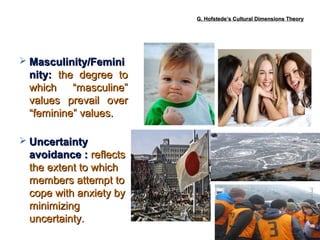
 Masculinity/Femini

nity: the degree to
which
“masculine”
values prevail over
“feminine” values.
 Uncertainty

avoidance : reflects
the extent to which
members attempt to
cope with anxiety by
minimizing
uncertainty.
G. Hofstede’s Cultural Dimensions Theory

 Long term orientation:

stands for fostering of virtues
oriented towards future
rewards through persevance
and thrifty.
VII.
Pr
e
Tra serv
ns e t
fer ale
kn nts
ow /
led
ge

GLOBAL HR PRESSURES

Identifying
and
Developing talent
Deployment/
Service
Knowledge
and
Innovation
Dissemination

ity
rs hip
ve rs
n i tne
U r
pa

Se
rvi
ce
P

rov
ide

rs

S
Ap A P
pl (S
ica y
tio ste
n m
Pr
od
uc
t)
VIII. RECRUITMENT/SELECTION in
International Staffing Policy
1. Types of Global Staff Members

2.

Expatriate 

Host country 

Approaches to Global Staffing or
Top Management Values





Ethnocentric
Polycentric
Regioncentric
Geocentric

Third country national
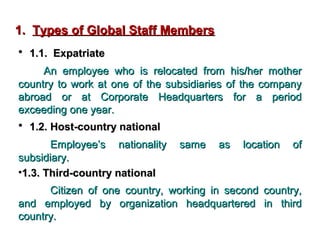
1. Types of Global Staff Members
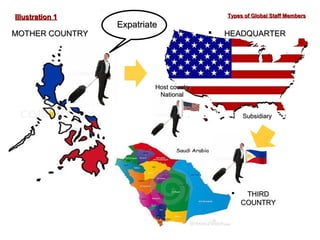
• 1.1. Expatriate
An employee who is relocated from his/her mother
country to work at one of the subsidiaries of the company
abroad or at Corporate Headquarters for a period
exceeding one year.

• 1.2. Host-country national
Employee’s nationality
subsidiary.
•1.3. Third-country national

same

as

location

of

Citizen of one country, working in second country,
and employed by organization headquartered in third
country.
Illustration 1

MOTHER COUNTRY

Types of Global Staff Members

Expatriate



HEADQUARTER

Host country
National
Subsidiary



THIRD
COUNTRY
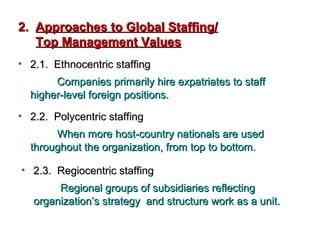
2. Approaches to Global Staffing/
Top Management Values
• 2.1. Ethnocentric staffing
Companies primarily hire expatriates to staff
higher-level foreign positions.
• 2.2. Polycentric staffing
When more host-country nationals are used
throughout the organization, from top to bottom.
• 2.3. Regiocentric staffing
Regional groups of subsidiaries reflecting
organization’s strategy and structure work as a unit.
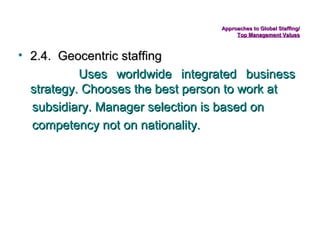
Approaches to Global Staffing/
Top Management Values

• 2.4. Geocentric staffing
Uses worldwide integrated business
strategy. Chooses the best person to work at
subsidiary. Manager selection is based on
competency not on nationality.
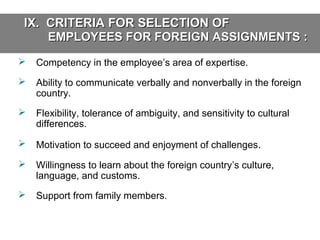
IX. CRITERIA FOR SELECTION OF
EMPLOYEES FOR FOREIGN ASSIGNMENTS :


Competency in the employee’s area of expertise.



Ability to communicate verbally and nonverbally in the foreign
country.



Flexibility, tolerance of ambiguity, and sensitivity to cultural
differences.



Motivation to succeed and enjoyment of challenges.



Willingness to learn about the foreign country’s culture,
language, and customs.



Support from family members.
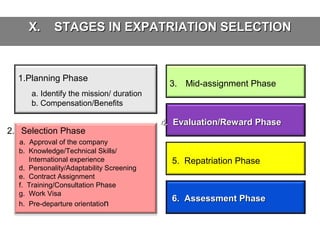
X.

STAGES IN EXPATRIATION SELECTION

1.Planning Phase

3. Mid-assignment Phase

a. Identify the mission/ duration
b. Compensation/Benefits

2. Selection Phase
a. Approval of the company
b. Knowledge/Technical Skills/
International experience
d. Personality/Adaptability Screening
e. Contract Assignment
f. Training/Consultation Phase
g. Work Visa
h. Pre-departure orientation

4. Evaluation/Reward Phase

5. Repatriation Phase

6. Assessment Phase
XI.

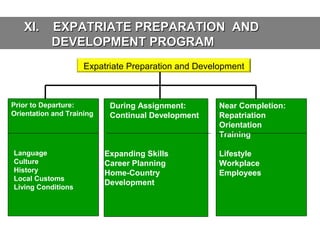
EXPATRIATE PREPARATION AND
DEVELOPMENT PROGRAM
Expatriate Preparation and Development

Prior to Departure:
Orientation and Training

Language
Culture
History
Local Customs
Living Conditions

During Assignment:
Continual Development

Expanding Skills
Career Planning
Home-Country
Development

Near Completion:
Repatriation
Orientation
Training
Lifestyle
Workplace
Employees
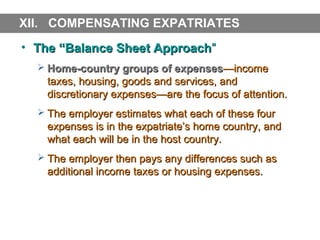
XII. COMPENSATING EXPATRIATES
• The “Balance Sheet Approach”
 Home-country groups of expenses—income

taxes, housing, goods and services, and
discretionary expenses—are the focus of attention.
 The employer estimates what each of these four

expenses is in the expatriate’s home country, and
what each will be in the host country.
 The employer then pays any differences such as

additional income taxes or housing expenses.
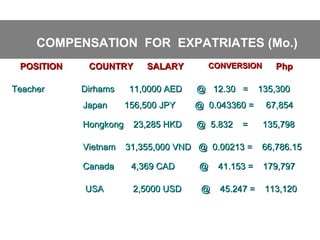
COMPENSATION FOR EXPATRIATES (Mo.)
POSITION
Teacher

COUNTRY
Dirhams
Japan
Hongkong
Vietnam

SALARY

11,0000 AED
156,500 JPY
23,285 HKD

CONVERSION

@ 12.30 =
@ 0.043360 =
@ 5.832

=

31,355,000 VND @ 0.00213 =

Php

135,300
67,854
135,798
66,786.15

Canada

4,369 CAD

@

41.153 =

179,797

USA

2,5000 USD

@

45.247 =

113,120
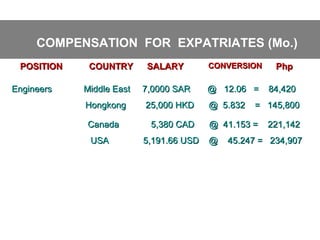
COMPENSATION FOR EXPATRIATES (Mo.)
POSITION
Engineers

COUNTRY
Middle East
Hongkong
Canada
USA

SALARY

CONVERSION

Php

7,0000 SAR

@ 12.06 =

84,420

25,000 HKD
5,380 CAD
5,191.66 USD

@ 5.832

= 145,800

@ 41.153 =
@

221,142

45.247 = 234,907
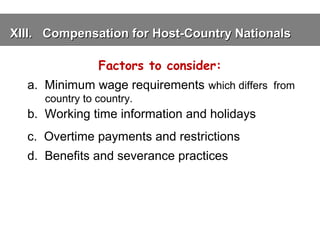
XIII. Compensation for Host-Country Nationals
Factors to consider:
a. Minimum wage requirements which differs from
country to country.

b. Working time information and holidays
c. Overtime payments and restrictions
d. Benefits and severance practices
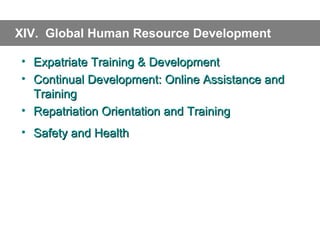
XIV. Global Human Resource Development
• Expatriate Training & Development
• Continual Development: Online Assistance and
Training
• Repatriation Orientation and Training
• Safety and Health
Managing Global Human Resource Management

Managing Global Human Resource Management

  • 1.
    Managing Global Human ResourceAdministration HUMAN RESOURCE ADMINISTRATION & DEVELOPMENT (MAEd GS-644) Presenter : Malyn C. Singson
  • 2.
    T T o o p ii c p c s s I.Definition of Human Resource Management vs. Global Human Resource Management II. Core Activities of Human Resource Management III. The Differences/Similarities of Global HR IV. Employers in the Global Marketplace V. Factors Affecting Global HR VI. G.Hofstede’s Cultural Dimension VII. Global HR Pressures
  • 3.
    VIII. Recruitment/Selection inInternational Staffing a. Types of Global Staff Members b. Approaches of Global Staffing IX. Criteria for Selection of Employees for foreign assignment X. Stages in Expatriation selection XI. Expatriate preparation and Development Program XII. Compensating Expatriates XIII. Compensating Host Country Nationals XIV. Global Human Resources Development
  • 4.
    I. What isHUMAN RESOURCE MANAGEMENT - the strategic and coherent approach to the management of an organization’s most valued assets - the PEOPLE working there individually and collectively. Why HUMAN RESOURCE MANAGEMENT Skilled workforce Limited availability Proper utilization George Elton Mayo – Father of Human Resource Management
  • 5.
    GLOBAL HUMAN RESOURCEMANAGEMENT - The process of employing, developing and rewarding people in international or global organization. An organization in which operations takes place subsidiaries overseas. Or manages its business internationally. It combines knowledge of business, culture, history and social practices to help companies find their niches in the international community.
  • 6.
    II. CORE ACTIVITIES Employee and Labor Mgnt. Relations Performance Appraisal Training and Dev’t. Recruitment, Selection, Orientationand Exit interview HUMAN RESOURCE MANAGEMENT Compensation and Benefits HR Analysis, Policy and Planning Employment Contract and Admin. Employee Records/ Database HUMAN RESOURCE MANAGEMENT
  • 7.
  • 8.
    IV. EMPLOYERS INTHE GLOBAL MARKET (Ways to participate in international business) • Importing and Exporting the buying and selling of goods and services with organizations in other countries.
  • 9.
    Employers in theGlobal Market rket • Multinational is an organization that operate branches a and business units in different countries.
  • 10.
    Employers in theGlobal Market rket • Global organization an organization having corporate units in a number of countries that are integrated to operate worldwide,
  • 11.
    V. FACTORS AFFECTINGGLOBAL HR Economic Economic Political Laws and Laws and Regulations Regulations Culture Culture Technical Technical Advancement Advancement
  • 12.
    VI. Geert HOFSTEDE’SCULTURAL DIMENSION THEORY Is a framework for cross-cultural communication. It describes the effects of a society’s culture on the values of its members and how these values relate to behavior.
  • 13.
    Geert Hofstede’s CulturalDimensions Theory  Power Distance: the inequality among the people of a nation.  Individualism: the moral stance, political philosophy, ideology or social outlook that emphasizes the moral worth of the individual.
  • 14.
    G. Hofstede’s CulturalDimensions Theory  Masculinity/Femini nity: the degree to which “masculine” values prevail over “feminine” values.  Uncertainty avoidance : reflects the extent to which members attempt to cope with anxiety by minimizing uncertainty.
  • 15.
    G. Hofstede’s CulturalDimensions Theory  Long term orientation: stands for fostering of virtues oriented towards future rewards through persevance and thrifty.
  • 16.
    VII. Pr e Tra serv ns et fer ale kn nts ow / led ge GLOBAL HR PRESSURES Identifying and Developing talent Deployment/ Service Knowledge and Innovation Dissemination ity rs hip ve rs n i tne U r pa Se rvi ce P rov ide rs S Ap A P pl (S ica y tio ste n m Pr od uc t)
  • 17.
    VIII. RECRUITMENT/SELECTION in InternationalStaffing Policy 1. Types of Global Staff Members  2. Expatriate  Host country  Approaches to Global Staffing or Top Management Values     Ethnocentric Polycentric Regioncentric Geocentric Third country national
  • 18.
    1. Types ofGlobal Staff Members • 1.1. Expatriate An employee who is relocated from his/her mother country to work at one of the subsidiaries of the company abroad or at Corporate Headquarters for a period exceeding one year. • 1.2. Host-country national Employee’s nationality subsidiary. •1.3. Third-country national same as location of Citizen of one country, working in second country, and employed by organization headquartered in third country.
  • 19.
    Illustration 1 MOTHER COUNTRY Typesof Global Staff Members Expatriate  HEADQUARTER Host country National Subsidiary  THIRD COUNTRY
  • 20.
    2. Approaches toGlobal Staffing/ Top Management Values • 2.1. Ethnocentric staffing Companies primarily hire expatriates to staff higher-level foreign positions. • 2.2. Polycentric staffing When more host-country nationals are used throughout the organization, from top to bottom. • 2.3. Regiocentric staffing Regional groups of subsidiaries reflecting organization’s strategy and structure work as a unit.
  • 21.
    Approaches to GlobalStaffing/ Top Management Values • 2.4. Geocentric staffing Uses worldwide integrated business strategy. Chooses the best person to work at subsidiary. Manager selection is based on competency not on nationality.
  • 22.
    IX. CRITERIA FORSELECTION OF EMPLOYEES FOR FOREIGN ASSIGNMENTS :  Competency in the employee’s area of expertise.  Ability to communicate verbally and nonverbally in the foreign country.  Flexibility, tolerance of ambiguity, and sensitivity to cultural differences.  Motivation to succeed and enjoyment of challenges.  Willingness to learn about the foreign country’s culture, language, and customs.  Support from family members.
  • 23.
    X. STAGES IN EXPATRIATIONSELECTION 1.Planning Phase 3. Mid-assignment Phase a. Identify the mission/ duration b. Compensation/Benefits 2. Selection Phase a. Approval of the company b. Knowledge/Technical Skills/ International experience d. Personality/Adaptability Screening e. Contract Assignment f. Training/Consultation Phase g. Work Visa h. Pre-departure orientation 4. Evaluation/Reward Phase 5. Repatriation Phase 6. Assessment Phase
  • 24.
    XI. EXPATRIATE PREPARATION AND DEVELOPMENTPROGRAM Expatriate Preparation and Development Prior to Departure: Orientation and Training Language Culture History Local Customs Living Conditions During Assignment: Continual Development Expanding Skills Career Planning Home-Country Development Near Completion: Repatriation Orientation Training Lifestyle Workplace Employees
  • 25.
    XII. COMPENSATING EXPATRIATES •The “Balance Sheet Approach”  Home-country groups of expenses—income taxes, housing, goods and services, and discretionary expenses—are the focus of attention.  The employer estimates what each of these four expenses is in the expatriate’s home country, and what each will be in the host country.  The employer then pays any differences such as additional income taxes or housing expenses.
  • 26.
    COMPENSATION FOR EXPATRIATES(Mo.) POSITION Teacher COUNTRY Dirhams Japan Hongkong Vietnam SALARY 11,0000 AED 156,500 JPY 23,285 HKD CONVERSION @ 12.30 = @ 0.043360 = @ 5.832 = 31,355,000 VND @ 0.00213 = Php 135,300 67,854 135,798 66,786.15 Canada 4,369 CAD @ 41.153 = 179,797 USA 2,5000 USD @ 45.247 = 113,120
  • 27.
    COMPENSATION FOR EXPATRIATES(Mo.) POSITION Engineers COUNTRY Middle East Hongkong Canada USA SALARY CONVERSION Php 7,0000 SAR @ 12.06 = 84,420 25,000 HKD 5,380 CAD 5,191.66 USD @ 5.832 = 145,800 @ 41.153 = @ 221,142 45.247 = 234,907
  • 28.
    XIII. Compensation forHost-Country Nationals Factors to consider: a. Minimum wage requirements which differs from country to country. b. Working time information and holidays c. Overtime payments and restrictions d. Benefits and severance practices
  • 29.
    XIV. Global HumanResource Development • Expatriate Training & Development • Continual Development: Online Assistance and Training • Repatriation Orientation and Training • Safety and Health