Chapter 3
Global Human Resource
Management
Introduction
• HRM is more complex in an international business
because of differences between countries in labor
markets, culture, legal systems, economic systems,
and so on.
• HRM must also determine when to use expatriate
managers (citizens of one country working
abroad),
• Who should be sent on foreign assignments, how
they should be compensated, how they should be
trained, and how they should be reoriented when
they return home.
Human Resource Management
What is Human Resource Management (HRM)?
Human Resource Management includes all activities used
to attract & retain employees and to ensure they perform
at a high level in meeting organizational goals.
These activities include:
1. Staffing (recruitment, selection).
2. Training and development.
3. Performance appraisal.
4. Compensation.
5. labor relations.
3
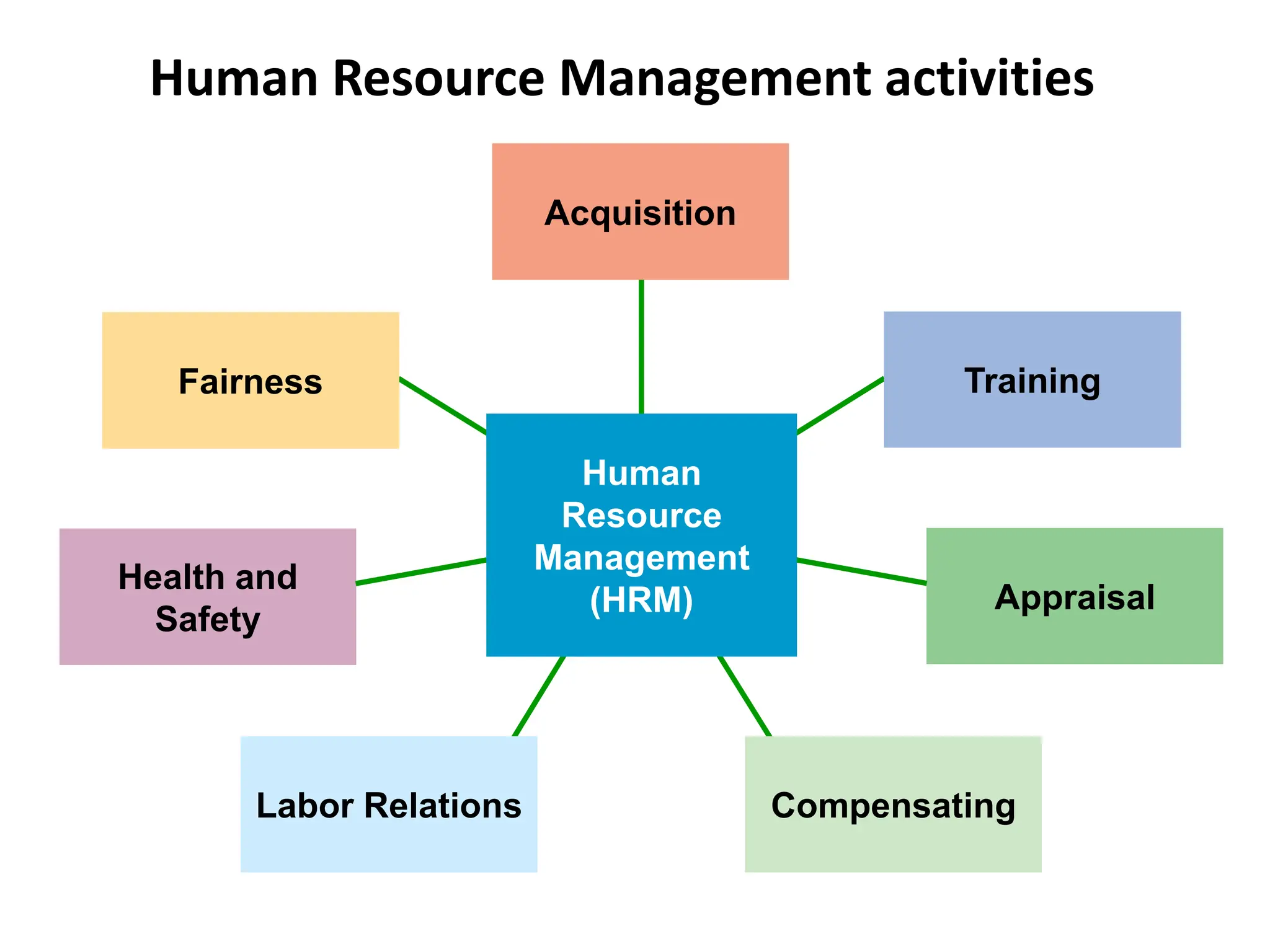
Human Resource Management activities
4
Acquisition
Training
Appraisal
Compensating
Labor Relations
Health and
Safety
Fairness
Human
Resource
Management
(HRM)
The Strategic Role of International HRM
Firms need to ensure there is a fit between
their human resources practices and strategy.
In order to carry out a strategy effectively,
employees need the right training,
 an appropriate compensation package, and
 a good performance appraisal system.
Global Staffing Issues
• Selecting candidates for overseas assignment.
• Cultural and language orientation and
training.
• Compensation processing.
• Tax administration.
• Career planning and development.
• Handling of spouse and dependent matters.
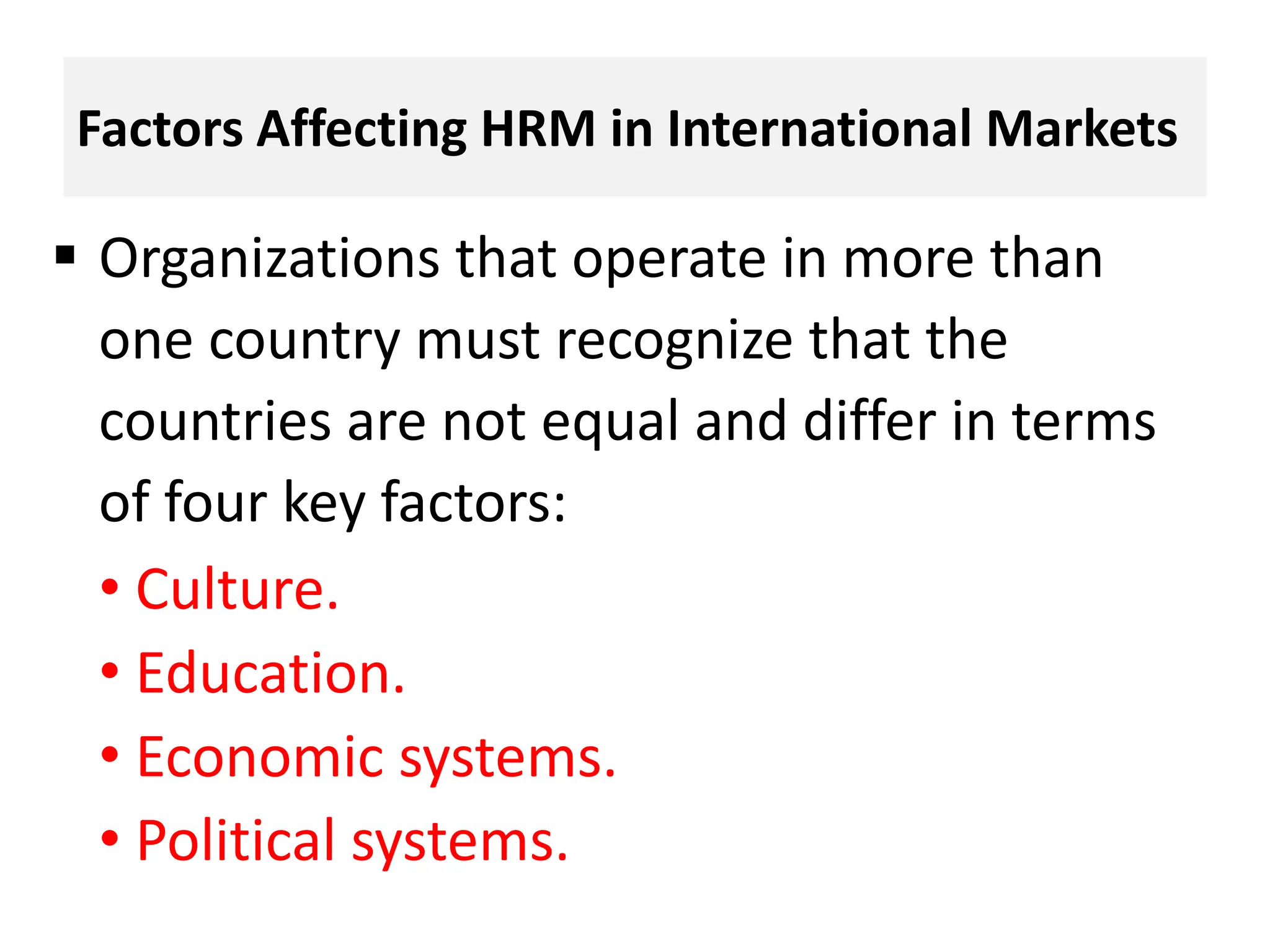
Factors Affecting HRM in International Markets
 Organizations that operate in more than
one country must recognize that the
countries are not equal and differ in terms
of four key factors:
• Culture.
• Education.
• Economic systems.
• Political systems.
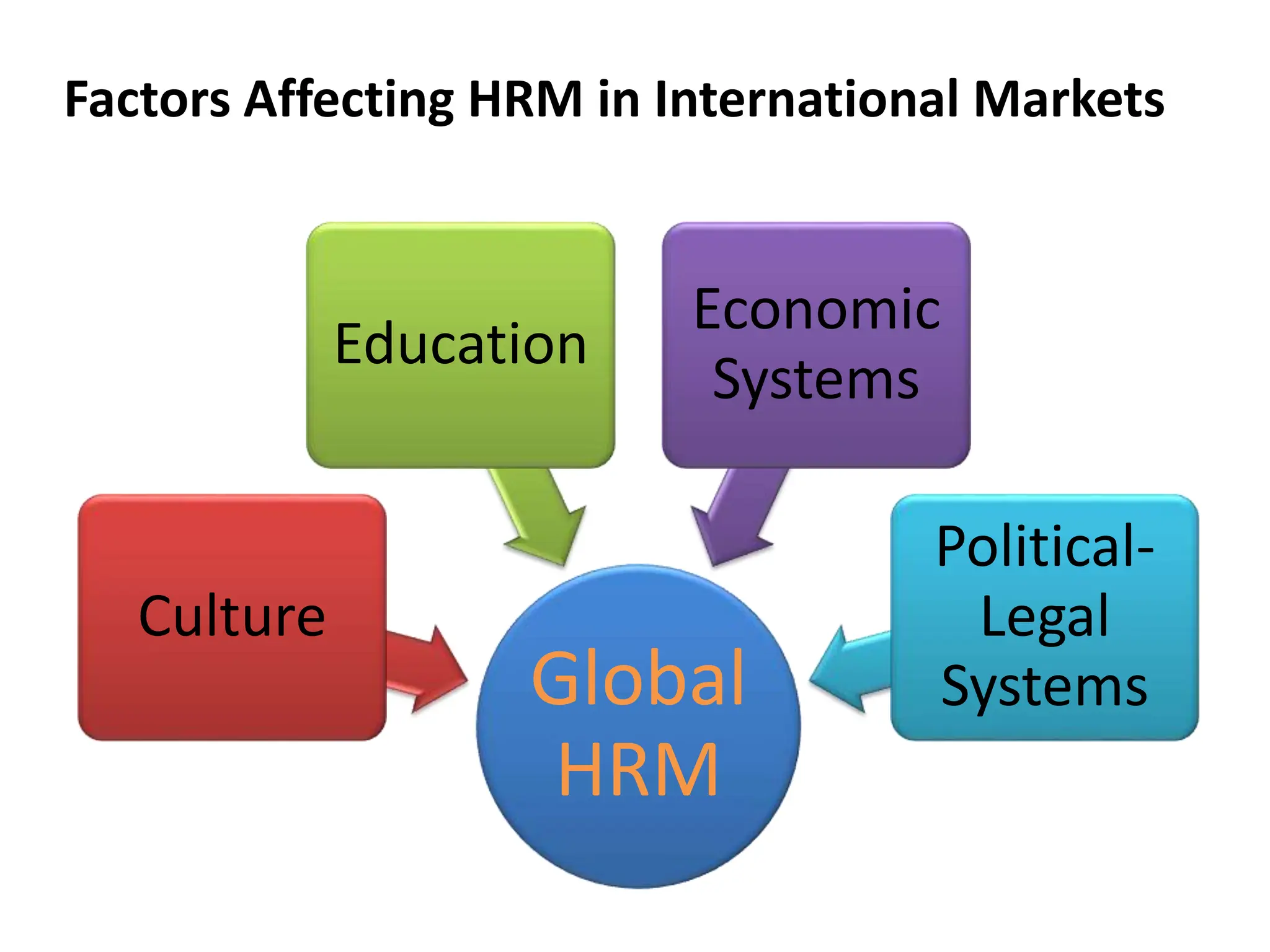
Factors Affecting HRM in International Markets
Global
HRM
Culture
Education
Economic
Systems
Political-
Legal
Systems
Culture
• Cultural characteristics influence the ways
members of an organization behave toward one
another as well as their attitudes toward various
HRM practices.
• Cultural differences can affect how people
communicate and how they coordinate their
activities.
Culture (continued)
 Organizations must prepare managers to
recognize and handle cultural differences.
– Recruit managers with knowledge of other cultures
– Provide training
 For expatriate assignments, organizations may
need to conduct an extensive selection process
to identify individuals who can adapt to new
environments.
Education and Skill Levels
• Countries also differ in the degree to which their labor
markets include people with education and skills of
value to employers.
• Companies with foreign operations locate in countries
where they can find suitable employees.
• The educations and skill levels of a country’s labor force
affect how and the extent to which companies want to
operate there.
• In countries with a poorly educated population,
companies will limit their activities to low-skill, low-
wage jobs.
Economic System
• A country’s economic system, whether capitalist
or socialist , as well as the government’s
involvement in the economy through taxes or
compensation, price controls, and other
activities, influences HRM practices in a number
of ways.
• The economic system provides many of the
incentives or disincentives for developing the
value of the labor force.
Economic System
 In developed countries with great wealth, labor
costs are relatively high. This impacts
compensation and staffing practices.
 Income tax differences between countries
make pay structures more complicated when
they cross national boundaries.
Political-Legal System
• The country’s laws often directive the
requirements for HRM practices: training,
compensation, hiring, and firing.
• An organization that expands internationally
must gain expertise in the host country’s legal
requirements and ways of dealing with its legal
system.
• Organizations will hire one or more host-
country nationals to help in the process.
1. Staffing Policy
When organizations operate globally. Employees may
come from:
• Parent (home)-country national – employee who was
born and works in the country in which an
organization’s headquarters is located.
• Host-country national – employee who is a citizen of
the country in which an organization operates a
facility.
• Third-country national – employee who is a citizen of
a country that is neither the parent country nor the
host country of the employer.
1. Staffing Policy
• A firm’s staffing policy is concerned with the
selection of employees who have the skills
required to perform a particular job
internationally.
• A staffing policy can be a tool for developing and
promoting the firm’s corporate culture (the
organization’s norms and value system)
• A strong corporate culture can help the firm
implement its strategy
Types of Staffing Policy
There are three main approaches to staffing
policy within international businesses:
1. the ethnocentric approach.
2. the polycentric approach.
3. the geocentric approach.
Types of Staffing Policy
1. The ethnocentric approach to staffing policy fills
key management positions with parent-country
nationals.
• It makes sense for firms with an international
strategy .
Firms that pursue an ethnocentric policy believe
that:
• there is a lack of qualified individuals in the host
country to fill senior management positions.
Types of Staffing Policy
• It is the best way to maintain a joined corporate
culture.
• Value can be created by transferring core
competencies to a foreign operation via parent
country nationals.
The ethnocentric staffing policy is no longer
popular with most firms because:
 it limits development opportunities for host
country nationals.
Types of Staffing Policy
2. The polycentric staffing policy recruits host
country nationals to manage branches in their own
country, and parent country nationals for positions
at head office.
The polycentric approach:
 may be less expensive to implement than an
ethnocentric policy.
There are two disadvantages to the polycentric
approach:
1. host country nationals have limited opportunities to
gain experience outside their own country and thus can’t
progress beyond senior positions in their own companies.
2. a gap can form between host country managers and
parent country managers.
Types of Staffing Policy
3. The geocentric staffing policy seeks the best
people, regardless of nationality for key jobs.
• It makes sense for firms pursuing either a global
or transnational strategy.
• Immigration policies of national governments
may limit the ability of a firm to pursue this
policy.
Types of Staffing Policy
 The Characteristics of Geocentric Approach:
• Enables the firm to make the best use of its
human resources.
• Builds a team of international executives who
feel at home working in a number of different
cultures.
• Can be limited by immigration laws.
• Is costly to implement.
Types of Staffing Policy
Expatriate Managers
• Expatriate Managers :Citizens of one country
working abroad (in another country).
• Most expatriates only stay in the foreign
country for a certain period of time, and plan
to return to their home country in the end,
although there are some who never return to
their country of citizenship.
Expatriate Managers Failure
• Expatriate failure is the early return of an
expatriate manager to his or her home country.
• Between 16 and 40 percent of all American
expatriates in developed countries fail to
complete their assignments, and almost 70
percent of Americans assigned to developing
countries return home early.
• Each expatriate failure can cost between
$250,000 and $1 million
Why Expatriate Assignments Fail?
The main reasons for expatriate failure are :
• Personality.
• Family pressures .
• Inability of the spouse to adjust.
• Inability to cope with larger overseas.
responsibility.
• Lack of cultural skills.
Research shows the main reasons for expatriate
failure for U.S. multinationals are:
• The inability of an expatriate's spouse to adapt
• The manager’s inability to adjust.
• The manager’s inability to cope with larger
overseas responsibilities .
Expatriate Managers Failure
For European firms, only one reason was found
to consistently explain expatriate failure:
• the inability of the manager’s spouse to adjust
to a new environment.
For Japanese firms, the reasons for failure are:
• difficulties with the new environment.
• personal or emotional problems.
• the inability of spouse to adjust
Expatriate Managers Failure
Helping Expatriate Assignment Succeed
Factors led to a successful Expatriate
Assignment:
• Providing realistic previews of what to expect.
• Careful screening.
• Improved orientation.
• Cultural and language training.
• Improved benefits packages.
• Improved selection procedures .
2. Training and Management Development
• Training focuses on preparing the manager for
a specific job.
• Management development is concerned with
developing the skills of the manager over his
or her career with the firm.
• Historically, most firms focus more on training
than on management development.
• Training and development programs should be
effective for all participating employees,
regardless of their country of origin.
• When organizations hire employees to work in a
foreign country or transfer them to another
country, the employer needs to provide the
employees with training in how to handle the
challenges associated with working in a foreign
country.
2. Training and Management Development
• Training is needed on:
– The impact of cultural differences on business
outcomes.
– How attitudes (both negative and positive) are
formed and how they influence behavior.
– Realistic knowledge about the target country.
– Language and adjustment and adaptation
skills.
2. Training and Management Development
Foreign Assignments
• Would you consider taking a foreign
assignment for a 6 months to 1 year duration?
A = Yes B = No
• Before you took on a foreign assignment, what
would you want to know?
• Cultural training (seeks to encourage an
appreciation for the host country's culture),
• The training covers all three phases of an
international assignment:
1. Preparation for departure.
2. The assignment itself.
3. Preparation for the return home.
Training For Expatriate Managers
Repatriation of Expatriates
• Repatriation – the process of preparing
expatriates to return home from foreign
assignment.
• Preparing and developing expatriate managers
for reentry into their home country.
• Organization is an important part of training
and development of expatriate managers
Repatriation
• HRM needs to develop good programs for
re-integrating expatriates back into work life
within their home country organization once
their foreign assignment is over, and for
employing the knowledge they acquired
while abroad.
17–36
Repatriation: Problems and Solutions (continued)
• Problem:
– Making sure that the expatriate and his or her family
don’t feel that the company has left them adrift.
• Solutions:
– Match the expatriate and his or her family with a
psychologist trained in repatriation issues.
– Make sure that the employee always feels that he or
she is still “in the relation” with what’s happening
back at the home office.
– Provide formal repatriation services.
3. International Labor Relations
• The key issue in international labor relations is
the degree to which labor unions is able to
limit the choices available to an international
business
• A firm's ability to pursue a transnational or
global strategy can be significantly constrained
by the actions of labor unions .
• HRM needs to foster harmony and minimize
conflict between the firm and organized labor
The Concerns of Labor Unions
• The bargaining power of unions comes from their ability
to threaten to disrupt production by striking or
protesting.
• However, labor unions is concerned that:
• multinationals can counter union bargaining power by
threatening to move production to another country.
• multinationals will farm out only low-skilled jobs to
foreign plants making it easier to switch production
locations.
• multinationals will import employment practices and
contractual agreements from their home countries and
reduce the influence of unions .
The Strategy of Labor Unions
Labor unions has responded to the increased
bargaining power of multinational corporations by:
• trying to set-up their own international
organizations.
• lobbying for national legislation to restrict
multinationals.
• trying to achieve regulations of multinationals
through international organization such as the
United Nations.
• However, these efforts have had only limited
success .

global human resource management ter-3.ppt

  • 1.
    Chapter 3 Global HumanResource Management
  • 2.
    Introduction • HRM ismore complex in an international business because of differences between countries in labor markets, culture, legal systems, economic systems, and so on. • HRM must also determine when to use expatriate managers (citizens of one country working abroad), • Who should be sent on foreign assignments, how they should be compensated, how they should be trained, and how they should be reoriented when they return home.
  • 3.
    Human Resource Management Whatis Human Resource Management (HRM)? Human Resource Management includes all activities used to attract & retain employees and to ensure they perform at a high level in meeting organizational goals. These activities include: 1. Staffing (recruitment, selection). 2. Training and development. 3. Performance appraisal. 4. Compensation. 5. labor relations. 3
  • 4.
    Human Resource Managementactivities 4 Acquisition Training Appraisal Compensating Labor Relations Health and Safety Fairness Human Resource Management (HRM)
  • 5.
    The Strategic Roleof International HRM Firms need to ensure there is a fit between their human resources practices and strategy. In order to carry out a strategy effectively, employees need the right training,  an appropriate compensation package, and  a good performance appraisal system.
  • 6.
    Global Staffing Issues •Selecting candidates for overseas assignment. • Cultural and language orientation and training. • Compensation processing. • Tax administration. • Career planning and development. • Handling of spouse and dependent matters.
  • 7.
    Factors Affecting HRMin International Markets  Organizations that operate in more than one country must recognize that the countries are not equal and differ in terms of four key factors: • Culture. • Education. • Economic systems. • Political systems.
  • 8.
    Factors Affecting HRMin International Markets Global HRM Culture Education Economic Systems Political- Legal Systems
  • 9.
    Culture • Cultural characteristicsinfluence the ways members of an organization behave toward one another as well as their attitudes toward various HRM practices. • Cultural differences can affect how people communicate and how they coordinate their activities.
  • 10.
    Culture (continued)  Organizationsmust prepare managers to recognize and handle cultural differences. – Recruit managers with knowledge of other cultures – Provide training  For expatriate assignments, organizations may need to conduct an extensive selection process to identify individuals who can adapt to new environments.
  • 11.
    Education and SkillLevels • Countries also differ in the degree to which their labor markets include people with education and skills of value to employers. • Companies with foreign operations locate in countries where they can find suitable employees. • The educations and skill levels of a country’s labor force affect how and the extent to which companies want to operate there. • In countries with a poorly educated population, companies will limit their activities to low-skill, low- wage jobs.
  • 12.
    Economic System • Acountry’s economic system, whether capitalist or socialist , as well as the government’s involvement in the economy through taxes or compensation, price controls, and other activities, influences HRM practices in a number of ways. • The economic system provides many of the incentives or disincentives for developing the value of the labor force.
  • 13.
    Economic System  Indeveloped countries with great wealth, labor costs are relatively high. This impacts compensation and staffing practices.  Income tax differences between countries make pay structures more complicated when they cross national boundaries.
  • 14.
    Political-Legal System • Thecountry’s laws often directive the requirements for HRM practices: training, compensation, hiring, and firing. • An organization that expands internationally must gain expertise in the host country’s legal requirements and ways of dealing with its legal system. • Organizations will hire one or more host- country nationals to help in the process.
  • 15.
    1. Staffing Policy Whenorganizations operate globally. Employees may come from: • Parent (home)-country national – employee who was born and works in the country in which an organization’s headquarters is located. • Host-country national – employee who is a citizen of the country in which an organization operates a facility. • Third-country national – employee who is a citizen of a country that is neither the parent country nor the host country of the employer.
  • 16.
    1. Staffing Policy •A firm’s staffing policy is concerned with the selection of employees who have the skills required to perform a particular job internationally. • A staffing policy can be a tool for developing and promoting the firm’s corporate culture (the organization’s norms and value system) • A strong corporate culture can help the firm implement its strategy
  • 17.
    Types of StaffingPolicy There are three main approaches to staffing policy within international businesses: 1. the ethnocentric approach. 2. the polycentric approach. 3. the geocentric approach.
  • 18.
    Types of StaffingPolicy 1. The ethnocentric approach to staffing policy fills key management positions with parent-country nationals. • It makes sense for firms with an international strategy . Firms that pursue an ethnocentric policy believe that: • there is a lack of qualified individuals in the host country to fill senior management positions.
  • 19.
    Types of StaffingPolicy • It is the best way to maintain a joined corporate culture. • Value can be created by transferring core competencies to a foreign operation via parent country nationals. The ethnocentric staffing policy is no longer popular with most firms because:  it limits development opportunities for host country nationals.
  • 20.
    Types of StaffingPolicy 2. The polycentric staffing policy recruits host country nationals to manage branches in their own country, and parent country nationals for positions at head office. The polycentric approach:  may be less expensive to implement than an ethnocentric policy.
  • 21.
    There are twodisadvantages to the polycentric approach: 1. host country nationals have limited opportunities to gain experience outside their own country and thus can’t progress beyond senior positions in their own companies. 2. a gap can form between host country managers and parent country managers. Types of Staffing Policy
  • 22.
    3. The geocentricstaffing policy seeks the best people, regardless of nationality for key jobs. • It makes sense for firms pursuing either a global or transnational strategy. • Immigration policies of national governments may limit the ability of a firm to pursue this policy. Types of Staffing Policy
  • 23.
     The Characteristicsof Geocentric Approach: • Enables the firm to make the best use of its human resources. • Builds a team of international executives who feel at home working in a number of different cultures. • Can be limited by immigration laws. • Is costly to implement. Types of Staffing Policy
  • 24.
    Expatriate Managers • ExpatriateManagers :Citizens of one country working abroad (in another country). • Most expatriates only stay in the foreign country for a certain period of time, and plan to return to their home country in the end, although there are some who never return to their country of citizenship.
  • 25.
    Expatriate Managers Failure •Expatriate failure is the early return of an expatriate manager to his or her home country. • Between 16 and 40 percent of all American expatriates in developed countries fail to complete their assignments, and almost 70 percent of Americans assigned to developing countries return home early. • Each expatriate failure can cost between $250,000 and $1 million
  • 26.
    Why Expatriate AssignmentsFail? The main reasons for expatriate failure are : • Personality. • Family pressures . • Inability of the spouse to adjust. • Inability to cope with larger overseas. responsibility. • Lack of cultural skills.
  • 27.
    Research shows themain reasons for expatriate failure for U.S. multinationals are: • The inability of an expatriate's spouse to adapt • The manager’s inability to adjust. • The manager’s inability to cope with larger overseas responsibilities . Expatriate Managers Failure
  • 28.
    For European firms,only one reason was found to consistently explain expatriate failure: • the inability of the manager’s spouse to adjust to a new environment. For Japanese firms, the reasons for failure are: • difficulties with the new environment. • personal or emotional problems. • the inability of spouse to adjust Expatriate Managers Failure
  • 29.
    Helping Expatriate AssignmentSucceed Factors led to a successful Expatriate Assignment: • Providing realistic previews of what to expect. • Careful screening. • Improved orientation. • Cultural and language training. • Improved benefits packages. • Improved selection procedures .
  • 30.
    2. Training andManagement Development • Training focuses on preparing the manager for a specific job. • Management development is concerned with developing the skills of the manager over his or her career with the firm. • Historically, most firms focus more on training than on management development.
  • 31.
    • Training anddevelopment programs should be effective for all participating employees, regardless of their country of origin. • When organizations hire employees to work in a foreign country or transfer them to another country, the employer needs to provide the employees with training in how to handle the challenges associated with working in a foreign country. 2. Training and Management Development
  • 32.
    • Training isneeded on: – The impact of cultural differences on business outcomes. – How attitudes (both negative and positive) are formed and how they influence behavior. – Realistic knowledge about the target country. – Language and adjustment and adaptation skills. 2. Training and Management Development
  • 33.
    Foreign Assignments • Wouldyou consider taking a foreign assignment for a 6 months to 1 year duration? A = Yes B = No • Before you took on a foreign assignment, what would you want to know?
  • 34.
    • Cultural training(seeks to encourage an appreciation for the host country's culture), • The training covers all three phases of an international assignment: 1. Preparation for departure. 2. The assignment itself. 3. Preparation for the return home. Training For Expatriate Managers
  • 35.
    Repatriation of Expatriates •Repatriation – the process of preparing expatriates to return home from foreign assignment. • Preparing and developing expatriate managers for reentry into their home country. • Organization is an important part of training and development of expatriate managers
  • 36.
    Repatriation • HRM needsto develop good programs for re-integrating expatriates back into work life within their home country organization once their foreign assignment is over, and for employing the knowledge they acquired while abroad. 17–36
  • 37.
    Repatriation: Problems andSolutions (continued) • Problem: – Making sure that the expatriate and his or her family don’t feel that the company has left them adrift. • Solutions: – Match the expatriate and his or her family with a psychologist trained in repatriation issues. – Make sure that the employee always feels that he or she is still “in the relation” with what’s happening back at the home office. – Provide formal repatriation services.
  • 38.
    3. International LaborRelations • The key issue in international labor relations is the degree to which labor unions is able to limit the choices available to an international business • A firm's ability to pursue a transnational or global strategy can be significantly constrained by the actions of labor unions . • HRM needs to foster harmony and minimize conflict between the firm and organized labor
  • 39.
    The Concerns ofLabor Unions • The bargaining power of unions comes from their ability to threaten to disrupt production by striking or protesting. • However, labor unions is concerned that: • multinationals can counter union bargaining power by threatening to move production to another country. • multinationals will farm out only low-skilled jobs to foreign plants making it easier to switch production locations. • multinationals will import employment practices and contractual agreements from their home countries and reduce the influence of unions .
  • 40.
    The Strategy ofLabor Unions Labor unions has responded to the increased bargaining power of multinational corporations by: • trying to set-up their own international organizations. • lobbying for national legislation to restrict multinationals. • trying to achieve regulations of multinationals through international organization such as the United Nations. • However, these efforts have had only limited success .