
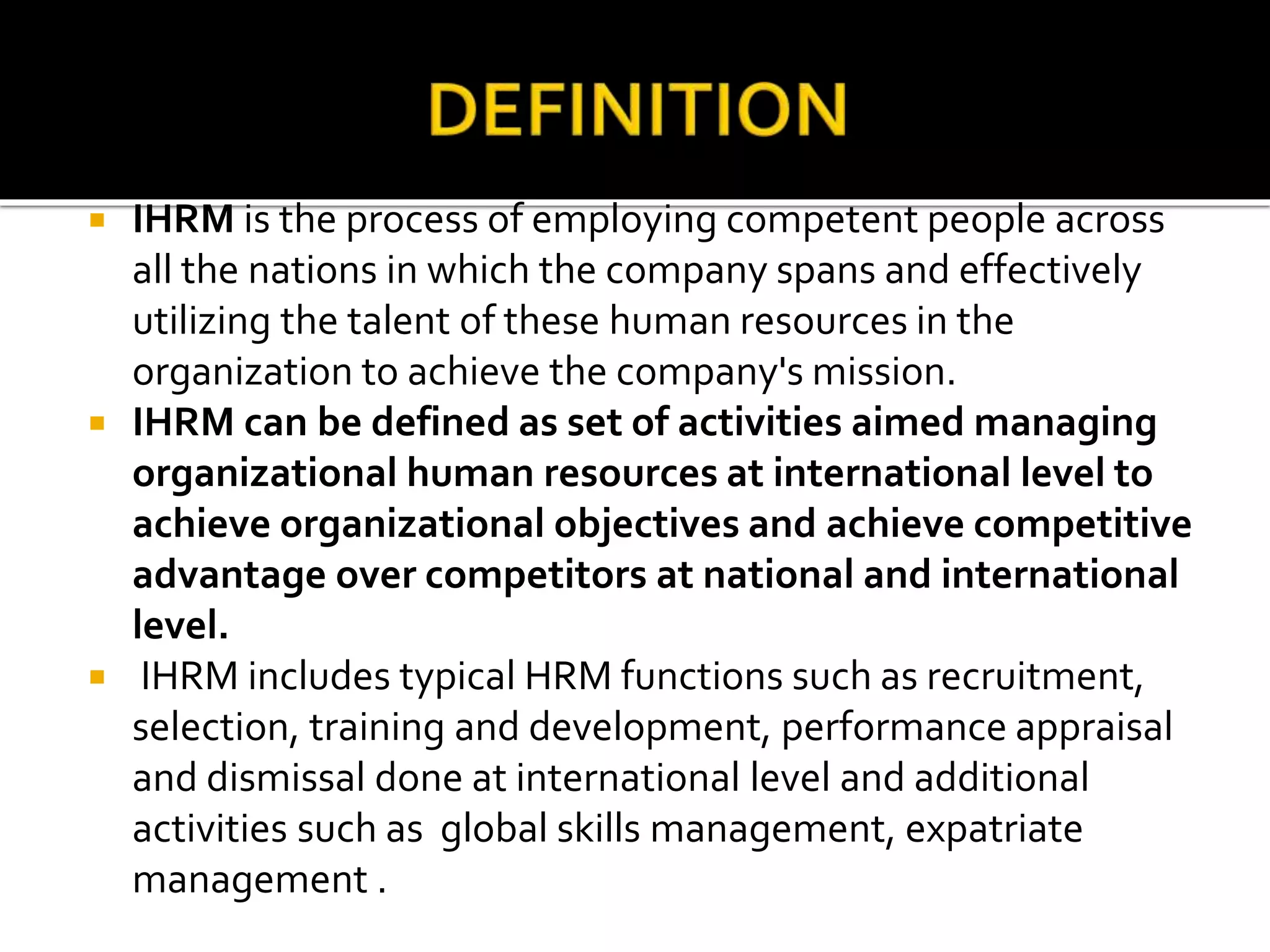
 IHRM is the process of employing competent people across
all the nations in which the company spans and effectively
utilizing the talent of these human resources in the
organization to achieve the company's mission.
 IHRM can be defined as set of activities aimed managing
organizational human resources at international level to
achieve organizational objectives and achieve competitive
advantage over competitors at national and international
level.
 IHRM includes typical HRM functions such as recruitment,
selection, training and development, performance appraisal
and dismissal done at international level and additional
activities such as global skills management, expatriate
management .
HR
ACTIVITIES
• PROCURE
• UTITLISE
• ALLOCATE
TYPES OF
EMPLOYEES
• HOME COUNTRY NATIONALS
• HOST COUNTRY NATIONALS
• THIRD COUNTRY NATIONALS
countries
• HOME COUNTRY
• HOST COUNTRY
• THIRD COUNTRY
 Home country - Where the headquarters is located.
Employees belonging to home country of the firm where
the corporate head quarter is situated.
 Host country - Where the subsidiary is located.
Employees belonging to the nation in which the subsidiary
is situated.
 Third country - These are the sources of human resources
.These are the employees who are not from home
country/host country but are employed at subsidiary or
corporate head quarters. As an example a American MNC
which has a subsidiary at India may employ a French
person as the CEO to the subsidiary.
The Frenchman employed is a third country employee.
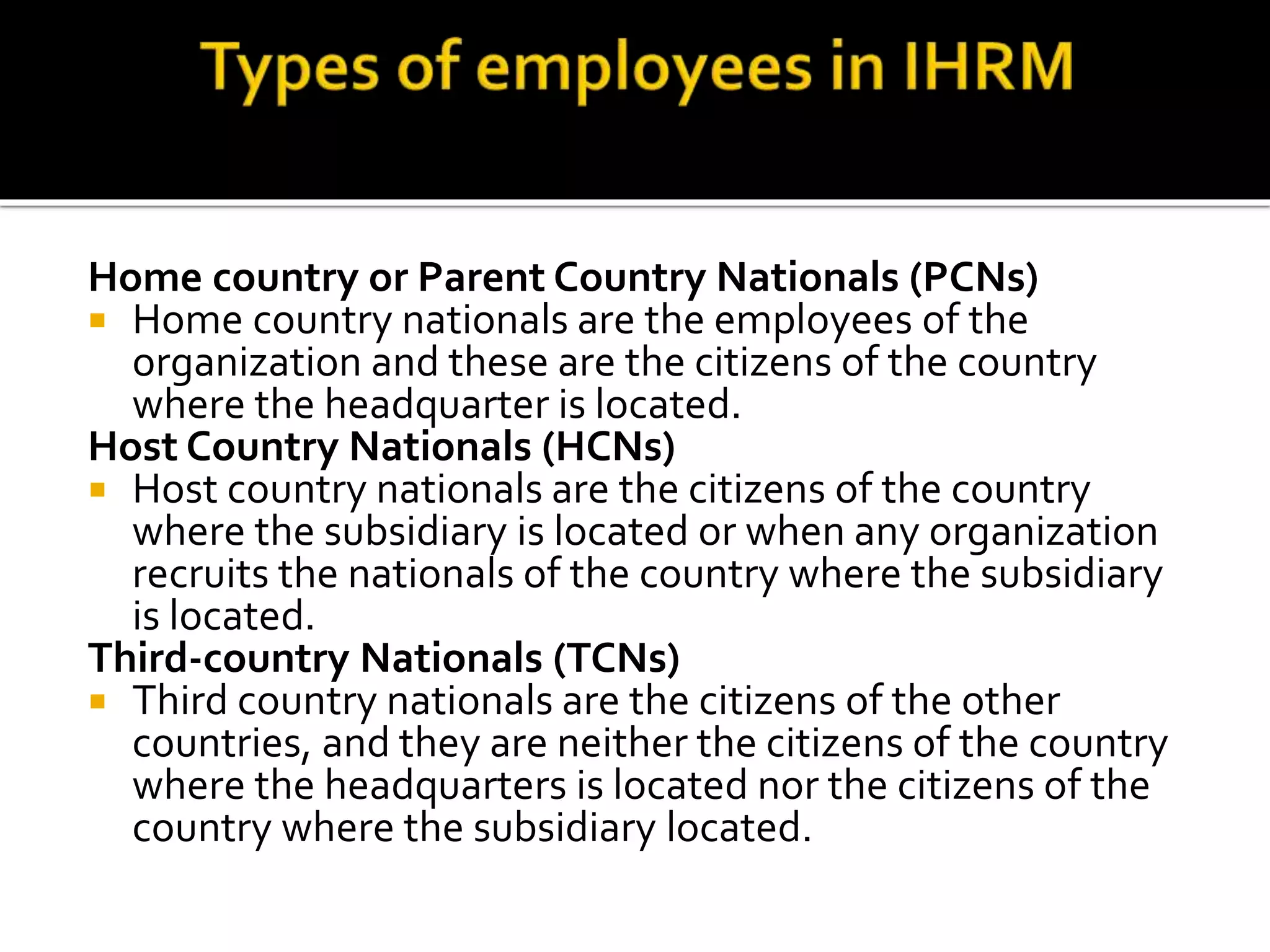
Home country or Parent Country Nationals (PCNs)
 Home country nationals are the employees of the
organization and these are the citizens of the country
where the headquarter is located.
Host Country Nationals (HCNs)
 Host country nationals are the citizens of the country
where the subsidiary is located or when any organization
recruits the nationals of the country where the subsidiary
is located.
Third-country Nationals (TCNs)
 Third country nationals are the citizens of the other
countries, and they are neither the citizens of the country
where the headquarters is located nor the citizens of the
country where the subsidiary located.
 Ethnocentric: key positions filled by
nationals of parent company.
 Polycentric: host country nationals
recruited to manage subsidiary in their
own country.
 Geocentric: best people recruited,
whatever their nationality.
1. Ethnocentric Approach
According to ethnocentric
approach, organizations
believe that the employees of
home country nationals can
perform better to fulfill the
organization’s mission, vision,
and objectives.
Advantages of ethnocentric Approach
 Organization’s culture can be easily adapted to all the subsidiaries
with the help of key managerial decisions such as vision, mission,
and objectives.
 Possible to eliminate communication barriers between the
headquarters and subsidiaries.
 Proper control is possible with the ethnocentric approach.
 The parent company can monitor the operations of the
subsidiaries effectively.
 Better coordination of activities between the parent company and
subsidiary are possible.
Disadvantages
 Need to pay more for the expatriates from the home country.
 Cross-cultural variations may lead to clashes between the various
levels of the employees.
 Host country national employees may get disappointed by losing
the key managerial roles.
Many companies are adopting this approach
because they believe that host country
nationals can help in fulfilling the objectives
of the organizations with a better
understanding of the local culture, beliefs,
and values. Here subsidiary is given freedom
to take decisions and formulate strategies
according to the local business environment
and vision and mission of the headquarters.
Advantages
 Host country managers can analyze and understand the local
markets and local people
 Better coordination with the business environment is possible,
both internal and external.
 No difficulty arises due to cultural issues.
 It creates job satisfaction and job enrichment to the host
country nationals.
 Hiring host country nationals is less expensive than hiring
expatriates.
Disadvantages
 It may not always create a scope of better coordination
between headquarters and subsidiaries.
 Quick control of operations is not possible because of the key
managerial positions are occupied by the host country
nationals.
 Organizations hire neither the home country
nationals nor the host country nationals
preferably.They recruit employees on the
basis of the concept right person for the right
job. Here organizations hire right persons or
suitable employees for the effective running
of the business operations, irrespective of the
nationality. Geocentric approach facilitates
competitive advantage by hiring most
talented and eligible people.
Advantages
 The geocentric approach creates a scope to hire world’s best talented
and skilled employees.
 It facilitates competitive advantage and helps in reaching the market
empire position.
 Hiring most talented and eligible people can fulfill the objectives of
the organization effectively.
 This approach helps in reducing the unfair treatments and clashes in
the organization due to the favoritism towards nationality.
Disadvantages
 Hiring according to geocentric approach is expensive.
 Chance of cross-cultural clashes become high
 It may not always facilitate better coordination and control of the
operations of the organization.
 Difficult to monitor and control the operations
 Organizations need to spend more on expatriate relocation
allowance.
 High cross-cultural variations arise.
 IHRM does not include studies that are focused
on issues outside the traditional activities
inherent in the HRM function.
E.g. leadership style is not IHRM, unless
specifically linked to an HRM function.
 IHRM does not include studies of HRM activities
in single countries.
E.g. a study of personnel selection practices in
Saudi Arabia, whether undertaken by an English,
German or Canadian researcher.
 Domestic HRM is done at national level and IHRM is done at
international level.
 Domestic HRM is concerned with managing
employees belonging to one nation and IHRM is concerned
with managing employees belonging to many nations
(Home country, host country and third country employees)
 Domestic HRM is concerned with managing limited number
of HRM activities at national level and IHRM has concerned
with managing additional activities such as
expatriate management.
 Domestic HRM is less complicated due to less influence from
the external environment. IHRM is very complicated as it is
affected heavily by external factors such as cultural distance
and institutional factors.
International human resource management

International human resource management

  • 2.
     IHRM isthe process of employing competent people across all the nations in which the company spans and effectively utilizing the talent of these human resources in the organization to achieve the company's mission.  IHRM can be defined as set of activities aimed managing organizational human resources at international level to achieve organizational objectives and achieve competitive advantage over competitors at national and international level.  IHRM includes typical HRM functions such as recruitment, selection, training and development, performance appraisal and dismissal done at international level and additional activities such as global skills management, expatriate management .
  • 3.
    HR ACTIVITIES • PROCURE • UTITLISE •ALLOCATE TYPES OF EMPLOYEES • HOME COUNTRY NATIONALS • HOST COUNTRY NATIONALS • THIRD COUNTRY NATIONALS countries • HOME COUNTRY • HOST COUNTRY • THIRD COUNTRY
  • 4.
     Home country- Where the headquarters is located. Employees belonging to home country of the firm where the corporate head quarter is situated.  Host country - Where the subsidiary is located. Employees belonging to the nation in which the subsidiary is situated.  Third country - These are the sources of human resources .These are the employees who are not from home country/host country but are employed at subsidiary or corporate head quarters. As an example a American MNC which has a subsidiary at India may employ a French person as the CEO to the subsidiary. The Frenchman employed is a third country employee.
  • 5.
    Home country orParent Country Nationals (PCNs)  Home country nationals are the employees of the organization and these are the citizens of the country where the headquarter is located. Host Country Nationals (HCNs)  Host country nationals are the citizens of the country where the subsidiary is located or when any organization recruits the nationals of the country where the subsidiary is located. Third-country Nationals (TCNs)  Third country nationals are the citizens of the other countries, and they are neither the citizens of the country where the headquarters is located nor the citizens of the country where the subsidiary located.
  • 6.
     Ethnocentric: keypositions filled by nationals of parent company.  Polycentric: host country nationals recruited to manage subsidiary in their own country.  Geocentric: best people recruited, whatever their nationality.
  • 7.
    1. Ethnocentric Approach Accordingto ethnocentric approach, organizations believe that the employees of home country nationals can perform better to fulfill the organization’s mission, vision, and objectives.
  • 8.
    Advantages of ethnocentricApproach  Organization’s culture can be easily adapted to all the subsidiaries with the help of key managerial decisions such as vision, mission, and objectives.  Possible to eliminate communication barriers between the headquarters and subsidiaries.  Proper control is possible with the ethnocentric approach.  The parent company can monitor the operations of the subsidiaries effectively.  Better coordination of activities between the parent company and subsidiary are possible. Disadvantages  Need to pay more for the expatriates from the home country.  Cross-cultural variations may lead to clashes between the various levels of the employees.  Host country national employees may get disappointed by losing the key managerial roles.
  • 9.
    Many companies areadopting this approach because they believe that host country nationals can help in fulfilling the objectives of the organizations with a better understanding of the local culture, beliefs, and values. Here subsidiary is given freedom to take decisions and formulate strategies according to the local business environment and vision and mission of the headquarters.
  • 10.
    Advantages  Host countrymanagers can analyze and understand the local markets and local people  Better coordination with the business environment is possible, both internal and external.  No difficulty arises due to cultural issues.  It creates job satisfaction and job enrichment to the host country nationals.  Hiring host country nationals is less expensive than hiring expatriates. Disadvantages  It may not always create a scope of better coordination between headquarters and subsidiaries.  Quick control of operations is not possible because of the key managerial positions are occupied by the host country nationals.
  • 11.
     Organizations hireneither the home country nationals nor the host country nationals preferably.They recruit employees on the basis of the concept right person for the right job. Here organizations hire right persons or suitable employees for the effective running of the business operations, irrespective of the nationality. Geocentric approach facilitates competitive advantage by hiring most talented and eligible people.
  • 12.
    Advantages  The geocentricapproach creates a scope to hire world’s best talented and skilled employees.  It facilitates competitive advantage and helps in reaching the market empire position.  Hiring most talented and eligible people can fulfill the objectives of the organization effectively.  This approach helps in reducing the unfair treatments and clashes in the organization due to the favoritism towards nationality. Disadvantages  Hiring according to geocentric approach is expensive.  Chance of cross-cultural clashes become high  It may not always facilitate better coordination and control of the operations of the organization.  Difficult to monitor and control the operations  Organizations need to spend more on expatriate relocation allowance.  High cross-cultural variations arise.
  • 13.
     IHRM doesnot include studies that are focused on issues outside the traditional activities inherent in the HRM function. E.g. leadership style is not IHRM, unless specifically linked to an HRM function.  IHRM does not include studies of HRM activities in single countries. E.g. a study of personnel selection practices in Saudi Arabia, whether undertaken by an English, German or Canadian researcher.
  • 14.
     Domestic HRMis done at national level and IHRM is done at international level.  Domestic HRM is concerned with managing employees belonging to one nation and IHRM is concerned with managing employees belonging to many nations (Home country, host country and third country employees)  Domestic HRM is concerned with managing limited number of HRM activities at national level and IHRM has concerned with managing additional activities such as expatriate management.  Domestic HRM is less complicated due to less influence from the external environment. IHRM is very complicated as it is affected heavily by external factors such as cultural distance and institutional factors.