Welcome
Name
MD.Mujahiduzzaman
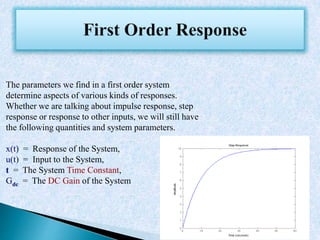
The parameters we find in a first order system
determine aspects of various kinds of responses.
Whether we are talking about impulse response, step
response or response to other inputs, we will still have
the following quantities and system parameters.
x(t) = Response of the System,
u(t) = Input to the System,
t = The System Time Constant,
Gdc = The DC Gain of the System
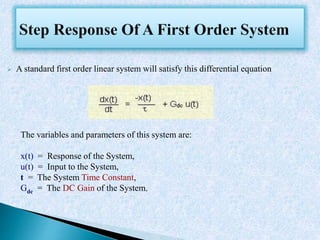
 A standard first order linear system will satisfy this differential equation
The variables and parameters of this system are:
x(t) = Response of the System,
u(t) = Input to the System,
t = The System Time Constant,
Gdc = The DC Gain of the System.
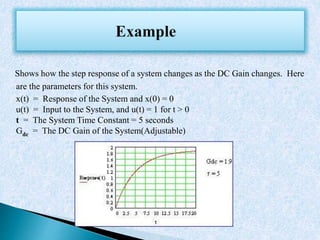
Shows how the step response of a system changes as the DC Gain changes. Here
are the parameters for this system.
x(t) = Response of the System and x(0) = 0
u(t) = Input to the System, and u(t) = 1 for t > 0
t = The System Time Constant = 5 seconds
Gdc = The DC Gain of the System(Adjustable)
The impulse response of a system is an important
response
 the impulse response is the response to a unit
impulse.
 the unit impulse has a Laplace transform of
unity (1). That gives the unit impulse a unique
stature.
Knowing that the impulse response is the inverse
transform of the transfer function of a system can
be useful in identifying systems
Consider a system with the following parameters.
•t = 0.1 sec
•Gdc = 20
The problem is to determine the impulse response of a system that has these
parameters. We know the form of the impulse response:
x(t) = (Gdc/t)e-t/t
With the parameters above, the impulse response is:
x(t) = (Gdc/t)e-t/t
x(t) = (20/.1)e-t/.1
x(t) = 200e-10t
And even though the DC gain is only 20, the impulse response starts at a value
of 200!
We know how a first order system responds to impulse and step inputs, there
are several different ways you can use that information.
•If we have a first order system, with either a step or impulse input, we can
compute the output response of the system. That is ananalysis problem.
•If we have an unknown system, and we have input and output data, and data
set resembles an impulse input and a first order impulse response, or a step
input and a first order step response, then we can use what we know to
determine what the system is. That is a system identification problem.
First order response

First order response

  • 1.
  • 2.
  • 3.
    The parameters wefind in a first order system determine aspects of various kinds of responses. Whether we are talking about impulse response, step response or response to other inputs, we will still have the following quantities and system parameters. x(t) = Response of the System, u(t) = Input to the System, t = The System Time Constant, Gdc = The DC Gain of the System
  • 4.
     A standardfirst order linear system will satisfy this differential equation The variables and parameters of this system are: x(t) = Response of the System, u(t) = Input to the System, t = The System Time Constant, Gdc = The DC Gain of the System.
  • 5.
    Shows how thestep response of a system changes as the DC Gain changes. Here are the parameters for this system. x(t) = Response of the System and x(0) = 0 u(t) = Input to the System, and u(t) = 1 for t > 0 t = The System Time Constant = 5 seconds Gdc = The DC Gain of the System(Adjustable)
  • 6.
    The impulse responseof a system is an important response  the impulse response is the response to a unit impulse.  the unit impulse has a Laplace transform of unity (1). That gives the unit impulse a unique stature. Knowing that the impulse response is the inverse transform of the transfer function of a system can be useful in identifying systems
  • 7.
    Consider a systemwith the following parameters. •t = 0.1 sec •Gdc = 20 The problem is to determine the impulse response of a system that has these parameters. We know the form of the impulse response: x(t) = (Gdc/t)e-t/t With the parameters above, the impulse response is: x(t) = (Gdc/t)e-t/t x(t) = (20/.1)e-t/.1 x(t) = 200e-10t And even though the DC gain is only 20, the impulse response starts at a value of 200!
  • 8.
    We know howa first order system responds to impulse and step inputs, there are several different ways you can use that information. •If we have a first order system, with either a step or impulse input, we can compute the output response of the system. That is ananalysis problem. •If we have an unknown system, and we have input and output data, and data set resembles an impulse input and a first order impulse response, or a step input and a first order step response, then we can use what we know to determine what the system is. That is a system identification problem.