

Niches and competitive exclusion
 Learning objectives:
 To define the terms ecology, habitat,
population and niche
 Use a model to describe the principle of
competitive exclusion
Definitions
 Ecosystem: “All of the biotic and abiotic factors in a
self-supporting system”
 Habitat: “The geographical area occupied by an
ecosystem”
 Community: “All of the living things in a defined
habitat”
 Population: “The number of individuals of a defined
species in a defined habitat at a particular time”
Niche
 The role of a species within an ecosystem. (The complex
interrelationship between this species and other organisms
in the habitat, its effect on the ecosystem and its “place”
within it)
 You could think of an organism’s (or a species’) habitat as
its address, and its niche as its occupation. But this is far
too simplistic.
Competitive Exclusion
 What happens when two living things have
the same or overlapping niches?
Brother Gregory Investigates:
Niches
Being the fictionalized story of
Gregor Mendel, the discover of Genetics,
ace detective and much more!
Herr Gustav Druer, the Brno wine grower and merchant has a
problem and Brother Gregory has been asked to help.
You are to become his research assistants and help him carry
out a research investigation into the properties of microbes.
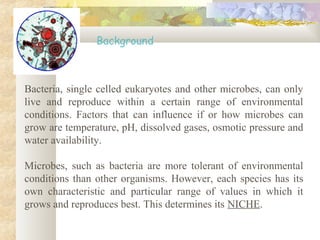
Bacteria, single celled eukaryotes and other microbes, can only
live and reproduce within a certain range of environmental
conditions. Factors that can influence if or how microbes can
grow are temperature, pH, dissolved gases, osmotic pressure and
water availability.
Microbes, such as bacteria are more tolerant of environmental
conditions than other organisms. However, each species has its
own characteristic and particular range of values in which it
grows and reproduces best. This determines its NICHE.
Background
Brother Gregory has collected a variety of
microbes from around Brno. He has taken these
back to the monastery for you (the research
monks and nuns) to investigate their growth and
find out the conditions under which they grow
best.
One species of microbe appears to have
contaminated all of Herr Druer’s stocks of yeast,
and is competitively excluding it, preventing
fermentation of the wine.
But which species is responsible?
Get to your scriptoriums!
(This seemed funny at the time)
Collecting data
 Data can be collected on temperature
ranges here:
 http://www.brooklyn.cuny.edu/bc/ahp/CellBio/Growth/M
 Scroll to the bottom of the page for the
links
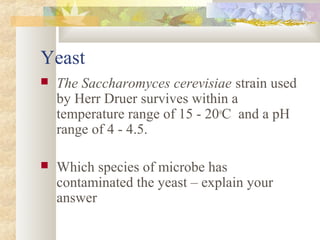
Yeast
 The Saccharomyces cerevisiae strain used
by Herr Druer survives within a
temperature range of 15 - 20o
C and a pH
range of 4 - 4.5.
 Which species of microbe has
contaminated the yeast – explain your
answer
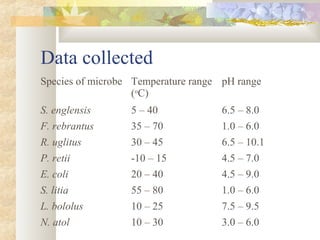
Data collected
Species of microbe Temperature range
(o
C)
pH range
S. englensis 5 – 40 6.5 – 8.0
F. rebrantus 35 – 70 1.0 – 6.0
R. uglitus 30 – 45 6.5 – 10.1
P. retii -10 – 15 4.5 – 7.0
E. coli 20 – 40 4.5 – 9.0
S. litia 55 – 80 1.0 – 6.0
L. bololus 10 – 25 7.5 – 9.5
N. atol 10 – 30 3.0 – 6.0
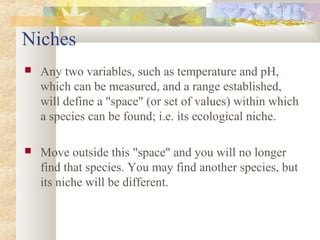
Niches
 Any two variables, such as temperature and pH,
which can be measured, and a range established,
will define a "space" (or set of values) within which
a species can be found; i.e. its ecological niche.
 Move outside this "space" and you will no longer
find that species. You may find another species, but
its niche will be different.
Niches
 Niches may overlap slightly. In these cases,
organisms come into competition for resources.
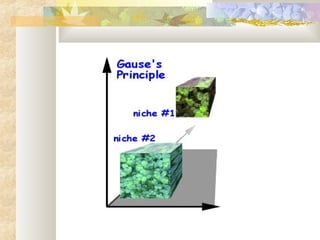
 However, A fundamental principle of ecology is
that no two species can occupy exactly the same
niche within the environment. This is called
Gause's Principle, or the principle of competitive
exclusion.
Ecology and niche

Ecology and niche

  • 1.
  • 2.
    Niches and competitiveexclusion  Learning objectives:  To define the terms ecology, habitat, population and niche  Use a model to describe the principle of competitive exclusion
  • 3.
    Definitions  Ecosystem: “Allof the biotic and abiotic factors in a self-supporting system”  Habitat: “The geographical area occupied by an ecosystem”  Community: “All of the living things in a defined habitat”  Population: “The number of individuals of a defined species in a defined habitat at a particular time”
  • 4.
    Niche  The roleof a species within an ecosystem. (The complex interrelationship between this species and other organisms in the habitat, its effect on the ecosystem and its “place” within it)  You could think of an organism’s (or a species’) habitat as its address, and its niche as its occupation. But this is far too simplistic.
  • 5.
    Competitive Exclusion  Whathappens when two living things have the same or overlapping niches?
  • 6.
    Brother Gregory Investigates: Niches Beingthe fictionalized story of Gregor Mendel, the discover of Genetics, ace detective and much more!
  • 7.
    Herr Gustav Druer,the Brno wine grower and merchant has a problem and Brother Gregory has been asked to help. You are to become his research assistants and help him carry out a research investigation into the properties of microbes.
  • 8.
    Bacteria, single celledeukaryotes and other microbes, can only live and reproduce within a certain range of environmental conditions. Factors that can influence if or how microbes can grow are temperature, pH, dissolved gases, osmotic pressure and water availability. Microbes, such as bacteria are more tolerant of environmental conditions than other organisms. However, each species has its own characteristic and particular range of values in which it grows and reproduces best. This determines its NICHE. Background
  • 9.
    Brother Gregory hascollected a variety of microbes from around Brno. He has taken these back to the monastery for you (the research monks and nuns) to investigate their growth and find out the conditions under which they grow best. One species of microbe appears to have contaminated all of Herr Druer’s stocks of yeast, and is competitively excluding it, preventing fermentation of the wine. But which species is responsible? Get to your scriptoriums! (This seemed funny at the time)
  • 10.
    Collecting data  Datacan be collected on temperature ranges here:  http://www.brooklyn.cuny.edu/bc/ahp/CellBio/Growth/M  Scroll to the bottom of the page for the links
  • 11.
    Yeast  The Saccharomycescerevisiae strain used by Herr Druer survives within a temperature range of 15 - 20o C and a pH range of 4 - 4.5.  Which species of microbe has contaminated the yeast – explain your answer
  • 12.
    Data collected Species ofmicrobe Temperature range (o C) pH range S. englensis 5 – 40 6.5 – 8.0 F. rebrantus 35 – 70 1.0 – 6.0 R. uglitus 30 – 45 6.5 – 10.1 P. retii -10 – 15 4.5 – 7.0 E. coli 20 – 40 4.5 – 9.0 S. litia 55 – 80 1.0 – 6.0 L. bololus 10 – 25 7.5 – 9.5 N. atol 10 – 30 3.0 – 6.0
  • 13.
    Niches  Any twovariables, such as temperature and pH, which can be measured, and a range established, will define a "space" (or set of values) within which a species can be found; i.e. its ecological niche.  Move outside this "space" and you will no longer find that species. You may find another species, but its niche will be different.
  • 14.
    Niches  Niches mayoverlap slightly. In these cases, organisms come into competition for resources.  However, A fundamental principle of ecology is that no two species can occupy exactly the same niche within the environment. This is called Gause's Principle, or the principle of competitive exclusion.