Renal Biopsy
By
Tamer ElSaid, MD
Associate Professor of Internal medicine and
Nephrology
Faculty of Medicine – Ain Shams University
Background
A renal biopsy is a procedure used to obtain a segment of renal tissue, usually through
a needle or another surgical instrument.
Analysis of this tissue is then used in the diagnosis of an underlying renal condition.
Renal biopsy is used to diagnose renal diseases ranging from infection to transient
rejection to renal cell carcinoma.
Once a biopsy diagnosis is established, it can be used to help guide treatment options
and may also assist in determining prognosis of the underlying condition.
Indications
Renal biopsy is typically performed under ultrasonographic or rarely CT guidance.
Most common indications:
Unexplained acute or rapidly progressive renal failure
Acute nephritic syndrome
Nephrotic syndrome
Isolated nonnephrotic proteinuria
Isolated glomerular hematuria
Renal masses (primary or secondary)
Renal allograft dysfunction Renal transplant rejection
Systemic diseases with renal involvement eg connective-tissue diseases such as SLE
‘All these indications are not absolute. In each situation, if associated clinical and
laboratory investigation suggest a predictable histological pattern, kidney biopsy may
not be required.’
Contraindications
Absolute:
Abnormal coagulopathy
Uncontrolled hypertension
Active renal or perirenal infection
Skin infection at biopsy site
Relative:
Uncooperative patient or unable to lie flat on bed
Anatomic abnormalities of the kidney which may increase risk
Small kidneys*
Solitary kidney
Equipment
Anesthesia
Renal biopsy is performed under local anesthesia using 1% lidocaine.
Positioning
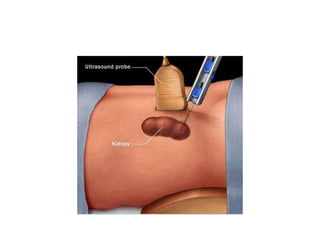
The patient is placed in the prone position, usually with a towel or pillow placed
underneath the abdomen to ensure appropriate positioning.
Ultrasound guidance
Post-procedural care
After the physician has finished obtaining all the tissue for the biopsy, the needle is
removed and pressure is applied to the biopsy site to tamponade any potential
bleeding, and, finally, a bandage is applied.
The patient should typically lay supine in bed for 6-8 hours immediately after the
procedure.
In total the patient should expect to stay in the hospital for at least 12 hours and may
have to spend one night in the hospital after the procedure.
During this time, the patient will be given proper pain medication, urine will be
checked for blood, and blood counts and vital signs will be monitored throughout the
patient’s stay in the hospital.
Complications
The most common complication of renal biopsy is pain and bleeding at the biopsy site.
Bleeding may occur in 3 distinct locations within the kidney: into the collecting system,
under the renal capsule, or into the perinephric space.
Another known complication of a renal biopsy is the development of an arteriovenous
fistula. (incidence: up to 18% - In most cases, asymptomatic, but some patients may
experience symptoms such as hematuria, hypertension, and/or renal insufficiency.
Treatment consists of selective angioembolization performed by a vascular
interventional radiologist to halt the bleeding.
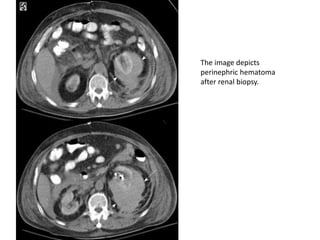
The image depicts
perinephric hematoma
after renal biopsy.
Adequacy of tissue sampling
Sample size – two cylinders with a minimal length of 1 cm and a diameter of at
least 1.2 mm are needed.
Needle gauge: 16 - 18 gauge (G).
11
The Renal Biopsy Laboratory handling
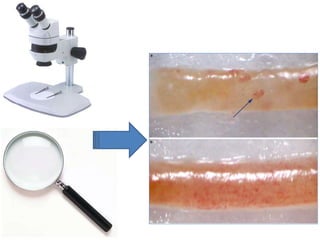
Biopsy adequacy:
– Cortex and medulla
– 1-2 glomeruli EM
– 3-5 glomeruli IF
– 6 glomeruli PS (native kidney)
– 10 glomeruli PS (renal allograft)
Sectioning and fixation
Diagram to illustrate division of kidney biopsy cores in the absence of a dissecting
microscope for laboratories using immunofluorescence
The standard approach is to first procure tissue
for electron microscopy (EM) from each core
by removing 1 mm cubes from the ends and
placing them in cooled glutaraldehyde or other
fixative suitable for EM [Figure 4]. Some
clinicians prefer that the pathology laboratory
obtain tissue for EM from the ends of the
formalin-fixed tissue. If the specimen is to be
sent to a laboratory that uses
immunofluorescence (IF), the first core can be
cut in half by cross-sectioning and the larger
piece placed in formalin or another fixative
suitable for light microscopy (LM); the smaller
portion is saved for IF evaluation. If a second
core is obtained, the ends should be taken for
EM and the specimen again divided almost in
half, with the larger tissue core now kept for IF
and the smaller for LM.
Biopsy Laboratory handling
1- fixation (Immediate):
• 10 % NB Formalin (paraffin sections)
• 4% Gluteraldehyde (EM)
• No fixation (Immunofluorescence)
2- Paraffin sections cut at 3 u thickness
3- Stains: HE PAS GMS TC CR …..
HE PAS GMS HE TC HE PAS GMS HE
TC HE HE PAS GMS HE TC PAS GMS
HE TC (CR, Microbial stains, others.)
4- Immunohistochemistry (IG, C, other antigens)
5- Immunofluorescence (IG, C)
Biopsy Fixation
10% Neutral Buffered Formalin Solution:
Why?
1. Cheap
2. Commonly available
3. Suitable for:
– All histological stains
– Immunohistological methods (not IF)
4. Reversible: Possible to transfer to another fixative for
electron microscopy.
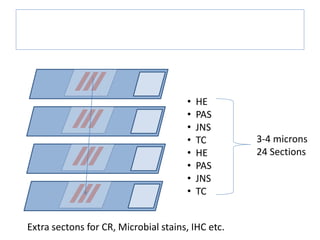
The Renal Biopsy Laboratory handling
• HE
• PAS
• JNS
• TC
• HE
• PAS
• JNS
• TC
3-4 microns
24 Sections
Extra sectons for CR, Microbial stains, IHC etc.
Morphological examination:
1. Glomeruli
2. Tubules
3. Interstitium
4. Blood vessels
Renal Biopsy Morphological Examination
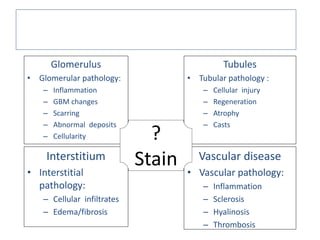
Primary Site of Renal Pathology
Glomerulus
• Glomerular pathology:
– Inflammation
– GBM changes
– Scarring
– Abnormal deposits
– Cellularity
Tubules
• Tubular pathology :
– Cellular injury
– Regeneration
– Atrophy
– Casts
Interstitium
• Interstitial
pathology:
– Cellular infiltrates
– Edema/fibrosis
Vascular disease
• Vascular pathology:
– Inflammation
– Sclerosis
– Hyalinosis
– Thrombosis
?
Stain
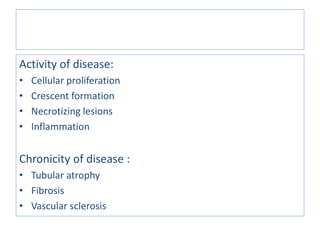
Activity of disease:
• Cellular proliferation
• Crescent formation
• Necrotizing lesions
• Inflammation
Chronicity of disease :
• Tubular atrophy
• Fibrosis
• Vascular sclerosis
Renal pathology report Disease Stage
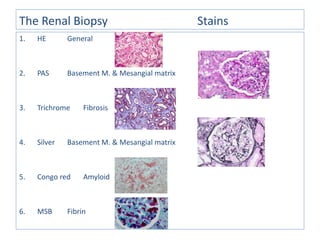
The Renal Biopsy Stains
1. HE General
2. PAS Basement M. & Mesangial matrix
3. Trichrome Fibrosis
4. Silver Basement M. & Mesangial matrix
5. Congo red Amyloid
6. MSB Fibrin
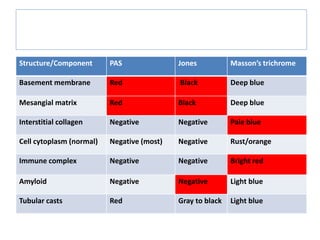
Structure/Component PAS Jones Masson’s trichrome
Basement membrane Red Black Deep blue
Mesangial matrix Red Black Deep blue
Interstitial collagen Negative Negative Pale blue
Cell cytoplasm (normal) Negative (most) Negative Rust/orange
Immune complex Negative Negative Bright red
Amyloid Negative Negative Light blue
Tubular casts Red Gray to black Light blue
Staining characteristics of selected normal and
abnormal renal structures
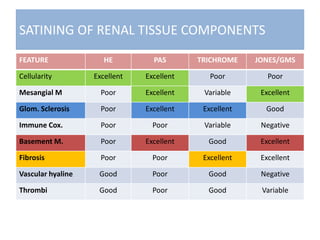
SATINING OF RENAL TISSUE COMPONENTS
FEATURE HE PAS TRICHROME JONES/GMS
Cellularity Excellent Excellent Poor Poor
Mesangial M Poor Excellent Variable Excellent
Glom. Sclerosis Poor Excellent Excellent Good
Immune Cox. Poor Poor Variable Negative
Basement M. Poor Excellent Good Excellent
Fibrosis Poor Poor Excellent Excellent
Vascular hyaline Good Poor Good Negative
Thrombi Good Poor Good Variable
Thank You
Reference
Agarwal SK, Sethi S, Dinda AK. Basics of kidney biopsy: A nephrologist’s
perspective. Indian Journal of Nephrology. 2013;23(4):243-252.
doi:10.4103/0971-4065.114462.

renal biopsy

  • 1.
    Renal Biopsy By Tamer ElSaid,MD Associate Professor of Internal medicine and Nephrology Faculty of Medicine – Ain Shams University
  • 2.
    Background A renal biopsyis a procedure used to obtain a segment of renal tissue, usually through a needle or another surgical instrument. Analysis of this tissue is then used in the diagnosis of an underlying renal condition. Renal biopsy is used to diagnose renal diseases ranging from infection to transient rejection to renal cell carcinoma. Once a biopsy diagnosis is established, it can be used to help guide treatment options and may also assist in determining prognosis of the underlying condition.
  • 3.
    Indications Renal biopsy istypically performed under ultrasonographic or rarely CT guidance. Most common indications: Unexplained acute or rapidly progressive renal failure Acute nephritic syndrome Nephrotic syndrome Isolated nonnephrotic proteinuria Isolated glomerular hematuria Renal masses (primary or secondary) Renal allograft dysfunction Renal transplant rejection Systemic diseases with renal involvement eg connective-tissue diseases such as SLE ‘All these indications are not absolute. In each situation, if associated clinical and laboratory investigation suggest a predictable histological pattern, kidney biopsy may not be required.’
  • 4.
    Contraindications Absolute: Abnormal coagulopathy Uncontrolled hypertension Activerenal or perirenal infection Skin infection at biopsy site Relative: Uncooperative patient or unable to lie flat on bed Anatomic abnormalities of the kidney which may increase risk Small kidneys* Solitary kidney
  • 5.
    Equipment Anesthesia Renal biopsy isperformed under local anesthesia using 1% lidocaine. Positioning The patient is placed in the prone position, usually with a towel or pillow placed underneath the abdomen to ensure appropriate positioning. Ultrasound guidance
  • 7.
    Post-procedural care After thephysician has finished obtaining all the tissue for the biopsy, the needle is removed and pressure is applied to the biopsy site to tamponade any potential bleeding, and, finally, a bandage is applied. The patient should typically lay supine in bed for 6-8 hours immediately after the procedure. In total the patient should expect to stay in the hospital for at least 12 hours and may have to spend one night in the hospital after the procedure. During this time, the patient will be given proper pain medication, urine will be checked for blood, and blood counts and vital signs will be monitored throughout the patient’s stay in the hospital.
  • 8.
    Complications The most commoncomplication of renal biopsy is pain and bleeding at the biopsy site. Bleeding may occur in 3 distinct locations within the kidney: into the collecting system, under the renal capsule, or into the perinephric space. Another known complication of a renal biopsy is the development of an arteriovenous fistula. (incidence: up to 18% - In most cases, asymptomatic, but some patients may experience symptoms such as hematuria, hypertension, and/or renal insufficiency. Treatment consists of selective angioembolization performed by a vascular interventional radiologist to halt the bleeding.
  • 9.
    The image depicts perinephrichematoma after renal biopsy.
  • 10.
    Adequacy of tissuesampling Sample size – two cylinders with a minimal length of 1 cm and a diameter of at least 1.2 mm are needed. Needle gauge: 16 - 18 gauge (G).
  • 11.
    11 The Renal BiopsyLaboratory handling Biopsy adequacy: – Cortex and medulla – 1-2 glomeruli EM – 3-5 glomeruli IF – 6 glomeruli PS (native kidney) – 10 glomeruli PS (renal allograft)
  • 13.
  • 14.
    Diagram to illustratedivision of kidney biopsy cores in the absence of a dissecting microscope for laboratories using immunofluorescence The standard approach is to first procure tissue for electron microscopy (EM) from each core by removing 1 mm cubes from the ends and placing them in cooled glutaraldehyde or other fixative suitable for EM [Figure 4]. Some clinicians prefer that the pathology laboratory obtain tissue for EM from the ends of the formalin-fixed tissue. If the specimen is to be sent to a laboratory that uses immunofluorescence (IF), the first core can be cut in half by cross-sectioning and the larger piece placed in formalin or another fixative suitable for light microscopy (LM); the smaller portion is saved for IF evaluation. If a second core is obtained, the ends should be taken for EM and the specimen again divided almost in half, with the larger tissue core now kept for IF and the smaller for LM.
  • 15.
    Biopsy Laboratory handling 1-fixation (Immediate): • 10 % NB Formalin (paraffin sections) • 4% Gluteraldehyde (EM) • No fixation (Immunofluorescence) 2- Paraffin sections cut at 3 u thickness 3- Stains: HE PAS GMS TC CR ….. HE PAS GMS HE TC HE PAS GMS HE TC HE HE PAS GMS HE TC PAS GMS HE TC (CR, Microbial stains, others.) 4- Immunohistochemistry (IG, C, other antigens) 5- Immunofluorescence (IG, C)
  • 16.
    Biopsy Fixation 10% NeutralBuffered Formalin Solution: Why? 1. Cheap 2. Commonly available 3. Suitable for: – All histological stains – Immunohistological methods (not IF) 4. Reversible: Possible to transfer to another fixative for electron microscopy.
  • 17.
    The Renal BiopsyLaboratory handling • HE • PAS • JNS • TC • HE • PAS • JNS • TC 3-4 microns 24 Sections Extra sectons for CR, Microbial stains, IHC etc.
  • 18.
    Morphological examination: 1. Glomeruli 2.Tubules 3. Interstitium 4. Blood vessels Renal Biopsy Morphological Examination
  • 19.
    Primary Site ofRenal Pathology Glomerulus • Glomerular pathology: – Inflammation – GBM changes – Scarring – Abnormal deposits – Cellularity Tubules • Tubular pathology : – Cellular injury – Regeneration – Atrophy – Casts Interstitium • Interstitial pathology: – Cellular infiltrates – Edema/fibrosis Vascular disease • Vascular pathology: – Inflammation – Sclerosis – Hyalinosis – Thrombosis ? Stain
  • 20.
    Activity of disease: •Cellular proliferation • Crescent formation • Necrotizing lesions • Inflammation Chronicity of disease : • Tubular atrophy • Fibrosis • Vascular sclerosis Renal pathology report Disease Stage
  • 21.
    The Renal BiopsyStains 1. HE General 2. PAS Basement M. & Mesangial matrix 3. Trichrome Fibrosis 4. Silver Basement M. & Mesangial matrix 5. Congo red Amyloid 6. MSB Fibrin
  • 22.
    Structure/Component PAS JonesMasson’s trichrome Basement membrane Red Black Deep blue Mesangial matrix Red Black Deep blue Interstitial collagen Negative Negative Pale blue Cell cytoplasm (normal) Negative (most) Negative Rust/orange Immune complex Negative Negative Bright red Amyloid Negative Negative Light blue Tubular casts Red Gray to black Light blue Staining characteristics of selected normal and abnormal renal structures
  • 23.
    SATINING OF RENALTISSUE COMPONENTS FEATURE HE PAS TRICHROME JONES/GMS Cellularity Excellent Excellent Poor Poor Mesangial M Poor Excellent Variable Excellent Glom. Sclerosis Poor Excellent Excellent Good Immune Cox. Poor Poor Variable Negative Basement M. Poor Excellent Good Excellent Fibrosis Poor Poor Excellent Excellent Vascular hyaline Good Poor Good Negative Thrombi Good Poor Good Variable
  • 24.
  • 25.
    Reference Agarwal SK, SethiS, Dinda AK. Basics of kidney biopsy: A nephrologist’s perspective. Indian Journal of Nephrology. 2013;23(4):243-252. doi:10.4103/0971-4065.114462.