STEM CELLS
Gabi Porenta, Maja Bešter
Mentor: univ. dipl. bio., prof. Marija Maruša
Vencelj
Gimnazija Kranj, Slovenija
What are stem cells?
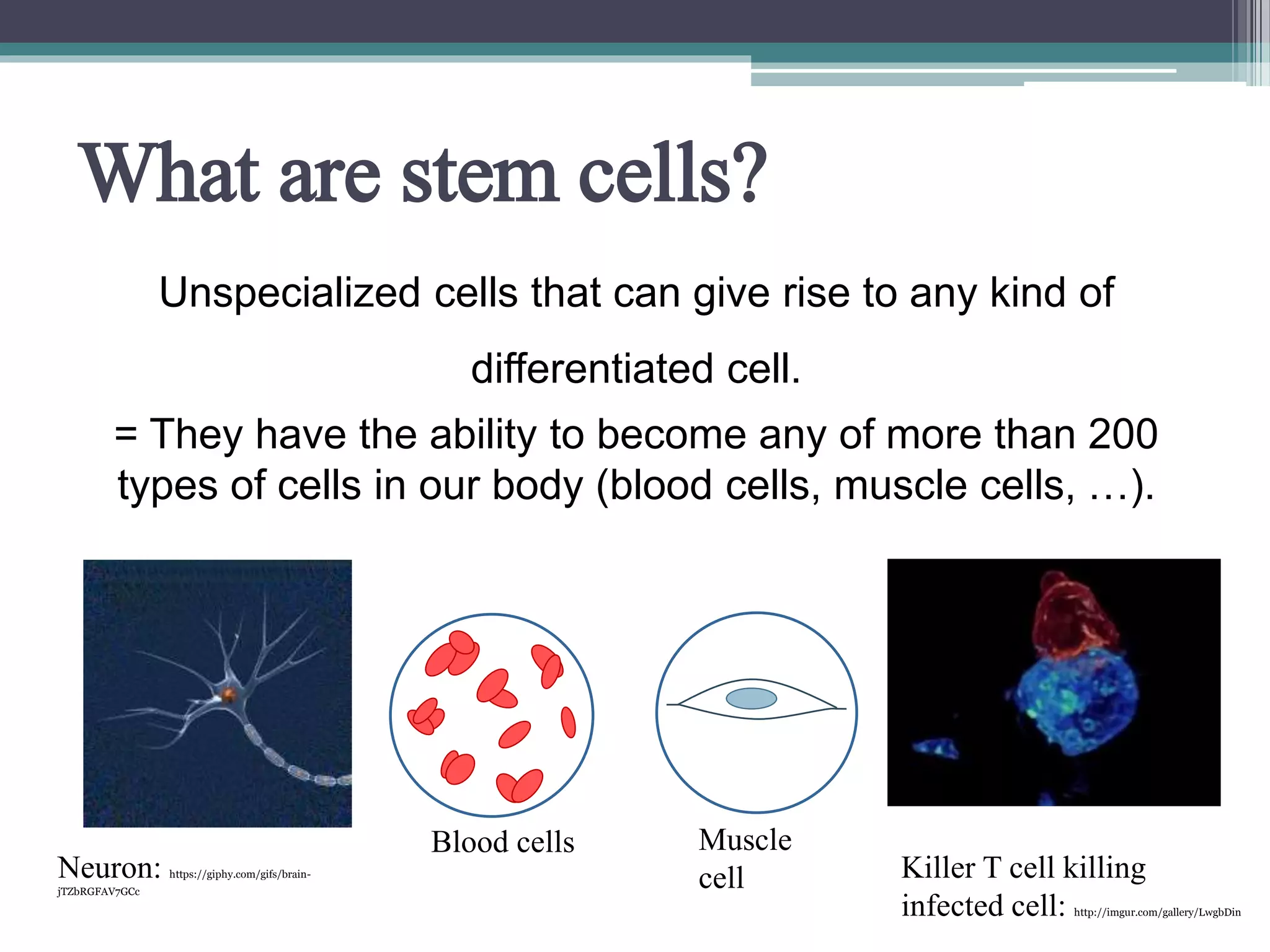
Unspecialized cells that can give rise to any kind of
differentiated cell.
= They have the ability to become any of more than 200
types of cells in our body (blood cells, muscle cells, …).
Blood cells Muscle
cellNeuron: https://giphy.com/gifs/brain-
jTZbRGFAV7GCc
Killer T cell killing
infected cell: http://imgur.com/gallery/LwgbDin
Basic terms
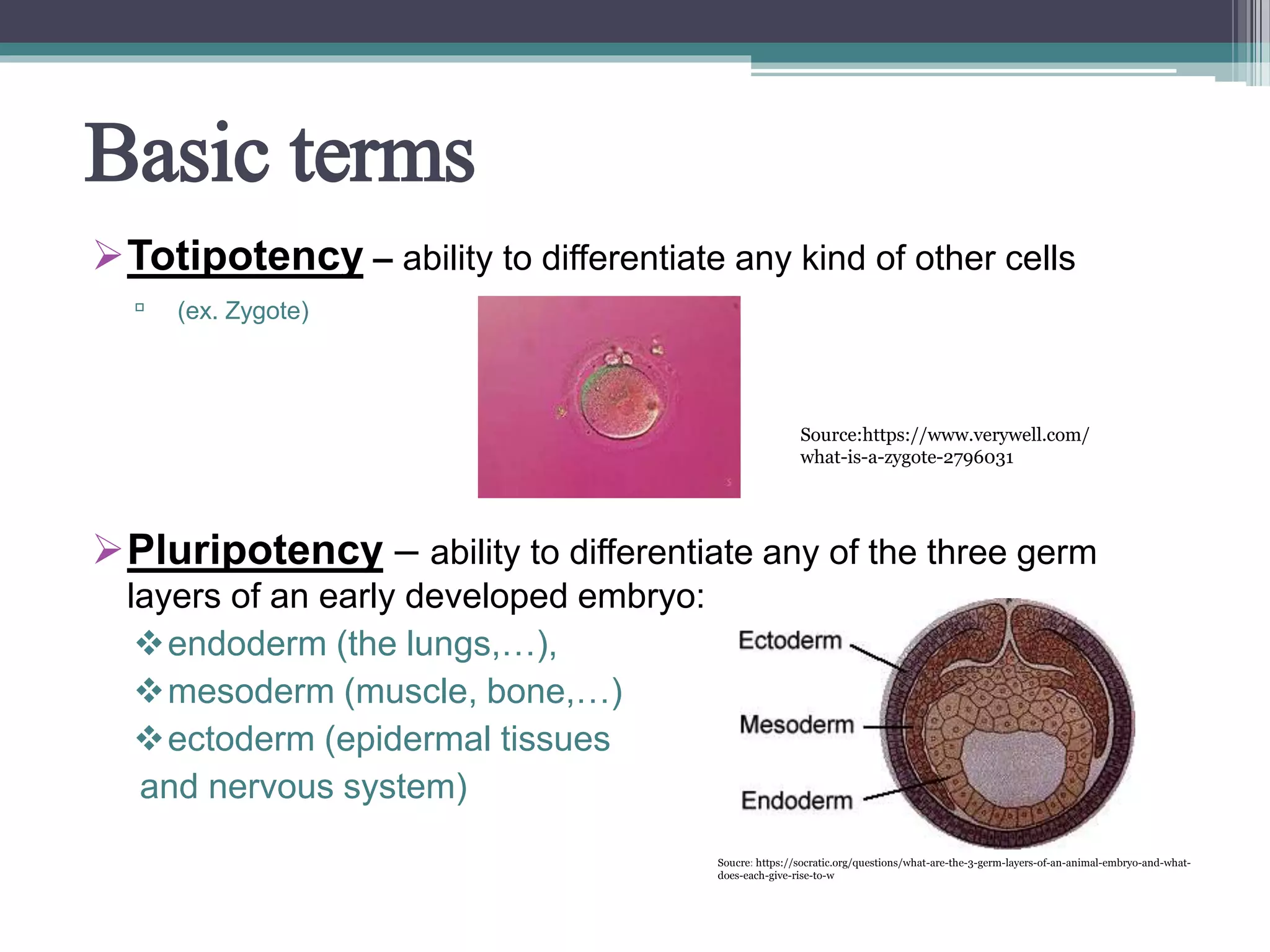
Totipotency – ability to differentiate any kind of other cells
▫ (ex. Zygote)
Pluripotency – ability to differentiate any of the three germ
layers of an early developed embryo:
endoderm (the lungs,…),
mesoderm (muscle, bone,…)
ectoderm (epidermal tissues
and nervous system)
Soucre: https://socratic.org/questions/what-are-the-3-germ-layers-of-an-animal-embryo-and-what-
does-each-give-rise-to-w
Source:https://www.verywell.com/
what-is-a-zygote-2796031
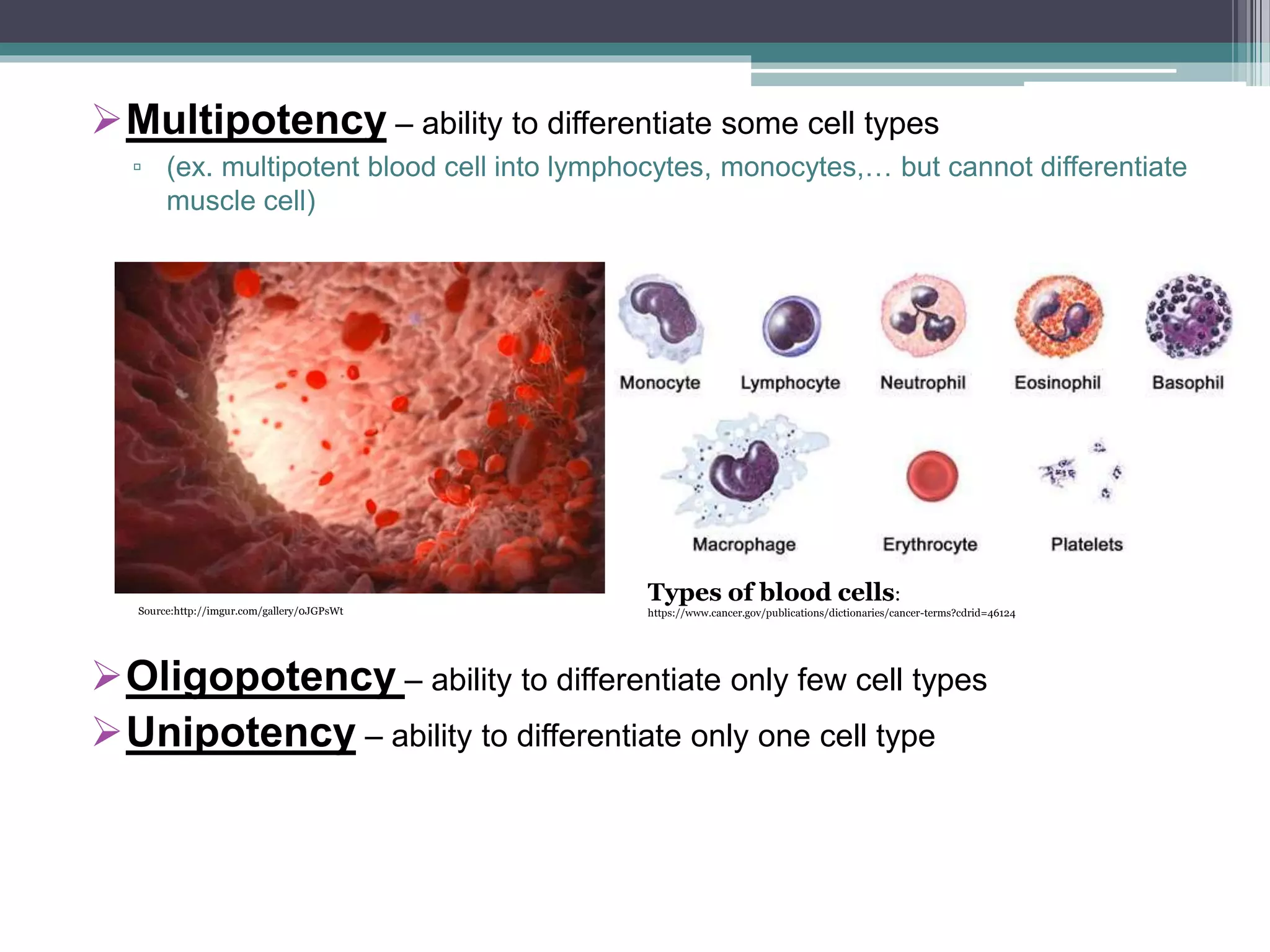
Multipotency – ability to differentiate some cell types
▫ (ex. multipotent blood cell into lymphocytes, monocytes,… but cannot differentiate
muscle cell)
Oligopotency – ability to differentiate only few cell types
Unipotency – ability to differentiate only one cell type
Types of blood cells:
https://www.cancer.gov/publications/dictionaries/cancer-terms?cdrid=46124Source:http://imgur.com/gallery/0JGPsWt
Allogeneic transplant
Transplantation of Stem Cells from another person
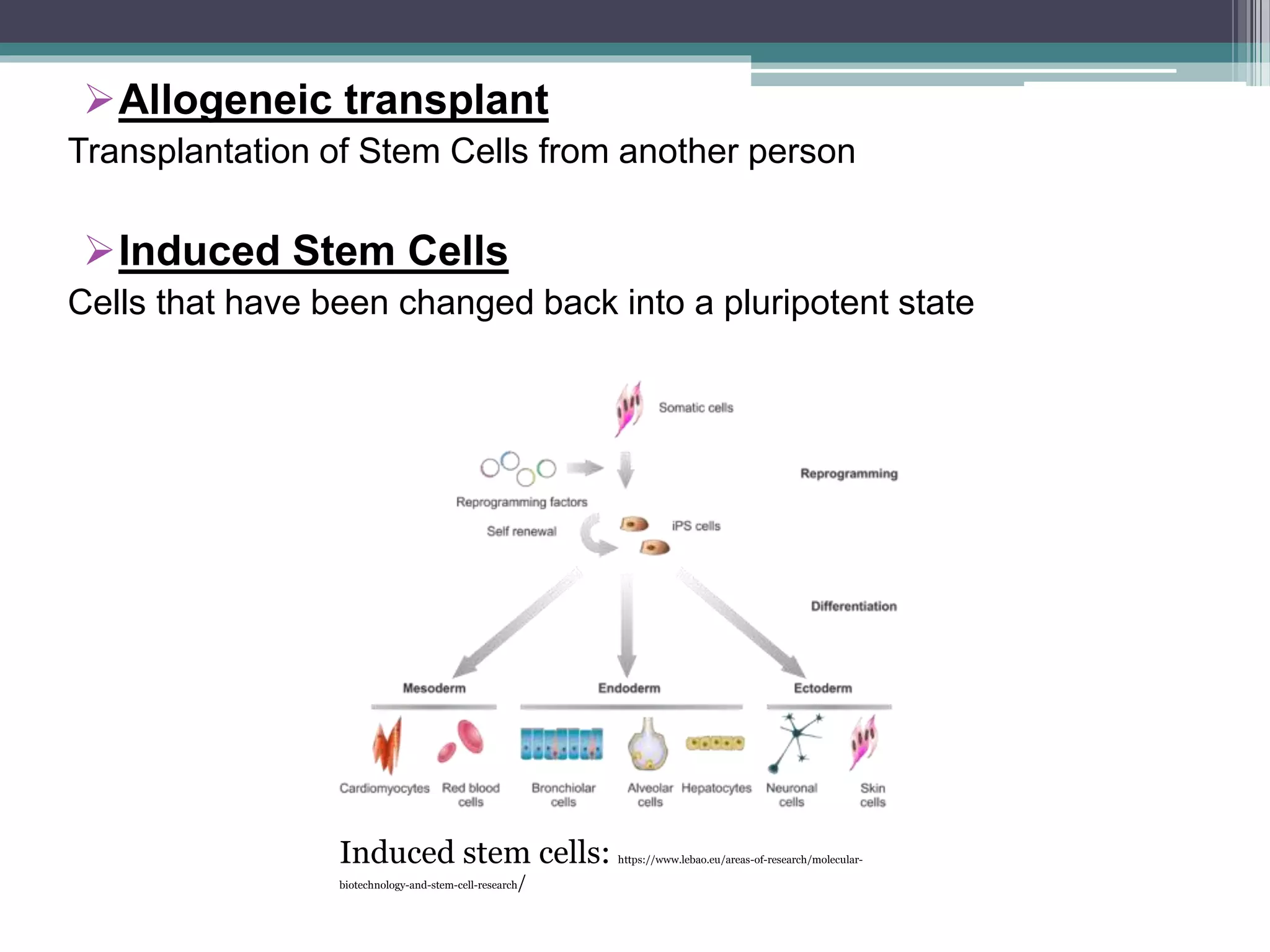
Induced Stem Cells
Cells that have been changed back into a pluripotent state
Induced stem cells: https://www.lebao.eu/areas-of-research/molecular-
biotechnology-and-stem-cell-research/
History of stem cells
1998: isolation of human stem cells
Used very early human emrbyo
Remain stable and pluripotent up to
8 months in vitro
2010: first spinal cord surgery
 Replacing the nerve cells that died during
the injury, by stem cells from bone marrow
 Suppressing the damaging inflammation by soaking up toxins
2012: blindness treated
 Injected embryonic stem cells into the eyes of two
patients, suffering from progressive blindness
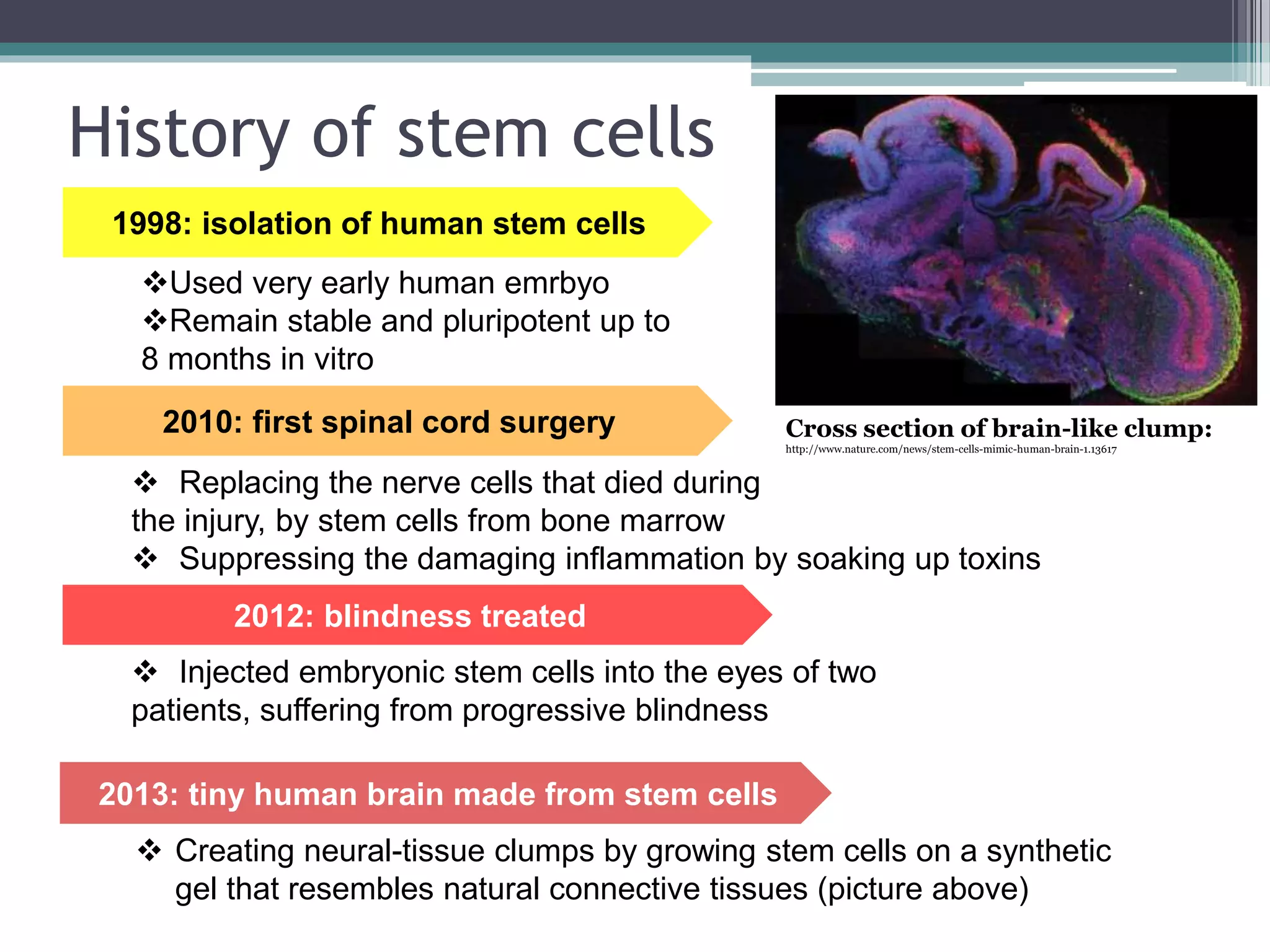
2013: tiny human brain made from stem cells
 Creating neural-tissue clumps by growing stem cells on a synthetic
gel that resembles natural connective tissues (picture above)
Cross section of brain-like clump:
http://www.nature.com/news/stem-cells-mimic-human-brain-1.13617
Cardiovascular disease
Deprive heart tissue of Oxygen
Kill cardiac muscle cells
Scar tissue, overload of blood flow,
pressure capacity
Number one cause of death in the US
One in ten women, one in seven men in the UK die from CHD
Damaged vs healthy heart tissue:
https://en.wikipedia.org/wiki/Cardiovascular_disease,
http://vcgsb.info/tag/cardiac-muscle-tissue-under-low-power/
Sources:
https://clipartfest.com/categories/view/dc8f907cffd9f02d8bce83a5a331c25541f1d813/woman-
figure-clipart.html
http://symbolsnet.com/symbols/woman-figure-symbol.html
http://www.clker.com/clipart-man-figure-symbol.html
http://symbolsnet.com/symbols/male-figure-symbol.html
• APPROPRIATE STEM CELL SOURCES FOR TREATMENT
 Embryonic stem cells
 Cardiac stem cells
 Muscle stem cells
 Endothenial progenitor cells
 Umbilical cord blood cells
• Positive results on
animals
(mice - brain damage…)
Process: http://www.nature.com/nrcardio/journal/v4/n2s/fig_tab/ncpcardio0734_F1.html
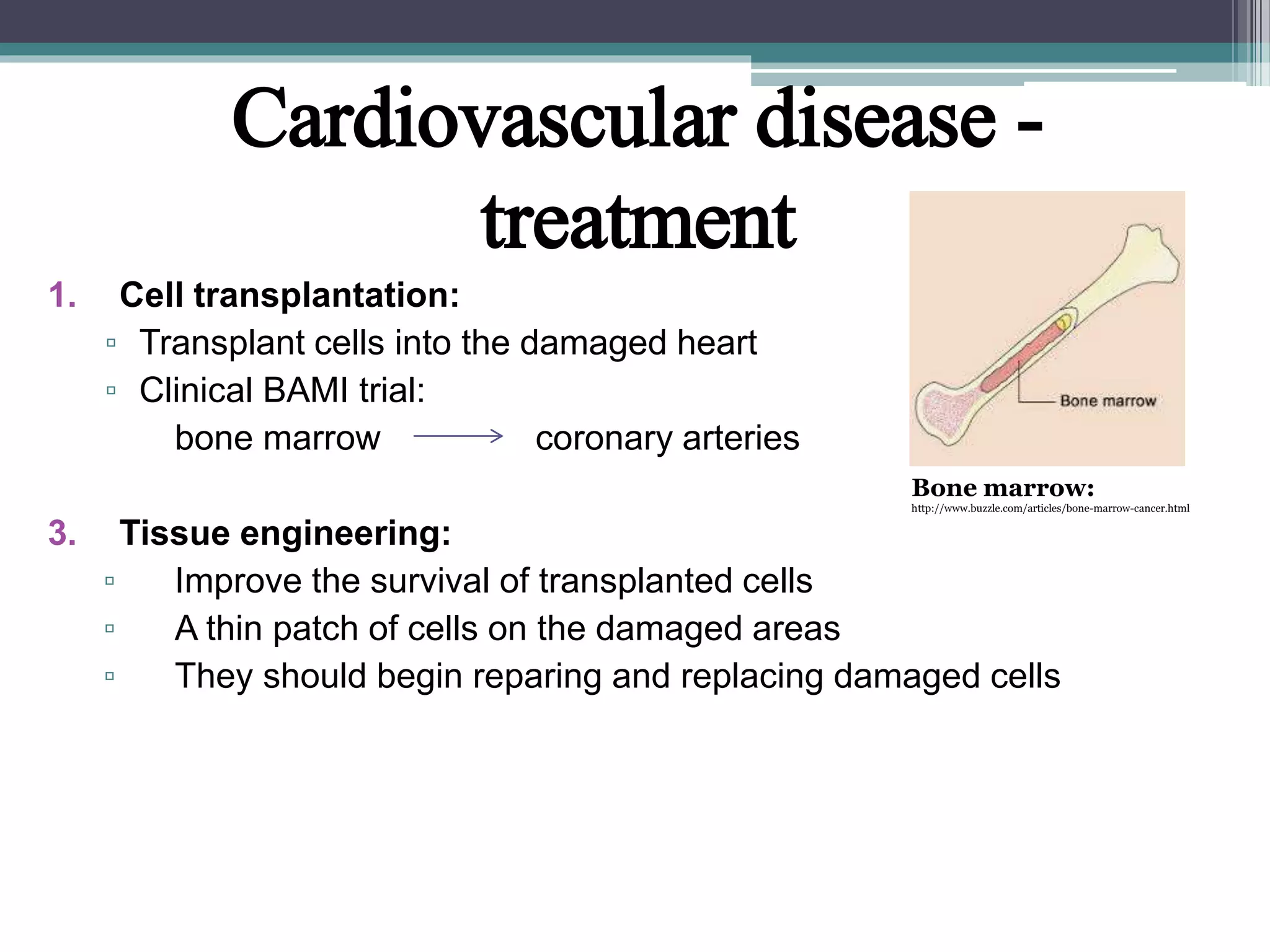
1. Cell transplantation:
▫ Transplant cells into the damaged heart
▫ Clinical BAMI trial:
bone marrow coronary arteries
3. Tissue engineering:
▫ Improve the survival of transplanted cells
▫ A thin patch of cells on the damaged areas
▫ They should begin reparing and replacing damaged cells
Cardiovascular disease -
treatment
Bone marrow:
http://www.buzzle.com/articles/bone-marrow-cancer.html
3. Resident heart cells:
▫ Reprograming structural cells
to become cardiomyomcytes,
or
▫ To deliver drugs that stimulate
cardiomyocytes to grow
Heart https://ninithi.com/2015/07/24/patching-up-weak-hearts-with-gold-nanowires/
Birth defects
Appearance of physical or mental development, organ function
Most present with first 3 months of pregnancy
Caused by genetics, lifestyle choices, use of certain medicines,
infections during pregnancy,…
Abnormal cell division and differentiation
Abnormal and normal blood cells: http://www.fertility-docs.com/programs-and-services/pgd-screening/genetic-
diagnosis-of-embryos-for-diseases-using-pgd.php
Poor lifestyle choices:
http://www.bbc.co.uk/news/health-16031149
Experiment with birth defects
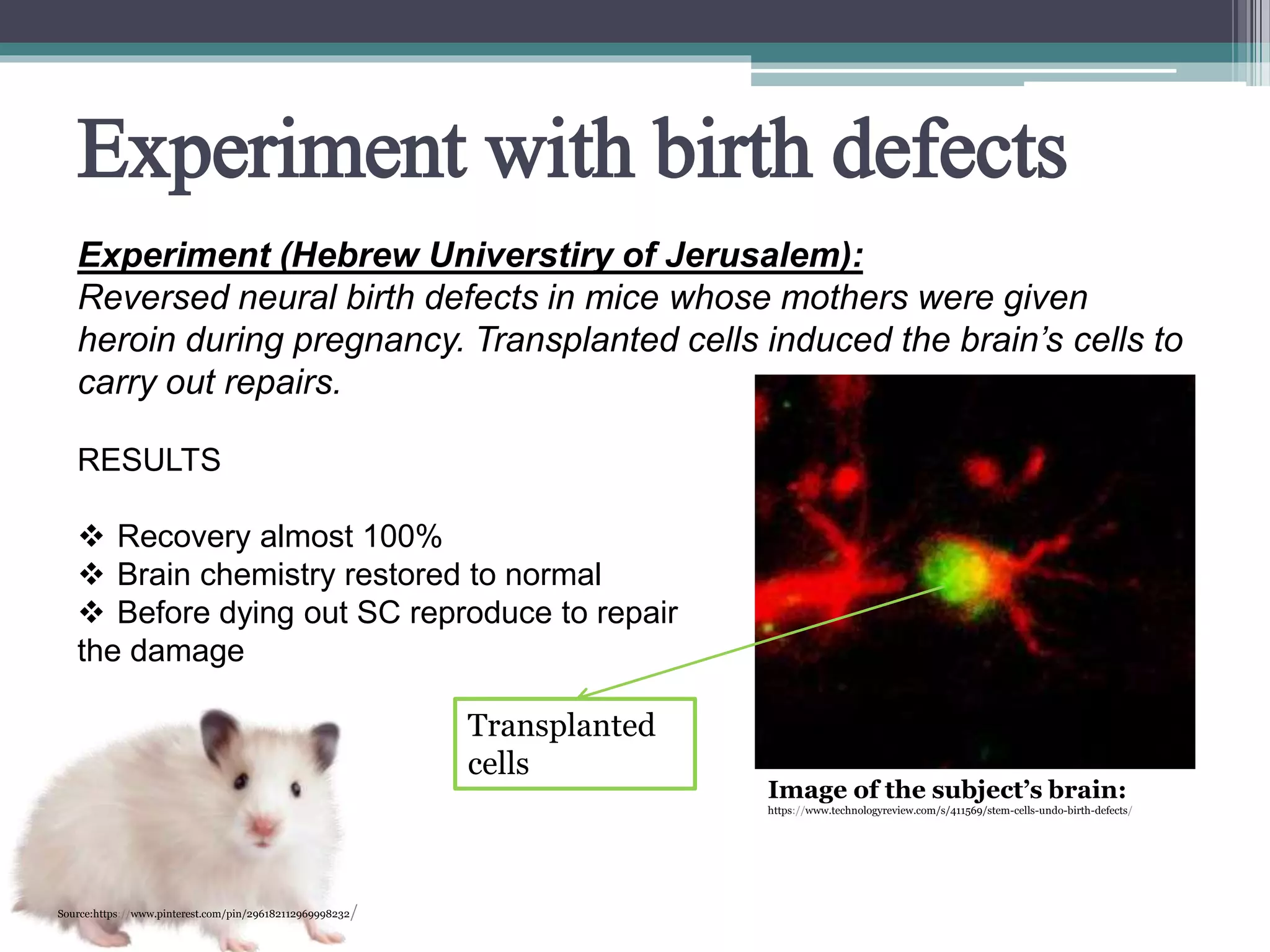
Image of the subject’s brain:
https://www.technologyreview.com/s/411569/stem-cells-undo-birth-defects/
Experiment (Hebrew Universtiry of Jerusalem):
Reversed neural birth defects in mice whose mothers were given
heroin during pregnancy. Transplanted cells induced the brain’s cells to
carry out repairs.
RESULTS
 Recovery almost 100%
 Brain chemistry restored to normal
 Before dying out SC reproduce to repair
the damage
Transplanted
cells
Source:https://www.pinterest.com/pin/296182112969998232/
Synthetic organs
• From patient’s own cells – personalized
▫ Reduce chance of rejection
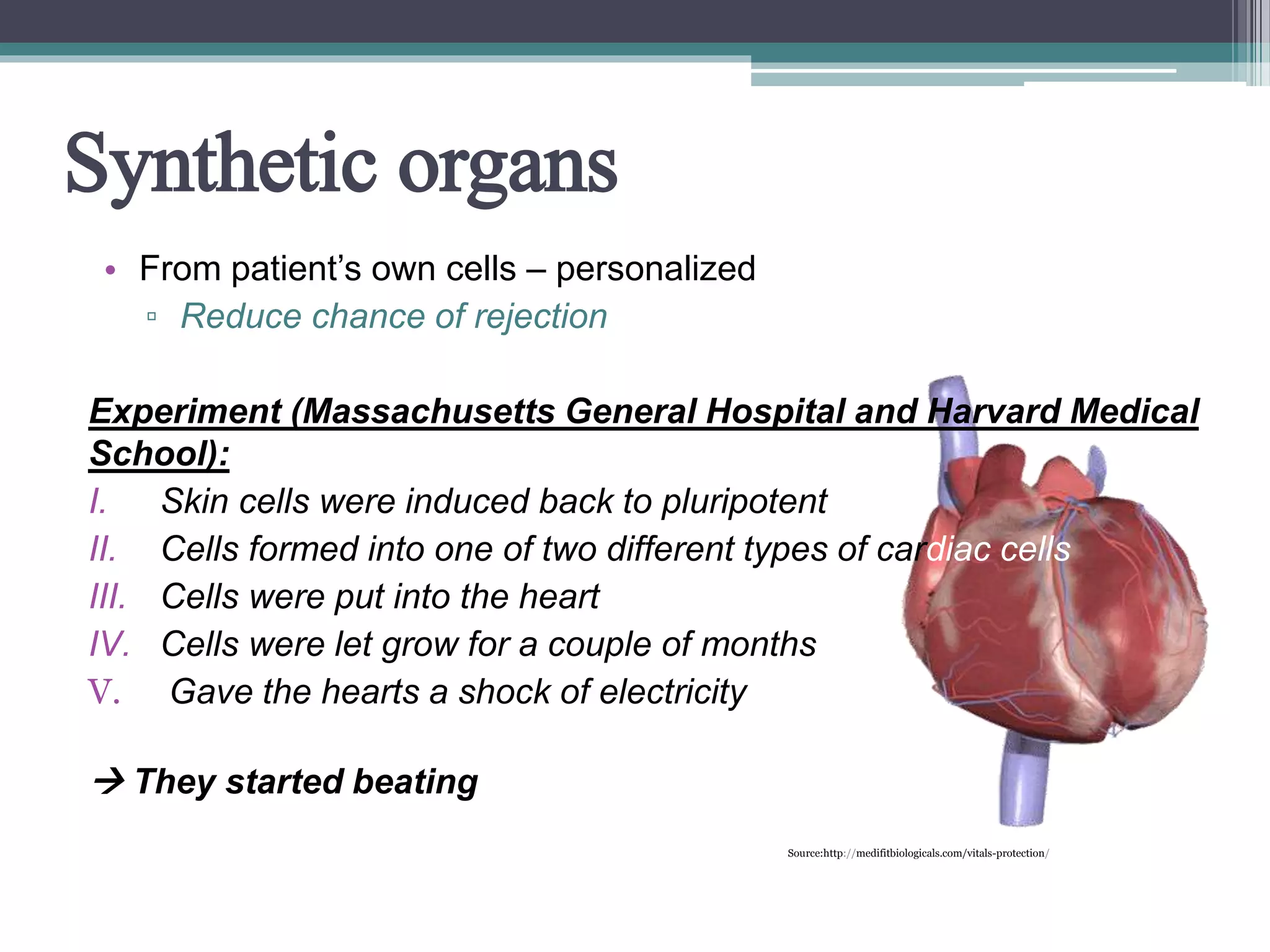
Experiment (Massachusetts General Hospital and Harvard Medical
School):
I. Skin cells were induced back to pluripotent
II. Cells formed into one of two different types of cardiac cells
III. Cells were put into the heart
IV. Cells were let grow for a couple of months
V. Gave the hearts a shock of electricity
 They started beating
Source:http://medifitbiologicals.com/vitals-protection/
Stem cell treatment in Slovenia
Started in 2005
One of the first in the world
2 groups of 55 patients
▫ 1. group with stem cells
▫ 2. group without
UKC Ljubljana: http://bioeden.si/veliki-dosezek-slovenske-medicine-srca-ne-mores-oviti-z-mavcem/
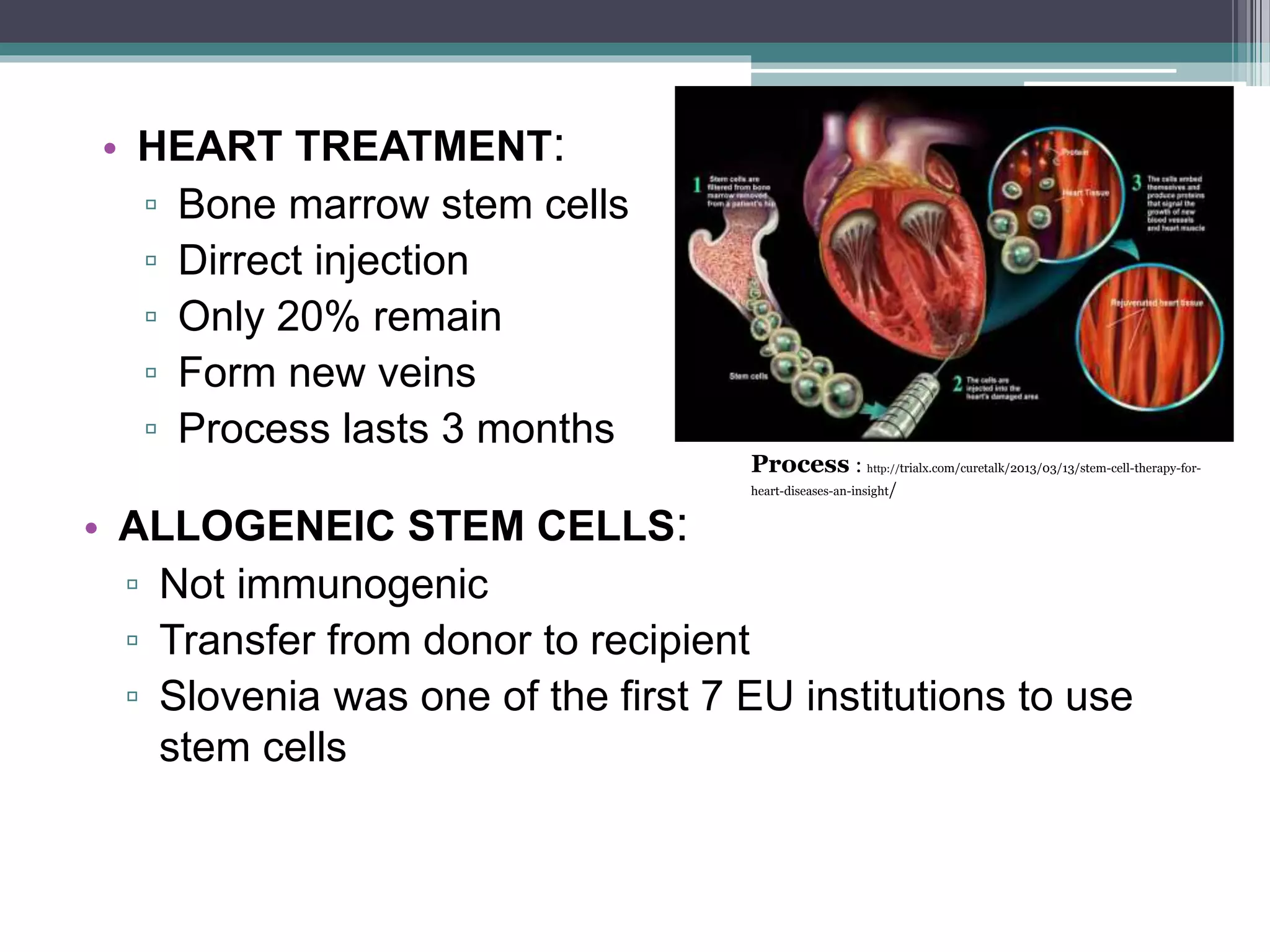
• HEART TREATMENT:
▫ Bone marrow stem cells
▫ Dirrect injection
▫ Only 20% remain
▫ Form new veins
▫ Process lasts 3 months
Process : http://trialx.com/curetalk/2013/03/13/stem-cell-therapy-for-
heart-diseases-an-insight/
• ALLOGENEIC STEM CELLS:
▫ Not immunogenic
▫ Transfer from donor to recipient
▫ Slovenia was one of the first 7 EU institutions to use
stem cells
Use of stem cells in the future
• Possible stem-cell therapies:
▫ macular degeneration,
▫ spinal cord injury,
▫ stroke,
▫ heart disease,
▫ diabetes,
▫ osteoarthritis
• Reversing aging, disease, injury
Forms stem cells can take on:
http://www.blumnico.com/our-blog/stem-cell-harvesting/
Problems of the use of stem cells
• Ethical problems
▫ “Does life begin at fertilization, in the womb, or at birth?”
▫ “Is a human embryo equivalent to a human child?”
▫ “Does a human embryo have any rights?”
▫ “Might the destruction of a single embryo be justified if it
provides a cure for a countless number of patients?”
• Cell rejection
Statictics Americans Favor Embryonic Stem
Cell Research
Stronly favor
Somewhat Favor
Somewhat oppose
Strongly oppose
Don't know
58
30
16
10 8 5 5 0.3 0.25 0.15
0
10
20
30
40
50
60
70
Potential Patients for Stem Cell Therapy
Sources
• http://seedmagazine.com/media/cribsheets/crib1_stemcells.pdf
• http://www.eurostemcell.org/european-court-bans-stem-cell-
patents
• https://www.theguardian.com/science/2011/oct/18/european-
patents-embryonic-stem-cells?INTCMP=SRCH
• http://blogs.discovermagazine.com/notrocketscience/2011/02/02/
research-into-reprogrammed-stem-cells-an-interactive-
timeline/#.WRfuhYkgWUk
• http://www.eurostemcell.org/spinal-cord-injuries-how-could-stem-
cells-help
• http://seedmagazine.com/media/cribsheets/crib1_stemcells.pdf
• http://12-pounds-movie.weebly.com/blog/cell-research
• http://wiki.ucalgary.ca/page/The_DNA_Game

Stem cells #SciChallenge2017

  • 1.
    STEM CELLS Gabi Porenta,Maja Bešter Mentor: univ. dipl. bio., prof. Marija Maruša Vencelj Gimnazija Kranj, Slovenija
  • 2.
    What are stemcells? Unspecialized cells that can give rise to any kind of differentiated cell. = They have the ability to become any of more than 200 types of cells in our body (blood cells, muscle cells, …). Blood cells Muscle cellNeuron: https://giphy.com/gifs/brain- jTZbRGFAV7GCc Killer T cell killing infected cell: http://imgur.com/gallery/LwgbDin
  • 3.
    Basic terms Totipotency –ability to differentiate any kind of other cells ▫ (ex. Zygote) Pluripotency – ability to differentiate any of the three germ layers of an early developed embryo: endoderm (the lungs,…), mesoderm (muscle, bone,…) ectoderm (epidermal tissues and nervous system) Soucre: https://socratic.org/questions/what-are-the-3-germ-layers-of-an-animal-embryo-and-what- does-each-give-rise-to-w Source:https://www.verywell.com/ what-is-a-zygote-2796031
  • 4.
    Multipotency – abilityto differentiate some cell types ▫ (ex. multipotent blood cell into lymphocytes, monocytes,… but cannot differentiate muscle cell) Oligopotency – ability to differentiate only few cell types Unipotency – ability to differentiate only one cell type Types of blood cells: https://www.cancer.gov/publications/dictionaries/cancer-terms?cdrid=46124Source:http://imgur.com/gallery/0JGPsWt
  • 5.
    Allogeneic transplant Transplantation ofStem Cells from another person Induced Stem Cells Cells that have been changed back into a pluripotent state Induced stem cells: https://www.lebao.eu/areas-of-research/molecular- biotechnology-and-stem-cell-research/
  • 6.
    History of stemcells 1998: isolation of human stem cells Used very early human emrbyo Remain stable and pluripotent up to 8 months in vitro 2010: first spinal cord surgery  Replacing the nerve cells that died during the injury, by stem cells from bone marrow  Suppressing the damaging inflammation by soaking up toxins 2012: blindness treated  Injected embryonic stem cells into the eyes of two patients, suffering from progressive blindness 2013: tiny human brain made from stem cells  Creating neural-tissue clumps by growing stem cells on a synthetic gel that resembles natural connective tissues (picture above) Cross section of brain-like clump: http://www.nature.com/news/stem-cells-mimic-human-brain-1.13617
  • 7.
    Cardiovascular disease Deprive hearttissue of Oxygen Kill cardiac muscle cells Scar tissue, overload of blood flow, pressure capacity Number one cause of death in the US One in ten women, one in seven men in the UK die from CHD Damaged vs healthy heart tissue: https://en.wikipedia.org/wiki/Cardiovascular_disease, http://vcgsb.info/tag/cardiac-muscle-tissue-under-low-power/ Sources: https://clipartfest.com/categories/view/dc8f907cffd9f02d8bce83a5a331c25541f1d813/woman- figure-clipart.html http://symbolsnet.com/symbols/woman-figure-symbol.html http://www.clker.com/clipart-man-figure-symbol.html http://symbolsnet.com/symbols/male-figure-symbol.html
  • 8.
    • APPROPRIATE STEMCELL SOURCES FOR TREATMENT  Embryonic stem cells  Cardiac stem cells  Muscle stem cells  Endothenial progenitor cells  Umbilical cord blood cells • Positive results on animals (mice - brain damage…) Process: http://www.nature.com/nrcardio/journal/v4/n2s/fig_tab/ncpcardio0734_F1.html
  • 9.
    1. Cell transplantation: ▫Transplant cells into the damaged heart ▫ Clinical BAMI trial: bone marrow coronary arteries 3. Tissue engineering: ▫ Improve the survival of transplanted cells ▫ A thin patch of cells on the damaged areas ▫ They should begin reparing and replacing damaged cells Cardiovascular disease - treatment Bone marrow: http://www.buzzle.com/articles/bone-marrow-cancer.html
  • 10.
    3. Resident heartcells: ▫ Reprograming structural cells to become cardiomyomcytes, or ▫ To deliver drugs that stimulate cardiomyocytes to grow Heart https://ninithi.com/2015/07/24/patching-up-weak-hearts-with-gold-nanowires/
  • 11.
    Birth defects Appearance ofphysical or mental development, organ function Most present with first 3 months of pregnancy Caused by genetics, lifestyle choices, use of certain medicines, infections during pregnancy,… Abnormal cell division and differentiation Abnormal and normal blood cells: http://www.fertility-docs.com/programs-and-services/pgd-screening/genetic- diagnosis-of-embryos-for-diseases-using-pgd.php Poor lifestyle choices: http://www.bbc.co.uk/news/health-16031149
  • 12.
    Experiment with birthdefects Image of the subject’s brain: https://www.technologyreview.com/s/411569/stem-cells-undo-birth-defects/ Experiment (Hebrew Universtiry of Jerusalem): Reversed neural birth defects in mice whose mothers were given heroin during pregnancy. Transplanted cells induced the brain’s cells to carry out repairs. RESULTS  Recovery almost 100%  Brain chemistry restored to normal  Before dying out SC reproduce to repair the damage Transplanted cells Source:https://www.pinterest.com/pin/296182112969998232/
  • 13.
    Synthetic organs • Frompatient’s own cells – personalized ▫ Reduce chance of rejection Experiment (Massachusetts General Hospital and Harvard Medical School): I. Skin cells were induced back to pluripotent II. Cells formed into one of two different types of cardiac cells III. Cells were put into the heart IV. Cells were let grow for a couple of months V. Gave the hearts a shock of electricity  They started beating Source:http://medifitbiologicals.com/vitals-protection/
  • 14.
    Stem cell treatmentin Slovenia Started in 2005 One of the first in the world 2 groups of 55 patients ▫ 1. group with stem cells ▫ 2. group without UKC Ljubljana: http://bioeden.si/veliki-dosezek-slovenske-medicine-srca-ne-mores-oviti-z-mavcem/
  • 15.
    • HEART TREATMENT: ▫Bone marrow stem cells ▫ Dirrect injection ▫ Only 20% remain ▫ Form new veins ▫ Process lasts 3 months Process : http://trialx.com/curetalk/2013/03/13/stem-cell-therapy-for- heart-diseases-an-insight/ • ALLOGENEIC STEM CELLS: ▫ Not immunogenic ▫ Transfer from donor to recipient ▫ Slovenia was one of the first 7 EU institutions to use stem cells
  • 16.
    Use of stemcells in the future • Possible stem-cell therapies: ▫ macular degeneration, ▫ spinal cord injury, ▫ stroke, ▫ heart disease, ▫ diabetes, ▫ osteoarthritis • Reversing aging, disease, injury Forms stem cells can take on: http://www.blumnico.com/our-blog/stem-cell-harvesting/
  • 17.
    Problems of theuse of stem cells • Ethical problems ▫ “Does life begin at fertilization, in the womb, or at birth?” ▫ “Is a human embryo equivalent to a human child?” ▫ “Does a human embryo have any rights?” ▫ “Might the destruction of a single embryo be justified if it provides a cure for a countless number of patients?” • Cell rejection
  • 18.
    Statictics Americans FavorEmbryonic Stem Cell Research Stronly favor Somewhat Favor Somewhat oppose Strongly oppose Don't know 58 30 16 10 8 5 5 0.3 0.25 0.15 0 10 20 30 40 50 60 70 Potential Patients for Stem Cell Therapy
  • 19.
    Sources • http://seedmagazine.com/media/cribsheets/crib1_stemcells.pdf • http://www.eurostemcell.org/european-court-bans-stem-cell- patents •https://www.theguardian.com/science/2011/oct/18/european- patents-embryonic-stem-cells?INTCMP=SRCH • http://blogs.discovermagazine.com/notrocketscience/2011/02/02/ research-into-reprogrammed-stem-cells-an-interactive- timeline/#.WRfuhYkgWUk • http://www.eurostemcell.org/spinal-cord-injuries-how-could-stem- cells-help • http://seedmagazine.com/media/cribsheets/crib1_stemcells.pdf • http://12-pounds-movie.weebly.com/blog/cell-research • http://wiki.ucalgary.ca/page/The_DNA_Game