Quantitative Research on Migration’s
Effects on Sending Communities:
Zimbabwean Case Study
Eva-Maria Egger – 7.08.2015
Research Program Consortium ‘Migrating out of Poverty’ funded by
the Department for International Development (DfID), UK
http://migratingoutofpoverty.dfid.gov.uk
African Centre for Migration and Society (ACMS), Wits University, and
Sussex Centre for Migration Research (SCMR), University of Sussex
Partners: Centre for Applied Social Sciences (CASS), University of
Zimbabwe and Mthente Research and Consulting Services, Cape Town
Overview
• Study background – ‘Migrating out of Poverty’
• Case study Zimbabwe
• Sampling
• Questionnaire
• Preliminary!!! results
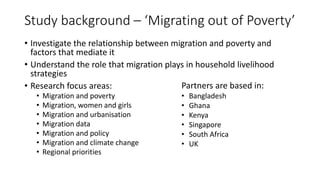
Study background – ‘Migrating out of Poverty’
• Investigate the relationship between migration and poverty and
factors that mediate it
• Understand the role that migration plays in household livelihood
strategies
• Research focus areas:
• Migration and poverty
• Migration, women and girls
• Migration and urbanisation
• Migration data
• Migration and policy
• Migration and climate change
• Regional priorities
Partners are based in:
• Bangladesh
• Ghana
• Kenya
• Singapore
• South Africa
• UK
Study background – ‘Migrating out of Poverty’
• Quantitative strand: provide data on migration in order to
• understand the differences/similarities of internal, regional and
international migration
• compare similar surveys in different regions (Ghana, Ethiopia,
Bangladesh, Indonesia and Zimbabwe)
• Follow-up surveys
• Open Access (in 2016)
Case study Zimbabwe
• Very few surveys conducted in Zimbabwe due to political
environment
• Long history of internal and international migration, but little
evidence
• Importance of regional migration in Southern Africa
Case selection
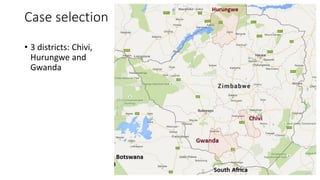
• 3 districts: Chivi,
Hurungwe and
Gwanda
Case selection
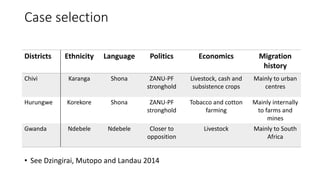
Districts Ethnicity Language Politics Economics Migration
history
Chivi Karanga Shona ZANU-PF
stronghold
Livestock, cash and
subsistence crops
Mainly to urban
centres
Hurungwe Korekore Shona ZANU-PF
stronghold
Tobacco and cotton
farming
Mainly internally
to farms and
mines
Gwanda Ndebele Ndebele Closer to
opposition
Livestock Mainly to South
Africa
• See Dzingirai, Mutopo and Landau 2014
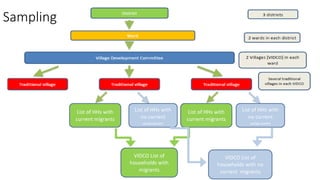
Sampling
Definitions
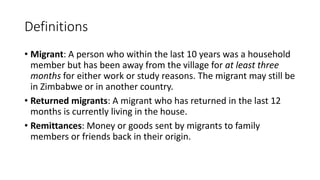
• Migrant: A person who within the last 10 years was a household
member but has been away from the village for at least three
months for either work or study reasons. The migrant may still be
in Zimbabwe or in another country.
• Returned migrants: A migrant who has returned in the last 12
months is currently living in the house.
• Remittances: Money or goods sent by migrants to family
members or friends back in their origin.
Questionnaire
Questionnaire
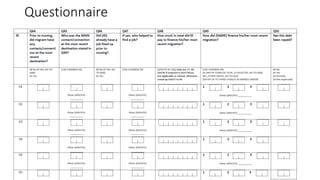
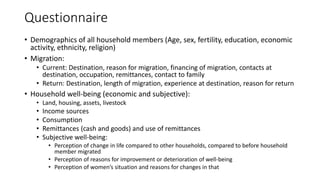
• Demographics of all household members (Age, sex, fertility, education, economic
activity, ethnicity, religion)
• Migration:
• Current: Destination, reason for migration, financing of migration, contacts at
destination, occupation, remittances, contact to family
• Return: Destination, length of migration, experience at destination, reason for return
• Household well-being (economic and subjective):
• Land, housing, assets, livestock
• Income sources
• Consumption
• Remittances (cash and goods) and use of remittances
• Subjective well-being:
• Perception of change in life compared to other households, compared to before household
member migrated
• Perception of reasons for improvement or deterioration of well-being
• Perception of women’s situation and reasons for changes in that
Sample across districts
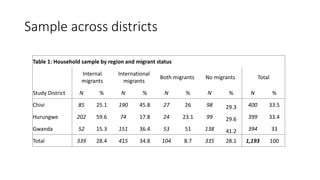
Table 1: Household sample by region and migrant status
Internal
migrants
International
migrants
Both migrants No migrants Total
Study District N % N % N % N % N %
Chivi 85 25.1 190 45.8 27 26 98 29.3 400 33.5
Hurungwe 202 59.6 74 17.8 24 23.1 99 29.6 399 33.4
Gwanda 52 15.3 151 36.4 53 51 138 41.2 394 33
Total 339 28.4 415 34.8 104 8.7 335 28.1 1,193 100
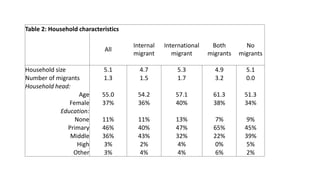
Table 2: Household characteristics
All
Internal
migrant
International
migrant
Both
migrants
No
migrants
Household size 5.1 4.7 5.3 4.9 5.1
Number of migrants 1.3 1.5 1.7 3.2 0.0
Household head:
Age 55.0 54.2 57.1 61.3 51.3
Female 37% 36% 40% 38% 34%
Education:
None 11% 11% 13% 7% 9%
Primary 46% 40% 47% 65% 45%
Middle 36% 43% 32% 22% 39%
High 3% 2% 4% 0% 5%
Other 3% 4% 4% 6% 2%
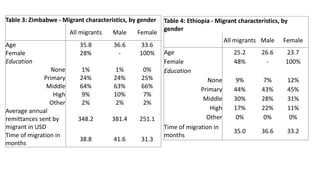
Table 3: Zimbabwe - Migrant characteristics, by gender
All migrants Male Female
Age 35.8 36.6 33.6
Female 28% - 100%
Education
None 1% 1% 0%
Primary 24% 24% 25%
Middle 64% 63% 66%
High 9% 10% 7%
Other 2% 2% 2%
Average annual
remittances sent by
migrant in USD
348.2 381.4 251.1
Time of migration in
months
38.8 41.6 31.3
Table 4: Ethiopia - Migrant characteristics, by
gender
All migrants Male Female
Age 25.2 26.6 23.7
Female 48% - 100%
Education
None 9% 7% 12%
Primary 44% 43% 45%
Middle 30% 28% 31%
High 17% 22% 11%
Other 0% 0% 0%
Time of migration in
months
35.0 36.6 33.2
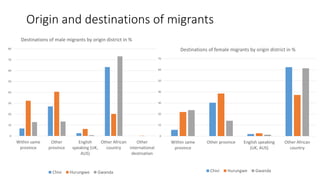
0
10
20
30
40
50
60
70
80
Within same
province
Other
province
English
speaking (UK,
AUS)
Other African
country
Other
international
destination
Destinations of male migrants by origin district in %
Chivi Hurungwe Gwanda
0
10
20
30
40
50
60
70
Within same
province
Other province English speaking
(UK, AUS)
Other African
country
Destinations of female migrants by origin district in %
Chivi Hurungwe Gwanda
Origin and destinations of migrants
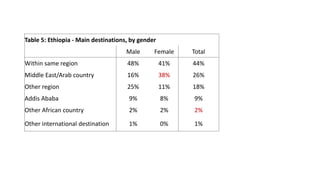
Table 5: Ethiopia - Main destinations, by gender
Male Female Total
Within same region 48% 41% 44%
Middle East/Arab country 16% 38% 26%
Other region 25% 11% 18%
Addis Ababa 9% 8% 9%
Other African country 2% 2% 2%
Other international destination 1% 0% 1%
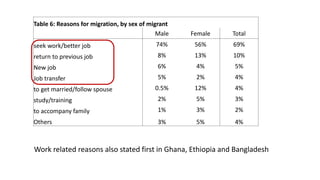
Table 6: Reasons for migration, by sex of migrant
Male Female Total
seek work/better job 74% 56% 69%
return to previous job 8% 13% 10%
New job 6% 4% 5%
Job transfer 5% 2% 4%
to get married/follow spouse 0.5% 12% 4%
study/training 2% 5% 3%
to accompany family 1% 3% 2%
Others 3% 5% 4%
Work related reasons also stated first in Ghana, Ethiopia and Bangladesh
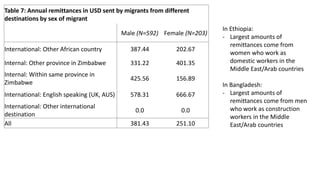
Table 7: Annual remittances in USD sent by migrants from different
destinations by sex of migrant
Male (N=592) Female (N=203)
International: Other African country 387.44 202.67
Internal: Other province in Zimbabwe 331.22 401.35
Internal: Within same province in
Zimbabwe
425.56 156.89
International: English speaking (UK, AUS) 578.31 666.67
International: Other international
destination
0.0 0.0
All 381.43 251.10
In Ethiopia:
- Largest amounts of
remittances come from
women who work as
domestic workers in the
Middle East/Arab countries
In Bangladesh:
- Largest amounts of
remittances come from men
who work as construction
workers in the Middle
East/Arab countries
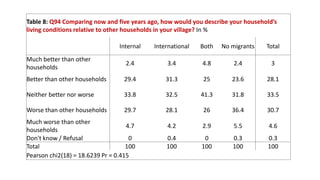
Table 8: Q94 Comparing now and five years ago, how would you describe your household’s
living conditions relative to other households in your village? In %
Internal International Both No migrants Total
Much better than other
households
2.4 3.4 4.8 2.4 3
Better than other households 29.4 31.3 25 23.6 28.1
Neither better nor worse 33.8 32.5 41.3 31.8 33.5
Worse than other households 29.7 28.1 26 36.4 30.7
Much worse than other
households
4.7 4.2 2.9 5.5 4.6
Don't know / Refusal 0 0.4 0 0.3 0.3
Total 100 100 100 100 100
Pearson chi2(18) = 18.6239 Pr = 0.415
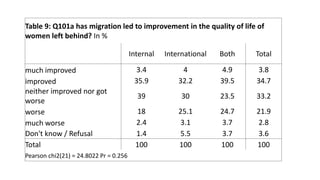
Table 9: Q101a has migration led to improvement in the quality of life of
women left behind? In %
Internal International Both Total
much improved 3.4 4 4.9 3.8
improved 35.9 32.2 39.5 34.7
neither improved nor got
worse
39 30 23.5 33.2
worse 18 25.1 24.7 21.9
much worse 2.4 3.1 3.7 2.8
Don't know / Refusal 1.4 5.5 3.7 3.6
Total 100 100 100 100
Pearson chi2(21) = 24.8022 Pr = 0.256
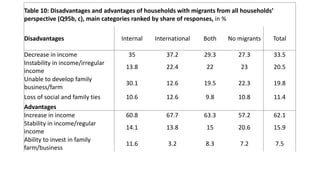
Table 10: Disadvantages and advantages of households with migrants from all households’
perspective (Q95b, c), main categories ranked by share of responses, in %
Disadvantages Internal International Both No migrants Total
Decrease in income 35 37.2 29.3 27.3 33.5
Instability in income/irregular
income
13.8 22.4 22 23 20.5
Unable to develop family
business/farm
30.1 12.6 19.5 22.3 19.8
Loss of social and family ties 10.6 12.6 9.8 10.8 11.4
Advantages
Increase in income 60.8 67.7 63.3 57.2 62.1
Stability in income/regular
income
14.1 13.8 15 20.6 15.9
Ability to invest in family
farm/business
11.6 3.2 8.3 7.2 7.5
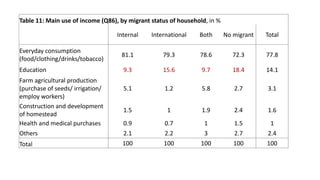
Table 11: Main use of income (Q86), by migrant status of household, in %
Internal International Both No migrant Total
Everyday consumption
(food/clothing/drinks/tobacco)
81.1 79.3 78.6 72.3 77.8
Education 9.3 15.6 9.7 18.4 14.1
Farm agricultural production
(purchase of seeds/ irrigation/
employ workers)
5.1 1.2 5.8 2.7 3.1
Construction and development
of homestead
1.5 1 1.9 2.4 1.6
Health and medical purchases 0.9 0.7 1 1.5 1
Others 2.1 2.2 3 2.7 2.4
Total 100 100 100 100 100
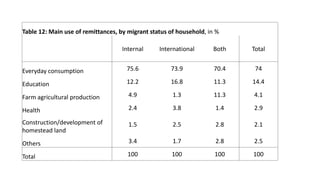
Table 12: Main use of remittances, by migrant status of household, in %
Internal International Both Total
Everyday consumption 75.6 73.9 70.4 74
Education 12.2 16.8 11.3 14.4
Farm agricultural production 4.9 1.3 11.3 4.1
Health 2.4 3.8 1.4 2.9
Construction/development of
homestead land
1.5 2.5 2.8 2.1
Others 3.4 1.7 2.8 2.5
Total 100 100 100 100
Thank you!
Any questions or comments, please?

Migration's effects on sending communities: Zimbabwe case study 7-8-15 - by Eva-Maria Egger

  • 1.
    Quantitative Research onMigration’s Effects on Sending Communities: Zimbabwean Case Study Eva-Maria Egger – 7.08.2015 Research Program Consortium ‘Migrating out of Poverty’ funded by the Department for International Development (DfID), UK http://migratingoutofpoverty.dfid.gov.uk African Centre for Migration and Society (ACMS), Wits University, and Sussex Centre for Migration Research (SCMR), University of Sussex Partners: Centre for Applied Social Sciences (CASS), University of Zimbabwe and Mthente Research and Consulting Services, Cape Town
  • 2.
    Overview • Study background– ‘Migrating out of Poverty’ • Case study Zimbabwe • Sampling • Questionnaire • Preliminary!!! results
  • 3.
    Study background –‘Migrating out of Poverty’ • Investigate the relationship between migration and poverty and factors that mediate it • Understand the role that migration plays in household livelihood strategies • Research focus areas: • Migration and poverty • Migration, women and girls • Migration and urbanisation • Migration data • Migration and policy • Migration and climate change • Regional priorities Partners are based in: • Bangladesh • Ghana • Kenya • Singapore • South Africa • UK
  • 4.
    Study background –‘Migrating out of Poverty’ • Quantitative strand: provide data on migration in order to • understand the differences/similarities of internal, regional and international migration • compare similar surveys in different regions (Ghana, Ethiopia, Bangladesh, Indonesia and Zimbabwe) • Follow-up surveys • Open Access (in 2016)
  • 5.
    Case study Zimbabwe •Very few surveys conducted in Zimbabwe due to political environment • Long history of internal and international migration, but little evidence • Importance of regional migration in Southern Africa
  • 6.
    Case selection • 3districts: Chivi, Hurungwe and Gwanda
  • 7.
    Case selection Districts EthnicityLanguage Politics Economics Migration history Chivi Karanga Shona ZANU-PF stronghold Livestock, cash and subsistence crops Mainly to urban centres Hurungwe Korekore Shona ZANU-PF stronghold Tobacco and cotton farming Mainly internally to farms and mines Gwanda Ndebele Ndebele Closer to opposition Livestock Mainly to South Africa • See Dzingirai, Mutopo and Landau 2014
  • 8.
  • 9.
    Definitions • Migrant: Aperson who within the last 10 years was a household member but has been away from the village for at least three months for either work or study reasons. The migrant may still be in Zimbabwe or in another country. • Returned migrants: A migrant who has returned in the last 12 months is currently living in the house. • Remittances: Money or goods sent by migrants to family members or friends back in their origin.
  • 10.
  • 11.
    Questionnaire • Demographics ofall household members (Age, sex, fertility, education, economic activity, ethnicity, religion) • Migration: • Current: Destination, reason for migration, financing of migration, contacts at destination, occupation, remittances, contact to family • Return: Destination, length of migration, experience at destination, reason for return • Household well-being (economic and subjective): • Land, housing, assets, livestock • Income sources • Consumption • Remittances (cash and goods) and use of remittances • Subjective well-being: • Perception of change in life compared to other households, compared to before household member migrated • Perception of reasons for improvement or deterioration of well-being • Perception of women’s situation and reasons for changes in that
  • 12.
    Sample across districts Table1: Household sample by region and migrant status Internal migrants International migrants Both migrants No migrants Total Study District N % N % N % N % N % Chivi 85 25.1 190 45.8 27 26 98 29.3 400 33.5 Hurungwe 202 59.6 74 17.8 24 23.1 99 29.6 399 33.4 Gwanda 52 15.3 151 36.4 53 51 138 41.2 394 33 Total 339 28.4 415 34.8 104 8.7 335 28.1 1,193 100
  • 13.
    Table 2: Householdcharacteristics All Internal migrant International migrant Both migrants No migrants Household size 5.1 4.7 5.3 4.9 5.1 Number of migrants 1.3 1.5 1.7 3.2 0.0 Household head: Age 55.0 54.2 57.1 61.3 51.3 Female 37% 36% 40% 38% 34% Education: None 11% 11% 13% 7% 9% Primary 46% 40% 47% 65% 45% Middle 36% 43% 32% 22% 39% High 3% 2% 4% 0% 5% Other 3% 4% 4% 6% 2%
  • 14.
    Table 3: Zimbabwe- Migrant characteristics, by gender All migrants Male Female Age 35.8 36.6 33.6 Female 28% - 100% Education None 1% 1% 0% Primary 24% 24% 25% Middle 64% 63% 66% High 9% 10% 7% Other 2% 2% 2% Average annual remittances sent by migrant in USD 348.2 381.4 251.1 Time of migration in months 38.8 41.6 31.3 Table 4: Ethiopia - Migrant characteristics, by gender All migrants Male Female Age 25.2 26.6 23.7 Female 48% - 100% Education None 9% 7% 12% Primary 44% 43% 45% Middle 30% 28% 31% High 17% 22% 11% Other 0% 0% 0% Time of migration in months 35.0 36.6 33.2
  • 15.
    0 10 20 30 40 50 60 70 80 Within same province Other province English speaking (UK, AUS) OtherAfrican country Other international destination Destinations of male migrants by origin district in % Chivi Hurungwe Gwanda 0 10 20 30 40 50 60 70 Within same province Other province English speaking (UK, AUS) Other African country Destinations of female migrants by origin district in % Chivi Hurungwe Gwanda Origin and destinations of migrants
  • 16.
    Table 5: Ethiopia- Main destinations, by gender Male Female Total Within same region 48% 41% 44% Middle East/Arab country 16% 38% 26% Other region 25% 11% 18% Addis Ababa 9% 8% 9% Other African country 2% 2% 2% Other international destination 1% 0% 1%
  • 17.
    Table 6: Reasonsfor migration, by sex of migrant Male Female Total seek work/better job 74% 56% 69% return to previous job 8% 13% 10% New job 6% 4% 5% Job transfer 5% 2% 4% to get married/follow spouse 0.5% 12% 4% study/training 2% 5% 3% to accompany family 1% 3% 2% Others 3% 5% 4% Work related reasons also stated first in Ghana, Ethiopia and Bangladesh
  • 18.
    Table 7: Annualremittances in USD sent by migrants from different destinations by sex of migrant Male (N=592) Female (N=203) International: Other African country 387.44 202.67 Internal: Other province in Zimbabwe 331.22 401.35 Internal: Within same province in Zimbabwe 425.56 156.89 International: English speaking (UK, AUS) 578.31 666.67 International: Other international destination 0.0 0.0 All 381.43 251.10 In Ethiopia: - Largest amounts of remittances come from women who work as domestic workers in the Middle East/Arab countries In Bangladesh: - Largest amounts of remittances come from men who work as construction workers in the Middle East/Arab countries
  • 21.
    Table 8: Q94Comparing now and five years ago, how would you describe your household’s living conditions relative to other households in your village? In % Internal International Both No migrants Total Much better than other households 2.4 3.4 4.8 2.4 3 Better than other households 29.4 31.3 25 23.6 28.1 Neither better nor worse 33.8 32.5 41.3 31.8 33.5 Worse than other households 29.7 28.1 26 36.4 30.7 Much worse than other households 4.7 4.2 2.9 5.5 4.6 Don't know / Refusal 0 0.4 0 0.3 0.3 Total 100 100 100 100 100 Pearson chi2(18) = 18.6239 Pr = 0.415
  • 22.
    Table 9: Q101ahas migration led to improvement in the quality of life of women left behind? In % Internal International Both Total much improved 3.4 4 4.9 3.8 improved 35.9 32.2 39.5 34.7 neither improved nor got worse 39 30 23.5 33.2 worse 18 25.1 24.7 21.9 much worse 2.4 3.1 3.7 2.8 Don't know / Refusal 1.4 5.5 3.7 3.6 Total 100 100 100 100 Pearson chi2(21) = 24.8022 Pr = 0.256
  • 23.
    Table 10: Disadvantagesand advantages of households with migrants from all households’ perspective (Q95b, c), main categories ranked by share of responses, in % Disadvantages Internal International Both No migrants Total Decrease in income 35 37.2 29.3 27.3 33.5 Instability in income/irregular income 13.8 22.4 22 23 20.5 Unable to develop family business/farm 30.1 12.6 19.5 22.3 19.8 Loss of social and family ties 10.6 12.6 9.8 10.8 11.4 Advantages Increase in income 60.8 67.7 63.3 57.2 62.1 Stability in income/regular income 14.1 13.8 15 20.6 15.9 Ability to invest in family farm/business 11.6 3.2 8.3 7.2 7.5
  • 24.
    Table 11: Mainuse of income (Q86), by migrant status of household, in % Internal International Both No migrant Total Everyday consumption (food/clothing/drinks/tobacco) 81.1 79.3 78.6 72.3 77.8 Education 9.3 15.6 9.7 18.4 14.1 Farm agricultural production (purchase of seeds/ irrigation/ employ workers) 5.1 1.2 5.8 2.7 3.1 Construction and development of homestead 1.5 1 1.9 2.4 1.6 Health and medical purchases 0.9 0.7 1 1.5 1 Others 2.1 2.2 3 2.7 2.4 Total 100 100 100 100 100
  • 25.
    Table 12: Mainuse of remittances, by migrant status of household, in % Internal International Both Total Everyday consumption 75.6 73.9 70.4 74 Education 12.2 16.8 11.3 14.4 Farm agricultural production 4.9 1.3 11.3 4.1 Health 2.4 3.8 1.4 2.9 Construction/development of homestead land 1.5 2.5 2.8 2.1 Others 3.4 1.7 2.8 2.5 Total 100 100 100 100
  • 26.
    Thank you! Any questionsor comments, please?