Migrant friendly or migration
           aware?
The challenges of a key population
approach to migration, HIV and TB
             Jo Vearey, PhD

          jo.vearey@wits.ac.za

           25th November 2012
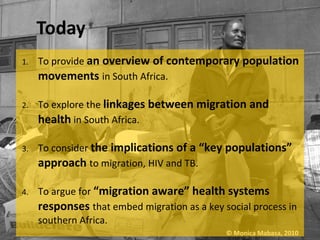
1.   To provide an overview of contemporary population
     movements in South Africa.

2.   To explore the linkages between migration and
     health in South Africa.

3.   To consider the implications of a “key populations”
     approach to migration, HIV and TB.

4.   To argue for “migration aware” health systems
     responses that embed migration as a key social process in
     southern Africa.
                                              © Monica Mabasa, 2010
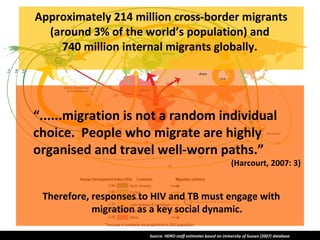
Approximately 214 million cross-border migrants
  (around 3% of the world’s population) and
    740 million internal migrants globally.


“......migration is not a random individual
choice. People who migrate are highly
organised and travel well-worn paths.”
                                                                  (Harcourt, 2007: 3)


 Therefore, responses to HIV and TB must engage with
            migration as a key social dynamic.

                        Source: HDRO staff estimates based on University of Sussex (2007) database
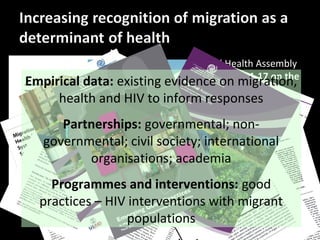
The 61st annual World Health Assembly
                   (WHA) adopted Resolution 61.17 on the
Empirical data:   existing evidence on migration,
                   Health of Migrants in 2008.
     health and HIV to inform responses
               This Resolution calls on member states
     Partnerships: governmental;to promote
               (including South Africa) non-
  governmental; civil society;to health promotion,
               equitable access international
               disease prevention and care for migrants.
             organisations; academia
              Four priority areas have been identified for
    Programmesachieving the WHA resolution:
               and interventions: good
  practices – HIV interventions with migrant
                            1. Monitoring migrant health
                            2. Partnerships and networks
                  populations Migrant sensitive health systems
                            3.
                                  4. Policy and legal frameworks
1. South(ern) Africa is associated with
historical and contemporary population
movements.
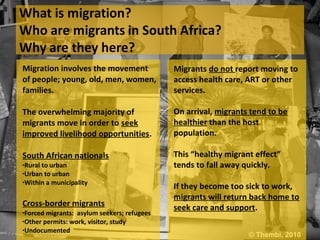
Migration involves the movement              Migrants do not report moving to
of people; young, old, men, women,           access health care, ART or other
families.                                    services.

The overwhelming majority of                 On arrival, migrants tend to be
migrants move in order to seek               healthier than the host
improved livelihood opportunities.           population.

South African nationals                      This “healthy migrant effect”
•Rural to urban                              tends to fall away quickly.
•Urban to urban
•Within a municipality
                                             If they become too sick to work,
                                             migrants will return back home to
Cross-border migrants                        seek care and support.
•Forced migrants: asylum seekers; refugees
•Other permits: work, visitor, study
•Undocumented
                                                                 © Thembi, 2010
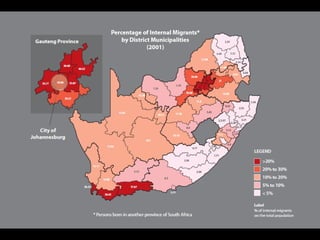
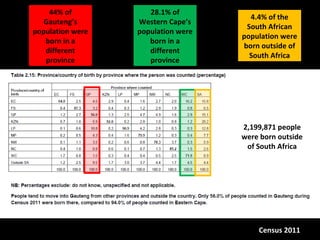
44% of           28.1% of
                                      4.4% of the
   Gauteng’s      Western Cape’s
                                     South African
population were   population were
                                    population were
   born in a         born in a
                                    born outside of
   different         different
                                      South Africa
   province          province


                                    2,199,871 people
                                    were born outside
                                     of South Africa


                                        Census 2011
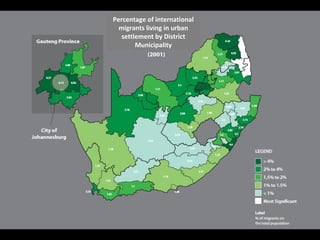
Percentage of international
  migrants living in urban
   settlement by District
        Municipality
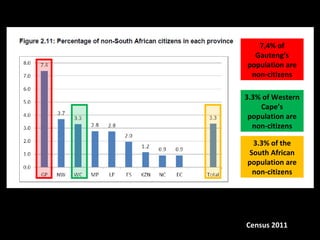
7,4% of
  Gauteng’s
population are
 non-citizens

3.3% of Western
    Cape’s
 population are
  non-citizens

 3.3% of the
South African
population are
 non-citizens


Census 2011
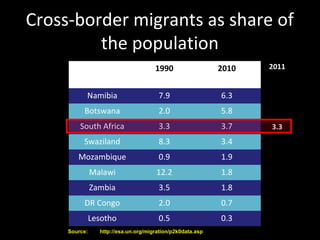
Cross-border migrants as share of
         the population
                                      1990                  2010   2011


           Namibia                     7.9                  6.3
          Botswana                     2.0                  5.8
         South Africa                  3.3                  3.7    3.3
          Swaziland                    8.3                  3.4
        Mozambique                     0.9                  1.9
               Malawi                 12.2                  1.8
               Zambia                  3.5                  1.8
          DR Congo                     2.0                  0.7
               Lesotho                 0.5                  0.3
     Source:     http://esa.un.org/migration/p2k0data.asp
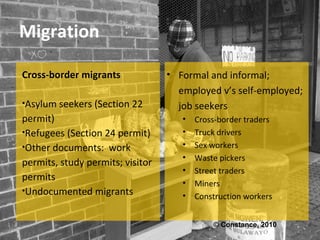
Migration

Cross-border migrants             • Formal and informal;
                                    employed v’s self-employed;
•Asylum seekers (Section 22         job seekers
permit)                              •   Cross-border traders
•Refugees (Section 24 permit)        •   Truck drivers
•Other documents: work               •   Sex workers
                                     •   Waste pickers
permits, study permits; visitor
                                     •   Street traders
permits
                                     •   Miners
•Undocumented migrants
                                     •   Construction workers


                                             © Constance, 2010
2. There are linkages between migration and health
in South(ern) Africa.
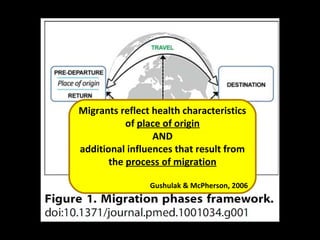
Migrants reflect health characteristics
           of place of origin
                 AND
additional influences that result from
       the process of migration

                Gushulak & McPherson, 2006
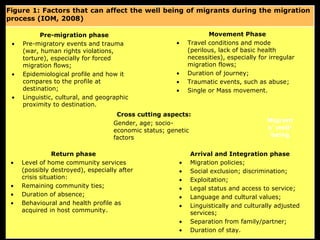
Figure 1: Factors that can affect the well being of migrants during the migration
process (IOM, 2008)

           Pre-migration phase                                     Movement Phase
 •   Pre-migratory events and trauma                   •    Travel conditions and mode
     (war, human rights violations,                         (perilous, lack of basic health
     torture), especially for forced                        necessities), especially for irregular
     migration flows;                                       migration flows;
 •   Epidemiological profile and how it                •    Duration of journey;
     compares to the profile at                        •    Traumatic events, such as abuse;
     destination;                                      •    Single or Mass movement.
 •   Linguistic, cultural, and geographic
     proximity to destination.
                                     Cross cutting aspects:
                                    Gender, age; socio-                                 Migrant
                                    economic status; genetic                            s’ well-
                                    factors                                              being


                Return phase                                Arrival and Integration phase
 •   Level of home community services                   •   Migration policies;
     (possibly destroyed), especially after             •   Social exclusion; discrimination;
     crisis situation:                                  •   Exploitation;
 •   Remaining community ties;                          •   Legal status and access to service;
 •   Duration of absence;                               •   Language and cultural values;
 •   Behavioural and health profile as                  •   Linguistically and culturally adjusted
     acquired in host community.                            services;
                                                        •   Separation from family/partner;
                                                        •   Duration of stay.
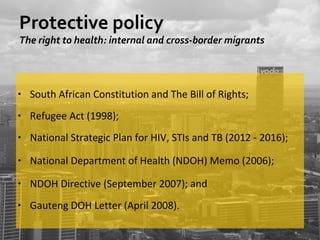
Protective policy
The right to health: internal and cross-border migrants


•   South African Constitution and The Bill of Rights;
•   Refugee Act (1998);
•   National Strategic Plan for HIV, STIs and TB (2012 - 2016);

•   National Department of Health (NDOH) Memo (2006);

•   NDOH Directive (September 2007); and
•   Gauteng DOH Letter (April 2008).
3. A “key populations” approach to migration, HIV
and TB has (unintended) negative consequences.
Challenges of a key population approach to
migration, HIV and TB.
• Migrant friendly approach:
        •   Individual focus (v’s population focus)
        •   Facility-level responses (v’s health system responses)
        •   Emphasis on language and translation; cultural competency
        •   Exceptionalise: focus on non-nationals

• “Right to health” focus
   •   Migrants perceived as sick, a burden on services, and in a larger number
       than they are

• Limited (no) systems response
   •   Client mobility within the health system is not addressed
4. There is a need for “migration aware” health
systems responses that embed migration as a key
social process in southern Africa.
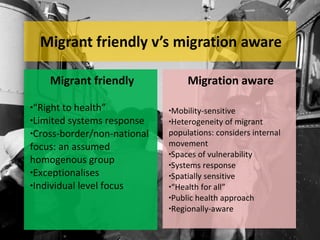
Migrant friendly              Migration aware

•“Right to health”           •Mobility-sensitive
•Limited systems response    •Heterogeneity of migrant
•Cross-border/non-national   populations: considers internal
focus: an assumed            movement
                             •Spaces of vulnerability
homogenous group             •Systems response
•Exceptionalises             •Spatially sensitive
•Individual level focus      •“Health for all”
                             •Public health approach
                             •Regionally-aware
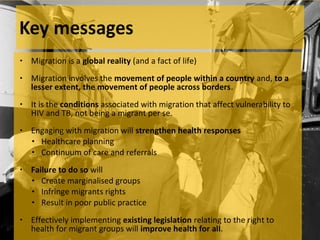
•   Migration is a global reality (and a fact of life)
•   Migration involves the movement of people within a country and, to a
    lesser extent, the movement of people across borders.
•   It is the conditions associated with migration that affect vulnerability to
    HIV and TB, not being a migrant per se.
•   Engaging with migration will strengthen health responses
    • Healthcare planning
    • Continuum of care and referrals

•   Failure to do so will
    • Create marginalised groups
    • Infringe migrants rights
    • Result in poor public practice

•   Effectively implementing existing legislation relating to the right to
    health for migrant groups will improve health for all.
Acknowledgements

•Lorena Nunez
•Matthew Wilhelm-Solomon
•Marlise Richter
•Dabea Gaboutloeloe

Migrant friendly or migration aware? The challenges of a key populations approach to migration, HIV and TB

  • 1.
    Migrant friendly ormigration aware? The challenges of a key population approach to migration, HIV and TB Jo Vearey, PhD jo.vearey@wits.ac.za 25th November 2012
  • 2.
    1. To provide an overview of contemporary population movements in South Africa. 2. To explore the linkages between migration and health in South Africa. 3. To consider the implications of a “key populations” approach to migration, HIV and TB. 4. To argue for “migration aware” health systems responses that embed migration as a key social process in southern Africa. © Monica Mabasa, 2010
  • 3.
    Approximately 214 millioncross-border migrants (around 3% of the world’s population) and 740 million internal migrants globally. “......migration is not a random individual choice. People who migrate are highly organised and travel well-worn paths.” (Harcourt, 2007: 3) Therefore, responses to HIV and TB must engage with migration as a key social dynamic. Source: HDRO staff estimates based on University of Sussex (2007) database
  • 4.
    The 61st annualWorld Health Assembly (WHA) adopted Resolution 61.17 on the Empirical data: existing evidence on migration, Health of Migrants in 2008. health and HIV to inform responses This Resolution calls on member states Partnerships: governmental;to promote (including South Africa) non- governmental; civil society;to health promotion, equitable access international disease prevention and care for migrants. organisations; academia Four priority areas have been identified for Programmesachieving the WHA resolution: and interventions: good practices – HIV interventions with migrant 1. Monitoring migrant health 2. Partnerships and networks populations Migrant sensitive health systems 3. 4. Policy and legal frameworks
  • 5.
    1. South(ern) Africais associated with historical and contemporary population movements.
  • 6.
    Migration involves themovement Migrants do not report moving to of people; young, old, men, women, access health care, ART or other families. services. The overwhelming majority of On arrival, migrants tend to be migrants move in order to seek healthier than the host improved livelihood opportunities. population. South African nationals This “healthy migrant effect” •Rural to urban tends to fall away quickly. •Urban to urban •Within a municipality If they become too sick to work, migrants will return back home to Cross-border migrants seek care and support. •Forced migrants: asylum seekers; refugees •Other permits: work, visitor, study •Undocumented © Thembi, 2010
  • 8.
    44% of 28.1% of 4.4% of the Gauteng’s Western Cape’s South African population were population were population were born in a born in a born outside of different different South Africa province province 2,199,871 people were born outside of South Africa Census 2011
  • 9.
    Percentage of international migrants living in urban settlement by District Municipality
  • 10.
    7,4% of Gauteng’s population are non-citizens 3.3% of Western Cape’s population are non-citizens 3.3% of the South African population are non-citizens Census 2011
  • 11.
    Cross-border migrants asshare of the population 1990 2010 2011 Namibia 7.9 6.3 Botswana 2.0 5.8 South Africa 3.3 3.7 3.3 Swaziland 8.3 3.4 Mozambique 0.9 1.9 Malawi 12.2 1.8 Zambia 3.5 1.8 DR Congo 2.0 0.7 Lesotho 0.5 0.3 Source: http://esa.un.org/migration/p2k0data.asp
  • 12.
    Migration Cross-border migrants • Formal and informal; employed v’s self-employed; •Asylum seekers (Section 22 job seekers permit) • Cross-border traders •Refugees (Section 24 permit) • Truck drivers •Other documents: work • Sex workers • Waste pickers permits, study permits; visitor • Street traders permits • Miners •Undocumented migrants • Construction workers © Constance, 2010
  • 13.
    2. There arelinkages between migration and health in South(ern) Africa.
  • 14.
    Migrants reflect healthcharacteristics of place of origin AND additional influences that result from the process of migration Gushulak & McPherson, 2006
  • 15.
    Figure 1: Factorsthat can affect the well being of migrants during the migration process (IOM, 2008) Pre-migration phase Movement Phase • Pre-migratory events and trauma • Travel conditions and mode (war, human rights violations, (perilous, lack of basic health torture), especially for forced necessities), especially for irregular migration flows; migration flows; • Epidemiological profile and how it • Duration of journey; compares to the profile at • Traumatic events, such as abuse; destination; • Single or Mass movement. • Linguistic, cultural, and geographic proximity to destination. Cross cutting aspects: Gender, age; socio- Migrant economic status; genetic s’ well- factors being Return phase Arrival and Integration phase • Level of home community services • Migration policies; (possibly destroyed), especially after • Social exclusion; discrimination; crisis situation: • Exploitation; • Remaining community ties; • Legal status and access to service; • Duration of absence; • Language and cultural values; • Behavioural and health profile as • Linguistically and culturally adjusted acquired in host community. services; • Separation from family/partner; • Duration of stay.
  • 16.
    Protective policy The rightto health: internal and cross-border migrants • South African Constitution and The Bill of Rights; • Refugee Act (1998); • National Strategic Plan for HIV, STIs and TB (2012 - 2016); • National Department of Health (NDOH) Memo (2006); • NDOH Directive (September 2007); and • Gauteng DOH Letter (April 2008).
  • 18.
    3. A “keypopulations” approach to migration, HIV and TB has (unintended) negative consequences.
  • 19.
    Challenges of akey population approach to migration, HIV and TB. • Migrant friendly approach: • Individual focus (v’s population focus) • Facility-level responses (v’s health system responses) • Emphasis on language and translation; cultural competency • Exceptionalise: focus on non-nationals • “Right to health” focus • Migrants perceived as sick, a burden on services, and in a larger number than they are • Limited (no) systems response • Client mobility within the health system is not addressed
  • 20.
    4. There isa need for “migration aware” health systems responses that embed migration as a key social process in southern Africa.
  • 21.
    Migrant friendly Migration aware •“Right to health” •Mobility-sensitive •Limited systems response •Heterogeneity of migrant •Cross-border/non-national populations: considers internal focus: an assumed movement •Spaces of vulnerability homogenous group •Systems response •Exceptionalises •Spatially sensitive •Individual level focus •“Health for all” •Public health approach •Regionally-aware
  • 22.
    Migration is a global reality (and a fact of life) • Migration involves the movement of people within a country and, to a lesser extent, the movement of people across borders. • It is the conditions associated with migration that affect vulnerability to HIV and TB, not being a migrant per se. • Engaging with migration will strengthen health responses • Healthcare planning • Continuum of care and referrals • Failure to do so will • Create marginalised groups • Infringe migrants rights • Result in poor public practice • Effectively implementing existing legislation relating to the right to health for migrant groups will improve health for all.
  • 23.

Editor's Notes

  • #4 Use of the map to emphasise that migration is a global reality and that southern Africa is mostly circular migration, most of which takes place within countries.
  • #5 Key point: Global, regional, and national recognition of the importance of engaging with migration in health, including HIV, responses. Talk to slide as the various images appear  Much evidence exists: research, programmatic evaluations, good practices These are based on partnerships, that already exist. So – a lot is known: we know that migration is a critical consideration for an effective HIV response.
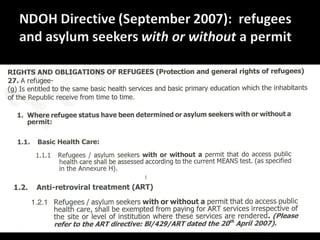
  • #17 A range of rights, including access to basic healthcare, are provided to non-nationals through the Refugee Act (1998) and the South African Constitution. The current HIV/AIDS and STI National Strategic Plan for South Africa (NSP) specifically includes non-nationals – international migrants, refugees and asylum seekers – and outlines their right to HIV prevention, treatment and support. In September 2007, the National Department of Health (NDOH) released a Revenue Directive [i] clarifying that refugees and asylum seekers – with or without a permit – shall be exempt from paying for antiretroviral treatment (ART) in the public sector. A key guiding principle to the successful implementation of the NSP is towards “ensuring equality and non-discrimination against marginalised groups”; refugees, asylum seekers and foreign migrants are specifically mentioned as having “a right to equal access to interventions for HIV prevention, treatment and support” [ii] . [i] Ref: BI 4/29 REFUG/ASYL 8 2007 [ii] Department of Health (2007) HIV & AIDS and STI Strategic Plan for South Africa, 2007 – 2011. April 2007: Pretoria: Department of Health, p56
  • #18 In September last year, the NDOH released a revenue directive clarifying that refugees and asylum seekers – with or without a permit – have to rhight to access basic health services and ART. They must be assessed according to the current means test, as applied to South African citizens, and must not be charged foreign category fees.
  • #23 I suggest we state these up front. So that they’re clear from the start.