IMPACT OF ECONOMIC
GLOBALIZATION
MIGRATION
What is Migration?
Migration is the permanent
movement of persons from
one geographical location or
region to another.
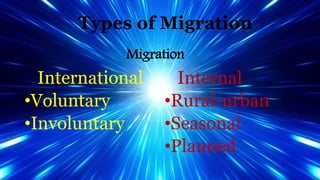
Types of Migration
Migration
International
•Voluntary
•Involuntary
Internal
•Rural-urban
•Seasonal
•Planned
International Migration
• Involuntary Migration Movement
of people caused by events which
force people to move against their
will.
• Voluntary Migration Movement of
people by choice or one’s own free
will.
Internal Migration
• Rural to Urban Migration: Movement of
people away from the rural region
(countryside, farms) to an urban (town, city)
area.
• Seasonal Migration: It refers to the
movement of people away from their homes
to find a livelihood, usually on a temporary
basis.
• Planned Migration: It refers to large-scale
migration of people within the country
usually carried out by the government.
Impacts of International Migration
Socio-economic impact:
• A possible disadvantages of
emigration is the ‘brain drain’, so
called because areas/countries can
lose their best workers.
• Social assimilation is related to
socio-political maturity of the host &
source societies.
Impacts of International Migration
Cultural Impact:
• Old colonial powers have relatively
cosmopolitan populations compared to
non-colonial nations
• In such countries there is also a
significant different between the ethnic
composition between urban & rural
areas.
Impacts of International Migration
Political Impact:
• In many countries with high
numbers of established/legal
immigrants they are more likely to
vote for political parties
sympathetic to their beliefs/needs.
Consequences Of Migration On The Country Of Origin
• • Economic Impact:
• • Positive
• The area benefits from
remittances sent home.
• Upon return, migrants bring
new skills to the country such as
the ability to speak foreign
languages. These new skills can
help to improve the economy in
the country of origin.
• There is less pressure on
resources such as food & social
services such as health care.
• • Negative
• Loss of young workforce; those
with skills & those with
entrepreneurial talents move,
slowing economic development.
• Loss of labor may reduce inward
investment by private companies,
increasing dependencies on
government initiatives.
Consequences Of Migration On The Country Of Origin
• dependencies on government
initiatives
• • Social Impacts
• • Positives
• Population density is reduced
& birth rate falls, as it’s the
younger population who migrates.
These can help ease
overpopulation.
• Remittances sent home by
economic migrants can be used
finance improved education &
health service.
• Returning migrants increased
social expectations for
communities, for example
increasing demand for better
leisure facilities.
• • Negatives
• Marriage rates fall & family
structures break down as men
migrate producing a generation
of single mums.
• Lost of young people
migrating out of the country can
increase the dependency ratio.
• Returning retired migrants
may increase social costs on the
community as supports
mechanisms aren’t in place for
them.
• Migration of men & young
families can cause a loss of
cultural leadership & traditions.
Consequences Of Migration On The Host Country
• • Economic Impacts
• • Positives
• Migrants take up less
desirable, menial jobs which
natives would not take but need
filling.
• The host country can gain
skilled labor for cheap.
• There is a labor surplus,
those with skills & education
fuel the economy.
• The “skill gap” in many host
countries can be filled by
migrants.
• Costs of retirement can be
transferred to the country of
origin
• • Negatives
• Migrant children must be
educated, they won’t
necessarily speak native
language of the host country.
• There is an over dependency
in some industries on migrant
labor, leading to a lack of jobs
for people native to the host
country.
• Much of the money earned by
the migrants isn’t spent in the
host country & is instead sent
back to the country of origin.
• More people increased the
pressure on resources &
services such as health care
system.
Consequences Of Migration On The Host Country
• • Social Impacts
• • Positives
• The creation of a
multiethnic society increases
understanding & tolerance of
other cultures.
• There is an influx of new or
revitalized services e.g,
Kebab shops & Turkish baths.
• People from other
countries can encourage the
learning of new languages,
helping people develop skills
for working internationally.
• • Negatives
• The dominance of males is
reinforced (due to large
number of male migrants)
especially in cultures where
women already have a low
status.
• Aspects of cultural identity
are lost, especially in second
generation children.
• Segregated ethnic areas
are created e.g, China Town.
Schools become dominated
by migrant children.
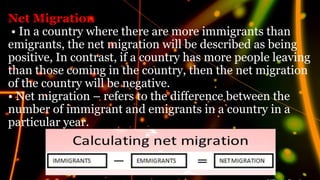
Net Migration
• In a country where there are more immigrants than
emigrants, the net migration will be described as being
positive, In contrast, if a country has more people leaving
than those coming in the country, then the net migration
of the country will be negative.
• Net migration – refers to the difference between the
number of immigrant and emigrants in a country in a
particular year.
Impact on Economic Globalization of Migration

Impact on Economic Globalization of Migration

  • 1.
  • 2.
    What is Migration? Migrationis the permanent movement of persons from one geographical location or region to another.
  • 3.
  • 4.
    International Migration • InvoluntaryMigration Movement of people caused by events which force people to move against their will. • Voluntary Migration Movement of people by choice or one’s own free will.
  • 5.
    Internal Migration • Ruralto Urban Migration: Movement of people away from the rural region (countryside, farms) to an urban (town, city) area. • Seasonal Migration: It refers to the movement of people away from their homes to find a livelihood, usually on a temporary basis. • Planned Migration: It refers to large-scale migration of people within the country usually carried out by the government.
  • 7.
    Impacts of InternationalMigration Socio-economic impact: • A possible disadvantages of emigration is the ‘brain drain’, so called because areas/countries can lose their best workers. • Social assimilation is related to socio-political maturity of the host & source societies.
  • 8.
    Impacts of InternationalMigration Cultural Impact: • Old colonial powers have relatively cosmopolitan populations compared to non-colonial nations • In such countries there is also a significant different between the ethnic composition between urban & rural areas.
  • 9.
    Impacts of InternationalMigration Political Impact: • In many countries with high numbers of established/legal immigrants they are more likely to vote for political parties sympathetic to their beliefs/needs.
  • 10.
    Consequences Of MigrationOn The Country Of Origin • • Economic Impact: • • Positive • The area benefits from remittances sent home. • Upon return, migrants bring new skills to the country such as the ability to speak foreign languages. These new skills can help to improve the economy in the country of origin. • There is less pressure on resources such as food & social services such as health care. • • Negative • Loss of young workforce; those with skills & those with entrepreneurial talents move, slowing economic development. • Loss of labor may reduce inward investment by private companies, increasing dependencies on government initiatives.
  • 11.
    Consequences Of MigrationOn The Country Of Origin • dependencies on government initiatives • • Social Impacts • • Positives • Population density is reduced & birth rate falls, as it’s the younger population who migrates. These can help ease overpopulation. • Remittances sent home by economic migrants can be used finance improved education & health service. • Returning migrants increased social expectations for communities, for example increasing demand for better leisure facilities. • • Negatives • Marriage rates fall & family structures break down as men migrate producing a generation of single mums. • Lost of young people migrating out of the country can increase the dependency ratio. • Returning retired migrants may increase social costs on the community as supports mechanisms aren’t in place for them. • Migration of men & young families can cause a loss of cultural leadership & traditions.
  • 12.
    Consequences Of MigrationOn The Host Country • • Economic Impacts • • Positives • Migrants take up less desirable, menial jobs which natives would not take but need filling. • The host country can gain skilled labor for cheap. • There is a labor surplus, those with skills & education fuel the economy. • The “skill gap” in many host countries can be filled by migrants. • Costs of retirement can be transferred to the country of origin • • Negatives • Migrant children must be educated, they won’t necessarily speak native language of the host country. • There is an over dependency in some industries on migrant labor, leading to a lack of jobs for people native to the host country. • Much of the money earned by the migrants isn’t spent in the host country & is instead sent back to the country of origin. • More people increased the pressure on resources & services such as health care system.
  • 13.
    Consequences Of MigrationOn The Host Country • • Social Impacts • • Positives • The creation of a multiethnic society increases understanding & tolerance of other cultures. • There is an influx of new or revitalized services e.g, Kebab shops & Turkish baths. • People from other countries can encourage the learning of new languages, helping people develop skills for working internationally. • • Negatives • The dominance of males is reinforced (due to large number of male migrants) especially in cultures where women already have a low status. • Aspects of cultural identity are lost, especially in second generation children. • Segregated ethnic areas are created e.g, China Town. Schools become dominated by migrant children.
  • 14.
    Net Migration • Ina country where there are more immigrants than emigrants, the net migration will be described as being positive, In contrast, if a country has more people leaving than those coming in the country, then the net migration of the country will be negative. • Net migration – refers to the difference between the number of immigrant and emigrants in a country in a particular year.