KAUSTUBH GUPTA – E31,NEHA GOSAIN – ,KRANTI- E47 ,DEVENDRA- E 24, MANISH- E 51
WWW.WTO.ORG

WWW.SCRIBD.COM

WWW.WORLDTRADEREVIEW.COM

WWW.UN.ORG

BRITANICA ENCYCLOPEDIA

BENARD HOEKMAN,AADIYA MATOO,EDWARD PHILIPS

LIBRARY.FE.DE/PDF

THE GREAT AMERICAN TRUCKING SHOW

EJIL.OXFORDJOURNALS.ORG
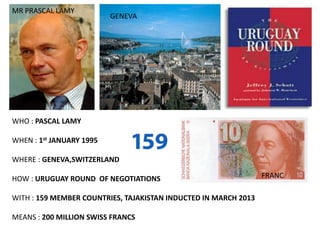
MR PRASCAL LAMY
                          GENEVA


WHO : PASCAL LAMY

WHEN : 1st JANUARY 1995

WHERE : GENEVA,SWITZERLAND

HOW : URUGUAY ROUND OF NEGOTIATIONS                              FRANC

WITH : 159 MEMBER COUNTRIES, TAJAKISTAN INDUCTED IN MARCH 2013

MEANS : 200 MILLION SWISS FRANCS
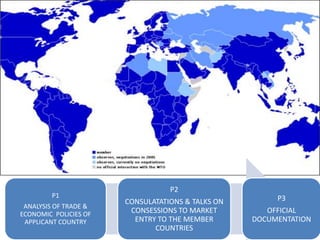
P2
        P1                                              P3
                       CONSULATATIONS & TALKS ON
 ANALYSIS OF TRADE &
ECONOMIC POLICIES OF    CONSESSIONS TO MARKET         OFFICIAL
 APPLICANT COUNTRY       ENTRY TO THE MEMBER       DOCUMENTATION
                              COUNTRIES
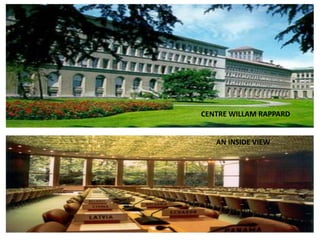
CENTRE WILLAM RAPPARD


   AN INSIDE VIEW
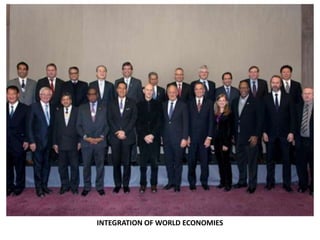
INTEGRATION OF WORLD ECONOMIES
WORLS TRADE ORGANIZATION COORDINATES WITH ITS SECRETARIAT,WHICH
EMPLOYEES 500 + STAFF INCLUDING ECONOMISTS,STATISTICIANS,LAWYERS AND
OTHER EXPERTS IN RELATED AREA OF CONCERN


 ● WTO AGREEMENTS COVER GOODS,SERVICES,INTELLECTUAL PROPERTY.

 ● AGREEMENTS INCLUDE COMMITMENTS TO LOWER CUSTOMS DUTIES
 AND OTHER TRADE BARRIERS COUPLED WITH OPENING OF MARKETS.

 ● IMPORTANTLY WTO SET PROCEDURES TO SETTLE DISPUTES

 ● TRADE NEGOTIATIONS AND CREATING LEVEL PLAYING FIELD FOR ALL.

 ● COOPERATION WITH OTHER INTERNATIONAL ESTABLISHMENTS.

 ● ASSISTING TECHNICALY & DEVELOPING COUNTRIES.
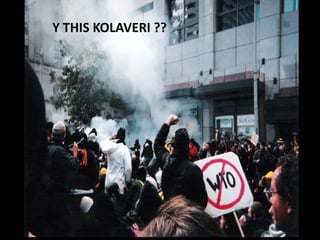
Y THIS KOLAVERI ??
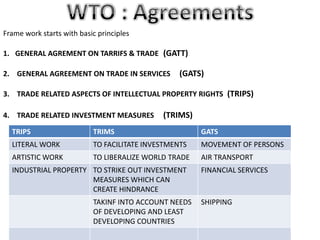
Frame work starts with basic principles

1. GENERAL AGREMENT ON TARRIFS & TRADE (GATT)

2. GENERAL AGREEMENT ON TRADE IN SERVICES         (GATS)

3. TRADE RELATED ASPECTS OF INTELLECTUAL PROPERTY RIGHTS (TRIPS)

4. TRADE RELATED INVESTMENT MEASURES         (TRIMS)
  TRIPS                    TRIMS                       GATS
  LITERAL WORK             TO FACILITATE INVESTMENTS   MOVEMENT OF PERSONS
  ARTISTIC WORK            TO LIBERALIZE WORLD TRADE   AIR TRANSPORT
  INDUSTRIAL PROPERTY TO STRIKE OUT INVESTMENT         FINANCIAL SERVICES
                      MEASURES WHICH CAN
                      CREATE HINDRANCE
                           TAKINF INTO ACCOUNT NEEDS   SHIPPING
                           OF DEVELOPING AND LEAST
                           DEVELOPING COUNTRIES
It is the GATT Uruguay Round Agreement on Trade Related Intellectual Property.
It deals with the protection & enforcement of “Trade-Related” intellectual property
“rights". It establishes minimum levels of protection that each government has to give to
the intellectual property of fellow WTO members

DEALS IN :


How basic principles of the trading system and other international intellectual property
agreements should be applied

●How to give adequate protection to intellectual property rights

●How countries should enforce those rights adequately in their own territories

●How to settle disputes on intellectual property between members of the WTO

●Special transitional arrangements during the period when the new system is being
introduced.
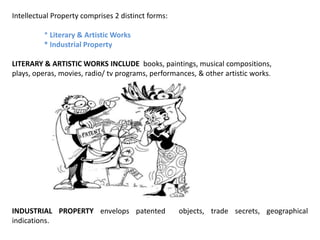
Intellectual Property comprises 2 distinct forms:

          * Literary & Artistic Works
          * Industrial Property

LITERARY & ARTISTIC WORKS INCLUDE books, paintings, musical compositions,
plays, operas, movies, radio/ tv programs, performances, & other artistic works.


INDUSTRIAL PROPERTY envelops patented               objects, trade secrets, geographical
indications.
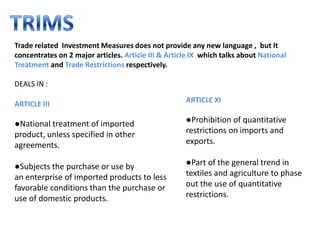
Trade related Investment Measures does not provide any new language , but It
concentrates on 2 major articles. Article III & Article IX which talks about National
Treatment and Trade Restrictions respectively.

DEALS IN :
                                                     ARTICLE XI
ARTICLE III

●National treatment of imported                      ●Prohibition of quantitative
product, unless specified in other                   restrictions on imports and
agreements.                                          exports.

●Subjects the purchase or use by                     ●Part of the general trend in
an enterprise of imported products to less           textiles and agriculture to phase
favorable conditions than the purchase or            out the use of quantitative
use of domestic products.                            restrictions.
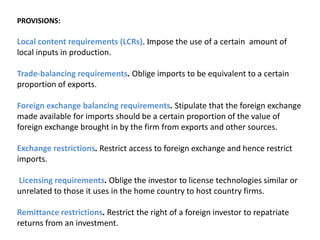
PROVISIONS:

Local content requirements (LCRs). Impose the use of a certain amount of
local inputs in production.

Trade-balancing requirements. Oblige imports to be equivalent to a certain
proportion of exports.

Foreign exchange balancing requirements. Stipulate that the foreign exchange
made available for imports should be a certain proportion of the value of
foreign exchange brought in by the firm from exports and other sources.

Exchange restrictions. Restrict access to foreign exchange and hence restrict
imports.

Licensing requirements. Oblige the investor to license technologies similar or
unrelated to those it uses in the home country to host country firms.

Remittance restrictions. Restrict the right of a foreign investor to repatriate
returns from an investment.
Local equity requirements. Specify that a certain percentage of a firm’s equity should
be held by local investors.

Domestic sales requirements. Require a company to sell a certain proportion of its
output locally, which amounts to a restriction on exportation.

Manufacturing requirements. Require certain products to be manufactured locally.

Export performance requirements (EPRs). Stipulate that a certain proportion of
production should be exported.

Product mandating requirements. Oblige an investor to supply certain markets with a
designated product or products manufactured from a specified facility or operation.

Manufacturing limitations. Prevent companies from manufacturing certain products or
product lines in the host country.

Technology transfer requirements. Require specified technologies to be transferred on
non-commercial terms and/or specific levels and types of research and development
(R & D) to be conducted locally.
Local equity requirements. Specify that a certain percentage of a firm’s
equity should be held by local investors.

Domestic sales requirements. Require a company to sell a certain proportion
of its output locally, which amounts to a restriction on exportation.

Manufacturing requirements. Require certain products to be manufactured
locally.
General Agreement on Trade in Services, is the first and the only comprehensive
multilateral discipline covering international trade in Services. It was negotiated during
Uruguay Round and came into force along with other WTO agreements in January
1995.

A simple definition of services is that services are the tradables, which are intangible,
invisible, and incapable of storage and, therefore, requiring simultaneous production
and consumption. This description does have its limitations as technical advancements
have made it possible for the services to be visible and capable of storage (for example,
a foreign consultant prepares a documentary film for a local company and sends it to
that company in the form of a video cassette)

As per WTO services are divided into 12 areas and sub divided into 164 areas

Business Services, Communication Services, Construction and
Engineering Services ,Distribution Services, Education Services,Environmental
Services, Financial Services, Health Services, Tourism and travel Services,
Recreation, cultural and sporting Services, Transport Services, Other Services
not included elsewhere.
MODES OF SUPPLY OF SERVICES

Mode 1: (Cross - Border Supply) - This refers to the delivery of service from the territory
of one country to the territory of the other country by crossing international border.
examples : financial trading, maritime transport and telecommunication services.

Mode 2: (Consumption Abroad) - In this method, consumer moves to a foreign country
to get services, such as tourism, education, medical treatment etc. examples :such as
repair and maintenance of aircrafts.

Mode 3: (Commercial Presence) - In this method, foreign service-providing companies
establish their local subsidiary offices (affiliates) to supply services in the domestic
market. Establishment of local branches of foreign banks or insurance companies is
example of services provided through this mode.

Mode 4: (Movement of Natural persons) - In this mode, the service supplying foreign
person moves to the host territory on temporary basis.
examples : business consultants, engineers and I.T. experts traveling to some country for
a short period of time.
The important principles falling in this category are Most Favoured Nation principle (MFN),
Domestic Regulations and Transparency.
MFN is the first principle and key instrument to prevent discrimination amongst the trading
partners and it is included in all the agreements of the WTO.

First principle "Most Favoured Nation" may be confusing but the principle itself is quite
simple.
It means that if a country grants a favour (tariff concession, favourable rules,
formalities etc.) to any other country, the same favour shall have to be granted
to all the member countries of the WTO (there are few exceptions also to this
rule).

Second important principle to be followed is that of “transparency” which means
that the information relevant to Trade in Services regarding domestic policies,
procedures, laws and regulations should be notified to the WTO Secretariat to be
circulated amongst all other member countries.

Third principle is related to the right of each member to “regulate on the supply
of services within her territory”.
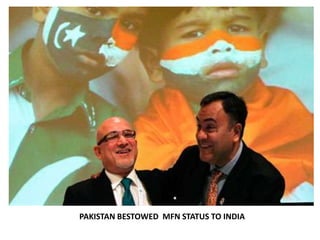
PAKISTAN BESTOWED MFN STATUS TO INDIA
CASE STUDY : TRIPS

EUROPEAN UNION & A MEMBER STATE : SEIZURE OF GENRIC DRUGS IN TRANSIT

CASE STUDY : TRIMS

TEXTILE QUOTAS & BANGLADESH

CHINA MEASURES AFFECTING ENTERTANMENT PRODUCTS

INDIA MEASURES AFFECTING AUTOMOTIVE INDUSTRY

CASE STUDY : GATS

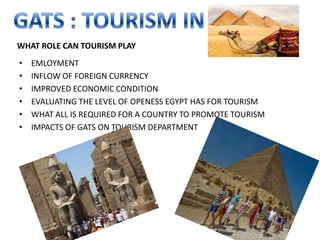
TOURISM IN EGYPT
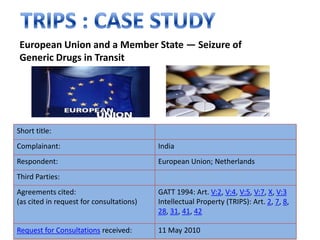
European Union and a Member State — Seizure of
Generic Drugs in Transit


Short title:
Complainant:                              India
Respondent:                               European Union; Netherlands
Third Parties:
Agreements cited:                         GATT 1994: Art. V:2, V:4, V:5, V:7, X, V:3
(as cited in request for consultations)   Intellectual Property (TRIPS): Art. 2, 7, 8,
                                          28, 31, 41, 42

Request for Consultations received:       11 May 2010
On 11 May 2010, India requested consultations with the European Union and the
Netherlands regarding the repeated seizures on patent infringement grounds of
generic drugs originating in India but transiting through ports and airports in the
Netherlands to third country destinations.

India alleges that the measures at issue are, in several respects, inconsistent as such
and as applied, with the obligations of the European Union and the Netherlands
under Articles V and X of GATT 1994 and under various provisions of the TRIPs
Agreement, namely, Article 28 read together with Article 2, Articles 41 and 42, and
Article 31 read together with the provisions of the August 2003 Decision on TRIPs and
Public Health.

On 28 May 2010, Brazil, Canada and Ecuador requested to join the consultations. On
31 May 2010, China, Japan and Turkey requested to join the consultations.


 Subsequently, the European Union informed the DSB that it had accepted the
requests of Canada, China, Ecuador, India, Japan and Turkey to join the consultations.
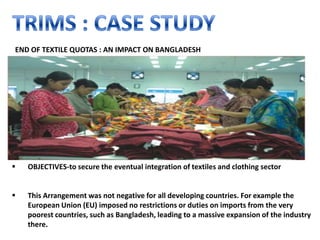
END OF TEXTILE QUOTAS : AN IMPACT ON BANGLADESH


   OBJECTIVES-to secure the eventual integration of textiles and clothing sector


   This Arrangement was not negative for all developing countries. For example the
    European Union (EU) imposed no restrictions or duties on imports from the very
    poorest countries, such as Bangladesh, leading to a massive expansion of the industry
    there.
The End of Textiles Quotas:
A Case Study of the Impact on Bangladesh


Under the WTO Agreement on Textiles and Clothing (ATC), all textile and clothing
(T&C) quotas maintained by industrial countries under the now defunct Multifiber
Arrangement (MFA) would be removed over the period 1995-2005.

During the 10-year transition period, the remaining quotas would also be enlarged .
Because these quotas are bilateral and the extent of their restrictiveness varies from
country to country, their removal will alter competitiveness of individual exporting
countries

Countries that have been facing more restrictive quotas will see their competitive
position improve after the quotas are removed, while those that have been less
restricted by quotas may find it difficult to maintain their current market share
1.CHINA – MEASURES AFFECTING TRADING RIGHTS AND DISTRIBUTION
SERVICES FOR CERTAIN PUBLICATIONS AND AUDIOVISUAL
ENTERTAINMENT PRODUCTS.

2. INDIA – MEASURES AFFECTING THE AUTOMOTIVE
WHAT ROLE CAN TOURISM PLAY
•   EMLOYMENT
•   INFLOW OF FOREIGN CURRENCY
•   IMPROVED ECONOMIC CONDITION
•   EVALUATING THE LEVEL OF OPENESS EGYPT HAS FOR TOURISM
•   WHAT ALL IS REQUIRED FOR A COUNTRY TO PROMOTE TOURISM
•   IMPACTS OF GATS ON TOURISM DEPARTMENT
WORLD TRADE ORGANIZATION

WORLD TRADE ORGANIZATION

  • 2.
    KAUSTUBH GUPTA –E31,NEHA GOSAIN – ,KRANTI- E47 ,DEVENDRA- E 24, MANISH- E 51
  • 3.
    WWW.WTO.ORG WWW.SCRIBD.COM WWW.WORLDTRADEREVIEW.COM WWW.UN.ORG BRITANICA ENCYCLOPEDIA BENARD HOEKMAN,AADIYAMATOO,EDWARD PHILIPS LIBRARY.FE.DE/PDF THE GREAT AMERICAN TRUCKING SHOW EJIL.OXFORDJOURNALS.ORG
  • 4.
    MR PRASCAL LAMY GENEVA WHO : PASCAL LAMY WHEN : 1st JANUARY 1995 WHERE : GENEVA,SWITZERLAND HOW : URUGUAY ROUND OF NEGOTIATIONS FRANC WITH : 159 MEMBER COUNTRIES, TAJAKISTAN INDUCTED IN MARCH 2013 MEANS : 200 MILLION SWISS FRANCS
  • 5.
    P2 P1 P3 CONSULATATIONS & TALKS ON ANALYSIS OF TRADE & ECONOMIC POLICIES OF CONSESSIONS TO MARKET OFFICIAL APPLICANT COUNTRY ENTRY TO THE MEMBER DOCUMENTATION COUNTRIES
  • 6.
    CENTRE WILLAM RAPPARD AN INSIDE VIEW
  • 7.
  • 8.
    WORLS TRADE ORGANIZATIONCOORDINATES WITH ITS SECRETARIAT,WHICH EMPLOYEES 500 + STAFF INCLUDING ECONOMISTS,STATISTICIANS,LAWYERS AND OTHER EXPERTS IN RELATED AREA OF CONCERN ● WTO AGREEMENTS COVER GOODS,SERVICES,INTELLECTUAL PROPERTY. ● AGREEMENTS INCLUDE COMMITMENTS TO LOWER CUSTOMS DUTIES AND OTHER TRADE BARRIERS COUPLED WITH OPENING OF MARKETS. ● IMPORTANTLY WTO SET PROCEDURES TO SETTLE DISPUTES ● TRADE NEGOTIATIONS AND CREATING LEVEL PLAYING FIELD FOR ALL. ● COOPERATION WITH OTHER INTERNATIONAL ESTABLISHMENTS. ● ASSISTING TECHNICALY & DEVELOPING COUNTRIES.
  • 10.
  • 11.
    Frame work startswith basic principles 1. GENERAL AGREMENT ON TARRIFS & TRADE (GATT) 2. GENERAL AGREEMENT ON TRADE IN SERVICES (GATS) 3. TRADE RELATED ASPECTS OF INTELLECTUAL PROPERTY RIGHTS (TRIPS) 4. TRADE RELATED INVESTMENT MEASURES (TRIMS) TRIPS TRIMS GATS LITERAL WORK TO FACILITATE INVESTMENTS MOVEMENT OF PERSONS ARTISTIC WORK TO LIBERALIZE WORLD TRADE AIR TRANSPORT INDUSTRIAL PROPERTY TO STRIKE OUT INVESTMENT FINANCIAL SERVICES MEASURES WHICH CAN CREATE HINDRANCE TAKINF INTO ACCOUNT NEEDS SHIPPING OF DEVELOPING AND LEAST DEVELOPING COUNTRIES
  • 12.
    It is theGATT Uruguay Round Agreement on Trade Related Intellectual Property. It deals with the protection & enforcement of “Trade-Related” intellectual property “rights". It establishes minimum levels of protection that each government has to give to the intellectual property of fellow WTO members DEALS IN : How basic principles of the trading system and other international intellectual property agreements should be applied ●How to give adequate protection to intellectual property rights ●How countries should enforce those rights adequately in their own territories ●How to settle disputes on intellectual property between members of the WTO ●Special transitional arrangements during the period when the new system is being introduced.
  • 13.
    Intellectual Property comprises2 distinct forms: * Literary & Artistic Works * Industrial Property LITERARY & ARTISTIC WORKS INCLUDE books, paintings, musical compositions, plays, operas, movies, radio/ tv programs, performances, & other artistic works. INDUSTRIAL PROPERTY envelops patented objects, trade secrets, geographical indications.
  • 14.
    Trade related InvestmentMeasures does not provide any new language , but It concentrates on 2 major articles. Article III & Article IX which talks about National Treatment and Trade Restrictions respectively. DEALS IN : ARTICLE XI ARTICLE III ●National treatment of imported ●Prohibition of quantitative product, unless specified in other restrictions on imports and agreements. exports. ●Subjects the purchase or use by ●Part of the general trend in an enterprise of imported products to less textiles and agriculture to phase favorable conditions than the purchase or out the use of quantitative use of domestic products. restrictions.
  • 15.
    PROVISIONS: Local content requirements(LCRs). Impose the use of a certain amount of local inputs in production. Trade-balancing requirements. Oblige imports to be equivalent to a certain proportion of exports. Foreign exchange balancing requirements. Stipulate that the foreign exchange made available for imports should be a certain proportion of the value of foreign exchange brought in by the firm from exports and other sources. Exchange restrictions. Restrict access to foreign exchange and hence restrict imports. Licensing requirements. Oblige the investor to license technologies similar or unrelated to those it uses in the home country to host country firms. Remittance restrictions. Restrict the right of a foreign investor to repatriate returns from an investment.
  • 16.
    Local equity requirements.Specify that a certain percentage of a firm’s equity should be held by local investors. Domestic sales requirements. Require a company to sell a certain proportion of its output locally, which amounts to a restriction on exportation. Manufacturing requirements. Require certain products to be manufactured locally. Export performance requirements (EPRs). Stipulate that a certain proportion of production should be exported. Product mandating requirements. Oblige an investor to supply certain markets with a designated product or products manufactured from a specified facility or operation. Manufacturing limitations. Prevent companies from manufacturing certain products or product lines in the host country. Technology transfer requirements. Require specified technologies to be transferred on non-commercial terms and/or specific levels and types of research and development (R & D) to be conducted locally.
  • 17.
    Local equity requirements.Specify that a certain percentage of a firm’s equity should be held by local investors. Domestic sales requirements. Require a company to sell a certain proportion of its output locally, which amounts to a restriction on exportation. Manufacturing requirements. Require certain products to be manufactured locally.
  • 18.
    General Agreement onTrade in Services, is the first and the only comprehensive multilateral discipline covering international trade in Services. It was negotiated during Uruguay Round and came into force along with other WTO agreements in January 1995. A simple definition of services is that services are the tradables, which are intangible, invisible, and incapable of storage and, therefore, requiring simultaneous production and consumption. This description does have its limitations as technical advancements have made it possible for the services to be visible and capable of storage (for example, a foreign consultant prepares a documentary film for a local company and sends it to that company in the form of a video cassette) As per WTO services are divided into 12 areas and sub divided into 164 areas Business Services, Communication Services, Construction and Engineering Services ,Distribution Services, Education Services,Environmental Services, Financial Services, Health Services, Tourism and travel Services, Recreation, cultural and sporting Services, Transport Services, Other Services not included elsewhere.
  • 19.
    MODES OF SUPPLYOF SERVICES Mode 1: (Cross - Border Supply) - This refers to the delivery of service from the territory of one country to the territory of the other country by crossing international border. examples : financial trading, maritime transport and telecommunication services. Mode 2: (Consumption Abroad) - In this method, consumer moves to a foreign country to get services, such as tourism, education, medical treatment etc. examples :such as repair and maintenance of aircrafts. Mode 3: (Commercial Presence) - In this method, foreign service-providing companies establish their local subsidiary offices (affiliates) to supply services in the domestic market. Establishment of local branches of foreign banks or insurance companies is example of services provided through this mode. Mode 4: (Movement of Natural persons) - In this mode, the service supplying foreign person moves to the host territory on temporary basis. examples : business consultants, engineers and I.T. experts traveling to some country for a short period of time.
  • 20.
    The important principlesfalling in this category are Most Favoured Nation principle (MFN), Domestic Regulations and Transparency. MFN is the first principle and key instrument to prevent discrimination amongst the trading partners and it is included in all the agreements of the WTO. First principle "Most Favoured Nation" may be confusing but the principle itself is quite simple. It means that if a country grants a favour (tariff concession, favourable rules, formalities etc.) to any other country, the same favour shall have to be granted to all the member countries of the WTO (there are few exceptions also to this rule). Second important principle to be followed is that of “transparency” which means that the information relevant to Trade in Services regarding domestic policies, procedures, laws and regulations should be notified to the WTO Secretariat to be circulated amongst all other member countries. Third principle is related to the right of each member to “regulate on the supply of services within her territory”.
  • 21.
    PAKISTAN BESTOWED MFNSTATUS TO INDIA
  • 22.
    CASE STUDY :TRIPS EUROPEAN UNION & A MEMBER STATE : SEIZURE OF GENRIC DRUGS IN TRANSIT CASE STUDY : TRIMS TEXTILE QUOTAS & BANGLADESH CHINA MEASURES AFFECTING ENTERTANMENT PRODUCTS INDIA MEASURES AFFECTING AUTOMOTIVE INDUSTRY CASE STUDY : GATS TOURISM IN EGYPT
  • 23.
    European Union anda Member State — Seizure of Generic Drugs in Transit Short title: Complainant: India Respondent: European Union; Netherlands Third Parties: Agreements cited: GATT 1994: Art. V:2, V:4, V:5, V:7, X, V:3 (as cited in request for consultations) Intellectual Property (TRIPS): Art. 2, 7, 8, 28, 31, 41, 42 Request for Consultations received: 11 May 2010
  • 24.
    On 11 May2010, India requested consultations with the European Union and the Netherlands regarding the repeated seizures on patent infringement grounds of generic drugs originating in India but transiting through ports and airports in the Netherlands to third country destinations. India alleges that the measures at issue are, in several respects, inconsistent as such and as applied, with the obligations of the European Union and the Netherlands under Articles V and X of GATT 1994 and under various provisions of the TRIPs Agreement, namely, Article 28 read together with Article 2, Articles 41 and 42, and Article 31 read together with the provisions of the August 2003 Decision on TRIPs and Public Health. On 28 May 2010, Brazil, Canada and Ecuador requested to join the consultations. On 31 May 2010, China, Japan and Turkey requested to join the consultations. Subsequently, the European Union informed the DSB that it had accepted the requests of Canada, China, Ecuador, India, Japan and Turkey to join the consultations.
  • 25.
    END OF TEXTILEQUOTAS : AN IMPACT ON BANGLADESH  OBJECTIVES-to secure the eventual integration of textiles and clothing sector  This Arrangement was not negative for all developing countries. For example the European Union (EU) imposed no restrictions or duties on imports from the very poorest countries, such as Bangladesh, leading to a massive expansion of the industry there.
  • 26.
    The End ofTextiles Quotas: A Case Study of the Impact on Bangladesh Under the WTO Agreement on Textiles and Clothing (ATC), all textile and clothing (T&C) quotas maintained by industrial countries under the now defunct Multifiber Arrangement (MFA) would be removed over the period 1995-2005. During the 10-year transition period, the remaining quotas would also be enlarged . Because these quotas are bilateral and the extent of their restrictiveness varies from country to country, their removal will alter competitiveness of individual exporting countries Countries that have been facing more restrictive quotas will see their competitive position improve after the quotas are removed, while those that have been less restricted by quotas may find it difficult to maintain their current market share
  • 27.
    1.CHINA – MEASURESAFFECTING TRADING RIGHTS AND DISTRIBUTION SERVICES FOR CERTAIN PUBLICATIONS AND AUDIOVISUAL ENTERTAINMENT PRODUCTS. 2. INDIA – MEASURES AFFECTING THE AUTOMOTIVE
  • 28.
    WHAT ROLE CANTOURISM PLAY • EMLOYMENT • INFLOW OF FOREIGN CURRENCY • IMPROVED ECONOMIC CONDITION • EVALUATING THE LEVEL OF OPENESS EGYPT HAS FOR TOURISM • WHAT ALL IS REQUIRED FOR A COUNTRY TO PROMOTE TOURISM • IMPACTS OF GATS ON TOURISM DEPARTMENT