WTO and barriers.pptx WTO ....................................
2.
Introduction
The WorldTrade Organization (WTO) is an
international organization that deals with the global
rules of trade between nations.
It was established on January 1, 1995, and is
headquartered in Geneva, Switzerland.
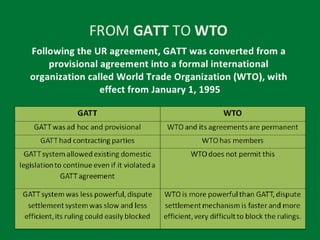
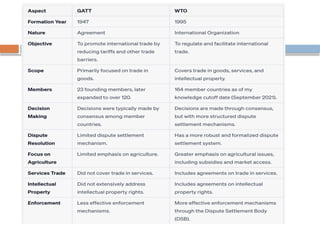
The WTO is a successor to the General Agreement
on Tariffs and Trade (GATT), which was
established in 1947 to regulate international trade.
7.
GATT
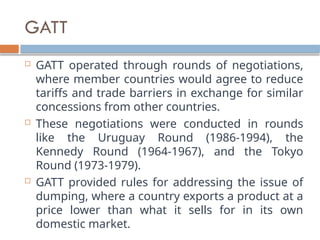
GATT operatedthrough rounds of negotiations,
where member countries would agree to reduce
tariffs and trade barriers in exchange for similar
concessions from other countries.
These negotiations were conducted in rounds
like the Uruguay Round (1986-1994), the
Kennedy Round (1964-1967), and the Tokyo
Round (1973-1979).
GATT provided rules for addressing the issue of
dumping, where a country exports a product at a
price lower than what it sells for in its own
domestic market.
9.
Weaknesses of GATT
The GATT failed to cover trade in services and
intellectual property rights, and the absence of an
international mechanism to resolve disputes in
international trade
11.
WTO
World TradeOrganisations.
It came into existence on January 1st
1995 and was
outcome of (1986-1994) Uruguay round of GATT
negotiations.
The WTO was essentially an extension of GATT.
First GATT became only one of the three major trade
agreements that went into the WTO (the other two
being the General Agreement on Trade in Services
(GATS) and the agreements on Trade Related Aspects
of Intellectual Property Rights (TRIPS).
12.
Contd…
The WTOaims to facilitate market access for goods and
services by reducing trade barriers, such as tariffs and
quotas.
The WTO encourages transparency in trade policies.
Member countries are required to publish their trade
regulations, provide information about their trade-related
policies, and notify the WTO about changes in their trade
policies.
One of the core principles of the WTO is the principle of
non-discrimination. This means that member countries
must treat all other members equally in terms of trade.
13.
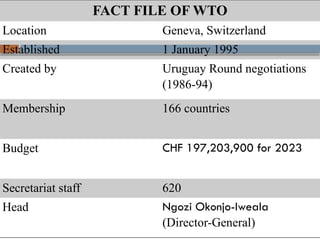
FACT FILE OFWTO
Location Geneva, Switzerland
Established 1 January 1995
Created by Uruguay Round negotiations
(1986-94)
Membership 166 countries
Budget CHF 197,203,900 for 2023
Secretariat staff 620
Head Ngozi Okonjo-Iweala
(Director-General)
14.
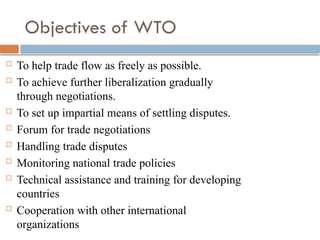
Objectives of WTO
To help trade flow as freely as possible.
To achieve further liberalization gradually
through negotiations.
To set up impartial means of settling disputes.
Forum for trade negotiations
Handling trade disputes
Monitoring national trade policies
Technical assistance and training for developing
countries
Cooperation with other international
organizations
15.
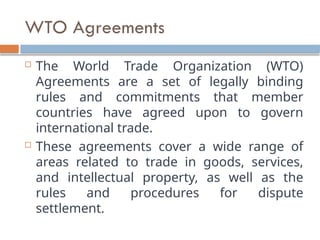
WTO Agreements
TheWorld Trade Organization (WTO)
Agreements are a set of legally binding
rules and commitments that member
countries have agreed upon to govern
international trade.
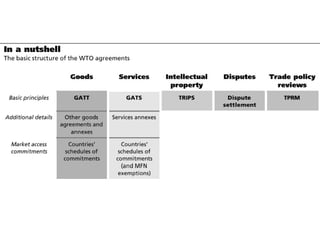
These agreements cover a wide range of
areas related to trade in goods, services,
and intellectual property, as well as the
rules and procedures for dispute
settlement.
17.
General Agreement onTariffs and
Trade (GATT)
• Objective: GATT, the predecessor to the WTO, primarily focuses
on the trade of goods. It aims to reduce tariffs and other trade
barriers to promote free and fair trade.
• Key Principles:
• Most-Favored-Nation (MFN): Members must treat all other
members equally, without discrimination. Any preferential
treatment given to one country must be extended to all.
• National Treatment: Imported goods must be treated the same
as domestically produced goods once they enter the market.
• Tariff Reduction and Elimination: Members commit to
reducing and eventually eliminating tariffs on a wide range of
goods.
18.
General Agreement onTrade in
Services (GATS)
• Objective: GATS regulates international trade in
services, covering areas like telecommunications,
finance, healthcare, education, and tourism.
• Key Principles:
• Most-Favored-Nation (MFN): Similar to GATT,
members must extend any favorable treatment to one
country to all others.
• Transparency and Commitments: Members are
encouraged to make commitments regarding the
liberalization of specific service sectors.
19.
Agreement on Trade-RelatedAspects of
Intellectual Property Rights (TRIPS):
• Objective: TRIPS aims to establish minimum
standards for the protection of intellectual property
rights, including patents, copyrights, trademarks,
and trade secrets.
• Key Provisions:
• Protection and Enforcement of Intellectual
Property Rights: It sets out rules for the protection
and enforcement of various forms of intellectual
property.
20.
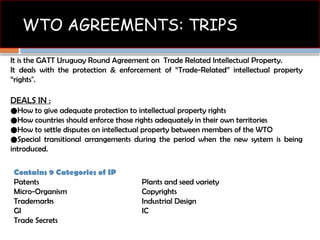
WTO AGREEMENTS: TRIPS
Itis the GATT Uruguay Round Agreement on Trade Related Intellectual Property.
It deals with the protection & enforcement of “Trade-Related” intellectual property
“rights".
DEALS IN :
●How to give adequate protection to intellectual property rights
●How countries should enforce those rights adequately in their own territories
●How to settle disputes on intellectual property between members of the WTO
●Special transitional arrangements during the period when the new system is being
introduced.
Contains 9 Categories of IP
Patents Plants and seed variety
Micro-Organism Copyrights
Trademarks Industrial Design
GI IC
Trade Secrets
21.
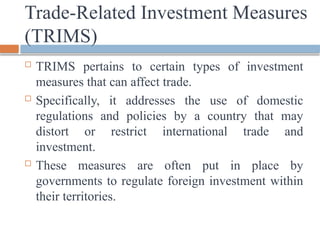
Trade-Related Investment Measures
(TRIMS)
TRIMS pertains to certain types of investment
measures that can affect trade.
Specifically, it addresses the use of domestic
regulations and policies by a country that may
distort or restrict international trade and
investment.
These measures are often put in place by
governments to regulate foreign investment within
their territories.
22.
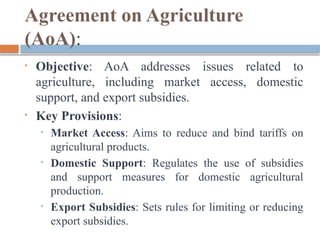
Agreement on Agriculture
(AoA):
•Objective: AoA addresses issues related to
agriculture, including market access, domestic
support, and export subsidies.
• Key Provisions:
• Market Access: Aims to reduce and bind tariffs on
agricultural products.
• Domestic Support: Regulates the use of subsidies
and support measures for domestic agricultural
production.
• Export Subsidies: Sets rules for limiting or reducing
export subsidies.
Press the spacebar to see the correct answer.
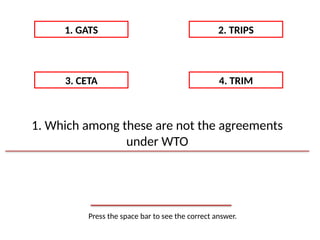
1. GATS 2. TRIPS
3. CETA 4. TRIM
1. Which among these are not the agreements
under WTO
26.
Press the spacebar to see the correct answer.
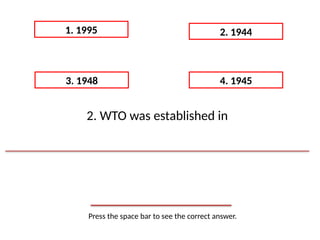
1. 1995 2. 1944
3. 1948 4. 1945
2. WTO was established in
27.
Press the spacebar to see the correct answer.
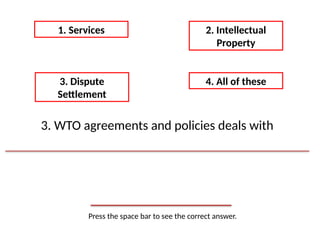
1. Services 2. Intellectual
Property
3. Dispute
Settlement
4. All of these
3. WTO agreements and policies deals with
28.
Press the spacebar to see the correct answer.
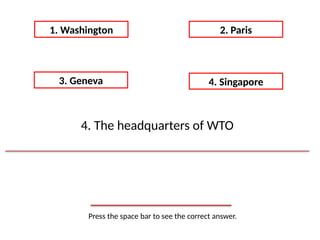
1. Washington 2. Paris
3. Geneva 4. Singapore
4. The headquarters of WTO
29.
Press the spacebar to see the correct answer.
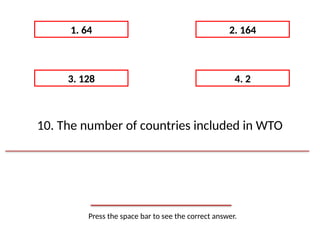
1. 64 2. 164
3. 128 4. 2
10. The number of countries included in WTO
30.
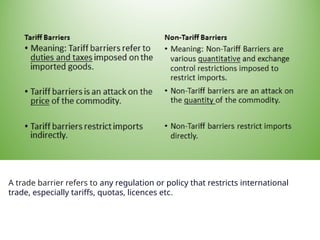
A trade barrierrefers to any regulation or policy that restricts international
trade, especially tariffs, quotas, licences etc.
31.
Tariff Barriers
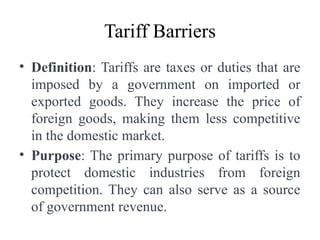
• Definition:Tariffs are taxes or duties that are
imposed by a government on imported or
exported goods. They increase the price of
foreign goods, making them less competitive
in the domestic market.
• Purpose: The primary purpose of tariffs is to
protect domestic industries from foreign
competition. They can also serve as a source
of government revenue.
32.
Types of Tariffs
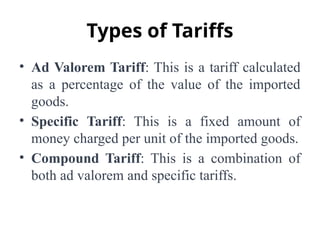
•Ad Valorem Tariff: This is a tariff calculated
as a percentage of the value of the imported
goods.
• Specific Tariff: This is a fixed amount of
money charged per unit of the imported goods.
• Compound Tariff: This is a combination of
both ad valorem and specific tariffs.
33.
Effects
• Protection ofDomestic Industries: Tariffs can shield
domestic industries from foreign competition by making
imported goods more expensive.
• Government Revenue: They can be a source of revenue
for the government, especially if the demand for the
imported goods is inelastic (not very responsive to price
changes).
• Higher Prices for Consumers: Tariffs can lead to higher
prices for imported goods, which can impact consumers'
purchasing power.
34.
Non-Tariff Barriers (NTBs):
•Definition: Non-tariff barriers encompass a wide
range of measures that countries use to restrict trade
without imposing a direct tax or duty.
• They can take various forms, including quotas,
licensing requirements, technical standards, and other
regulatory measures.
• Purpose: NTBs can serve multiple purposes, such as
protecting domestic industries, ensuring product
safety and quality, and achieving specific policy
objectives.
35.
Types of Non-TariffBarriers
• Quotas: A limit on the quantity or value of specific
goods that can be imported or exported during a
specified period.
• Licensing Requirements: Requiring importers to
obtain licenses or permits to import certain goods.
• Technical Standards and Regulations: Establishing
specific criteria for product quality, safety, or
performance that imported goods must meet.
36.
Contd..
• Subsidies andDomestic Support: Providing
financial assistance or incentives to domestic
industries, which can distort competition with foreign
goods.
• Sanitary and Phytosanitary Measures (SPS):
Measures related to food safety, animal and plant
health, and disease control.
• Customs Procedures: Administrative procedures and
documentation requirements that can be complex and
time-consuming for importers and exporters.
37.
Effects
• Restriction ofImports: NTBs can limit the quantity or
value of imports, effectively protecting domestic
industries.
• Increased Costs for Exporters and Importers:
Compliance with technical standards or licensing
requirements can increase the costs of doing business in
foreign markets.
• Reduced Competition: NTBs can limit competition,
which may lead to higher prices for consumers and
potentially lower quality products.
#4 Most-Favored-Nation (MFN) Treatment: Each member country must treat all other members equally, without giving preferential treatment to any specific country.
#5 Quantitative restrictions (QRs) are restrictions on the importation or exportation of goods that are not tariffs or other taxes.
Specific numerical limits on the quantity or value of goods that can be imported (or exported) during a specific period.
#6 Quantitative restrictions (QRs) are restrictions on the importation or exportation of goods that are not tariffs or other taxes.
Specific numerical limits on the quantity or value of goods that can be imported (or exported) during a specific period.
#13 The WTO derives most of the income for its annual budget from contributions by its Members. These are established according to a formula based on their share of international trade
https://www.youtube.com/watch?v=VnHtAvMLPLo
https://www.youtube.com/watch?v=HF7wbKXCyxM
https://www.youtube.com/watch?v=Crby5WYko0g
#16 Agreement on Trade-Related Aspects of Intellectual Property Rights
#20 Integrated circuit intellectual property rights (IP) include the protection of the layout design of an integrated circuit.