Media Framework: Audience
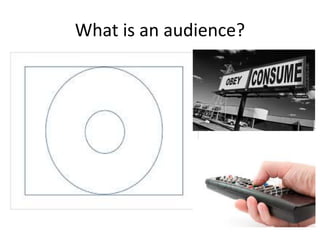
What is an audience?
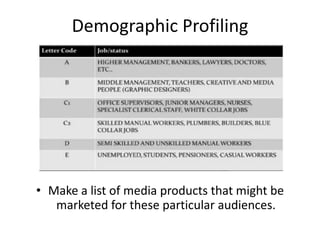
Demographic Profiling
• Make a list of media products that might be
marketed for these particular audiences.
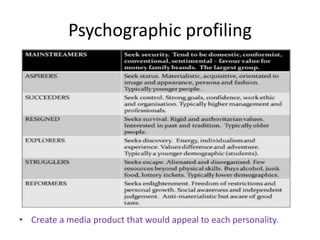
Psychographic profiling
• Create a media product that would appeal to each personality.
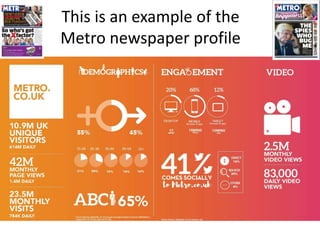
This is an example of the
Metro newspaper profile
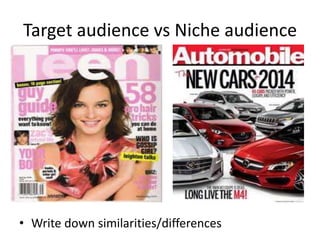
Target audience vs Niche audience
• Write down similarities/differences
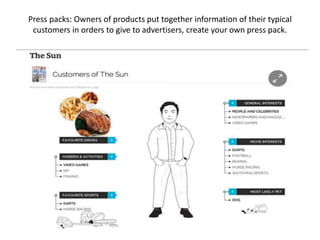
Press packs: Owners of products put together information of their typical
customers in orders to give to advertisers, create your own press pack.
.
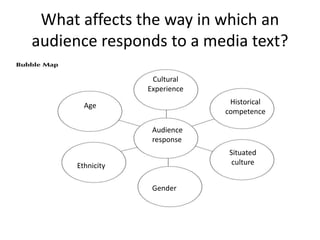
What affects the way in which an
audience responds to a media text?
Audience
response
Age
Ethnicity
Cultural
Experience
Historical
competence
Gender
Situated
culture
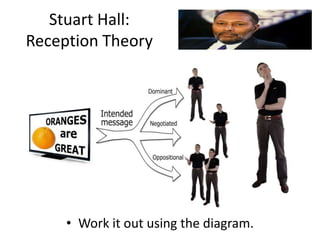
Stuart Hall:
Reception Theory
• Work it out using the diagram.
Interactive audiences:
• Key terms:
• Participatory culture
• Event television
• Prosumer
Watch this advert closely
• This will be your first chance to demonstrate
your learning.
• Focus on Language, Representation and
Audience
• Gilette - The Best A Man Can Get
Language: Technical, Visual, Audio Codes (camerawork, mise en scene, sound, editing), Narrative, Genre
Representation: Stereotypes,
Encoding/Decoding, Contexts
Audience: Categories, Mode of Address, Response,
Interaction
Application of theories: Teacher comments:
Audiences
Most media texts work to the principal of being a success is
to either
• Generate money
• Attract as large an audience as possible
• Genres are used to appeal to a specific audience.
Audiences seek out genres that they enjoy
• Media texts are used to bring in advertisers and therefore
generate money
• Subscription services use pay monthly schemes to
generate money
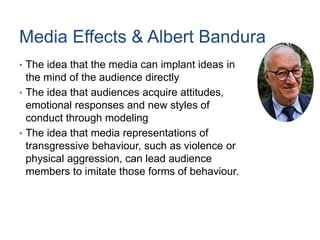
Media Effects & Albert Bandura
• The idea that the media can implant ideas in
the mind of the audience directly
• The idea that audiences acquire attitudes,
emotional responses and new styles of
conduct through modeling
• The idea that media representations of
transgressive behaviour, such as violence or
physical aggression, can lead audience
members to imitate those forms of behaviour.
Media Effects & Albert Bandura
• Bandura looks at the way that media texts have a direct
influence on it’s audience. For instance he argues that
violence is prevalent in the media and therefore exposure
to this violence in various forms (e.g. different TV
programmes) enables us to perceive violence as
acceptable way to deal with situations. Bandura called
this ‘modeling’ of behaviour.
Media Effects & Albert Bandura
• T: Conduct some research into the following
• Moral panics
• Hypodermic Needle Theory
• Media effects theory relating to Marilyn Manson and
Natural Born Killers
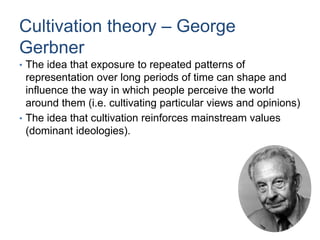
Cultivation theory – George
Gerbner
• The idea that exposure to repeated patterns of
representation over long periods of time can shape and
influence the way in which people perceive the world
around them (i.e. cultivating particular views and opinions)
• The idea that cultivation reinforces mainstream values
(dominant ideologies).
George Gerbner
• That media messages aren’t directly injected into the
passive media audience but they are built up by a series
of repetition and enforcing of the message. This then
instates the hegemony.
• This is similar to what Altusser describes as interpellation
the process of hearing and seeing similar messages in
media texts so that the ideology is enforced onto the
audience, which in tern makes them passive
Reception Theory – Stuart Hall
• the idea that communication is a process involving
encoding by producers and decoding by audiences
• the idea that there are three hypothetical positions from
which messages and meanings may be decoded:
• the dominant-hegemonic position: the encoder’s intended
meaning (the preferred reading) is fully understood and accepted
• the negotiated position: the legitimacy of the encoder’s message
is acknowledged in general terms, although the message is
adapted or negotiated to better fit the decoder’s own individual
experiences or context
• the oppositional position: the encoder’s message is understood,
but the decoder disagrees with it, reading it in a contrary or
oppositional way.
Reception Theory – Stuart Hall
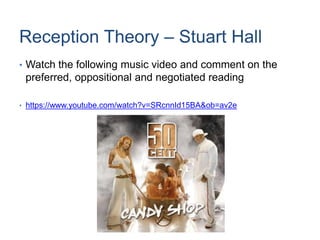
• Watch the following music video and comment on the
preferred, oppositional and negotiated reading
• https://www.youtube.com/watch?v=SRcnnId15BA&ob=av2e

Intro to audience

  • 1.
  • 2.
    What is anaudience?
  • 3.
    Demographic Profiling • Makea list of media products that might be marketed for these particular audiences.
  • 4.
    Psychographic profiling • Createa media product that would appeal to each personality.
  • 5.
    This is anexample of the Metro newspaper profile
  • 6.
    Target audience vsNiche audience • Write down similarities/differences
  • 7.
    Press packs: Ownersof products put together information of their typical customers in orders to give to advertisers, create your own press pack. .
  • 8.
    What affects theway in which an audience responds to a media text? Audience response Age Ethnicity Cultural Experience Historical competence Gender Situated culture
  • 9.
    Stuart Hall: Reception Theory •Work it out using the diagram.
  • 10.
    Interactive audiences: • Keyterms: • Participatory culture • Event television • Prosumer
  • 11.
    Watch this advertclosely • This will be your first chance to demonstrate your learning. • Focus on Language, Representation and Audience • Gilette - The Best A Man Can Get
  • 12.
    Language: Technical, Visual,Audio Codes (camerawork, mise en scene, sound, editing), Narrative, Genre
  • 13.
    Representation: Stereotypes, Encoding/Decoding, Contexts Audience:Categories, Mode of Address, Response, Interaction Application of theories: Teacher comments:
  • 14.
    Audiences Most media textswork to the principal of being a success is to either • Generate money • Attract as large an audience as possible • Genres are used to appeal to a specific audience. Audiences seek out genres that they enjoy • Media texts are used to bring in advertisers and therefore generate money • Subscription services use pay monthly schemes to generate money
  • 15.
    Media Effects &Albert Bandura • The idea that the media can implant ideas in the mind of the audience directly • The idea that audiences acquire attitudes, emotional responses and new styles of conduct through modeling • The idea that media representations of transgressive behaviour, such as violence or physical aggression, can lead audience members to imitate those forms of behaviour.
  • 16.
    Media Effects &Albert Bandura • Bandura looks at the way that media texts have a direct influence on it’s audience. For instance he argues that violence is prevalent in the media and therefore exposure to this violence in various forms (e.g. different TV programmes) enables us to perceive violence as acceptable way to deal with situations. Bandura called this ‘modeling’ of behaviour.
  • 17.
    Media Effects &Albert Bandura • T: Conduct some research into the following • Moral panics • Hypodermic Needle Theory • Media effects theory relating to Marilyn Manson and Natural Born Killers
  • 18.
    Cultivation theory –George Gerbner • The idea that exposure to repeated patterns of representation over long periods of time can shape and influence the way in which people perceive the world around them (i.e. cultivating particular views and opinions) • The idea that cultivation reinforces mainstream values (dominant ideologies).
  • 19.
    George Gerbner • Thatmedia messages aren’t directly injected into the passive media audience but they are built up by a series of repetition and enforcing of the message. This then instates the hegemony. • This is similar to what Altusser describes as interpellation the process of hearing and seeing similar messages in media texts so that the ideology is enforced onto the audience, which in tern makes them passive
  • 20.
    Reception Theory –Stuart Hall • the idea that communication is a process involving encoding by producers and decoding by audiences • the idea that there are three hypothetical positions from which messages and meanings may be decoded: • the dominant-hegemonic position: the encoder’s intended meaning (the preferred reading) is fully understood and accepted • the negotiated position: the legitimacy of the encoder’s message is acknowledged in general terms, although the message is adapted or negotiated to better fit the decoder’s own individual experiences or context • the oppositional position: the encoder’s message is understood, but the decoder disagrees with it, reading it in a contrary or oppositional way.
  • 21.
    Reception Theory –Stuart Hall • Watch the following music video and comment on the preferred, oppositional and negotiated reading • https://www.youtube.com/watch?v=SRcnnId15BA&ob=av2e