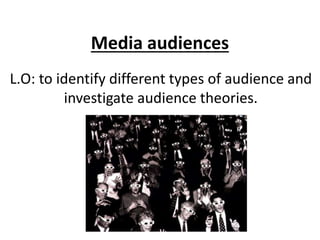
Media audiences
L.O: to identify different types of audience and
investigate audience theories.
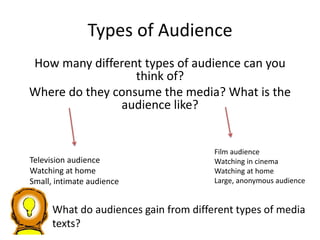
Types of Audience
How many different types of audience can you
think of?
Where do they consume the media? What is the
audience like?
Television audience
Watching at home
Small, intimate audience
Film audience
Watching in cinema
Watching at home
Large, anonymous audience
What do audiences gain from different types of media
texts?
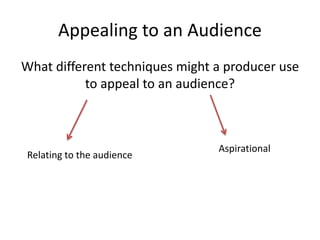
Appealing to an Audience
What different techniques might a producer use
to appeal to an audience?
Relating to the audience
Aspirational
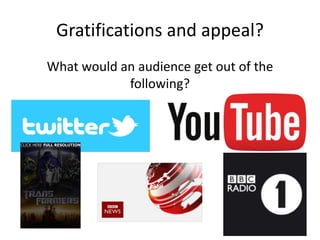
Gratifications and appeal?
What would an audience get out of the
following?
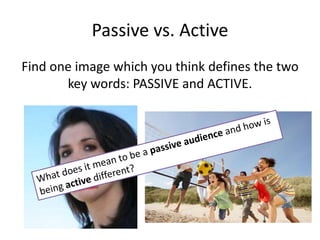
Passive vs. Active
Find one image which you think defines the two
key words: PASSIVE and ACTIVE.
Active or passive?
• Reading the Daily Mail on the tube.
• Texting in to Radio 1 on a Friday evening for a shout
out/song request.
• Going to the cinema to watch a new independent film
and getting dinner afterwards to discuss messages.
• Watching the UKIP party conference highlights and
posting a response video on YouTube.
• Becoming the fifth judge on X Factor.
• Reading Glamour magazine and buying a new anti-
cellulite product.
• Reading Glamour magazine at the hairdressers and
talking about the issues with your stylist.
• Playing Grand Theft Auto with your friends in person.
Media effects theories
Tip: the media have an effect on the audience.
1. Hypodermic Syringe
2. Two-step Flow
3. Cultivation Theory
Key question: what position is the audience put in?
What’s wrong with these approaches?
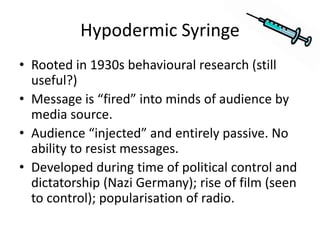
Hypodermic Syringe
• Rooted in 1930s behavioural research (still
useful?)
• Message is “fired” into minds of audience by
media source.
• Audience “injected” and entirely passive. No
ability to resist messages.
• Developed during time of political control and
dictatorship (Nazi Germany); rise of film (seen
to control); popularisation of radio.
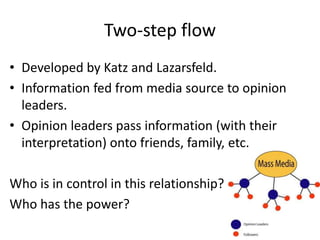
Two-step flow
• Developed by Katz and Lazarsfeld.
• Information fed from media source to opinion
leaders.
• Opinion leaders pass information (with their
interpretation) onto friends, family, etc.
Who is in control in this relationship?
Who has the power?
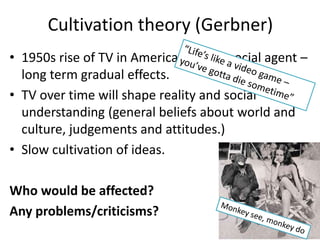
Cultivation theory (Gerbner)
• 1950s rise of TV in America. TV as a social agent –
long term gradual effects.
• TV over time will shape reality and social
understanding (general beliefs about world and
culture, judgements and attitudes.)
• Slow cultivation of ideas.
Who would be affected?
Any problems/criticisms?
Active audiences
• “Viewing as a purposeful, seeking sensation, a
highly motivated activity” (Shimpach, 2005)
• “Viewing (being an audience) implies ‘deliberate,
contemplative practice…in a sustained, more or
less intentional encounter’” (Shimpach, 2005)
• “Context factors rather than textual ones account
for the experiences that spectators have watching
films and television” (Staiger, 2000)
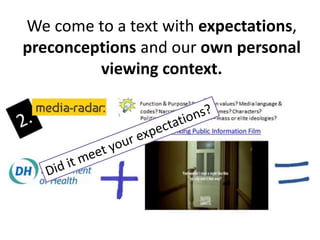
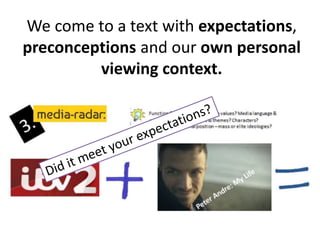
We come to a text with expectations,
preconceptions and our own personal
viewing context.
We come to a text with expectations,
preconceptions and our own personal
viewing context.
Uses and Gratifications
A better take on audience theory?
Limitations of Uses and Gratifications
• Self-reports from viewers which are
retrospective - viewers may not know why
they chose to watch what they did. Reasons
which can be articulated may be the least
important.
• Goal-directed accounts of media use suggest
rational choices of a predetermined purpose.
• TV viewing and media consumption can be an
end in itself.
Target audiences
Demographic – a group of media consumer
defined by age, gender, race, class, education
and income level (also demographic profiling).
Psychographic profiling – activity, interests,
opinions, attitudes, values, behaviour.
Imagine you are the producer of a new television programme.
Design a questionnaire which aims to find out as much as you can
about your audience.

5. active and passive audiences

  • 1.
    Media audiences L.O: toidentify different types of audience and investigate audience theories.
  • 2.
    Types of Audience Howmany different types of audience can you think of? Where do they consume the media? What is the audience like? Television audience Watching at home Small, intimate audience Film audience Watching in cinema Watching at home Large, anonymous audience What do audiences gain from different types of media texts?
  • 3.
    Appealing to anAudience What different techniques might a producer use to appeal to an audience? Relating to the audience Aspirational
  • 4.
    Gratifications and appeal? Whatwould an audience get out of the following?
  • 5.
    Passive vs. Active Findone image which you think defines the two key words: PASSIVE and ACTIVE.
  • 6.
    Active or passive? •Reading the Daily Mail on the tube. • Texting in to Radio 1 on a Friday evening for a shout out/song request. • Going to the cinema to watch a new independent film and getting dinner afterwards to discuss messages. • Watching the UKIP party conference highlights and posting a response video on YouTube. • Becoming the fifth judge on X Factor. • Reading Glamour magazine and buying a new anti- cellulite product. • Reading Glamour magazine at the hairdressers and talking about the issues with your stylist. • Playing Grand Theft Auto with your friends in person.
  • 7.
    Media effects theories Tip:the media have an effect on the audience. 1. Hypodermic Syringe 2. Two-step Flow 3. Cultivation Theory Key question: what position is the audience put in? What’s wrong with these approaches?
  • 8.
    Hypodermic Syringe • Rootedin 1930s behavioural research (still useful?) • Message is “fired” into minds of audience by media source. • Audience “injected” and entirely passive. No ability to resist messages. • Developed during time of political control and dictatorship (Nazi Germany); rise of film (seen to control); popularisation of radio.
  • 9.
    Two-step flow • Developedby Katz and Lazarsfeld. • Information fed from media source to opinion leaders. • Opinion leaders pass information (with their interpretation) onto friends, family, etc. Who is in control in this relationship? Who has the power?
  • 10.
    Cultivation theory (Gerbner) •1950s rise of TV in America. TV as a social agent – long term gradual effects. • TV over time will shape reality and social understanding (general beliefs about world and culture, judgements and attitudes.) • Slow cultivation of ideas. Who would be affected? Any problems/criticisms?
  • 11.
    Active audiences • “Viewingas a purposeful, seeking sensation, a highly motivated activity” (Shimpach, 2005) • “Viewing (being an audience) implies ‘deliberate, contemplative practice…in a sustained, more or less intentional encounter’” (Shimpach, 2005) • “Context factors rather than textual ones account for the experiences that spectators have watching films and television” (Staiger, 2000)
  • 12.
    We come toa text with expectations, preconceptions and our own personal viewing context.
  • 13.
    We come toa text with expectations, preconceptions and our own personal viewing context.
  • 14.
    Uses and Gratifications Abetter take on audience theory?
  • 15.
    Limitations of Usesand Gratifications • Self-reports from viewers which are retrospective - viewers may not know why they chose to watch what they did. Reasons which can be articulated may be the least important. • Goal-directed accounts of media use suggest rational choices of a predetermined purpose. • TV viewing and media consumption can be an end in itself.
  • 16.
    Target audiences Demographic –a group of media consumer defined by age, gender, race, class, education and income level (also demographic profiling). Psychographic profiling – activity, interests, opinions, attitudes, values, behaviour. Imagine you are the producer of a new television programme. Design a questionnaire which aims to find out as much as you can about your audience.

Editor's Notes

  • #13 http://www.youtube.com/watch?v=HAmI1MJECZ4
  • #14 http://www.youtube.com/watch?v=EuhIZscBSs8&feature=kp