Audience theory
Hannah Halliday
Blumler and Katz- Uses and
Gratifications
 Uses and gratifications theory is an approach to understanding why and
how people actively seek out specific media to satisfy specific needs.
 The ‘Uses and Grafication’ theory is an audience-centred approach to
understanding mass communication.
 Diverging from other media effect theories that question "what does
media do to people?", uses and gratification theory focuses on "what do
people do with media?”.
 It assumes that audience members are not passive consumers of media.
Rather, the audience has power over their media consumption and
assumes an active role in interpreting and integrating media into their own
lives. Unlike other theoretical perspectives, UGT holds that audiences are
responsible for choosing media to meet their desires and needs to achieve
gratification. This theory would then imply that the media compete against
other information sources for viewers' gratification.
Uses and Gratification
 Beginning in the 1940s, researchers began seeing patterns under the
perspective of the uses and gratifications theory in radio listeners.
 Early research was concerned with topics such as children's use of comics and
the absence of newspapers during a newspaper strike.
 The audience has four simple needs:
 Diversion- the need to relax and ‘escape’.
 Personal relationships- using the media to fulfil their personal relationships with
friends (becoming part of a social group).
 Personality identity- using media to find out more about yourselves.
 Surveillance- using the media to find out what is going on around us.
Stuart Hall
 This considers how texts are encoded with meaning by producers and then
decoded (understood) by audiences.
 The theory suggests that when a producer constructs a text, it is encoded with a
meaning or message that the producer wishes to convey to the audience.
 In some cases audiences will correctly decode the message or meaning and
understand what the producer was trying to say.
 In other cases the audience will either reject or fail to correctly understand the
message.
 Hall was concerned with how the power of the media and how it circulates
certain social values that create dominant ideologies in society such as
feminism, the welfare system and immigration.
 He believed that the mass media create and define issues of public concern and
interest through audience positioning.
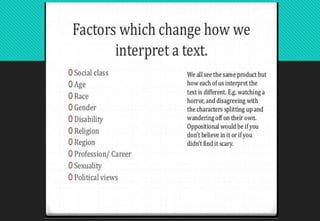
Three types of audience:-
Stuart Hall identified three types of audience:
Dominant or Preferred- This is where the audience decodes the message given as
the producer wanted them to and broadly agrees with it.
For example- Watching a political speech and agreeing with it.
Negotiated- Where the audience accepts, rejects or refines elements of the text in
light of previously held views.
For example- Neither agreeing or disagreeing with the political speech.
Oppositional- This is where the dominant meaning of a text is recognised but is
rejected for cultural, political or ideological reasons.
For example- Total rejection of the political speech.
The Effects Theory
 The effect theory is how media can affect society and how society affects the
media. Some negative implications of this theory are when people copy the
things they see within any media texts they see, such as, when a teenage boy
murdered his best friend, the game ‘Manhunt’ was banned in the UK, because
the murder was styled upon a murder within the game.
 An audience that tends to see the audience as passive and sees how exposure
to particular aspects of media content can influence the behaviour of the reader
or viewer.
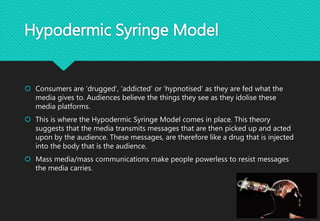
Hypodermic Syringe Model
 Consumers are ‘drugged’, ‘addicted’ or ‘hypnotised’ as they are fed what the
media gives to. Audiences believe the things they see as they idolise these
media platforms.
 This is where the Hypodermic Syringe Model comes in place. This theory
suggests that the media transmits messages that are then picked up and acted
upon by the audience. These messages, are therefore like a drug that is injected
into the body that is the audience.
 Mass media/mass communications make people powerless to resist messages
the media carries.
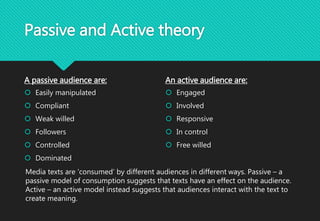
Passive and Active theory
A passive audience are:
 Easily manipulated
 Compliant
 Weak willed
 Followers
 Controlled
 Dominated
An active audience are:
 Engaged
 Involved
 Responsive
 In control
 Free willed
Media texts are ‘consumed’ by different audiences in different ways. Passive – a
passive model of consumption suggests that texts have an effect on the audience.
Active – an active model instead suggests that audiences interact with the text to
create meaning.
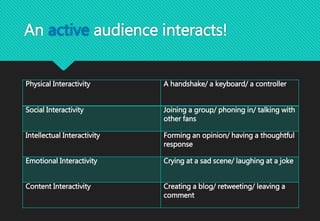
An active audience interacts!
Physical Interactivity A handshake/ a keyboard/ a controller
Social Interactivity Joining a group/ phoning in/ talking with
other fans
Intellectual Interactivity Forming an opinion/ having a thoughtful
response
Emotional Interactivity Crying at a sad scene/ laughing at a joke
Content Interactivity Creating a blog/ retweeting/ leaving a
comment
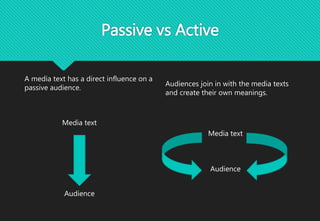
Passive vs Active
A media text has a direct influence on a
passive audience.
Audiences join in with the media texts
and create their own meanings.
Media text
Audience
Media text
Audience

Audience theory

  • 1.
  • 2.
    Blumler and Katz-Uses and Gratifications  Uses and gratifications theory is an approach to understanding why and how people actively seek out specific media to satisfy specific needs.  The ‘Uses and Grafication’ theory is an audience-centred approach to understanding mass communication.  Diverging from other media effect theories that question "what does media do to people?", uses and gratification theory focuses on "what do people do with media?”.  It assumes that audience members are not passive consumers of media. Rather, the audience has power over their media consumption and assumes an active role in interpreting and integrating media into their own lives. Unlike other theoretical perspectives, UGT holds that audiences are responsible for choosing media to meet their desires and needs to achieve gratification. This theory would then imply that the media compete against other information sources for viewers' gratification.
  • 3.
    Uses and Gratification Beginning in the 1940s, researchers began seeing patterns under the perspective of the uses and gratifications theory in radio listeners.  Early research was concerned with topics such as children's use of comics and the absence of newspapers during a newspaper strike.  The audience has four simple needs:  Diversion- the need to relax and ‘escape’.  Personal relationships- using the media to fulfil their personal relationships with friends (becoming part of a social group).  Personality identity- using media to find out more about yourselves.  Surveillance- using the media to find out what is going on around us.
  • 4.
    Stuart Hall  Thisconsiders how texts are encoded with meaning by producers and then decoded (understood) by audiences.  The theory suggests that when a producer constructs a text, it is encoded with a meaning or message that the producer wishes to convey to the audience.  In some cases audiences will correctly decode the message or meaning and understand what the producer was trying to say.  In other cases the audience will either reject or fail to correctly understand the message.  Hall was concerned with how the power of the media and how it circulates certain social values that create dominant ideologies in society such as feminism, the welfare system and immigration.  He believed that the mass media create and define issues of public concern and interest through audience positioning.
  • 5.
    Three types ofaudience:- Stuart Hall identified three types of audience: Dominant or Preferred- This is where the audience decodes the message given as the producer wanted them to and broadly agrees with it. For example- Watching a political speech and agreeing with it. Negotiated- Where the audience accepts, rejects or refines elements of the text in light of previously held views. For example- Neither agreeing or disagreeing with the political speech. Oppositional- This is where the dominant meaning of a text is recognised but is rejected for cultural, political or ideological reasons. For example- Total rejection of the political speech.
  • 7.
    The Effects Theory The effect theory is how media can affect society and how society affects the media. Some negative implications of this theory are when people copy the things they see within any media texts they see, such as, when a teenage boy murdered his best friend, the game ‘Manhunt’ was banned in the UK, because the murder was styled upon a murder within the game.  An audience that tends to see the audience as passive and sees how exposure to particular aspects of media content can influence the behaviour of the reader or viewer.
  • 8.
    Hypodermic Syringe Model Consumers are ‘drugged’, ‘addicted’ or ‘hypnotised’ as they are fed what the media gives to. Audiences believe the things they see as they idolise these media platforms.  This is where the Hypodermic Syringe Model comes in place. This theory suggests that the media transmits messages that are then picked up and acted upon by the audience. These messages, are therefore like a drug that is injected into the body that is the audience.  Mass media/mass communications make people powerless to resist messages the media carries.
  • 9.
    Passive and Activetheory A passive audience are:  Easily manipulated  Compliant  Weak willed  Followers  Controlled  Dominated An active audience are:  Engaged  Involved  Responsive  In control  Free willed Media texts are ‘consumed’ by different audiences in different ways. Passive – a passive model of consumption suggests that texts have an effect on the audience. Active – an active model instead suggests that audiences interact with the text to create meaning.
  • 10.
    An active audienceinteracts! Physical Interactivity A handshake/ a keyboard/ a controller Social Interactivity Joining a group/ phoning in/ talking with other fans Intellectual Interactivity Forming an opinion/ having a thoughtful response Emotional Interactivity Crying at a sad scene/ laughing at a joke Content Interactivity Creating a blog/ retweeting/ leaving a comment
  • 11.
    Passive vs Active Amedia text has a direct influence on a passive audience. Audiences join in with the media texts and create their own meanings. Media text Audience Media text Audience