• Chris Timothy
• cjt@kinged6nun.ac.uk
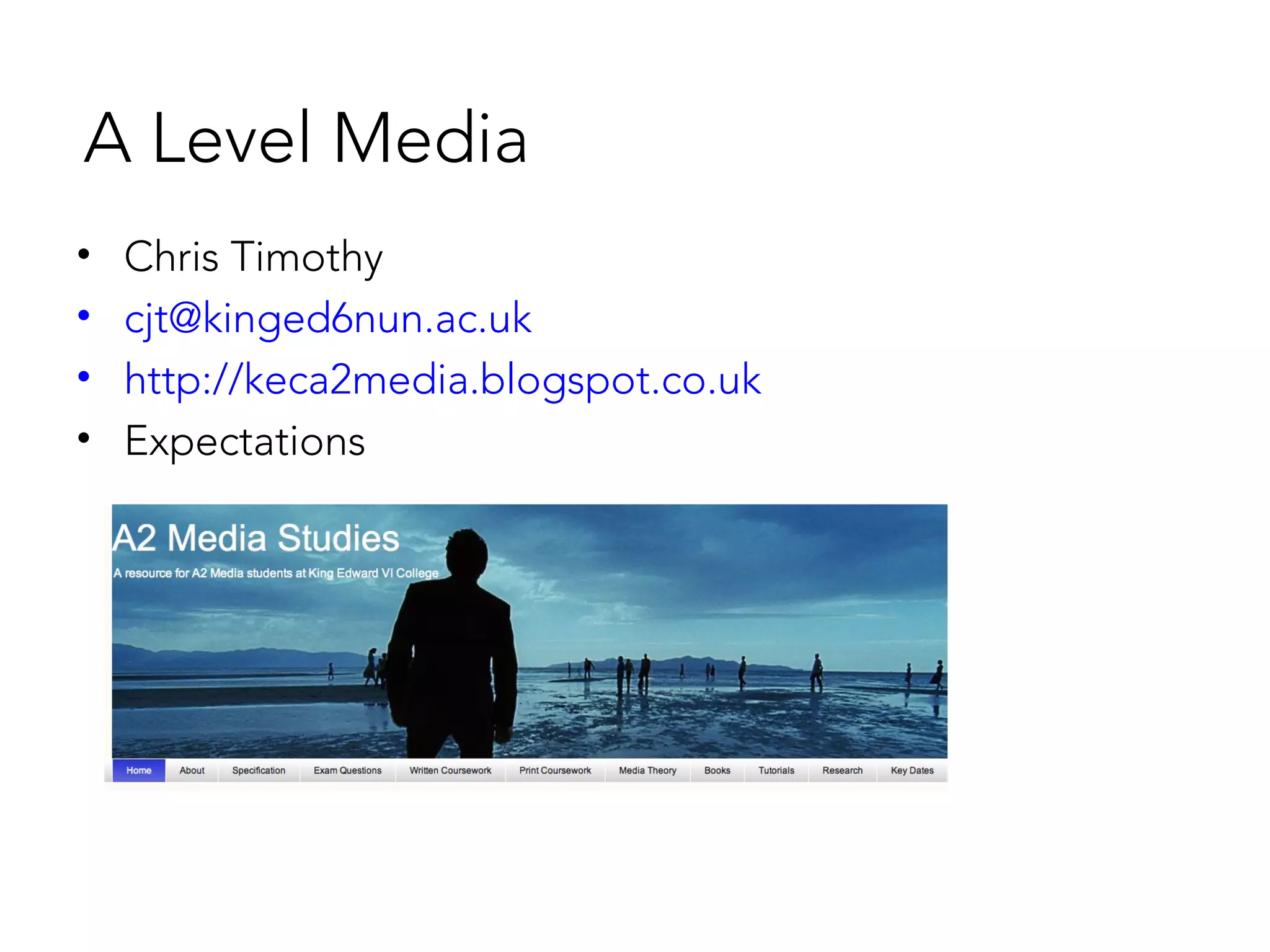
• http://keca2media.blogspot.co.uk
• Expectations
A Level Media
What are the differences to last year?
-Amount of time you spend working outside of class
-A university standard essay for coursework
-The level of Technical skills you must display, marking is much
harsher
-Coursework is more essay based than practical
A Level Media
A Level Media
The year is broken into 3 pieces of coursework which all link and make
up 50% of your second year.
1.The investigation
2.Print or moving image practical piece
3. Evaluation
A2 Media - Coursework
Students are required to produce three pieces of linked work;
1.Research Investigation > Practical Coursework > Evaluation
Research Investigation
Key Points
1.1400 – 1800 words not including any quotes or references
2.Students need to focus on one of the following topics: genre, narrative or
representation. (One of these words should be in the essay title)
3.The title must be a question
4.Once the essay is complete it should enable a conclusion to be reached that
will inform their production.
5.The investigation must demonstrate you can apply theory to your subject
and your understanding of it helps you answer your question.
6.The investigation needs to contain references.
7.The investigation must have two specific case studies
Poor Essay Titles
1.Male Representation
2.Investigating Sci/Fi conventions
3.How are Action films structured?
4.Are females portrayed accurately in reality T.V today?
5.Are Romance films over reliant on non linear structures?
1. How are young males represented within the teen movie genre with
particular focus on American Pie and Super Bad ?
2.Has the Sci Fi genre evolved in terms of its use of traditional genre conventions and
plot devices from the 1970’s and the film Alien to the more contemporary District 9?
3.Do the Action films Die Hard and Transformers apply the traditional
narrative structure of Todorov?
4.Do British so called reality T.V represent females to contain stereotypical
gender roles with a Particular focus on, TOWIE and Made in Chelsea?
5.Is the western romance genre and in particular, The Notebook and Take this Waltz,
guilty of using non linear narrative conventions to develop character investment?
Referencing
Student Statement
“Body image ultimately does play a part in the lives of women yet there is an increasing
trend of this effect on teenagers also.”
This viewpoint has been supported in a number of studies.
Too generic? Which particular ones? You could be presuming or making it up?
“Teen-age girls who viewed commercials depicting women with unrealistically thin-ideal
body type and beauty caused adolescent girls to feel less confident, angrier, and more
dissatisfied with their weight and appearance” (1) This was the conclusion of a study
conducted by Oxford University in 2001 when interviewing over 1000 teenagers between
the age of ………..
Great, Point Proven, dates, quotes, proof
Bilbliography
(1) Hargreaves, D. A., & Tiggemann, M. (2002)
Ok, who says? Prove it? What evidance do you have? Who agrees with you?
A Level Media
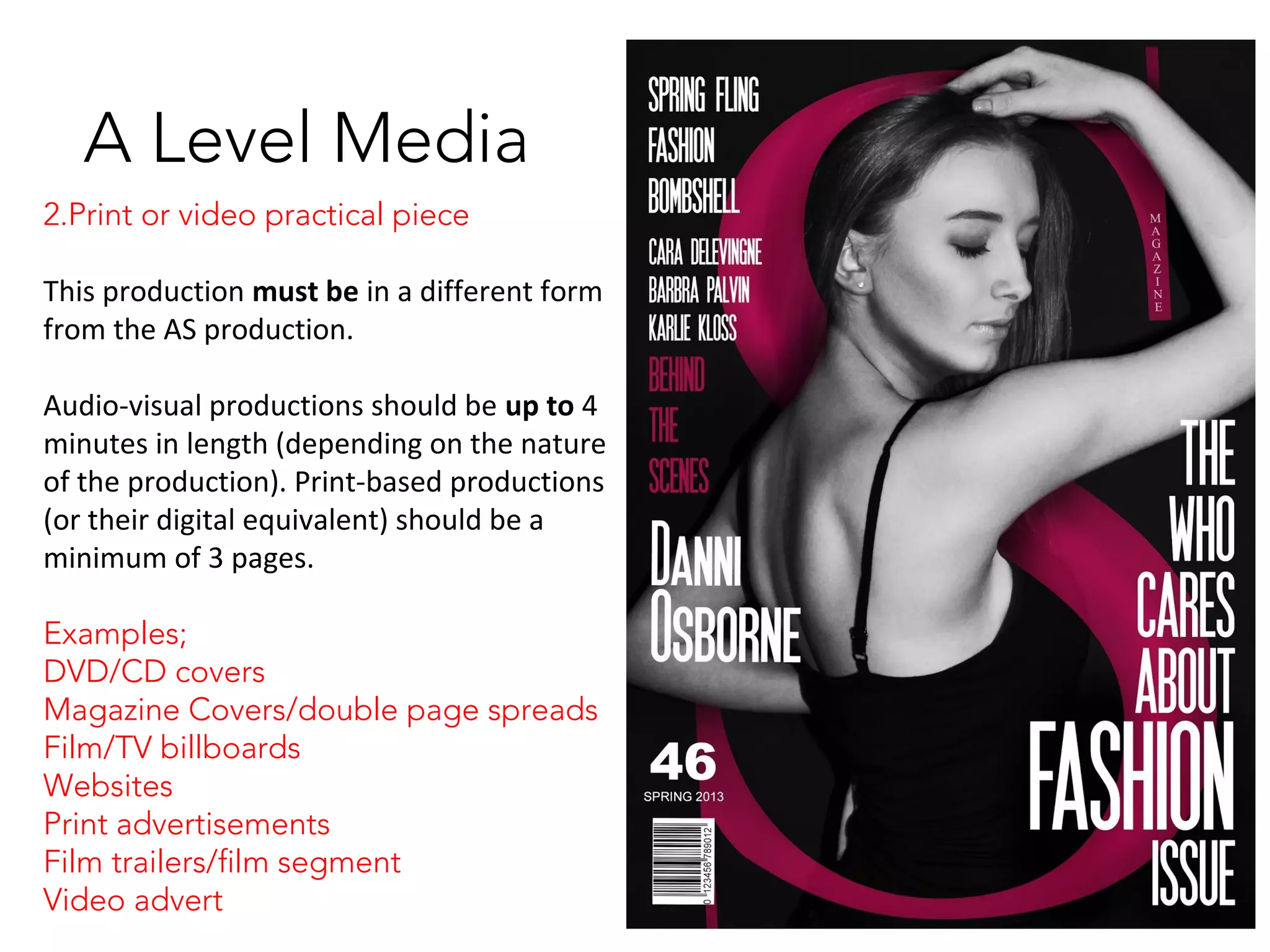
2.Print or video practical piece
This production must be in a different form
from the AS production.
Audio-visual productions should be up to 4
minutes in length (depending on the nature
of the production). Print-based productions
(or their digital equivalent) should be a
minimum of 3 pages.
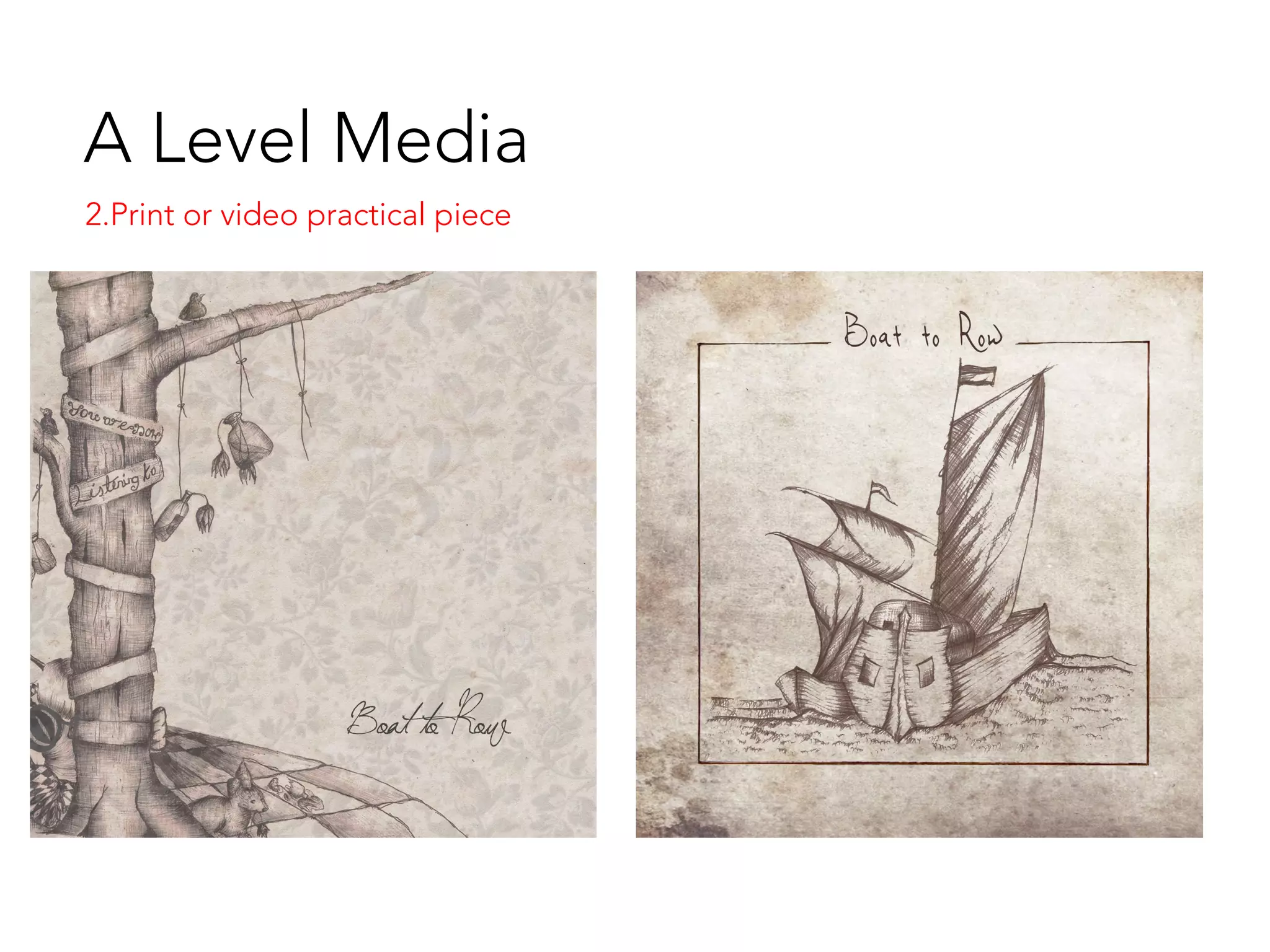
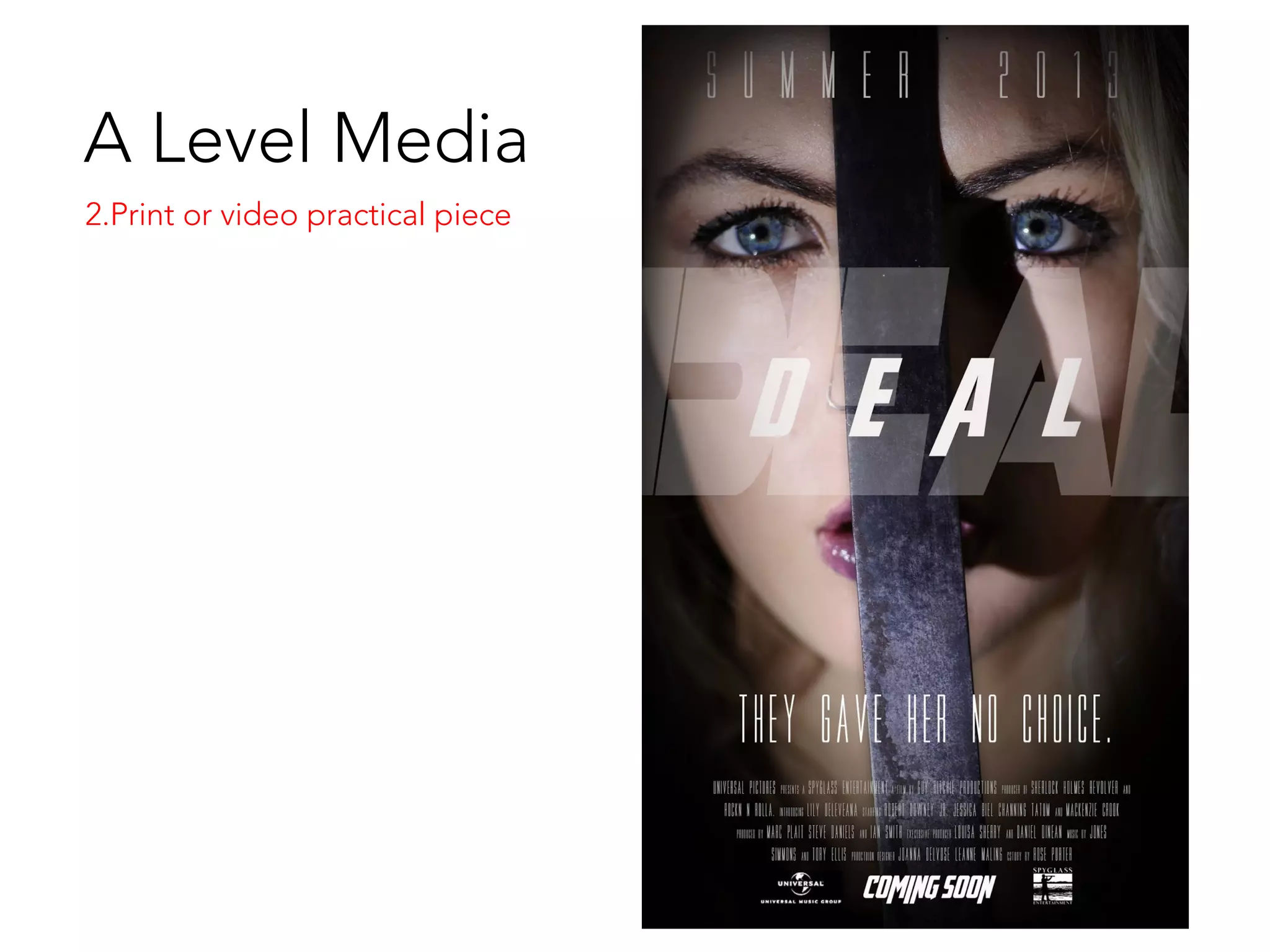
Examples;
DVD/CD covers
Magazine Covers/double page spreads
Film/TV billboards
Websites
Print advertisements
Film trailers/film segment
Video advert
A Level Media
2.Print or video practical piece
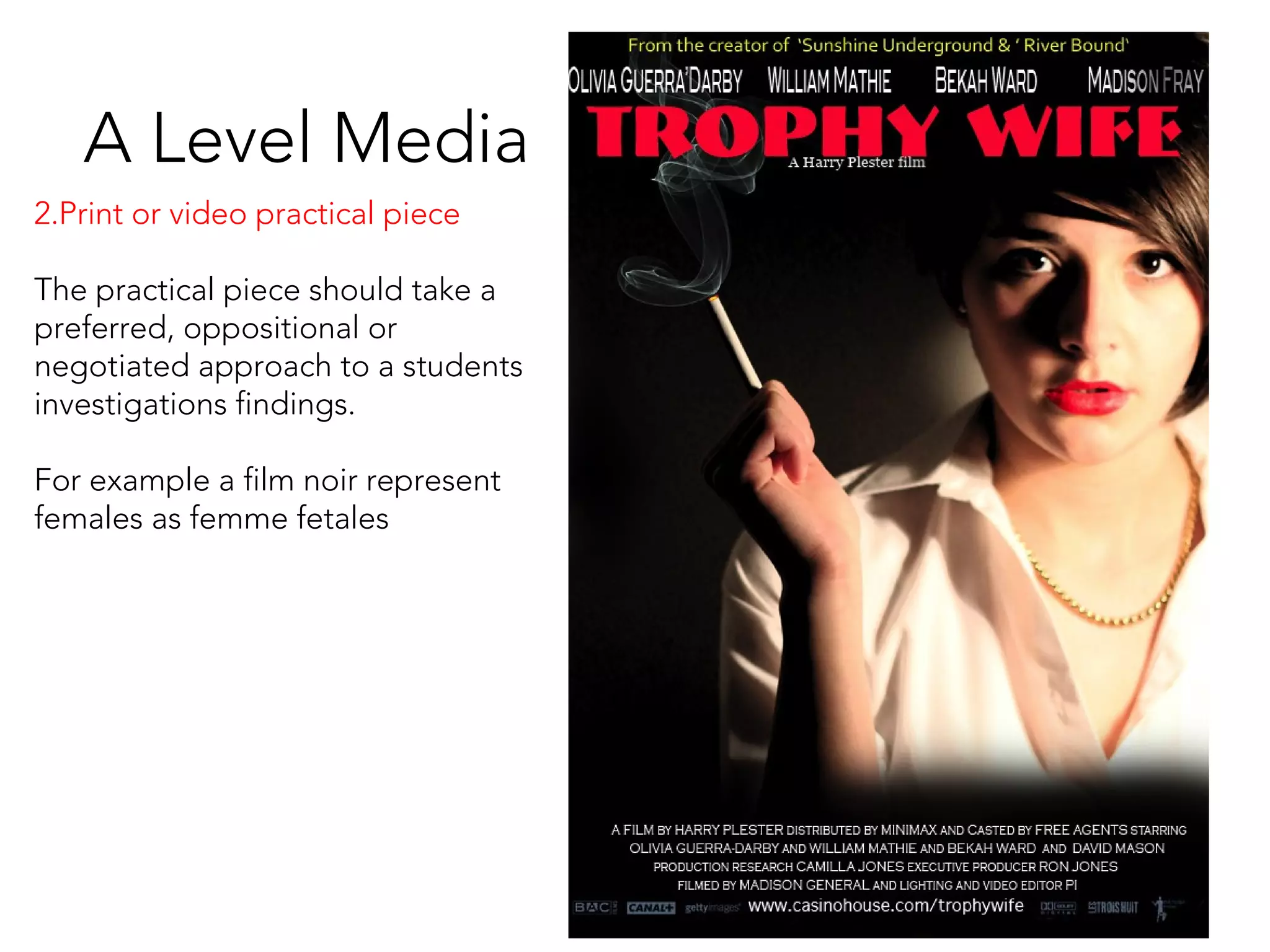
The practical piece should take a
preferred, oppositional or
negotiated approach to a students
investigations findings.
For example a film noir represent
females as femme fetales
A Level Media
2.Print or video practical piece
Or within action films females main
role within the narrative is to be
objectified.
A Level Media
2.Print or video practical piece
A Level Media
2.Print or video practical piece
A Level Media
2.Print or video practical piece
A Level Media
2.Print or video practical piece
A Level Media
2.Print or video practical piece
A Level Media
2.Print or video practical piece
Evaluation
Justifies and describes
how the practical links
to the investigation and
what approach they
took
Analyses strengths and
weaknesses
Has a sophisticated use
of terminology and
media language
750 words
Media Theory
1.The investigation must demonstrate you can
apply theory to your subject and your
understanding of it helps you answer your
question.
This was our weakness in AS exams
Audience
Genre
Representation
Narrative
Write down as many media theories as you can from AS and
highlight any that are audience theories
Audience
Media producers need to ensure they can readily define a target audience for
a particular product and then create a product which will appeal directly to
that target audience.
Producers must know their audience so they can target them effectively and
ensure a text gratifies them with the correct mode of address.
Film cost $200m
Studio spent another $100m
on marketing and advertising
Thus far the film has made
$184m on ticket sales.
However half of that amount
goes to the cinemas
$300m - $92m = $208m loss
Why?
Audience
Niche
Mainstream
Types
Gratifications
In pairs define a niche and mainstream audience and select some text you
believe to fit into each category.
Secondly define gratification, and if you know any gratifications, list them.
Types of audience
Mass Audience: large audiences- often termed as ‘broadcast’ audiences, who
consume mainstream or popular culture texts. E.g. soap operas, sit-coms,
reality TV shows etc
Niche Audience: smaller than mass. This type of audience can be influenced,
dedicated and loyal. One example is BBC four, which is aimed at a niche
audience interested in artistic programmes, or specific subscription channels.
Types of audience
Uses and Gratifications Model
This model stems from the idea that audiences are a complex mixture of individuals who select media texts that best
suits their needs of consumption. According to the theory the audience have to be active in order for it to work.
The model suggests that media audiences make active decisions about what they consume in relation to their social
and cultural setting, backgrounds and needs/desires.
This was summed up by theorists Blumier and Katz in 1974;
‘Media usage can be explained in that it provides
gratifications related to the satisfaction of social and psychological needs’.
Put simply this means that audiences choose to watch texts that make them feel good (gratifications) for example.
soaps and sitcoms, or texts that give them information that they can use (uses) e.g. news or information about new
products or the world around them.
Blumier and Katz (1975) went into greater detail and identified four main uses:
Personal identity – our need to define our identity and increase our sense of self. Part of our sense of self is
informed by making judgments about all sorts of people and things. This is also true of judgments we make
about TV, film characters, and celebrities. Our choice of music, the shows we watch, the stars we like can be an
expression of our identities. We desire to project ourselves via the texts we consume. One aspect of this type of
gratification is known as value reinforcement. This is where we choose television programmes or newspapers
that have similar beliefs to those we hold.
Information – our need to know what is going on in the world. This relates to Maslow’s need for security. By
keeping up to date with news about local and international events we feel we have the knowledge to avoid or
deal with dangers.
Entertainment – the need for escape, entertainment and relaxation. All types of television programmes can be
‘used’ to wind down and offer diversion, as well as satisfying some of the other needs at the same time.
Social– our need for to interact with other people. This is provided by forming virtual relationships with
characters in soaps, films and all kinds of drama, and other programmes and other media texts.
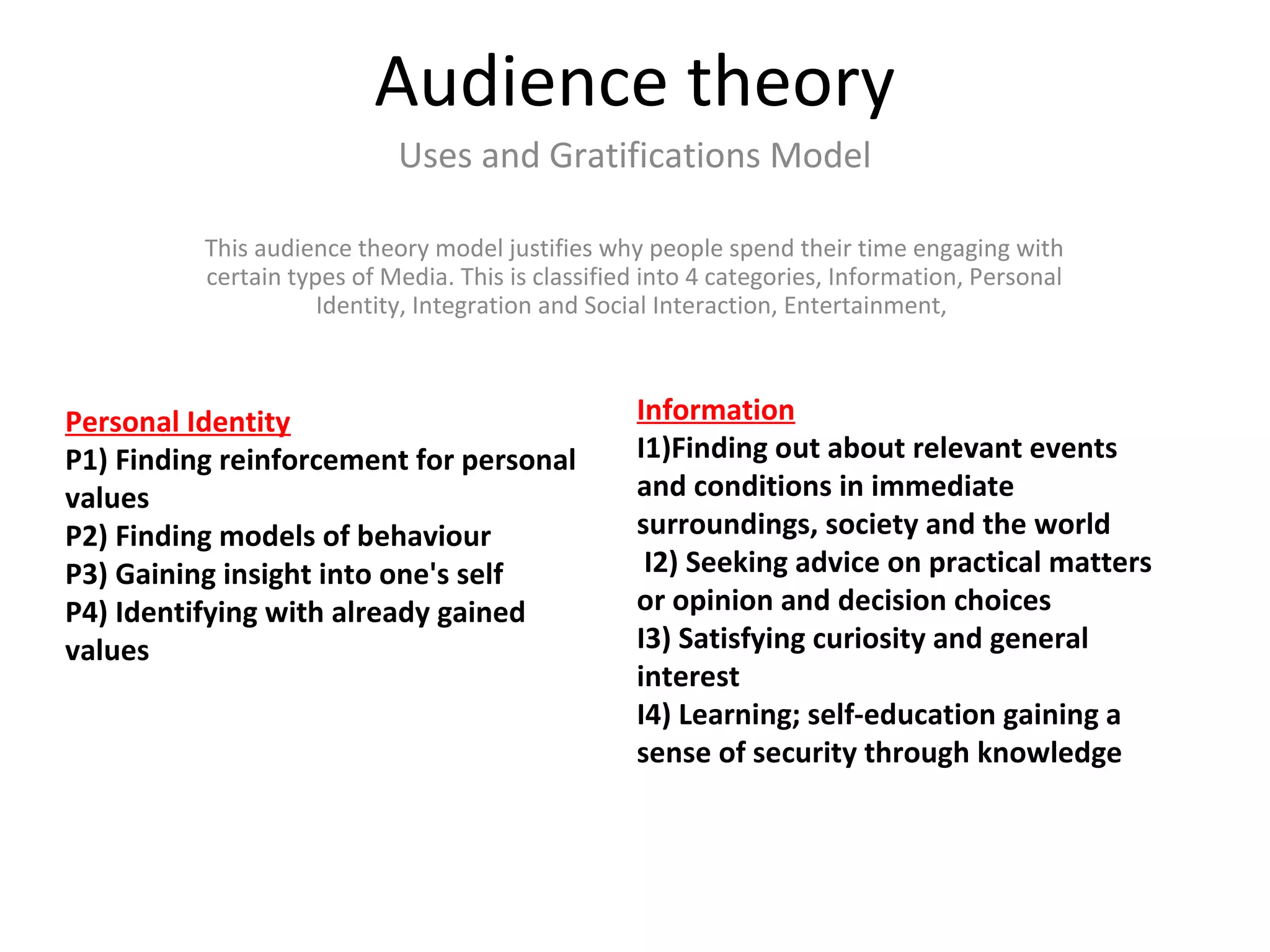
Audience theory
Uses and Gratifications Model
This audience theory model justifies why people spend their time engaging with
certain types of Media. This is classified into 4 categories, Information, Personal
Identity, Integration and Social Interaction, Entertainment,
Information
I1)Finding out about relevant events
and conditions in immediate
surroundings, society and the world
I2) Seeking advice on practical matters
or opinion and decision choices
I3) Satisfying curiosity and general
interest
I4) Learning; self-education gaining a
sense of security through knowledge
Personal Identity
P1) Finding reinforcement for personal
values
P2) Finding models of behaviour
P3) Gaining insight into one's self
P4) Identifying with already gained
values
Audience theory
Uses and Gratifications Model
This audience theory model justifies why people spend their time engaging with
certain types of Media. This is classified into 4 categories, Information, Personal
Identity, Integration and Social Interaction, Entertainment,
Integration and Social Interaction S1)
Gaining insight into circumstances of
others; social empathy
S2) Identifying with others and gaining
a sense of belonging
S3) Finding a basis for conversation and
social interaction
S4) Having a substitute for real-life
companionship
S5) Helping to carry out social roles
S6) Enabling one to connect with
family, friends and society
Entertainment
E1) Escaping, or being diverted, from
problems
E2) Relaxing
E3) Getting intrinsic cultural or
aesthetic enjoyment
E4) FIlling time
E5) Emotional release
E6) Sexual arousal
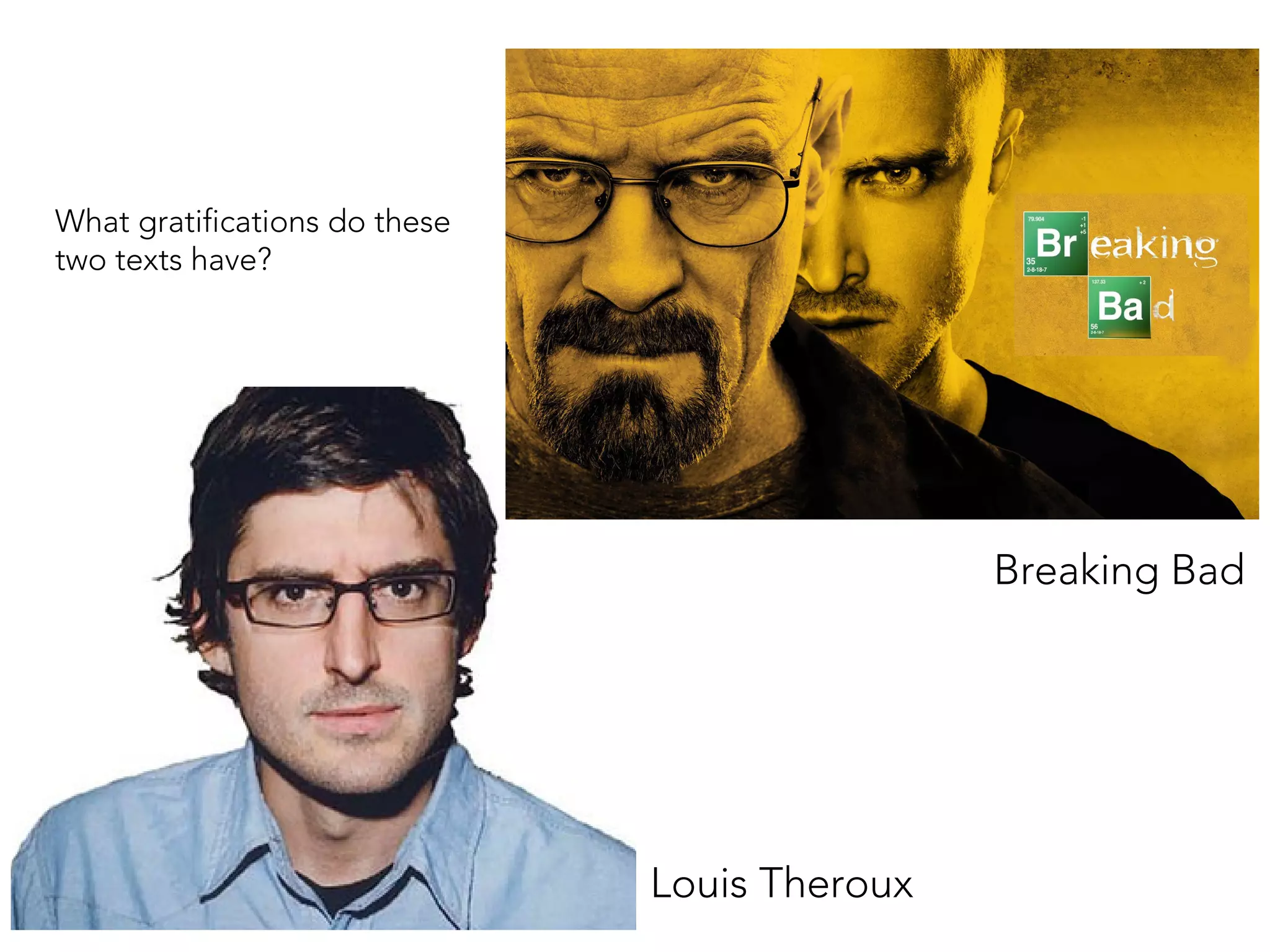
Breaking Bad
Louis Theroux
What gratifications do these
two texts have?

Media audience theory

  • 1.
    • Chris Timothy •cjt@kinged6nun.ac.uk • http://keca2media.blogspot.co.uk • Expectations A Level Media
  • 2.
    What are thedifferences to last year? -Amount of time you spend working outside of class -A university standard essay for coursework -The level of Technical skills you must display, marking is much harsher -Coursework is more essay based than practical A Level Media
  • 3.
    A Level Media Theyear is broken into 3 pieces of coursework which all link and make up 50% of your second year. 1.The investigation 2.Print or moving image practical piece 3. Evaluation
  • 4.
    A2 Media -Coursework Students are required to produce three pieces of linked work; 1.Research Investigation > Practical Coursework > Evaluation Research Investigation Key Points 1.1400 – 1800 words not including any quotes or references 2.Students need to focus on one of the following topics: genre, narrative or representation. (One of these words should be in the essay title) 3.The title must be a question 4.Once the essay is complete it should enable a conclusion to be reached that will inform their production. 5.The investigation must demonstrate you can apply theory to your subject and your understanding of it helps you answer your question. 6.The investigation needs to contain references. 7.The investigation must have two specific case studies
  • 5.
    Poor Essay Titles 1.MaleRepresentation 2.Investigating Sci/Fi conventions 3.How are Action films structured? 4.Are females portrayed accurately in reality T.V today? 5.Are Romance films over reliant on non linear structures? 1. How are young males represented within the teen movie genre with particular focus on American Pie and Super Bad ? 2.Has the Sci Fi genre evolved in terms of its use of traditional genre conventions and plot devices from the 1970’s and the film Alien to the more contemporary District 9? 3.Do the Action films Die Hard and Transformers apply the traditional narrative structure of Todorov? 4.Do British so called reality T.V represent females to contain stereotypical gender roles with a Particular focus on, TOWIE and Made in Chelsea? 5.Is the western romance genre and in particular, The Notebook and Take this Waltz, guilty of using non linear narrative conventions to develop character investment?
  • 6.
    Referencing Student Statement “Body imageultimately does play a part in the lives of women yet there is an increasing trend of this effect on teenagers also.” This viewpoint has been supported in a number of studies. Too generic? Which particular ones? You could be presuming or making it up? “Teen-age girls who viewed commercials depicting women with unrealistically thin-ideal body type and beauty caused adolescent girls to feel less confident, angrier, and more dissatisfied with their weight and appearance” (1) This was the conclusion of a study conducted by Oxford University in 2001 when interviewing over 1000 teenagers between the age of ……….. Great, Point Proven, dates, quotes, proof Bilbliography (1) Hargreaves, D. A., & Tiggemann, M. (2002) Ok, who says? Prove it? What evidance do you have? Who agrees with you?
  • 7.
    A Level Media 2.Printor video practical piece This production must be in a different form from the AS production. Audio-visual productions should be up to 4 minutes in length (depending on the nature of the production). Print-based productions (or their digital equivalent) should be a minimum of 3 pages. Examples; DVD/CD covers Magazine Covers/double page spreads Film/TV billboards Websites Print advertisements Film trailers/film segment Video advert
  • 8.
    A Level Media 2.Printor video practical piece The practical piece should take a preferred, oppositional or negotiated approach to a students investigations findings. For example a film noir represent females as femme fetales
  • 9.
    A Level Media 2.Printor video practical piece Or within action films females main role within the narrative is to be objectified.
  • 10.
    A Level Media 2.Printor video practical piece
  • 11.
    A Level Media 2.Printor video practical piece
  • 12.
    A Level Media 2.Printor video practical piece
  • 13.
    A Level Media 2.Printor video practical piece
  • 14.
    A Level Media 2.Printor video practical piece
  • 15.
    A Level Media 2.Printor video practical piece
  • 16.
    Evaluation Justifies and describes howthe practical links to the investigation and what approach they took Analyses strengths and weaknesses Has a sophisticated use of terminology and media language 750 words
  • 17.
    Media Theory 1.The investigationmust demonstrate you can apply theory to your subject and your understanding of it helps you answer your question. This was our weakness in AS exams
  • 18.
    Audience Genre Representation Narrative Write down asmany media theories as you can from AS and highlight any that are audience theories
  • 19.
    Audience Media producers needto ensure they can readily define a target audience for a particular product and then create a product which will appeal directly to that target audience. Producers must know their audience so they can target them effectively and ensure a text gratifies them with the correct mode of address. Film cost $200m Studio spent another $100m on marketing and advertising Thus far the film has made $184m on ticket sales. However half of that amount goes to the cinemas $300m - $92m = $208m loss Why?
  • 20.
    Audience Niche Mainstream Types Gratifications In pairs definea niche and mainstream audience and select some text you believe to fit into each category. Secondly define gratification, and if you know any gratifications, list them.
  • 21.
    Types of audience MassAudience: large audiences- often termed as ‘broadcast’ audiences, who consume mainstream or popular culture texts. E.g. soap operas, sit-coms, reality TV shows etc
  • 22.
    Niche Audience: smallerthan mass. This type of audience can be influenced, dedicated and loyal. One example is BBC four, which is aimed at a niche audience interested in artistic programmes, or specific subscription channels. Types of audience
  • 23.
    Uses and GratificationsModel This model stems from the idea that audiences are a complex mixture of individuals who select media texts that best suits their needs of consumption. According to the theory the audience have to be active in order for it to work. The model suggests that media audiences make active decisions about what they consume in relation to their social and cultural setting, backgrounds and needs/desires. This was summed up by theorists Blumier and Katz in 1974;
‘Media usage can be explained in that it provides gratifications related to the satisfaction of social and psychological needs’. Put simply this means that audiences choose to watch texts that make them feel good (gratifications) for example. soaps and sitcoms, or texts that give them information that they can use (uses) e.g. news or information about new products or the world around them.
  • 24.
    Blumier and Katz(1975) went into greater detail and identified four main uses: Personal identity – our need to define our identity and increase our sense of self. Part of our sense of self is informed by making judgments about all sorts of people and things. This is also true of judgments we make about TV, film characters, and celebrities. Our choice of music, the shows we watch, the stars we like can be an expression of our identities. We desire to project ourselves via the texts we consume. One aspect of this type of gratification is known as value reinforcement. This is where we choose television programmes or newspapers that have similar beliefs to those we hold. Information – our need to know what is going on in the world. This relates to Maslow’s need for security. By keeping up to date with news about local and international events we feel we have the knowledge to avoid or deal with dangers. Entertainment – the need for escape, entertainment and relaxation. All types of television programmes can be ‘used’ to wind down and offer diversion, as well as satisfying some of the other needs at the same time. Social– our need for to interact with other people. This is provided by forming virtual relationships with characters in soaps, films and all kinds of drama, and other programmes and other media texts.
  • 25.
    Audience theory Uses andGratifications Model This audience theory model justifies why people spend their time engaging with certain types of Media. This is classified into 4 categories, Information, Personal Identity, Integration and Social Interaction, Entertainment, Information I1)Finding out about relevant events and conditions in immediate surroundings, society and the world I2) Seeking advice on practical matters or opinion and decision choices I3) Satisfying curiosity and general interest I4) Learning; self-education gaining a sense of security through knowledge Personal Identity P1) Finding reinforcement for personal values P2) Finding models of behaviour P3) Gaining insight into one's self P4) Identifying with already gained values
  • 26.
    Audience theory Uses andGratifications Model This audience theory model justifies why people spend their time engaging with certain types of Media. This is classified into 4 categories, Information, Personal Identity, Integration and Social Interaction, Entertainment, Integration and Social Interaction S1) Gaining insight into circumstances of others; social empathy S2) Identifying with others and gaining a sense of belonging S3) Finding a basis for conversation and social interaction S4) Having a substitute for real-life companionship S5) Helping to carry out social roles S6) Enabling one to connect with family, friends and society Entertainment E1) Escaping, or being diverted, from problems E2) Relaxing E3) Getting intrinsic cultural or aesthetic enjoyment E4) FIlling time E5) Emotional release E6) Sexual arousal
  • 27.
    Breaking Bad Louis Theroux Whatgratifications do these two texts have?