 By
 Dr.C.Karthikeyan
 Assistant Professor
 Department of Earth Sciences
 Annamalai University.
AEOLIAN LANDFORMS
WIND/AEOLIANLANDFORMS
Wind action is quite pronounced in the arid and semi arid areas of
the world where the absence of vegetation cover and presence of extensive
bare rocks help in the erosional, transportation and depositional processes.
Apart from the descents and regions, wind action is also quite significant
on sandy coasts, out wash plains of glaciated areas.
Wind is an effective geologic agent. It erodes and can transport
loose, consolidated fragments of sand and dust. It transports sand by
saltation and surface creep. Dust is transported suspension and it can
remain high in the atmosphere for long percols. At wind speed of
3dkm/hour sand grains can be removed, but extremely rare gusts of
120km/hour, are needed to roll, pebbles along the surface.
WIND EROSION;
Wind performs erosion in three different ways. Attrition, deflation
and abrasion or corrosion. Attrition is the mutual wearing down of the
rock particles carried along by the wind. Deflation is the lifting and
removed of loose materials from the earth’s surface by wind action.
Abrasion or corrosion is the cutting of rocks surface by moving
weathered rock particles or more concretely the sand-blast action of
wind –blown sand.
A) ATTRITION: In the arid regions on account of the great diurnal
range of temperature and the action of frost there is rapid mechanical
disintegration of rocks. When these rocks particles are carried along by
the wind, they not only strike against the rocks standing in their way but
also strike against one another. Thus by mutual friction and forceful
contact they break down further and there is a gradual reduction in their
size and ultimately they are converted into sand and dust particles which
cover large part of the desert. This process of gradual reduction in the
size of rock particles by mutual impact is called attrition.
b) DEFLATION: In the dry regions the wind can easily lift and transport the unconsolidated
sand and dust particles. This process is called deflation. The lifting or entrainment of loose
particles takes place by a variety of processes such as, shear, lift and ballistic impact. Large
scale removal of sand and dust from a desert region may result either in the formation of
depressions called blowouts or in the exposure of the rocky surface beneath the sandy cover.
As the wind removes sand and smaller size particles by deflation, the coarser materials
which the wind is unable to lift and carry are left behind. In areas of strong winds the ground
may thus be left covered with boulders and pebbles. These concentrations of boulders and
pebbles and larger sized particles which are left behind after the smaller sized particles have
been removed by wind are called lag deposits or gravel lags.
C.ABRASION OR CORROSION:-Abrasion is the work of wind charged with sand particles.
Strong winds carry with them enormous quantities of sand and small angular rock fragments
which act as tools of erosion as they strike against rock surfaces. The principal mineral of sand
is quartz which is harder than most rock-forming minerals. When wind blown sand particles
strike against rocks, they act as powerful sandpaper and homogeneous rock surfaces are
smoothened and polished. Where there are both hard and soft rocks, the soft rocks more easily
cut and the surfaces are grooved and fluted. Pebbles or gravels which are worn and polished by
wind abrasion and show one or more polished and faceted surfaces and sharp edges are called
ventifacts.
Wind abrasion is most effective with in a few metres of the earth’s
surface of the sand is seldom lifted more than two metres above the
ground. As the wind cannot lift sand more than a few meters, the
effect of abrasion becomes negligible after some height. Under
cutting is, there fore, a marked feature of wind abrasion. Where the
wind blows from one direction, only the windward face of the rock
is undercut, but where the wind is variable and blows from all
directions, the rock is under-cut from all sides.
EROSIONAL LANDFORMS
long-continued erosional works through the mechanisms of
abrasion or sandblasting and deflation produces some characteristic
landforms in desert areas such as blow-outs or deflation basins,
mushroom rocks or pedestal rocks, inselbergs, demoiselles,
yardangs, ventifacts, dreikanters, wind windows etc.
DEFLATION BASINS—depressions formed in the deserts due to removal of
sands through the process of deflation are called deflation basins or blow-
outs, the depth of which is determined by groundwater table.
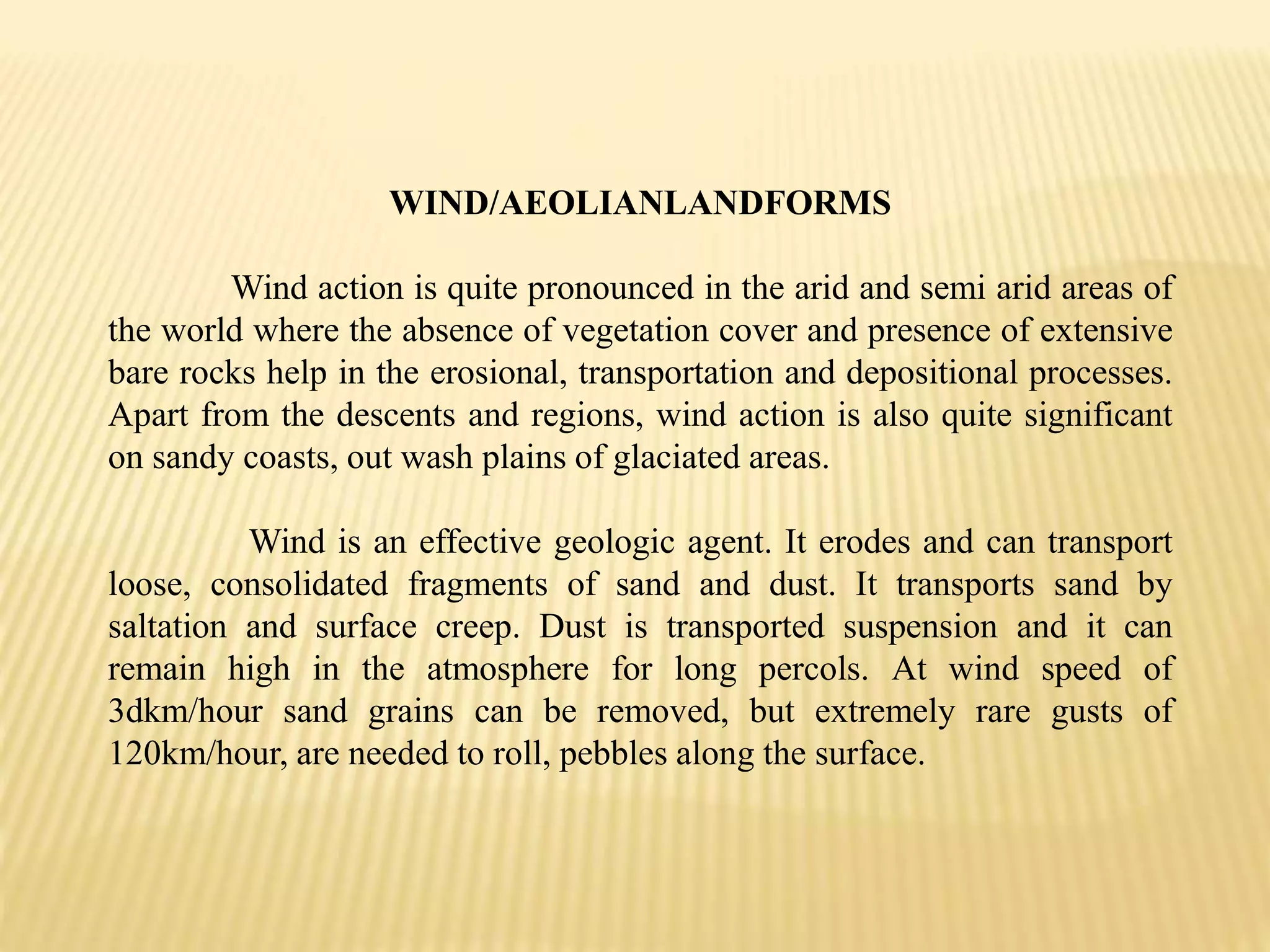
MUSHROOM ROCKS: - the rocks having broad upper part and narrow base
resembling an umbrella or mushroom are called mushroom rocks or pedestal
rocks. These undercut pedestal rocks are formed due to abrasive works of
wind.
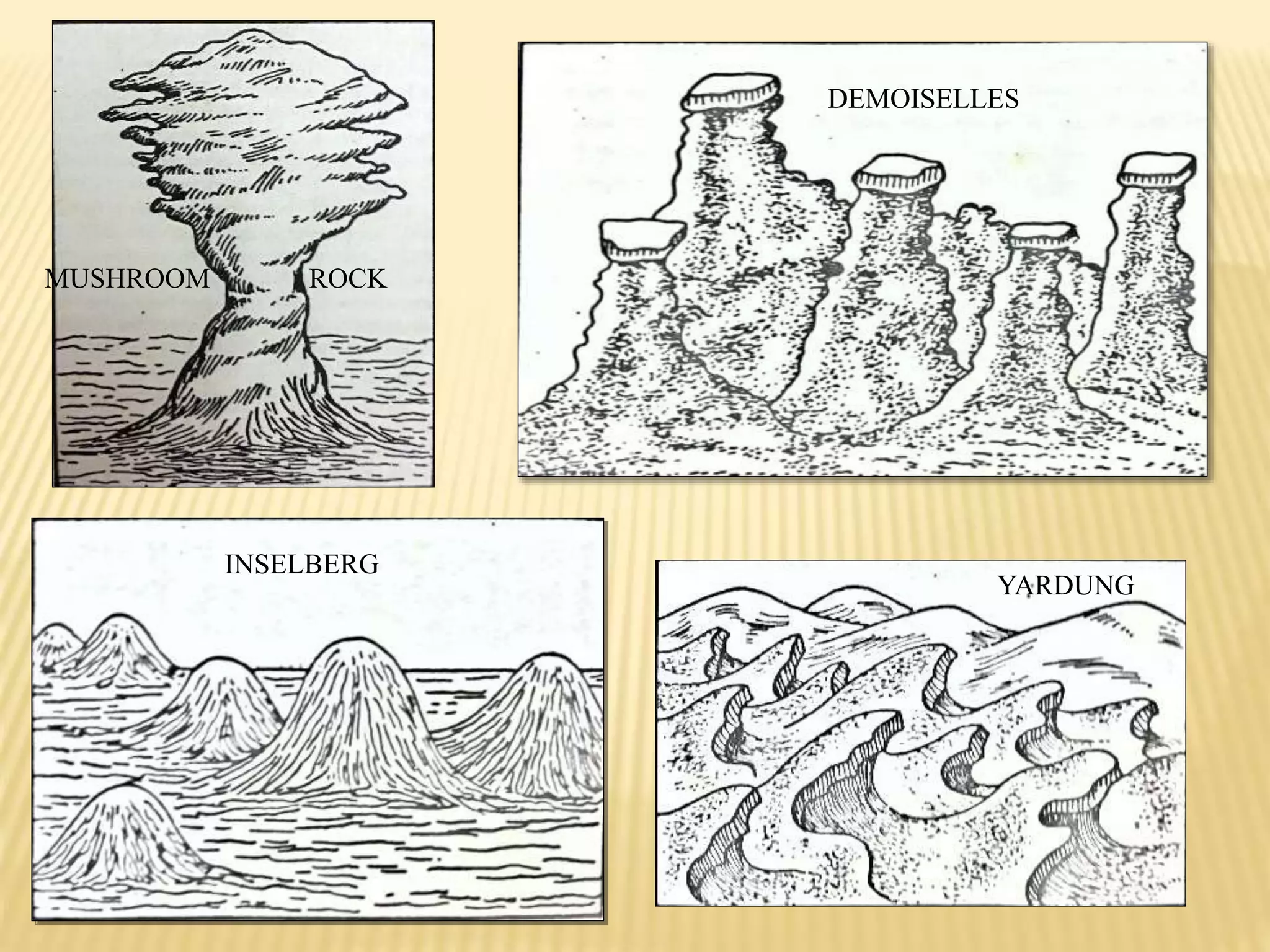
INSELBERGS: - are sharply raising residual hill above the flat surfaces. It
may be pointed out that inselbergs are the product of weathering and erosion
in different climatic regions.
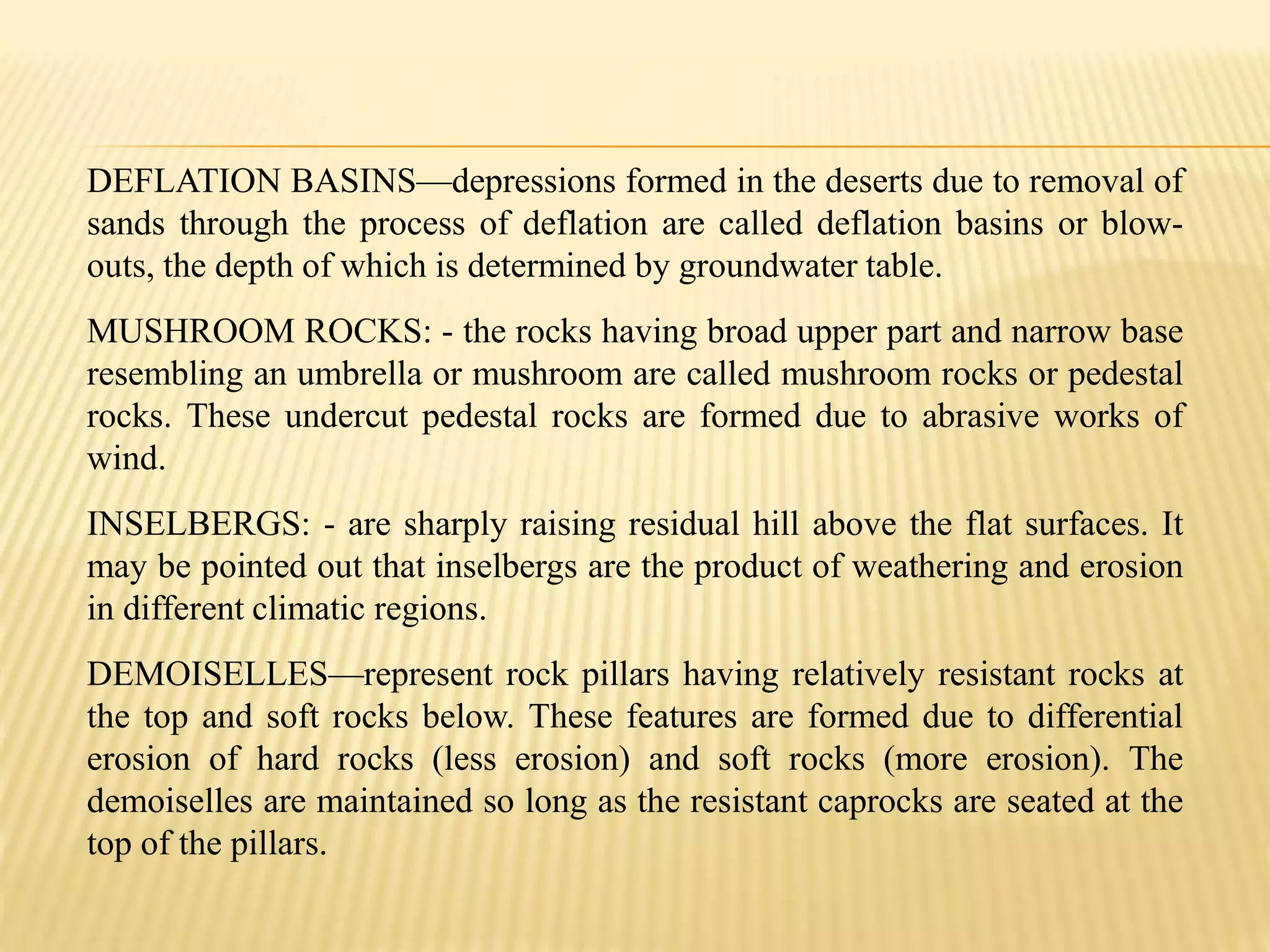
DEMOISELLES—represent rock pillars having relatively resistant rocks at
the top and soft rocks below. These features are formed due to differential
erosion of hard rocks (less erosion) and soft rocks (more erosion). The
demoiselles are maintained so long as the resistant caprocks are seated at the
top of the pillars.
MUSHROOM ROCK
DEMOISELLES
INSELBERG
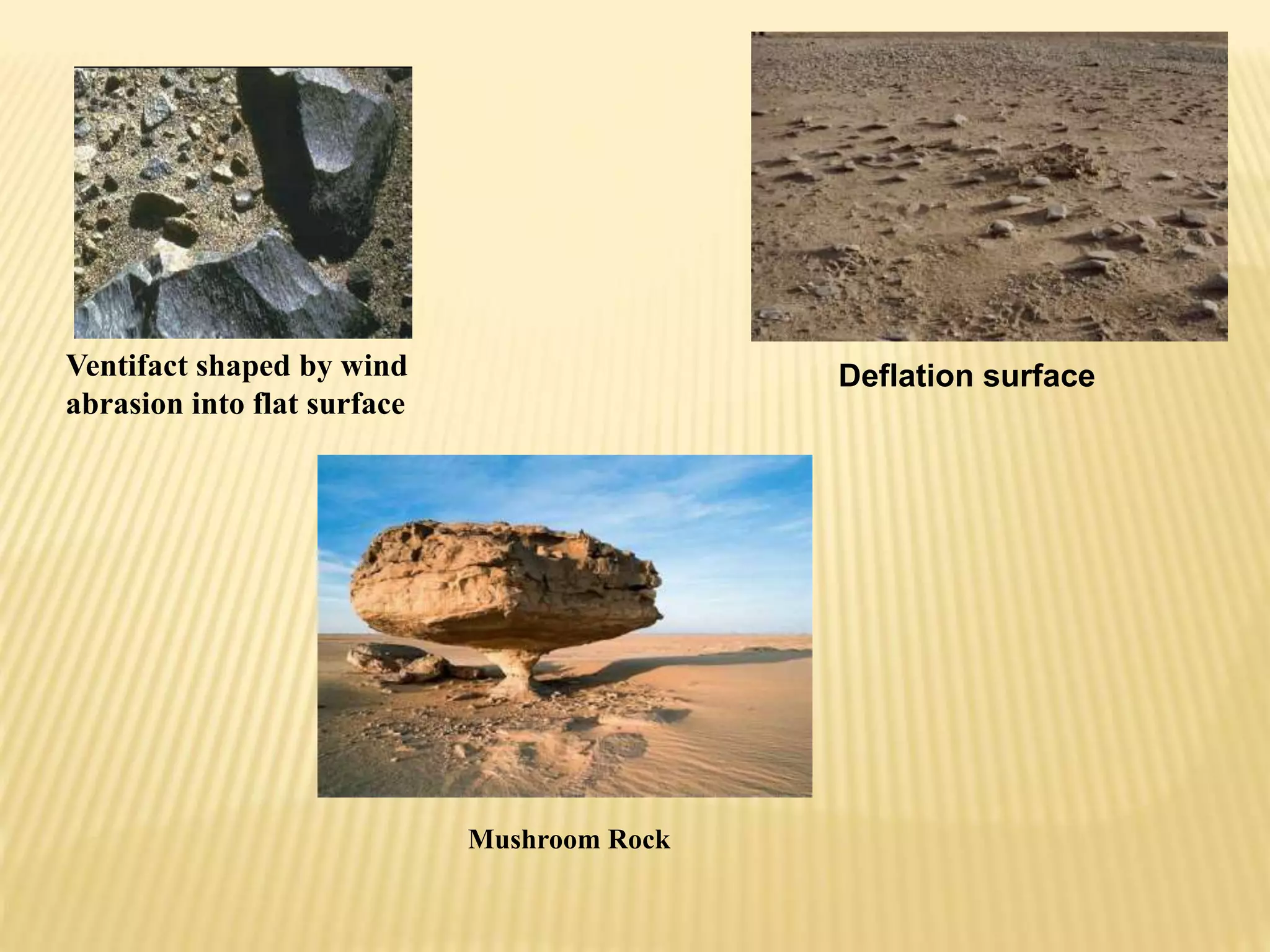
YARDUNG
Deflation surface
Mushroom Rock
Ventifact shaped by wind
abrasion into flat surface
YARDANGS—are steep-sided deeply undercut overhanging rock ridges
separated from one another by long grooves or corriders or passageways
cut in desert floors of relatively softer rocks. They are formed where
alternate bands of hard and soft rocks are vertical or inclined to the
horizontal plane. The intervening beds of softer rocks are abraded and
eroded materials are blown away by deflation process.
VENTIFACTS- faceted rock boulders, cobbles and pebbles abraded by
long periods of wind erosion are called ventifacts.
STONE LATTICE—the rocks of varying composition and resistance
when abraded by powerful wind charged with erosion tools become
uneven surface as the powerful wind abrades weaker sections of rocks and
removes the abraded materials while relatively resistant sections are least
affected by abrasion. Such pitted and fluted rock surfaces are called stone
lattices.
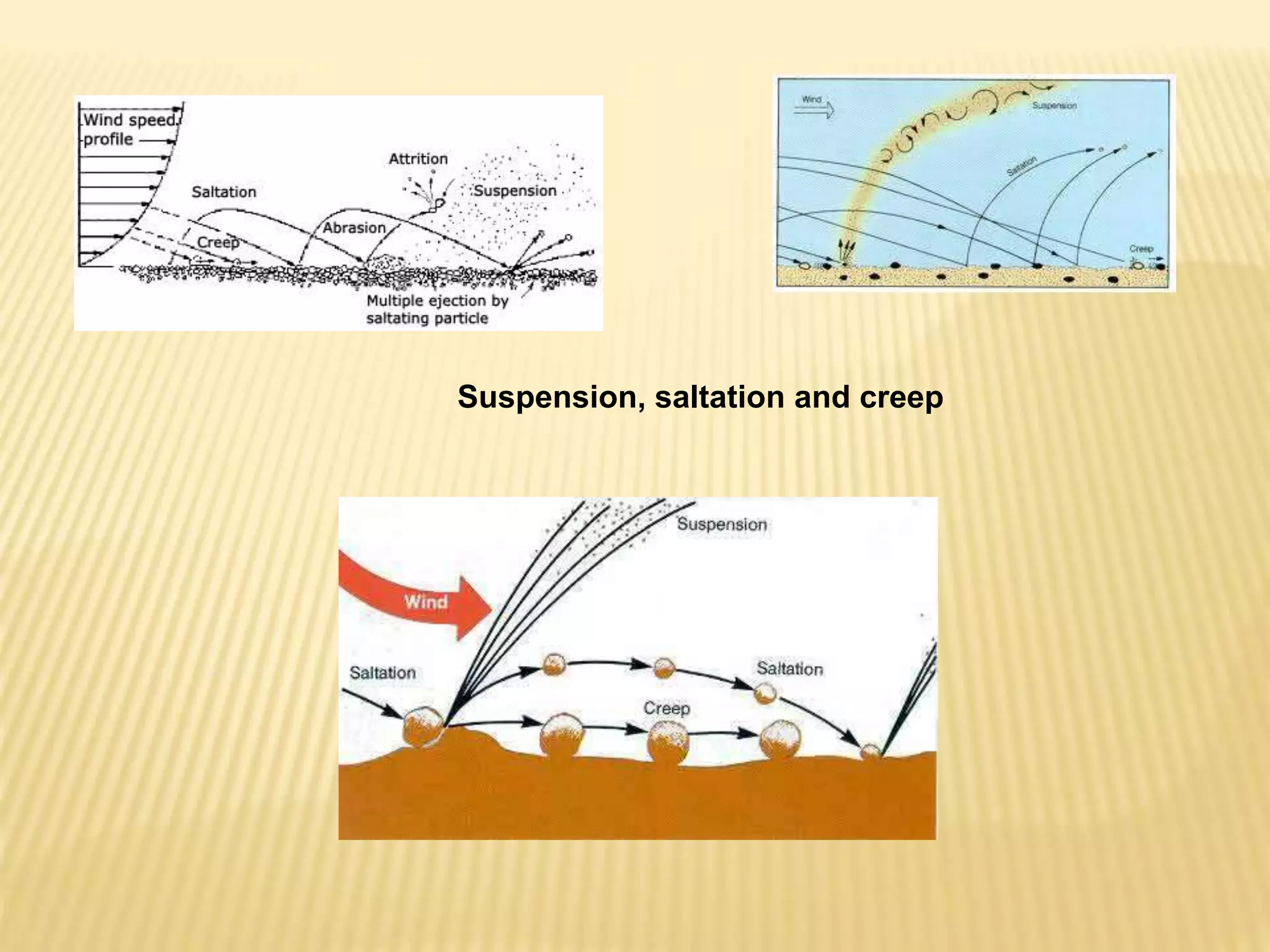
TRANSPORTATIONAL WORK OF WIND: - The transportational work of wind
differs from other agents of erosion. Because the direction of wind is highly variable.
Wind transport involves entrainment of loosened grains of sands and dust in the air and
their movement to new locations of deposition. Wind transports the material through
the mechanism of suspension, saltation and traction. Very fine materials with a
diameter of less than 0.2 mm are kept in suspension by upward moving air. Such
materials kept in suspension are called dusts and extremely fine particulate matters are
called haze or smoke. The suspended matters are carried by wind for greater distance.
The materials larger than 0.2 mm in diameter are transported through the mechanism of
wind transport are called saltation.
The mechanism of transport of loosened materials on the ground surface is called
surface creep or traction wherein the materials always touch the ground and move
forward without saltating. The following are the main characteristics of wind transport.
1. The direction of wind transport is variable because wind very often changes its
direction. 2. Wind transport involves large areas and greater distances (thousands of
kilometers). 3. Win transports the materials at the ground surface and above the ground
(in the air) 4. Only very fine materials are transported to greater distances in one step
while coarser materials are transported in stages and steps by rolling, leaping and
jumping.
Suspension, saltation and creep
DEPOSITIONAL WORK OF WIND;
Depositional work of wind is geomorphologically very important because
significant feature like sand dunes and loess are formed. Deposition of wind
blown sediments occurs due to marked reduction in wind speed and obstructions
caused by bushes, forest, marshes and swamps, lakes, big rivers, walls etc. sands
are deposited on both windward and lee ward sides of fixed obstruction. The
accumulated sand mounds on either side of the obstruction are called sand
shadows. Accumulation of sands between obstacles is called sand drifts.
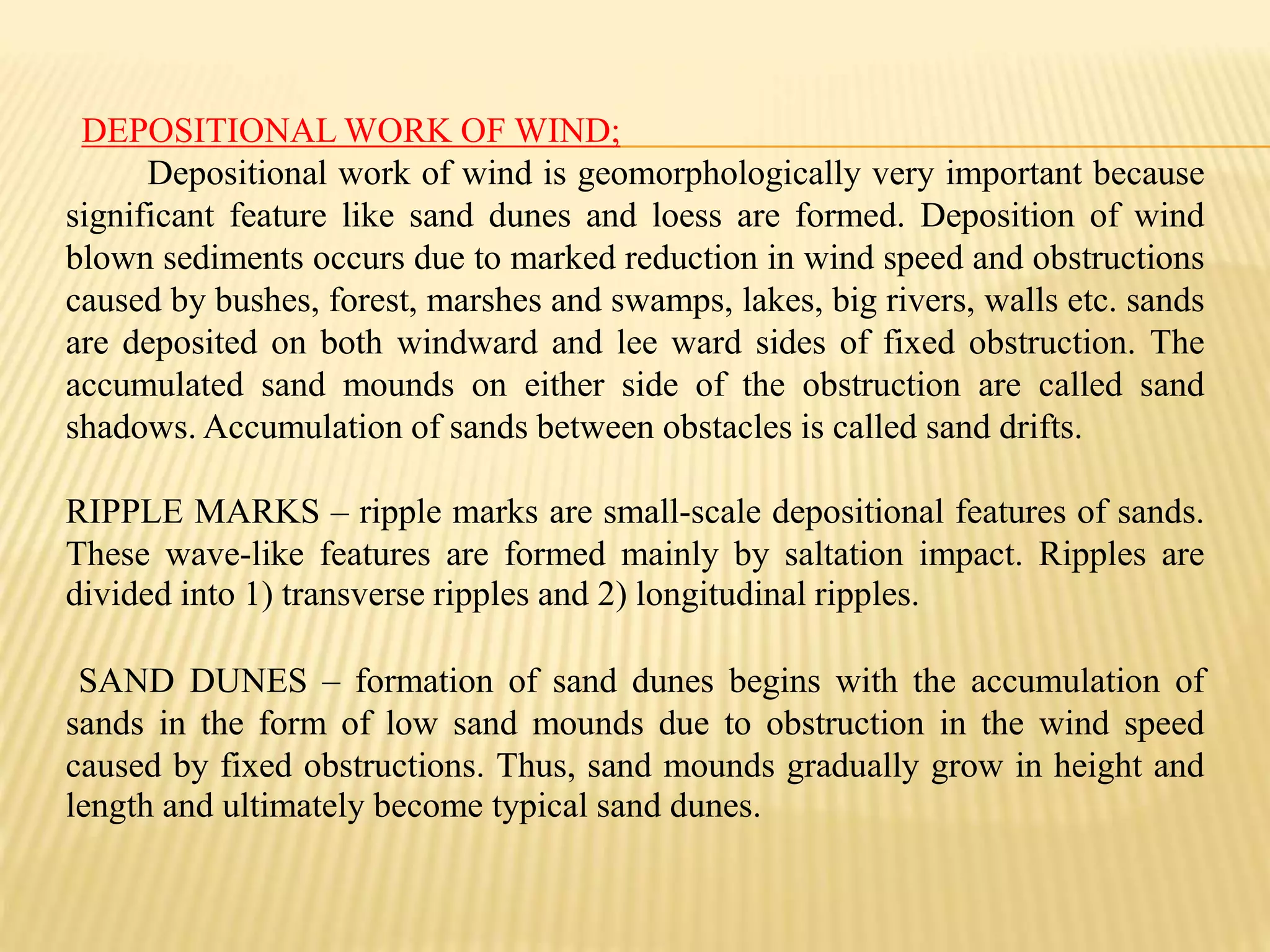
RIPPLE MARKS – ripple marks are small-scale depositional features of sands.
These wave-like features are formed mainly by saltation impact. Ripples are
divided into 1) transverse ripples and 2) longitudinal ripples.
SAND DUNES – formation of sand dunes begins with the accumulation of
sands in the form of low sand mounds due to obstruction in the wind speed
caused by fixed obstructions. Thus, sand mounds gradually grow in height and
length and ultimately become typical sand dunes.
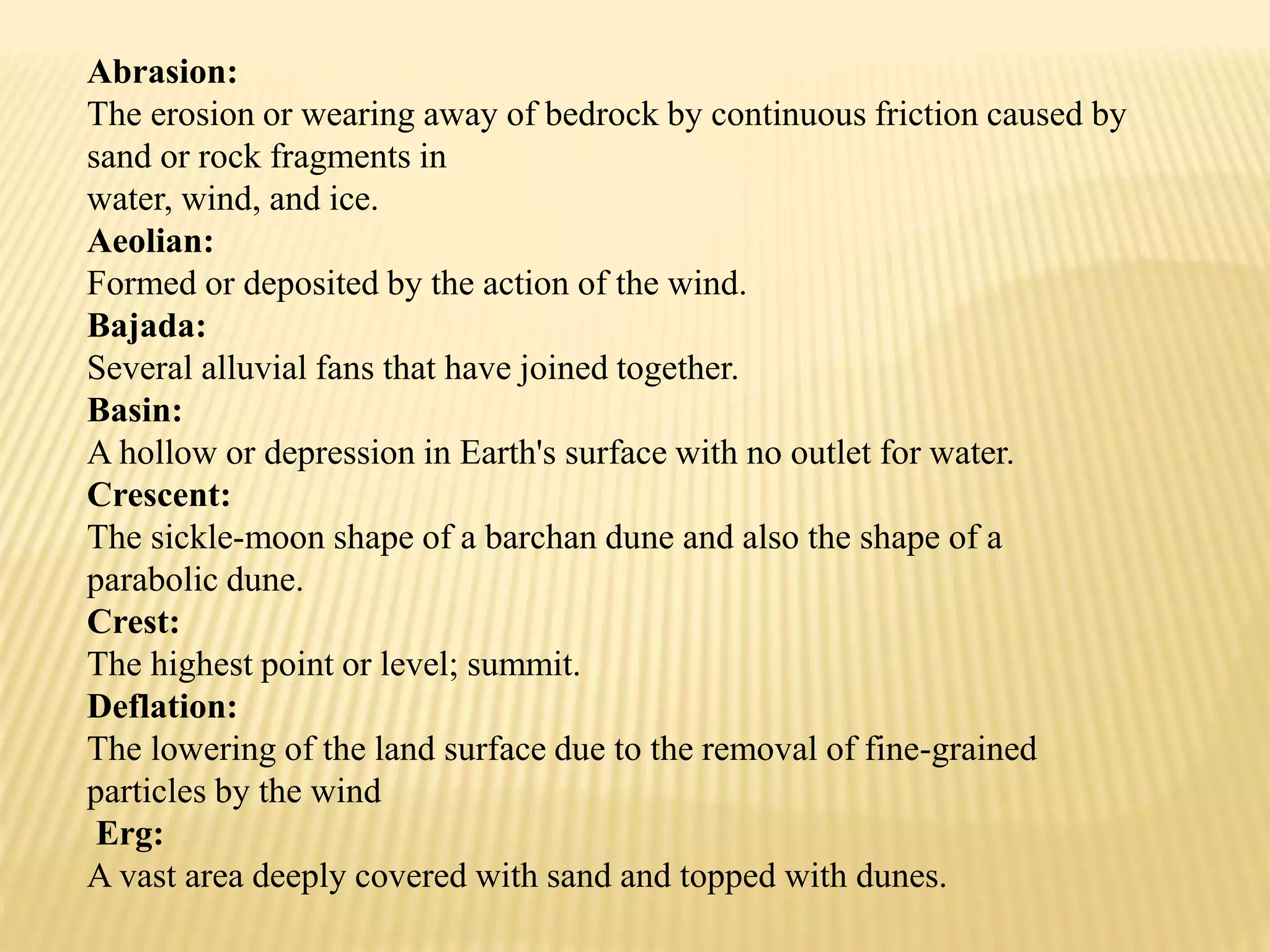
DUNE TYPES – dunes are classified on various bases viz. morphology, structure,
orientation, location, ground pattern, internal structure, number of slip faces etc.
•Longitudinal dunes: - sand dunes formed parallel to the wind direction are called
longitudinal dunes. They are huge Aeolian landforms extending hundreds of kilometers in
length. Windward slope of these dunes is gentle while leeward slope is steep.
•Transverse dunes: - dunes formed transverse to the direction of prevailing winds are
called transverse dunes. These are formed by ineffective winds along the coasts and
margins of deserts. They are not very common depositional features in extensive deserts.
They appear as wave-like features.
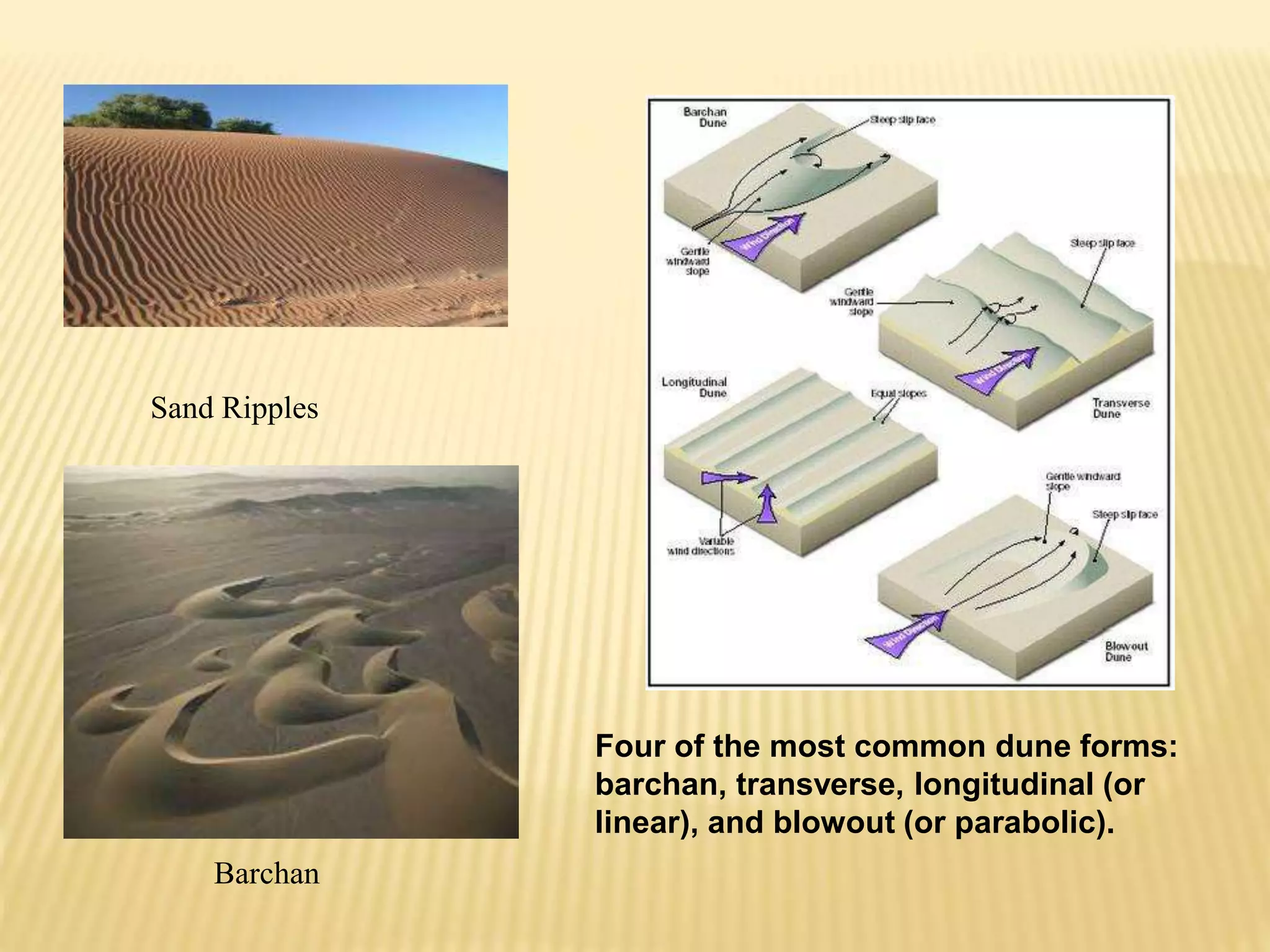
•Barchan dunes: - sand dunes of crecentic shape having two horns are called barchans. In
fact, barchans are special types of transverse dunes. The windward side having gentle
slope is convex in plan while the leeward side is concave in plan with steep slope. The
horns always project downward. Transverse dunes are transformed into barchans when
sand supply becomes more limited downwind.
•Parabolic dunes: - parabolic dunes generally develop in the partially stabilized sandy
terrains. They are usually U-shaped having convex nose which migrates downwind. These
dunes are much longer and narrower than barchans but are always associated with a
blowout.
LOESS: - Loess represents thick deposits of unstratified, non indurated, buff-coloured,
well sorted, fine grained sediments consisting of quartz silt with small clay fraction and
higher content of carbonate minerals.
Four of the most common dune forms:
barchan, transverse, longitudinal (or
linear), and blowout (or parabolic).
Barchan
Sand Ripples
Abrasion:
The erosion or wearing away of bedrock by continuous friction caused by
sand or rock fragments in
water, wind, and ice.
Aeolian:
Formed or deposited by the action of the wind.
Bajada:
Several alluvial fans that have joined together.
Basin:
A hollow or depression in Earth's surface with no outlet for water.
Crescent:
The sickle-moon shape of a barchan dune and also the shape of a
parabolic dune.
Crest:
The highest point or level; summit.
Deflation:
The lowering of the land surface due to the removal of fine-grained
particles by the wind
Erg:
A vast area deeply covered with sand and topped with dunes.
Erosion:
The gradual wearing away of Earth surfaces through the action of wind
and water
Gully:
A channel cut into the Earth's surface by running water, especially after a
heavy rain.
Leeward:
On or toward the side facing away from the wind.
Saltation:
The jumping movement of sand caused by the wind.
Silt:
Fine earthy particles smaller than sand carried by moving water and
deposited as a sediment.
Slip face:
The steeply sloped side of a dune that faces away from the wind.
Surface creep:
The rolling and pushing of sand and slightly larger particles by the wind.
Ventifact:
A stone or bedrock surface that has been shaped or eroded by the wind.
Windward:
On or toward the side facing into the wind
Wind / Aeolian landforms

Wind / Aeolian landforms

  • 1.
     By  Dr.C.Karthikeyan Assistant Professor  Department of Earth Sciences  Annamalai University. AEOLIAN LANDFORMS
  • 2.
    WIND/AEOLIANLANDFORMS Wind action isquite pronounced in the arid and semi arid areas of the world where the absence of vegetation cover and presence of extensive bare rocks help in the erosional, transportation and depositional processes. Apart from the descents and regions, wind action is also quite significant on sandy coasts, out wash plains of glaciated areas. Wind is an effective geologic agent. It erodes and can transport loose, consolidated fragments of sand and dust. It transports sand by saltation and surface creep. Dust is transported suspension and it can remain high in the atmosphere for long percols. At wind speed of 3dkm/hour sand grains can be removed, but extremely rare gusts of 120km/hour, are needed to roll, pebbles along the surface.
  • 3.
    WIND EROSION; Wind performserosion in three different ways. Attrition, deflation and abrasion or corrosion. Attrition is the mutual wearing down of the rock particles carried along by the wind. Deflation is the lifting and removed of loose materials from the earth’s surface by wind action. Abrasion or corrosion is the cutting of rocks surface by moving weathered rock particles or more concretely the sand-blast action of wind –blown sand. A) ATTRITION: In the arid regions on account of the great diurnal range of temperature and the action of frost there is rapid mechanical disintegration of rocks. When these rocks particles are carried along by the wind, they not only strike against the rocks standing in their way but also strike against one another. Thus by mutual friction and forceful contact they break down further and there is a gradual reduction in their size and ultimately they are converted into sand and dust particles which cover large part of the desert. This process of gradual reduction in the size of rock particles by mutual impact is called attrition.
  • 4.
    b) DEFLATION: Inthe dry regions the wind can easily lift and transport the unconsolidated sand and dust particles. This process is called deflation. The lifting or entrainment of loose particles takes place by a variety of processes such as, shear, lift and ballistic impact. Large scale removal of sand and dust from a desert region may result either in the formation of depressions called blowouts or in the exposure of the rocky surface beneath the sandy cover. As the wind removes sand and smaller size particles by deflation, the coarser materials which the wind is unable to lift and carry are left behind. In areas of strong winds the ground may thus be left covered with boulders and pebbles. These concentrations of boulders and pebbles and larger sized particles which are left behind after the smaller sized particles have been removed by wind are called lag deposits or gravel lags. C.ABRASION OR CORROSION:-Abrasion is the work of wind charged with sand particles. Strong winds carry with them enormous quantities of sand and small angular rock fragments which act as tools of erosion as they strike against rock surfaces. The principal mineral of sand is quartz which is harder than most rock-forming minerals. When wind blown sand particles strike against rocks, they act as powerful sandpaper and homogeneous rock surfaces are smoothened and polished. Where there are both hard and soft rocks, the soft rocks more easily cut and the surfaces are grooved and fluted. Pebbles or gravels which are worn and polished by wind abrasion and show one or more polished and faceted surfaces and sharp edges are called ventifacts.
  • 5.
    Wind abrasion ismost effective with in a few metres of the earth’s surface of the sand is seldom lifted more than two metres above the ground. As the wind cannot lift sand more than a few meters, the effect of abrasion becomes negligible after some height. Under cutting is, there fore, a marked feature of wind abrasion. Where the wind blows from one direction, only the windward face of the rock is undercut, but where the wind is variable and blows from all directions, the rock is under-cut from all sides. EROSIONAL LANDFORMS long-continued erosional works through the mechanisms of abrasion or sandblasting and deflation produces some characteristic landforms in desert areas such as blow-outs or deflation basins, mushroom rocks or pedestal rocks, inselbergs, demoiselles, yardangs, ventifacts, dreikanters, wind windows etc.
  • 6.
    DEFLATION BASINS—depressions formedin the deserts due to removal of sands through the process of deflation are called deflation basins or blow- outs, the depth of which is determined by groundwater table. MUSHROOM ROCKS: - the rocks having broad upper part and narrow base resembling an umbrella or mushroom are called mushroom rocks or pedestal rocks. These undercut pedestal rocks are formed due to abrasive works of wind. INSELBERGS: - are sharply raising residual hill above the flat surfaces. It may be pointed out that inselbergs are the product of weathering and erosion in different climatic regions. DEMOISELLES—represent rock pillars having relatively resistant rocks at the top and soft rocks below. These features are formed due to differential erosion of hard rocks (less erosion) and soft rocks (more erosion). The demoiselles are maintained so long as the resistant caprocks are seated at the top of the pillars.
  • 7.
  • 8.
    Deflation surface Mushroom Rock Ventifactshaped by wind abrasion into flat surface
  • 9.
    YARDANGS—are steep-sided deeplyundercut overhanging rock ridges separated from one another by long grooves or corriders or passageways cut in desert floors of relatively softer rocks. They are formed where alternate bands of hard and soft rocks are vertical or inclined to the horizontal plane. The intervening beds of softer rocks are abraded and eroded materials are blown away by deflation process. VENTIFACTS- faceted rock boulders, cobbles and pebbles abraded by long periods of wind erosion are called ventifacts. STONE LATTICE—the rocks of varying composition and resistance when abraded by powerful wind charged with erosion tools become uneven surface as the powerful wind abrades weaker sections of rocks and removes the abraded materials while relatively resistant sections are least affected by abrasion. Such pitted and fluted rock surfaces are called stone lattices.
  • 10.
    TRANSPORTATIONAL WORK OFWIND: - The transportational work of wind differs from other agents of erosion. Because the direction of wind is highly variable. Wind transport involves entrainment of loosened grains of sands and dust in the air and their movement to new locations of deposition. Wind transports the material through the mechanism of suspension, saltation and traction. Very fine materials with a diameter of less than 0.2 mm are kept in suspension by upward moving air. Such materials kept in suspension are called dusts and extremely fine particulate matters are called haze or smoke. The suspended matters are carried by wind for greater distance. The materials larger than 0.2 mm in diameter are transported through the mechanism of wind transport are called saltation. The mechanism of transport of loosened materials on the ground surface is called surface creep or traction wherein the materials always touch the ground and move forward without saltating. The following are the main characteristics of wind transport. 1. The direction of wind transport is variable because wind very often changes its direction. 2. Wind transport involves large areas and greater distances (thousands of kilometers). 3. Win transports the materials at the ground surface and above the ground (in the air) 4. Only very fine materials are transported to greater distances in one step while coarser materials are transported in stages and steps by rolling, leaping and jumping.
  • 11.
  • 12.
    DEPOSITIONAL WORK OFWIND; Depositional work of wind is geomorphologically very important because significant feature like sand dunes and loess are formed. Deposition of wind blown sediments occurs due to marked reduction in wind speed and obstructions caused by bushes, forest, marshes and swamps, lakes, big rivers, walls etc. sands are deposited on both windward and lee ward sides of fixed obstruction. The accumulated sand mounds on either side of the obstruction are called sand shadows. Accumulation of sands between obstacles is called sand drifts. RIPPLE MARKS – ripple marks are small-scale depositional features of sands. These wave-like features are formed mainly by saltation impact. Ripples are divided into 1) transverse ripples and 2) longitudinal ripples. SAND DUNES – formation of sand dunes begins with the accumulation of sands in the form of low sand mounds due to obstruction in the wind speed caused by fixed obstructions. Thus, sand mounds gradually grow in height and length and ultimately become typical sand dunes.
  • 13.
    DUNE TYPES –dunes are classified on various bases viz. morphology, structure, orientation, location, ground pattern, internal structure, number of slip faces etc. •Longitudinal dunes: - sand dunes formed parallel to the wind direction are called longitudinal dunes. They are huge Aeolian landforms extending hundreds of kilometers in length. Windward slope of these dunes is gentle while leeward slope is steep. •Transverse dunes: - dunes formed transverse to the direction of prevailing winds are called transverse dunes. These are formed by ineffective winds along the coasts and margins of deserts. They are not very common depositional features in extensive deserts. They appear as wave-like features. •Barchan dunes: - sand dunes of crecentic shape having two horns are called barchans. In fact, barchans are special types of transverse dunes. The windward side having gentle slope is convex in plan while the leeward side is concave in plan with steep slope. The horns always project downward. Transverse dunes are transformed into barchans when sand supply becomes more limited downwind. •Parabolic dunes: - parabolic dunes generally develop in the partially stabilized sandy terrains. They are usually U-shaped having convex nose which migrates downwind. These dunes are much longer and narrower than barchans but are always associated with a blowout. LOESS: - Loess represents thick deposits of unstratified, non indurated, buff-coloured, well sorted, fine grained sediments consisting of quartz silt with small clay fraction and higher content of carbonate minerals.
  • 14.
    Four of themost common dune forms: barchan, transverse, longitudinal (or linear), and blowout (or parabolic). Barchan Sand Ripples
  • 17.
    Abrasion: The erosion orwearing away of bedrock by continuous friction caused by sand or rock fragments in water, wind, and ice. Aeolian: Formed or deposited by the action of the wind. Bajada: Several alluvial fans that have joined together. Basin: A hollow or depression in Earth's surface with no outlet for water. Crescent: The sickle-moon shape of a barchan dune and also the shape of a parabolic dune. Crest: The highest point or level; summit. Deflation: The lowering of the land surface due to the removal of fine-grained particles by the wind Erg: A vast area deeply covered with sand and topped with dunes.
  • 18.
    Erosion: The gradual wearingaway of Earth surfaces through the action of wind and water Gully: A channel cut into the Earth's surface by running water, especially after a heavy rain. Leeward: On or toward the side facing away from the wind. Saltation: The jumping movement of sand caused by the wind. Silt: Fine earthy particles smaller than sand carried by moving water and deposited as a sediment. Slip face: The steeply sloped side of a dune that faces away from the wind. Surface creep: The rolling and pushing of sand and slightly larger particles by the wind. Ventifact: A stone or bedrock surface that has been shaped or eroded by the wind. Windward: On or toward the side facing into the wind