Webinar
July 31, 2014
Lean Coaching:
Asking the Right Questions
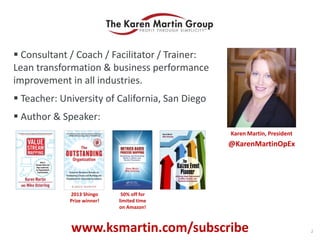
 Consultant / Coach / Facilitator / Trainer:
Lean transformation & business performance
improvement in all industries.
 Teacher: University of California, San Diego
 Author & Speaker:
Karen Martin, President
@KarenMartinOpEx
2013 Shingo
Prize winner!
www.ksmartin.com/subscribe
50% off for
limited time
on Amazon!
2
3
For more Coaching information
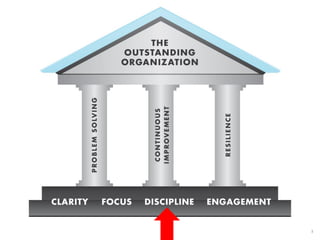
See Chapter 4 - Discipline
www.bitly.com/TOObk
4
Learning Objectives
• The role of the improvement coach
• Necessary skills for improvement coaches
• How to accelerate problem-solving skill
building through asking the right
questions at the right time
• When it’s appropriate to “tell” people
what to do
5
5 Observations & 1 Decree
1. There aren’t enough improvement “experts” to
go around in an organization.
2. Improvement “experts” aren’t content experts
(and, therefore, shouldn’t be the ones solving
problems).
3. Problems aren’t being solved quickly enough.
4. Problems aren’t being solved well enough.
5. Managers don’t know enough about the
improvement process.
6. Improvement can’t be delegated.
6
7
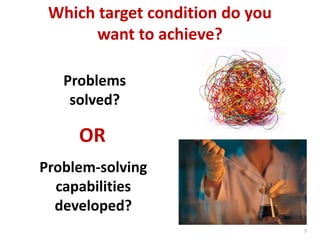
Problem-solving
capabilities
developed?
Which target condition do you
want to achieve?
OR
Problems
solved?
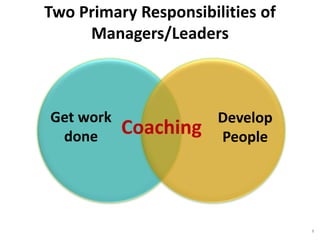
Two Primary Responsibilities of
Managers/Leaders
8
Coaching
Get work
done
Develop
People
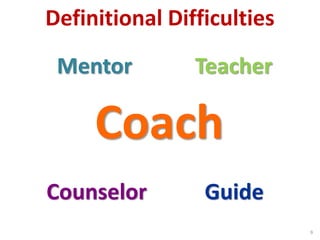
Definitional Difficulties
Mentor
Coach
Teacher
GuideCounselor
9
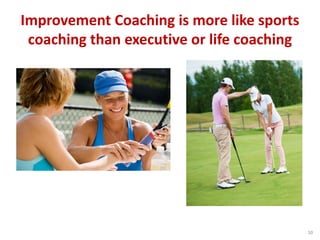
Improvement Coaching is more like sports
coaching than executive or life coaching
10
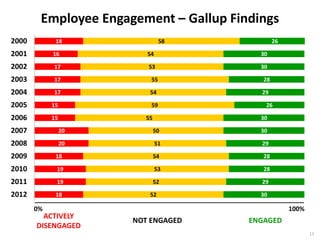
Employee Engagement – Gallup Findings
18
19
19
18
20
20
15
15
17
17
17
16
18
52
52
53
54
51
50
55
59
54
55
53
54
58
30
29
28
28
29
30
30
26
29
28
30
30
26
2012
2011
2010
2009
2008
2007
2006
2005
2004
2003
2002
2001
2000
11
ACTIVELY
DISENGAGED
NOT ENGAGED ENGAGED
0% 100%
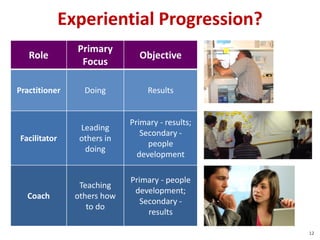
Experiential Progression?
Role
Primary
Focus
Objective
Practitioner Doing Results
Facilitator
Leading
others in
doing
Primary - results;
Secondary -
people
development
Coach
Teaching
others how
to do
Primary - people
development;
Secondary -
results
12
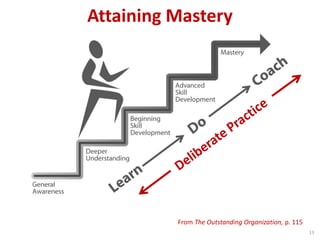
Attaining Mastery
13
From The Outstanding Organization, p. 115
Coaching Skills
Self-Assessment
14
15
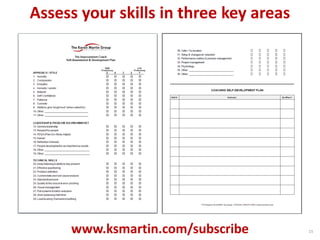
Assess your skills in three key areas
www.ksmartin.com/subscribe
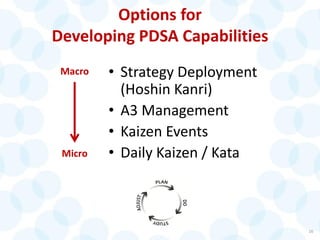
Options for
Developing PDSA Capabilities
• Strategy Deployment
(Hoshin Kanri)
• A3 Management
• Kaizen Events
• Daily Kaizen / Kata
16
Macro
Micro
17
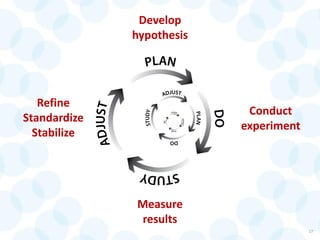
Develop
hypothesis
Conduct
experiment
Measure
results
Refine
Standardize
Stabilize
18
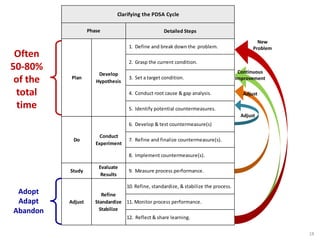
Detailed Steps
1. Define and break down the problem.
2. Grasp the current condition.
3. Set a target condition.
4. Conduct root cause & gap analysis.
5. Identify potential countermeasures.
6. Develop & test countermeasure(s)
7. Refine and finalize countermeasure(s).
8. Implement countermeasure(s).
Study
Evaluate
Results
9. Measure process performance.
10. Refine, standardize, & stabilize the process.
11. Monitor process performance.
12. Reflect & share learning.
Adjust
Do
Clarifying the PDSA Cycle
Plan
Develop
Hypothesis
Conduct
Experiment
Refine
Standardize
Stabilize
Phase
Continuous
Improvement
New
Problem
Often
50-80%
of the
total
time
Adjust
Adjust
Adopt
Adapt
Abandon
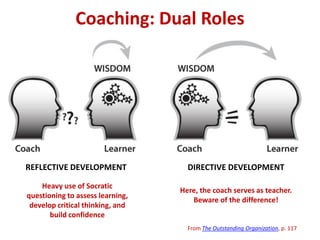
Coaching: Dual Roles
REFLECTIVE DEVELOPMENT DIRECTIVE DEVELOPMENT
From The Outstanding Organization, p. 117
Heavy use of Socratic
questioning to assess learning,
develop critical thinking, and
build confidence
Here, the coach serves as teacher.
Beware of the difference!
The
Problem
with
“Telling”
20
Warning: The Expert Turned Coach
• Be aware of the juice you get from being the expert.
– Replace with the juice of serving others
• Avoid believing that everyone needs to think and
behave the same way you do.
• Avoid “the way I would do it” thinking.
• Turn “THE” thing they need to learn to “A” thing
they need to learn.
• Be aware of moving into “do-er,” “rescuer,” or
“fixer” mode.
21
Socratic Questioning
• Named for Socrates
• Based on his belief that the
deepest learning results from a
disciplined practice of thoughtful
questioning.
– Way of assuring rigorous thinking
• Open-ended questions that cause
the learner to think deeply.
22
23
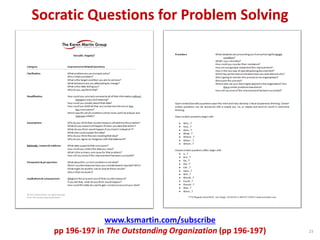
Socratic Questions for Problem Solving
www.ksmartin.com/subscribe
pp 196-197 in The Outstanding Organization (pp 196-197)
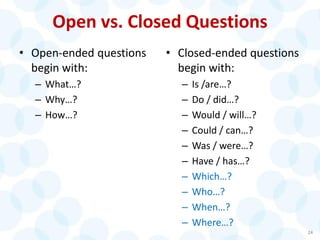
Open vs. Closed Questions
• Open-ended questions
begin with:
– What…?
– Why…?
– How…?
• Closed-ended questions
begin with:
– Is /are…?
– Do / did…?
– Would / will…?
– Could / can…?
– Was / were…?
– Have / has…?
– Which…?
– Who…?
– When…?
– Where…?
24
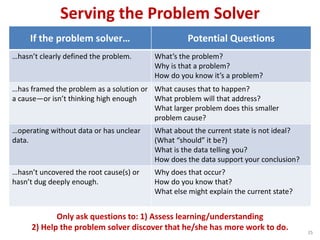
Serving the Problem Solver
If the problem solver… Potential Questions
…hasn’t clearly defined the problem. What’s the problem?
Why is that a problem?
How do you know it’s a problem?
…has framed the problem as a solution or
a cause—or isn’t thinking high enough
What causes that to happen?
What problem will that address?
What larger problem does this smaller
problem cause?
…operating without data or has unclear
data.
What about the current state is not ideal?
(What “should” it be?)
What is the data telling you?
How does the data support your conclusion?
…hasn’t uncovered the root cause(s) or
hasn’t dug deeply enough.
Why does that occur?
How do you know that?
What else might explain the current state?
Only ask questions to: 1) Assess learning/understanding
2) Help the problem solver discover that he/she has more work to do. 25
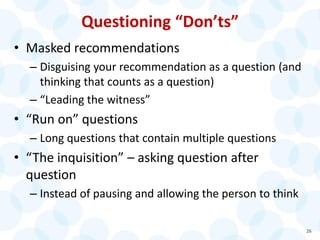
Questioning “Don’ts”
• Masked recommendations
– Disguising your recommendation as a question (and
thinking that counts as a question)
– “Leading the witness”
• “Run on” questions
– Long questions that contain multiple questions
• “The inquisition” – asking question after
question
– Instead of pausing and allowing the person to think
26
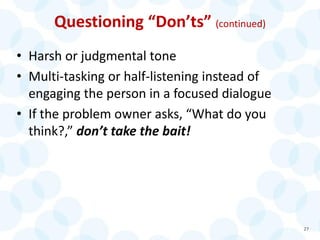
Questioning “Don’ts” (continued)
• Harsh or judgmental tone
• Multi-tasking or half-listening instead of
engaging the person in a focused dialogue
• If the problem owner asks, “What do you
think?,” don’t take the bait!
27
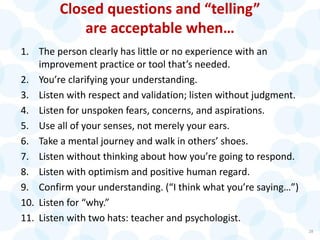
Closed questions and “telling”
are acceptable when…
1. The person clearly has little or no experience with an
improvement practice or tool that’s needed.
2. You’re clarifying your understanding.
3. Listen with respect and validation; listen without judgment.
4. Listen for unspoken fears, concerns, and aspirations.
5. Use all of your senses, not merely your ears.
6. Take a mental journey and walk in others’ shoes.
7. Listen without thinking about how you’re going to respond.
8. Listen with optimism and positive human regard.
9. Confirm your understanding. (“I think what you’re saying…”)
10. Listen for “why.”
11. Listen with two hats: teacher and psychologist.
28
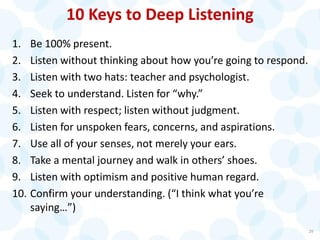
10 Keys to Deep Listening
1. Be 100% present.
2. Listen without thinking about how you’re going to respond.
3. Listen with two hats: teacher and psychologist.
4. Seek to understand. Listen for “why.”
5. Listen with respect; listen without judgment.
6. Listen for unspoken fears, concerns, and aspirations.
7. Use all of your senses, not merely your ears.
8. Take a mental journey and walk in others’ shoes.
9. Listen with optimism and positive human regard.
10. Confirm your understanding. (“I think what you’re
saying…”)
29
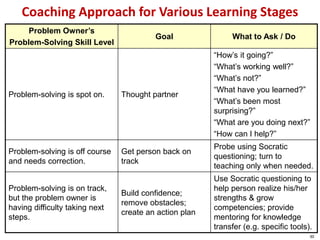
Coaching Approach for Various Learning Stages
Problem Owner’s
Problem-Solving Skill Level
Goal What to Ask / Do
Problem-solving is spot on. Thought partner
“How’s it going?”
“What’s working well?”
“What’s not?”
“What have you learned?”
“What’s been most
surprising?”
“What are you doing next?”
“How can I help?”
Problem-solving is off course
and needs correction.
Get person back on
track
Probe using Socratic
questioning; turn to
teaching only when needed.
Problem-solving is on track,
but the problem owner is
having difficulty taking next
steps.
Build confidence;
remove obstacles;
create an action plan
Use Socratic questioning to
help person realize his/her
strengths & grow
competencies; provide
mentoring for knowledge
transfer (e.g. specific tools).
30
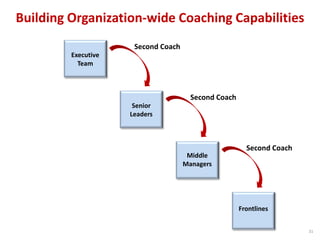
Building Organization-wide Coaching Capabilities
Executive
Team
Senior
Leaders
Middle
Managers
Frontlines
Second Coach
Second Coach
Second Coach
31
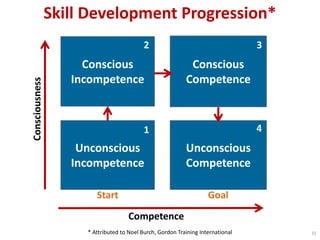
Skill Development Progression*
32
Unconscious
Incompetence
Conscious
Incompetence
Conscious
Competence
* Attributed to Noel Burch, Gordon Training International
Start Goal
Unconscious
Competence
Consciousness
Competence
1 4
32
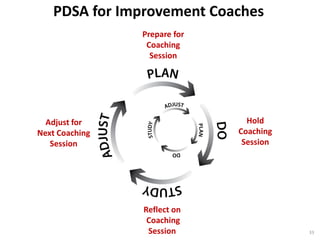
PDSA for Improvement Coaches
Prepare for
Coaching
Session
Hold
Coaching
Session
Reflect on
Coaching
Session
Adjust for
Next Coaching
Session
33
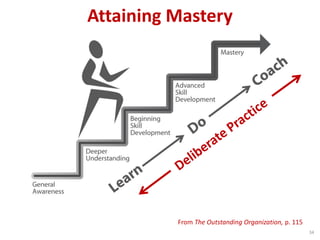
Attaining Mastery
34
From The Outstanding Organization, p. 115
Karen Martin, President
858.677.6799
@karenmartinopex
Blog & newsletter: www.ksmartin.com/subscribe
35

Coaching: Asking the Right Questions

  • 1.
    Webinar July 31, 2014 LeanCoaching: Asking the Right Questions
  • 2.
     Consultant /Coach / Facilitator / Trainer: Lean transformation & business performance improvement in all industries.  Teacher: University of California, San Diego  Author & Speaker: Karen Martin, President @KarenMartinOpEx 2013 Shingo Prize winner! www.ksmartin.com/subscribe 50% off for limited time on Amazon! 2
  • 3.
  • 4.
    For more Coachinginformation See Chapter 4 - Discipline www.bitly.com/TOObk 4
  • 5.
    Learning Objectives • Therole of the improvement coach • Necessary skills for improvement coaches • How to accelerate problem-solving skill building through asking the right questions at the right time • When it’s appropriate to “tell” people what to do 5
  • 6.
    5 Observations &1 Decree 1. There aren’t enough improvement “experts” to go around in an organization. 2. Improvement “experts” aren’t content experts (and, therefore, shouldn’t be the ones solving problems). 3. Problems aren’t being solved quickly enough. 4. Problems aren’t being solved well enough. 5. Managers don’t know enough about the improvement process. 6. Improvement can’t be delegated. 6
  • 7.
    7 Problem-solving capabilities developed? Which target conditiondo you want to achieve? OR Problems solved?
  • 8.
    Two Primary Responsibilitiesof Managers/Leaders 8 Coaching Get work done Develop People
  • 9.
  • 10.
    Improvement Coaching ismore like sports coaching than executive or life coaching 10
  • 11.
    Employee Engagement –Gallup Findings 18 19 19 18 20 20 15 15 17 17 17 16 18 52 52 53 54 51 50 55 59 54 55 53 54 58 30 29 28 28 29 30 30 26 29 28 30 30 26 2012 2011 2010 2009 2008 2007 2006 2005 2004 2003 2002 2001 2000 11 ACTIVELY DISENGAGED NOT ENGAGED ENGAGED 0% 100%
  • 12.
    Experiential Progression? Role Primary Focus Objective Practitioner DoingResults Facilitator Leading others in doing Primary - results; Secondary - people development Coach Teaching others how to do Primary - people development; Secondary - results 12
  • 13.
    Attaining Mastery 13 From TheOutstanding Organization, p. 115
  • 14.
  • 15.
    15 Assess your skillsin three key areas www.ksmartin.com/subscribe
  • 16.
    Options for Developing PDSACapabilities • Strategy Deployment (Hoshin Kanri) • A3 Management • Kaizen Events • Daily Kaizen / Kata 16 Macro Micro
  • 17.
  • 18.
    18 Detailed Steps 1. Defineand break down the problem. 2. Grasp the current condition. 3. Set a target condition. 4. Conduct root cause & gap analysis. 5. Identify potential countermeasures. 6. Develop & test countermeasure(s) 7. Refine and finalize countermeasure(s). 8. Implement countermeasure(s). Study Evaluate Results 9. Measure process performance. 10. Refine, standardize, & stabilize the process. 11. Monitor process performance. 12. Reflect & share learning. Adjust Do Clarifying the PDSA Cycle Plan Develop Hypothesis Conduct Experiment Refine Standardize Stabilize Phase Continuous Improvement New Problem Often 50-80% of the total time Adjust Adjust Adopt Adapt Abandon
  • 19.
    Coaching: Dual Roles REFLECTIVEDEVELOPMENT DIRECTIVE DEVELOPMENT From The Outstanding Organization, p. 117 Heavy use of Socratic questioning to assess learning, develop critical thinking, and build confidence Here, the coach serves as teacher. Beware of the difference!
  • 20.
  • 21.
    Warning: The ExpertTurned Coach • Be aware of the juice you get from being the expert. – Replace with the juice of serving others • Avoid believing that everyone needs to think and behave the same way you do. • Avoid “the way I would do it” thinking. • Turn “THE” thing they need to learn to “A” thing they need to learn. • Be aware of moving into “do-er,” “rescuer,” or “fixer” mode. 21
  • 22.
    Socratic Questioning • Namedfor Socrates • Based on his belief that the deepest learning results from a disciplined practice of thoughtful questioning. – Way of assuring rigorous thinking • Open-ended questions that cause the learner to think deeply. 22
  • 23.
    23 Socratic Questions forProblem Solving www.ksmartin.com/subscribe pp 196-197 in The Outstanding Organization (pp 196-197)
  • 24.
    Open vs. ClosedQuestions • Open-ended questions begin with: – What…? – Why…? – How…? • Closed-ended questions begin with: – Is /are…? – Do / did…? – Would / will…? – Could / can…? – Was / were…? – Have / has…? – Which…? – Who…? – When…? – Where…? 24
  • 25.
    Serving the ProblemSolver If the problem solver… Potential Questions …hasn’t clearly defined the problem. What’s the problem? Why is that a problem? How do you know it’s a problem? …has framed the problem as a solution or a cause—or isn’t thinking high enough What causes that to happen? What problem will that address? What larger problem does this smaller problem cause? …operating without data or has unclear data. What about the current state is not ideal? (What “should” it be?) What is the data telling you? How does the data support your conclusion? …hasn’t uncovered the root cause(s) or hasn’t dug deeply enough. Why does that occur? How do you know that? What else might explain the current state? Only ask questions to: 1) Assess learning/understanding 2) Help the problem solver discover that he/she has more work to do. 25
  • 26.
    Questioning “Don’ts” • Maskedrecommendations – Disguising your recommendation as a question (and thinking that counts as a question) – “Leading the witness” • “Run on” questions – Long questions that contain multiple questions • “The inquisition” – asking question after question – Instead of pausing and allowing the person to think 26
  • 27.
    Questioning “Don’ts” (continued) •Harsh or judgmental tone • Multi-tasking or half-listening instead of engaging the person in a focused dialogue • If the problem owner asks, “What do you think?,” don’t take the bait! 27
  • 28.
    Closed questions and“telling” are acceptable when… 1. The person clearly has little or no experience with an improvement practice or tool that’s needed. 2. You’re clarifying your understanding. 3. Listen with respect and validation; listen without judgment. 4. Listen for unspoken fears, concerns, and aspirations. 5. Use all of your senses, not merely your ears. 6. Take a mental journey and walk in others’ shoes. 7. Listen without thinking about how you’re going to respond. 8. Listen with optimism and positive human regard. 9. Confirm your understanding. (“I think what you’re saying…”) 10. Listen for “why.” 11. Listen with two hats: teacher and psychologist. 28
  • 29.
    10 Keys toDeep Listening 1. Be 100% present. 2. Listen without thinking about how you’re going to respond. 3. Listen with two hats: teacher and psychologist. 4. Seek to understand. Listen for “why.” 5. Listen with respect; listen without judgment. 6. Listen for unspoken fears, concerns, and aspirations. 7. Use all of your senses, not merely your ears. 8. Take a mental journey and walk in others’ shoes. 9. Listen with optimism and positive human regard. 10. Confirm your understanding. (“I think what you’re saying…”) 29
  • 30.
    Coaching Approach forVarious Learning Stages Problem Owner’s Problem-Solving Skill Level Goal What to Ask / Do Problem-solving is spot on. Thought partner “How’s it going?” “What’s working well?” “What’s not?” “What have you learned?” “What’s been most surprising?” “What are you doing next?” “How can I help?” Problem-solving is off course and needs correction. Get person back on track Probe using Socratic questioning; turn to teaching only when needed. Problem-solving is on track, but the problem owner is having difficulty taking next steps. Build confidence; remove obstacles; create an action plan Use Socratic questioning to help person realize his/her strengths & grow competencies; provide mentoring for knowledge transfer (e.g. specific tools). 30
  • 31.
    Building Organization-wide CoachingCapabilities Executive Team Senior Leaders Middle Managers Frontlines Second Coach Second Coach Second Coach 31
  • 32.
    Skill Development Progression* 32 Unconscious Incompetence Conscious Incompetence Conscious Competence *Attributed to Noel Burch, Gordon Training International Start Goal Unconscious Competence Consciousness Competence 1 4 32
  • 33.
    PDSA for ImprovementCoaches Prepare for Coaching Session Hold Coaching Session Reflect on Coaching Session Adjust for Next Coaching Session 33
  • 34.
    Attaining Mastery 34 From TheOutstanding Organization, p. 115
  • 35.
    Karen Martin, President 858.677.6799 @karenmartinopex Blog& newsletter: www.ksmartin.com/subscribe 35