4006ME Engineering Problem Solving Lecture 2 – Problem Solving Techniques and strategies
Calendar You Are Here
Today’s Lecture Problem Solving Heuristics Effective Problem Solvers Working in Teams Gathering Information
PROBLEM SOLVING HEURISTICS Part 1:
Heuristic???? Heuristic  - a commonsense rule (or set of rules) intended to increase the probability of solving some problem
Problem Solving Heuristics Analogous to a road map A systematic approach to problem solving Guides through solution process Ensures uniform approach
Problem Solving Heuristic – Five Steps 1.Define the  real problem 2.Generate Solutions 3.Decide on the course of action 4.Implement the solution 5.Evaluate the solution
What’s The Disease?
1.Define the real problem Gather information Define the problem from information found Ask these questions: Has it been solved before? Is it worth solving? What resources are available in solution of the problem?
2. Generate solutions Use brainstorming, analogy and other techniques to generate ideas with impunity. Consider what is and what is not possible.
3. Decide on a course of action  Decide on which problems to address first and what actions need to be taken to address the problem Select the best solution from the possible alternatives Decide how to avoid problems as we implement the solution
4. Implement the solution Plan activities you need to solve the problem. Allocate  time and resources in order  to carry the solution through to successful completion.
5. Evaluate the solution Consider the final solution in terms of the original problem. Were all the problems really solved? Did you implement the best solution? Did you violate any of the restraints? Is the solution new or novel or just a re-hash of an existing solution? Is the solution safe, ethical and socially responsible?
EFFECTIVE PROBLEM SOLVERS Part 2:
Effective Problem Solvers.........
Effective Problem Solvers......... Tackle the problem  aggressively Are concerned with  accuracy  Persist,  ask questions (of themselves and others) Sketch  and draw figures Take time  to understand the facts and the relationships surrounding the problem
Attitudes and Actions Believe in themselves Are proactive in solving the problem Ask questions Reread and re-frame the problem statement Don’t jump to conclusions Create a mental picture Sketch, draw, write down facts, discover underlying theories / equations
Solutions and Accuracy Keep track of progress Break larger problems into sub-problems Start off where they understand Use key concepts as building blocks Use heuristics Persevere when stuck Quantify using formula and descriptions / images Check and re-check Validate assumptions
The 7 Habits of Highly Effective People 1.  Be proactive:  take the initiative, work on things you can do something   about, admit mistakes and move on. 2.  Begin with the end in mind:  Know where you want to be, identify how you   will accomplish it. 3.  Put first things first:  List your top priorities, schedule and work on them. Say “no” to unimportant tasks. Stay focussed. 4.  Think win/win:  Identify key issues and results that would constitute a fully acceptable solution to all. Get everyone involved in the decision and committed to the plan of action
5.  Listen:  Try to see the problem from the other person’s perspective. Present logically, not emotionally. 6.  Synergise:  Make the whole greater than the sum of the parts Foster open and honest communication. 7.  Practice renewal:  Physical (exercise), Mental (reading), Spiritual (commitment / meditation), Social/emotional (self-esteem, empathy) The 7 Habits of Highly Effective People The 7 Habits of Highly Effective People , COPYRIGHT, 1989 by Covey, Stephen R
WORKING IN TEAMS Part 3:
Bruce Tuckman’s research identifies 4 stages of team development: Forming:  Introductions, group goals, ground rules, initial discussions about the problem. Storming:  Chaos. Lots of talking, little listening, no shared vision, little progress. Disagreements will occur – encourage constructive controversy. Don’t get personal Norming:  Team gels, a shared vision is created. Tasks mapped to timetable. Good communications ensue. Performing:  Progress is seen on project objectives, creative brainstorming develops, ideas (rather than personal agendas) are debated. The team takes pride in its work and output.
Your past experience, biggest problem working as a team.......
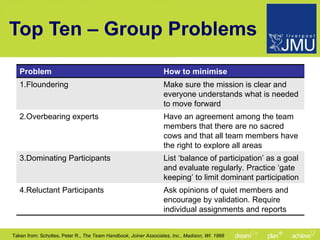
Top Ten – Group Problems Taken from: Scholtes, Peter R.,  The Team Handbook ,  Joiner Associates, Inc., Madison, WI. 1988 Problem How to minimise 1.Floundering Make sure the mission is clear and everyone understands what is needed to move forward 2.Overbearing experts Have an agreement among the team members that there are no sacred cows and that all team members have the right to explore all areas 3.Dominating Participants List ‘balance of participation’ as a goal and evaluate regularly. Practice ‘gate keeping’ to limit dominant participation 4.Reluctant Participants Ask opinions of quiet members and encourage by validation. Require individual assignments and reports
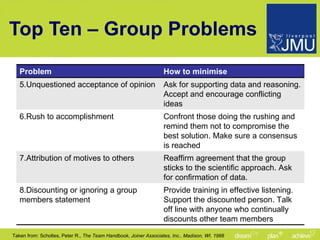
Top Ten – Group Problems Taken from: Scholtes, Peter R.,  The Team Handbook ,  Joiner Associates, Inc., Madison, WI. 1988 Problem How to minimise 5.Unquestioned acceptance of opinion Ask for supporting data and reasoning. Accept and encourage conflicting ideas 6.Rush to accomplishment Confront those doing the rushing and remind them not to compromise the best solution. Make sure a consensus is reached 7.Attribution of motives to others Reaffirm agreement that the group sticks to the scientific approach. Ask for confirmation of data. 8.Discounting or ignoring a group members statement Provide training in effective listening. Support the discounted person. Talk off line with anyone who continually discounts other team members
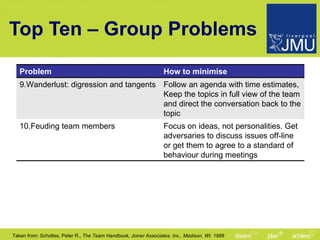
Top Ten – Group Problems Taken from: Scholtes, Peter R.,  The Team Handbook ,  Joiner Associates, Inc., Madison, WI. 1988 Problem How to minimise 9.Wanderlust: digression and tangents Follow an agenda with time estimates, Keep the topics in full view of the team and direct the conversation back to the topic 10.Feuding team members Focus on ideas, not personalities. Get adversaries to discuss issues off-line or get them to agree to a standard of behaviour during meetings
GATHERING INFORMATION Part 4:
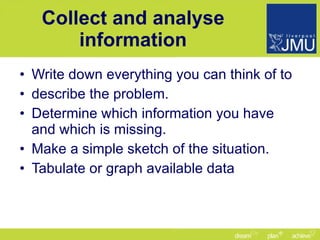
Collect and analyse information Write down everything you can think of to describe the problem. Determine which information you have and which is missing. Make a simple sketch of the situation. Tabulate or graph available data
Talk to people Find out who knows about the problem and ask questions: Look beyond the obvious When and how the problem occurred Ask for clarification Challenge explanations as to the cause (suspend judgement) Separate facts from opinion
View the problem firsthand Talking to people alone is not as good as witnessing something for yourself Or try to recreate the problem if seeing the problem firsthand is not possible
Confirm key findings Verify the information you’ve collected Confirm all important pieces of information Search for biases or miss-representation of facts Challenge assumptions and assertions
Don’t stop! Continue to gather information throughout the problem-solving process Read any and all literature around the subject Learn about the underlying principles and any peripheral concepts Maybe the problem’s been solved before?
Finally “ 4 - 5 weeks in the lab can save you an hour in the library” – George Quarderer, Dow Chemical Co.

Lecture 2 problem solving strategies

  • 1.
    4006ME Engineering ProblemSolving Lecture 2 – Problem Solving Techniques and strategies
  • 2.
  • 3.
    Today’s Lecture ProblemSolving Heuristics Effective Problem Solvers Working in Teams Gathering Information
  • 4.
  • 5.
    Heuristic???? Heuristic - a commonsense rule (or set of rules) intended to increase the probability of solving some problem
  • 6.
    Problem Solving HeuristicsAnalogous to a road map A systematic approach to problem solving Guides through solution process Ensures uniform approach
  • 7.
    Problem Solving Heuristic– Five Steps 1.Define the real problem 2.Generate Solutions 3.Decide on the course of action 4.Implement the solution 5.Evaluate the solution
  • 8.
  • 9.
    1.Define the realproblem Gather information Define the problem from information found Ask these questions: Has it been solved before? Is it worth solving? What resources are available in solution of the problem?
  • 10.
    2. Generate solutionsUse brainstorming, analogy and other techniques to generate ideas with impunity. Consider what is and what is not possible.
  • 11.
    3. Decide ona course of action Decide on which problems to address first and what actions need to be taken to address the problem Select the best solution from the possible alternatives Decide how to avoid problems as we implement the solution
  • 12.
    4. Implement thesolution Plan activities you need to solve the problem. Allocate time and resources in order to carry the solution through to successful completion.
  • 13.
    5. Evaluate thesolution Consider the final solution in terms of the original problem. Were all the problems really solved? Did you implement the best solution? Did you violate any of the restraints? Is the solution new or novel or just a re-hash of an existing solution? Is the solution safe, ethical and socially responsible?
  • 14.
  • 15.
  • 16.
    Effective Problem Solvers.........Tackle the problem aggressively Are concerned with accuracy Persist, ask questions (of themselves and others) Sketch and draw figures Take time to understand the facts and the relationships surrounding the problem
  • 17.
    Attitudes and ActionsBelieve in themselves Are proactive in solving the problem Ask questions Reread and re-frame the problem statement Don’t jump to conclusions Create a mental picture Sketch, draw, write down facts, discover underlying theories / equations
  • 18.
    Solutions and AccuracyKeep track of progress Break larger problems into sub-problems Start off where they understand Use key concepts as building blocks Use heuristics Persevere when stuck Quantify using formula and descriptions / images Check and re-check Validate assumptions
  • 19.
    The 7 Habitsof Highly Effective People 1. Be proactive: take the initiative, work on things you can do something about, admit mistakes and move on. 2. Begin with the end in mind: Know where you want to be, identify how you will accomplish it. 3. Put first things first: List your top priorities, schedule and work on them. Say “no” to unimportant tasks. Stay focussed. 4. Think win/win: Identify key issues and results that would constitute a fully acceptable solution to all. Get everyone involved in the decision and committed to the plan of action
  • 20.
    5. Listen: Try to see the problem from the other person’s perspective. Present logically, not emotionally. 6. Synergise: Make the whole greater than the sum of the parts Foster open and honest communication. 7. Practice renewal: Physical (exercise), Mental (reading), Spiritual (commitment / meditation), Social/emotional (self-esteem, empathy) The 7 Habits of Highly Effective People The 7 Habits of Highly Effective People , COPYRIGHT, 1989 by Covey, Stephen R
  • 21.
  • 22.
    Bruce Tuckman’s researchidentifies 4 stages of team development: Forming: Introductions, group goals, ground rules, initial discussions about the problem. Storming: Chaos. Lots of talking, little listening, no shared vision, little progress. Disagreements will occur – encourage constructive controversy. Don’t get personal Norming: Team gels, a shared vision is created. Tasks mapped to timetable. Good communications ensue. Performing: Progress is seen on project objectives, creative brainstorming develops, ideas (rather than personal agendas) are debated. The team takes pride in its work and output.
  • 23.
    Your past experience,biggest problem working as a team.......
  • 24.
    Top Ten –Group Problems Taken from: Scholtes, Peter R., The Team Handbook , Joiner Associates, Inc., Madison, WI. 1988 Problem How to minimise 1.Floundering Make sure the mission is clear and everyone understands what is needed to move forward 2.Overbearing experts Have an agreement among the team members that there are no sacred cows and that all team members have the right to explore all areas 3.Dominating Participants List ‘balance of participation’ as a goal and evaluate regularly. Practice ‘gate keeping’ to limit dominant participation 4.Reluctant Participants Ask opinions of quiet members and encourage by validation. Require individual assignments and reports
  • 25.
    Top Ten –Group Problems Taken from: Scholtes, Peter R., The Team Handbook , Joiner Associates, Inc., Madison, WI. 1988 Problem How to minimise 5.Unquestioned acceptance of opinion Ask for supporting data and reasoning. Accept and encourage conflicting ideas 6.Rush to accomplishment Confront those doing the rushing and remind them not to compromise the best solution. Make sure a consensus is reached 7.Attribution of motives to others Reaffirm agreement that the group sticks to the scientific approach. Ask for confirmation of data. 8.Discounting or ignoring a group members statement Provide training in effective listening. Support the discounted person. Talk off line with anyone who continually discounts other team members
  • 26.
    Top Ten –Group Problems Taken from: Scholtes, Peter R., The Team Handbook , Joiner Associates, Inc., Madison, WI. 1988 Problem How to minimise 9.Wanderlust: digression and tangents Follow an agenda with time estimates, Keep the topics in full view of the team and direct the conversation back to the topic 10.Feuding team members Focus on ideas, not personalities. Get adversaries to discuss issues off-line or get them to agree to a standard of behaviour during meetings
  • 27.
  • 28.
    Collect and analyseinformation Write down everything you can think of to describe the problem. Determine which information you have and which is missing. Make a simple sketch of the situation. Tabulate or graph available data
  • 29.
    Talk to peopleFind out who knows about the problem and ask questions: Look beyond the obvious When and how the problem occurred Ask for clarification Challenge explanations as to the cause (suspend judgement) Separate facts from opinion
  • 30.
    View the problemfirsthand Talking to people alone is not as good as witnessing something for yourself Or try to recreate the problem if seeing the problem firsthand is not possible
  • 31.
    Confirm key findingsVerify the information you’ve collected Confirm all important pieces of information Search for biases or miss-representation of facts Challenge assumptions and assertions
  • 32.
    Don’t stop! Continueto gather information throughout the problem-solving process Read any and all literature around the subject Learn about the underlying principles and any peripheral concepts Maybe the problem’s been solved before?
  • 33.
    Finally “ 4- 5 weeks in the lab can save you an hour in the library” – George Quarderer, Dow Chemical Co.