Submitted to:
Dr. V J Savaliya
Dept. Of agril extension
College of agriculture
JAU, Junagadh.
Presented by:
Jyothi P
M.Sc.(agri) I yr
Agricultural extension
College of agriculture
JAU, Junagadh.
Meaning...
• A case study is an in-depth comprehensive
study of a person, a social group, a process,
a situation, a programme, a community, an
institution or any other social unit.
• It is one of the most popular types of the
research methods
• Its purpose is to understand the life cycle of
the unit under the study or interaction between
the factors that explain the present status or the
development over period of time
Examples of case study
• Social anthropological study of the rural or
tribal community
• A study of labour participation in management
of particular enterprise
• A study of life style of working women
• A study of slum dwellers
Functions
• The case study describes a case in terms of its
peculiarities. It gives us an insight in to the
typical or extreme cases whose unique features
are not reflected by the usual statistical
methods.
• It helps us to get a wealth of information about
the unit of study, which may provide the clues
& ideas for further research work.
• It examines the complex factors involved in a
given situation so as to identify casual factors
operating in it
• It aims at studying everything about something
rather than something about everything
• The ‘Individual’ representing the ‘Wholeness’
is preserved, as it is an approach which views
any physical unit as a whole
• The case study, as a research method, often
employs more techniques than one. The
techniques may be:
-interview
-mail questionnaire
-check lists
-rating scales
• It ascertain the generic development of a social
unit under study.
• It is most valuable for diagnostic,
administrative & therapeutic purposes.
• It develops ideas, sometimes leading to the
conclusion & sometimes to the hypotheses to
be tested.
• It also develops new concepts or test the
existing concepts.
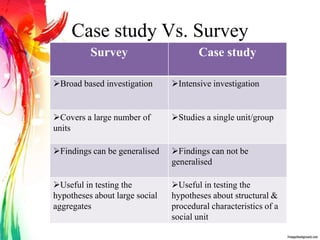
Survey Case study
Broad based investigation Intensive investigation
Covers a large number of
units
Studies a single unit/group
Findings can be generalised Findings can not be
generalised
Useful in testing the
hypotheses about large social
aggregates
Useful in testing the
hypotheses about structural &
procedural characteristics of a
social unit
Case study Vs. Survey
Merits
• Case studies are flexible with respect to data
collection methods.
• It can be extended virtually to any dimension
of the topic studied.
• It may be conducted practically
• It offers specific instances of tests of theories
• It is highly fruitful approach for the purpose of
group or process analysis as against the
analysis of individual traits alone
• It gives a wider range of insights into human
life, which can not be gained through a general
survey
Demerits
• Case studies may not be sufficient for making
the meaningful generalizations to larger social
aggregates
• They are generally more time consuming than
surveys
• The danger of investigator’s over confidence is
more in a case study which may lead to some
errors
• Case study method is inadequate for analysis
of macro-problems
case study

case study

  • 2.
    Submitted to: Dr. VJ Savaliya Dept. Of agril extension College of agriculture JAU, Junagadh. Presented by: Jyothi P M.Sc.(agri) I yr Agricultural extension College of agriculture JAU, Junagadh.
  • 4.
    Meaning... • A casestudy is an in-depth comprehensive study of a person, a social group, a process, a situation, a programme, a community, an institution or any other social unit.
  • 5.
    • It isone of the most popular types of the research methods • Its purpose is to understand the life cycle of the unit under the study or interaction between the factors that explain the present status or the development over period of time
  • 6.
    Examples of casestudy • Social anthropological study of the rural or tribal community • A study of labour participation in management of particular enterprise • A study of life style of working women • A study of slum dwellers
  • 7.
    Functions • The casestudy describes a case in terms of its peculiarities. It gives us an insight in to the typical or extreme cases whose unique features are not reflected by the usual statistical methods. • It helps us to get a wealth of information about the unit of study, which may provide the clues & ideas for further research work.
  • 8.
    • It examinesthe complex factors involved in a given situation so as to identify casual factors operating in it • It aims at studying everything about something rather than something about everything • The ‘Individual’ representing the ‘Wholeness’ is preserved, as it is an approach which views any physical unit as a whole
  • 9.
    • The casestudy, as a research method, often employs more techniques than one. The techniques may be: -interview -mail questionnaire -check lists -rating scales
  • 10.
    • It ascertainthe generic development of a social unit under study. • It is most valuable for diagnostic, administrative & therapeutic purposes. • It develops ideas, sometimes leading to the conclusion & sometimes to the hypotheses to be tested. • It also develops new concepts or test the existing concepts.
  • 11.
    Survey Case study Broadbased investigation Intensive investigation Covers a large number of units Studies a single unit/group Findings can be generalised Findings can not be generalised Useful in testing the hypotheses about large social aggregates Useful in testing the hypotheses about structural & procedural characteristics of a social unit Case study Vs. Survey
  • 12.
    Merits • Case studiesare flexible with respect to data collection methods. • It can be extended virtually to any dimension of the topic studied. • It may be conducted practically • It offers specific instances of tests of theories
  • 13.
    • It ishighly fruitful approach for the purpose of group or process analysis as against the analysis of individual traits alone • It gives a wider range of insights into human life, which can not be gained through a general survey
  • 14.
    Demerits • Case studiesmay not be sufficient for making the meaningful generalizations to larger social aggregates • They are generally more time consuming than surveys
  • 15.
    • The dangerof investigator’s over confidence is more in a case study which may lead to some errors • Case study method is inadequate for analysis of macro-problems