Camera
  Techniques
Anuj Gupta, Julia Kim, Chantel Romero
       Hernandez, Matt Sutton
Whip Pan, Whip Cut
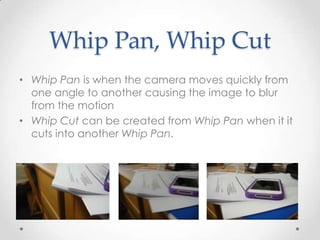
• Whip Pan is when the camera moves quickly from
  one angle to another causing the image to blur
  from the motion
• Whip Cut can be created from Whip Pan when it it
  cuts into another Whip Pan.
Whip Zoom Look
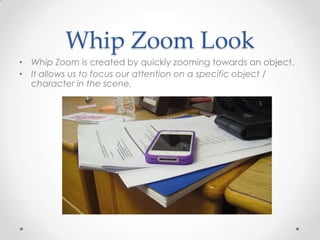
• Whip Zoom is created by quickly zooming towards an object.
• It allows us to focus our attention on a specific object /
  character in the scene.
Search Up
• Search up is a
  technique that’s used
  to visually and
  gradually describe a
  character or an object.

• It’s as if your eyes
  were to scan over a
  person’s body from
  their feet to their head.
Back To Front
• Back to Front is when we see an action taking
   place in the background then see an action that
   happens close to the camera.
• It emphasizes depth and is used to compare two
   related scenes without moving the camera.
http://vimeo.com/15533975
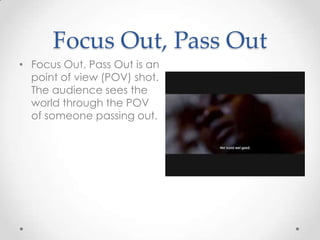
Focus Out, Pass Out
• Focus Out, Pass Out is an
  point of view (POV) shot.
  The audience sees the
  world through the POV
  of someone passing out.
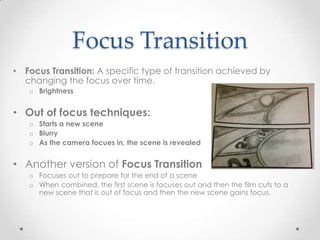
Focus Transition
• Focus Transition: A specific type of transition achieved by
  changing the focus over time.
   o Brightness


• Out of focus techniques:
   o Starts a new scene
   o Blurry
   o As the camera focues in, the scene is revealed


• Another version of Focus Transition
   o Focuses out to prepare for the end of a scene
   o When combined, the first scene is focuses out and then the film cuts to a
     new scene that is out of focus and then the new scene gains focus.
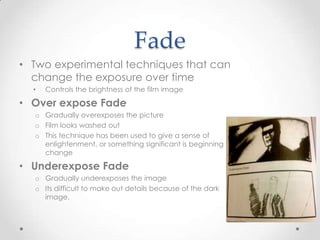
Fade
• Two experimental techniques that can
  change the exposure over time
  •   Controls the brightness of the film image

• Over expose Fade
  o Gradually overexposes the picture
  o Film looks washed out
  o This technique has been used to give a sense of
    enlightenment, or something significant is beginning to
    change

• Underexpose Fade
  o Gradually underexposes the image
  o Its difficult to make out details because of the dark
    image.
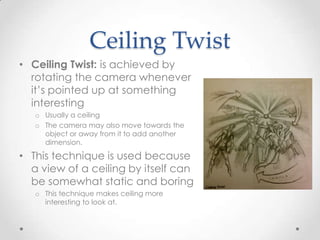
Ceiling Twist
• Ceiling Twist: is achieved by
  rotating the camera whenever
  it’s pointed up at something
  interesting
   o Usually a ceiling
   o The camera may also move towards the
     object or away from it to add another
     dimension.

• This technique is used because
  a view of a ceiling by itself can
  be somewhat static and boring
   o This technique makes ceiling more
     interesting to look at.
FLIP                        OVER

A flip over “starts out looking at the world and ends up
           looking at the world upside down”


The camera can be tilted panned craned, dollied, and spinned. - The flip
over can be used to accompany these techniques by an inverse.
- This is done often to convey some sort of emotion, like uneasiness or
suspense.
A shifting angle is when the camera continuously
changes the viewing angle, inducing a dizzying
                      effect.


- A shifting angle is related to the “Tilted Horizon technique”
           - For a tilted horizon, the camera always stay tilted at the same
angle.
Featured in:
                           -Army of Darkness
                          -Natural Born Killers
                         - Dangerous Liaisons


The technique can add “an incredible kinetic energy to the film” but can also “make
you sick if you are prone to dizziness.” (89, Shots)
OVER
                           FLIP
Famous


             The flip over is most notably featured in:
                             - Cape Fear
                          -Mission to Mars
                      -2001: A Space Odyssey


 - In 2001: A Space Odyssey, The flip over is used to “[emphasize] the lack of a horizon
 in space.
Bibliography
• Videos taken from Youtube and Vimeo
• Videos edited at cellsea.com
  o Search Up: Terminator 2 Judgment Day (3:23-3:37)
  o Back to Front: Deep Focus Lens System Demonstration (0:06-0:16)
  o Focus Out, Pass Out: Obsessed (5:18-5:24)

Camera Techniques

  • 1.
    Camera Techniques AnujGupta, Julia Kim, Chantel Romero Hernandez, Matt Sutton
  • 2.
    Whip Pan, WhipCut • Whip Pan is when the camera moves quickly from one angle to another causing the image to blur from the motion • Whip Cut can be created from Whip Pan when it it cuts into another Whip Pan.
  • 3.
    Whip Zoom Look •Whip Zoom is created by quickly zooming towards an object. • It allows us to focus our attention on a specific object / character in the scene.
  • 4.
    Search Up • Searchup is a technique that’s used to visually and gradually describe a character or an object. • It’s as if your eyes were to scan over a person’s body from their feet to their head.
  • 5.
    Back To Front •Back to Front is when we see an action taking place in the background then see an action that happens close to the camera. • It emphasizes depth and is used to compare two related scenes without moving the camera. http://vimeo.com/15533975
  • 6.
    Focus Out, PassOut • Focus Out, Pass Out is an point of view (POV) shot. The audience sees the world through the POV of someone passing out.
  • 7.
    Focus Transition • FocusTransition: A specific type of transition achieved by changing the focus over time. o Brightness • Out of focus techniques: o Starts a new scene o Blurry o As the camera focues in, the scene is revealed • Another version of Focus Transition o Focuses out to prepare for the end of a scene o When combined, the first scene is focuses out and then the film cuts to a new scene that is out of focus and then the new scene gains focus.
  • 8.
    Fade • Two experimentaltechniques that can change the exposure over time • Controls the brightness of the film image • Over expose Fade o Gradually overexposes the picture o Film looks washed out o This technique has been used to give a sense of enlightenment, or something significant is beginning to change • Underexpose Fade o Gradually underexposes the image o Its difficult to make out details because of the dark image.
  • 9.
    Ceiling Twist • CeilingTwist: is achieved by rotating the camera whenever it’s pointed up at something interesting o Usually a ceiling o The camera may also move towards the object or away from it to add another dimension. • This technique is used because a view of a ceiling by itself can be somewhat static and boring o This technique makes ceiling more interesting to look at.
  • 10.
    FLIP OVER A flip over “starts out looking at the world and ends up looking at the world upside down” The camera can be tilted panned craned, dollied, and spinned. - The flip over can be used to accompany these techniques by an inverse. - This is done often to convey some sort of emotion, like uneasiness or suspense.
  • 11.
    A shifting angleis when the camera continuously changes the viewing angle, inducing a dizzying effect. - A shifting angle is related to the “Tilted Horizon technique” - For a tilted horizon, the camera always stay tilted at the same angle.
  • 12.
    Featured in: -Army of Darkness -Natural Born Killers - Dangerous Liaisons The technique can add “an incredible kinetic energy to the film” but can also “make you sick if you are prone to dizziness.” (89, Shots)
  • 13.
    OVER FLIP Famous The flip over is most notably featured in: - Cape Fear -Mission to Mars -2001: A Space Odyssey - In 2001: A Space Odyssey, The flip over is used to “[emphasize] the lack of a horizon in space.
  • 14.
    Bibliography • Videos takenfrom Youtube and Vimeo • Videos edited at cellsea.com o Search Up: Terminator 2 Judgment Day (3:23-3:37) o Back to Front: Deep Focus Lens System Demonstration (0:06-0:16) o Focus Out, Pass Out: Obsessed (5:18-5:24)