G321/G322 Technical Aspects of 
Moving Image
Mise en Scene 
 Mise en scene is a French term meaning 
‘everything in the frame.’ Elements that make up 
mise en scene include: 
 Setting and Location 
 Props 
 Costume 
 Performance and Movement
Cinematography 
 Refers to the visual aspects of a films language. 
 Camera shots and movements can give us clear 
indicators of emotion, motive and give audiences 
clues as to things that may be about to happen. 
 It is important that you can identify shots and 
consider how the choices made impact on the 
narrative.
PERFORMANCE AND 
MOVEMENT. 
This refers to the meanings conveyed by 
actors through their physical 
performance. Meaning can be conveyed 
through the following means: 
Facial expression 
Gaze 
Gesture 
Posture 
Body Contact 
Appearance 
Spatial behaviour
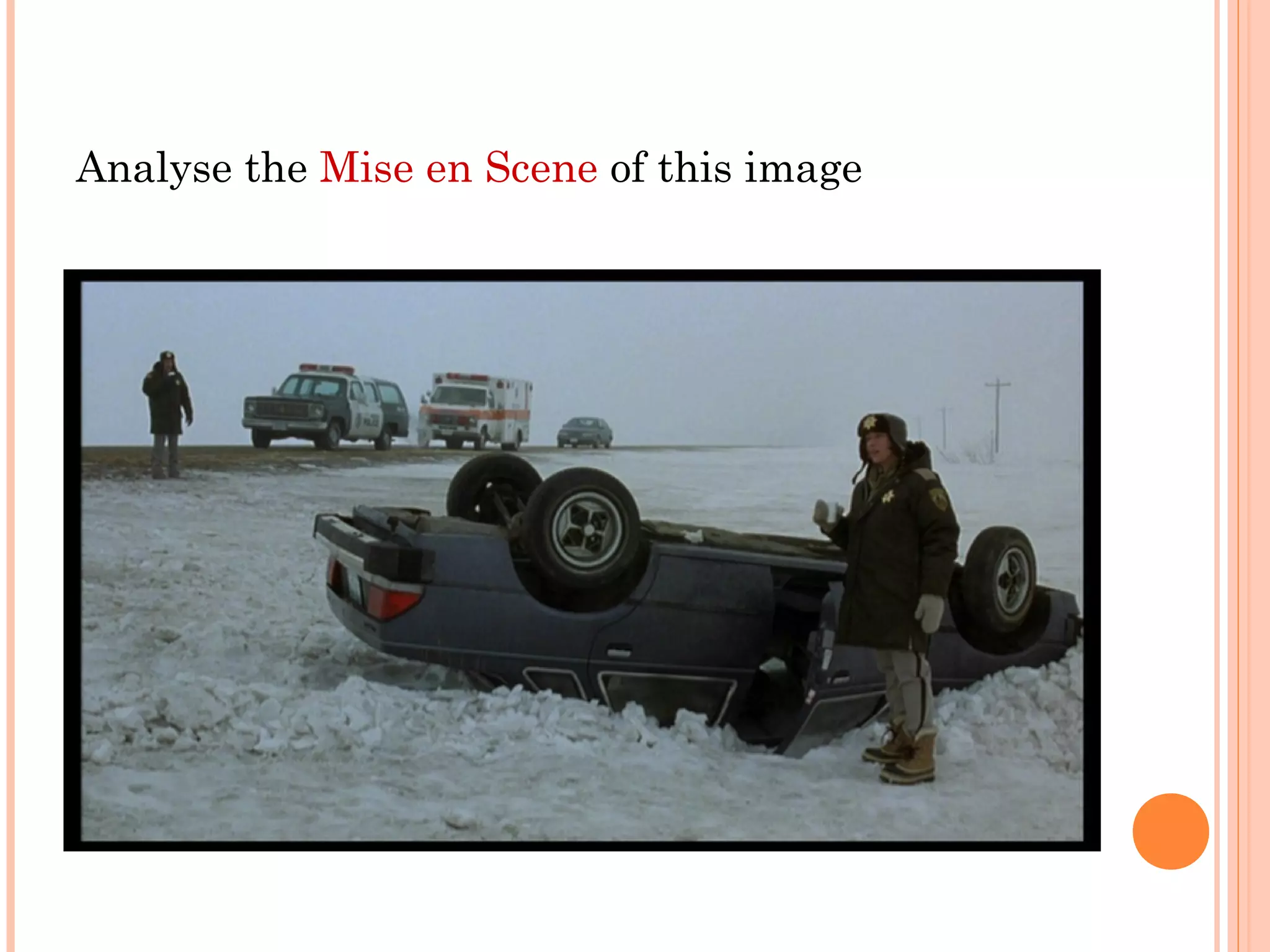
Analyse the Mise en Scene of this image
LIGHTING 
There are two main approaches to the use 
of lighting in film these are: 
Realistic lighting (high key). This 
involves the use of a key light (the main 
source of light), fill light and back lighting 
to create a natural look to the scene (this 
is called three point lighting). 
Lighting can be adapted to suggest 
different times of day eliminate shadow 
and pick the subject out from the 
background
Lighting 
Expressive lighting is predominately 
low key. 
A key light is used with little or no fill to 
create high contrast and shadow to convey 
a dark expressive mood. 
Subjects are sometimes back lit only to 
create a silhouetted figure. 
Expressive lighting may also involve the 
use of single hue ‘gels’, filters and other 
optical effects to create a specific mood.
three point lighting 
Click here for more on three point lighting
High key lighting 
The Virgin Suicides (Coppola, 1999)
Low key lighting Citizen Kane 
(Welles, 1941)
Red hue Mean Streets (Scorsese, 
1973)
Camera 
In looking at camera work the following areas 
need to be considered: 
 Angle 
 Movement 
 Position 
 Composition 
 Depth of field
ANGLE 
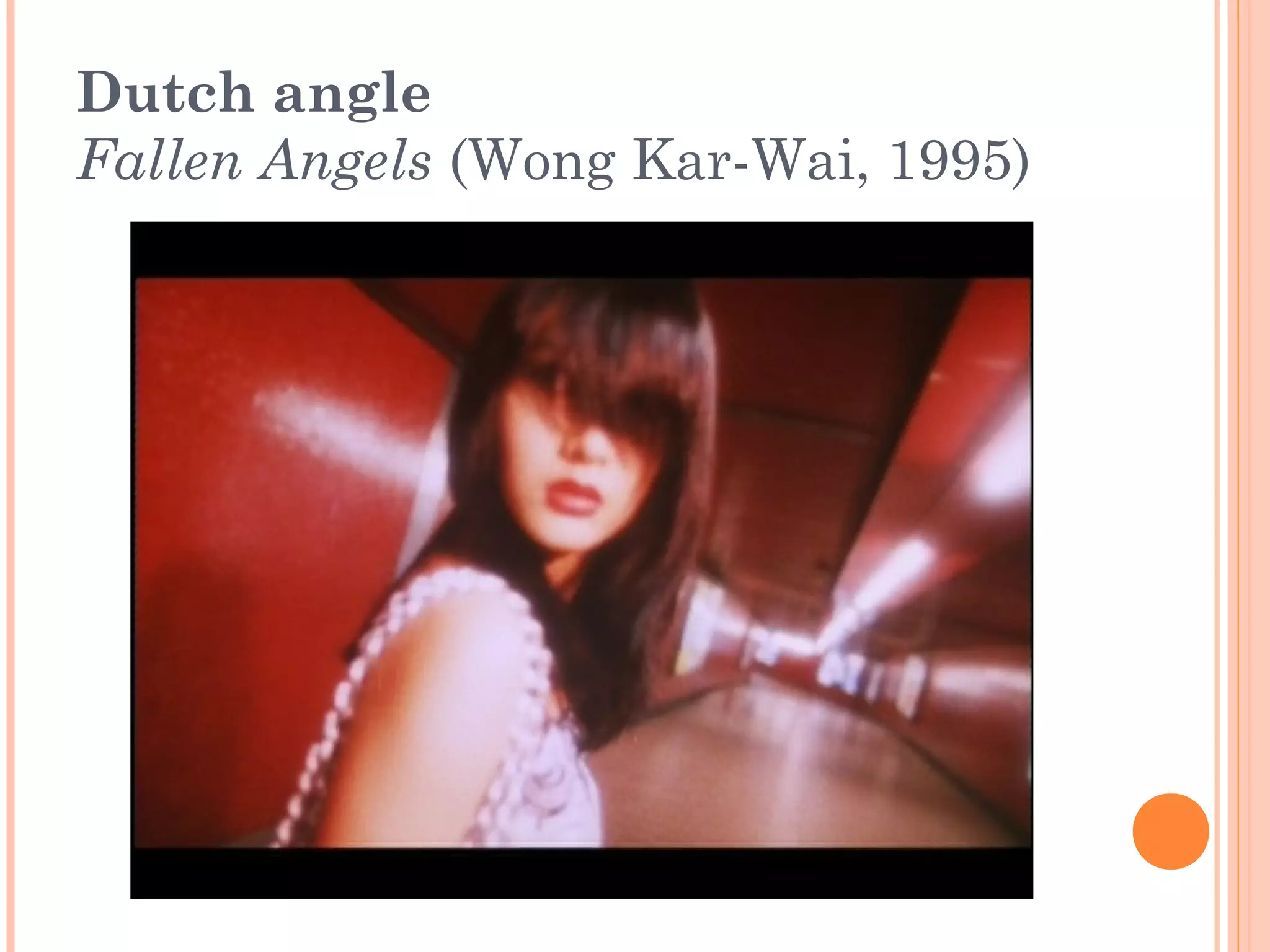
 High and low angle shots can be used by a 
filmmaker in order to convey meaning. A 
filmmaker may also use a titled angle 
(sometimes called ‘dutch’ or ‘canted’) to create a 
skewed frame.
High angle 
Fargo (Coen Bros, 1996)
Low angle 
Citizen Kane (Welles, 1941)
Dutch angle 
Fallen Angels (Wong Kar-Wai, 1995)
MOVEMENT 
 The use of camera movement allows the 
filmmaker to alter the framing of an image 
whilst filming. Different types of camera 
movement include: 
 pan – horizontal movement of the camera 
from a static position. 
 tracking – camera moves on tracks to follow a 
subject at close proximity. This effect can also 
be created using a dolly (a platform on wheels) 
or a steadicam (a camera mounted on the 
body which uses weights and balances to 
create smooth movement). Click here to see a 
steadicam used in The Shining (Kubrick, 
1980) 
 tilt – a subtle movement on the vertical (up or 
down)
MOVEMENT 
 crab – a subtle movement on the horizontal (left or 
right) 
 crane – the camera is mounted on to a crane so 
that it can move dramatically up or down and from 
side to side. Sometimes cranes are put on tracks to 
create spectacular tracking and craning movement. 
Click here to see a tracking and craning shot 
from Touch of Evil (Welles,1958) 
 handheld – a shaky movement the follows the 
movement of the camera operator. Often used to 
create realism, urgent and sudden figure 
movement or to create a point of view shot (we 
are seeing things through the eyes of a character). 
Click here to see the use of handheld camera in The 
Blair Witch Project (Myrick/Sanchez,1999) 
 zoom lens – creates the illusion of movement by 
altering the lens length.
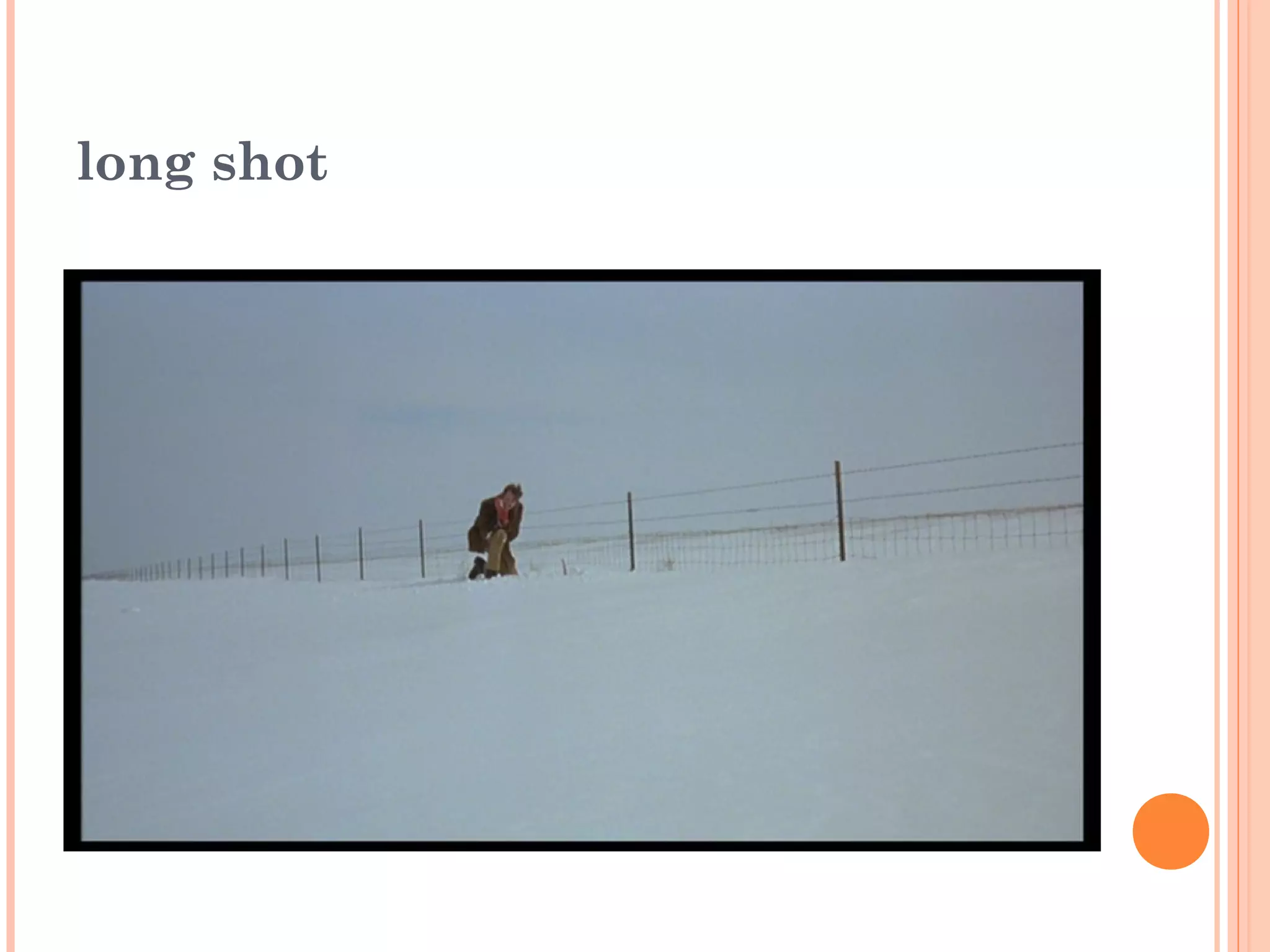
Position 
Position 
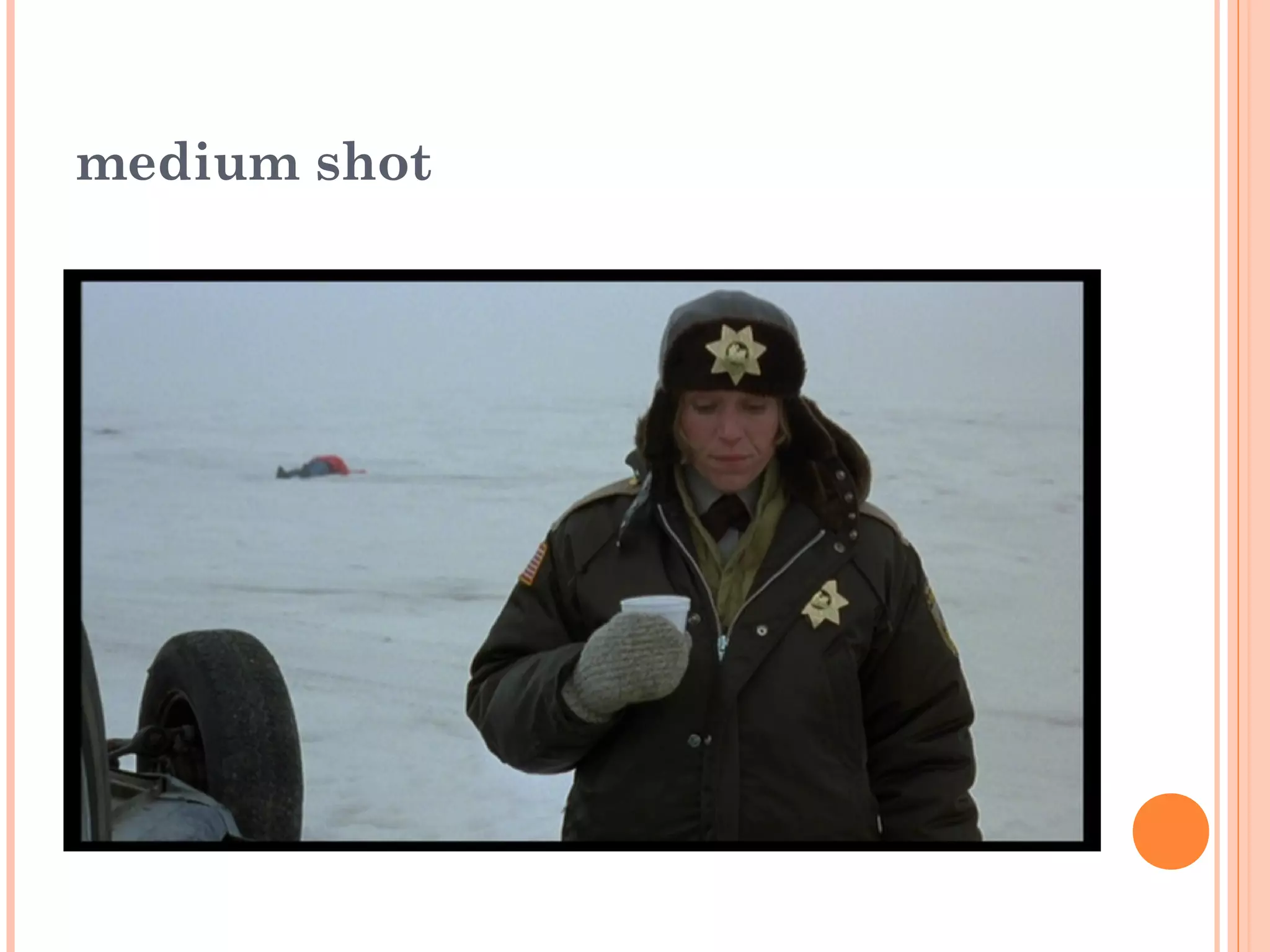
 The distance between the camera and the 
subject. The position selected relates to the 
information the filmmaker is trying to 
communicate. Camera distances can be defined 
as follows. All the examples below are from 
Fargo.
extreme long shot
long shot
medium shot
close up
extreme close up
COMPOSITION 
 The way a frame is composed can help to convey important 
information. A basic convention of composition dictates 
that a framing should be balanced according to the 
principle of the rule of thirds. The rule of thirds is a 
compositional rule of thumb in photography. 
 The rule states that an image can be divided into nine 
equal parts by two equally-spaced horizontal lines and two 
equally-spaced vertical lines. 
 The four points formed by the intersections of these lines 
can be used to align features in the photograph. 
 Proponents of this technique claim that aligning a 
photograph with these points in mind creates more 
tension, energy and interest in the image than simply 
centering the subject would. Click here to find out more 
about this technique.
Rule of thirds Dead Man 
(Jarmusch, 1995)
DEPTH OF FIELD 
 A frame’s depth of field refers to the focal 
length. 
 Where a frame shows everything sharp or in 
focus this is called deep focus. 
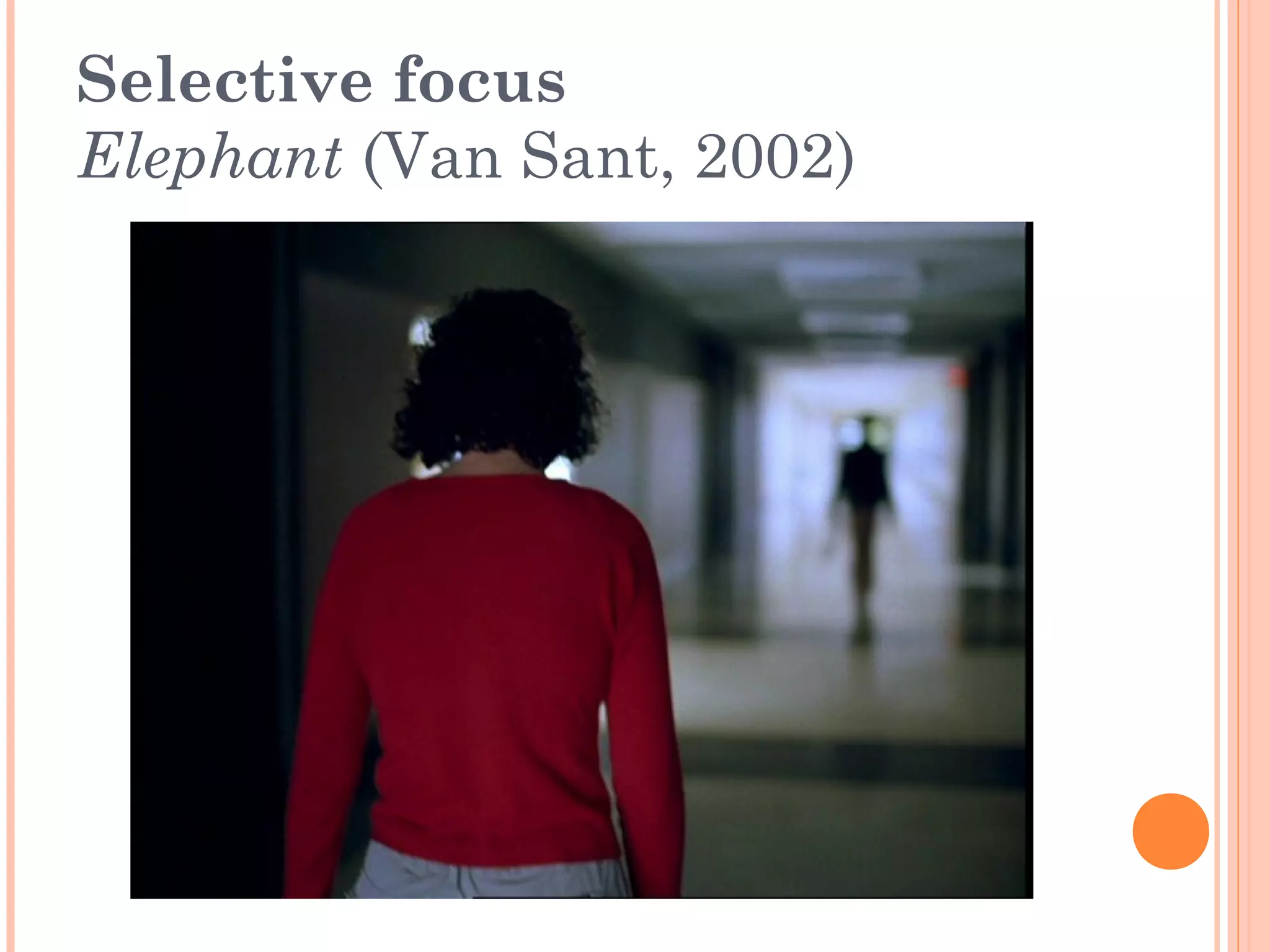
 When a particular part of the frame is picked out 
and the rest of the frame is blurred or indistinct 
it is called selective focus. 
 When the focal point changes within the frame 
this is called pull or ‘rack’ focus. 
 To get an idea of how this works put your 
finger in front of your face and concentrate 
on it. The finger will appear in focus and the 
background blurred. Now concentrate on the 
background, the human eye ‘pulls’ focus 
from the foreground to the background.
Selective focus 
Elephant (Van Sant, 2002)
Deep focus 
Citizen Kane (Welles, 1941)
EDITING 
 Editing in film is a process of cutting and 
assembling film footage to produce a finished 
product. 
 The role of the film editor includes organising 
transitions between shots making decisions 
about shot duration and maintaining 
continuity.
TRANSITION 
The process of cutting from one shot to 
another usually involves a simple 
straight cut. However there are other 
means of transition available to a film 
editor 
Fade to black 
Dissolve/cross fade 
Wipe
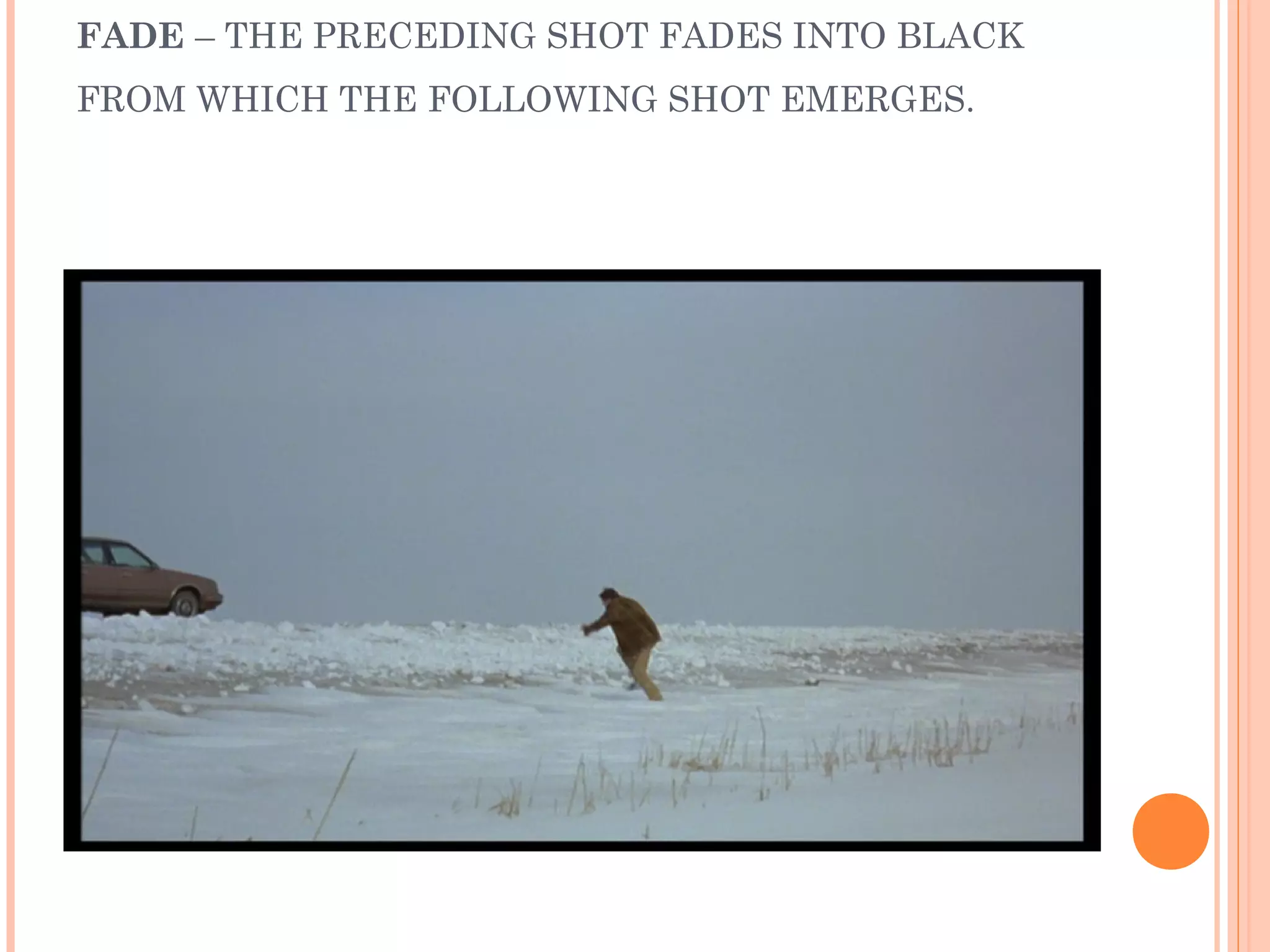
FADE – THE PRECEDING SHOT FADES INTO BLACK 
FROM WHICH THE FOLLOWING SHOT EMERGES.
FADE – THE PRECEDING SHOT FADES INTO BLACK 
FROM WHICH THE FOLLOWING SHOT EMERGES.
FADE – THE PRECEDING SHOT FADES INTO BLACK 
FROM WHICH THE FOLLOWING SHOT EMERGES.
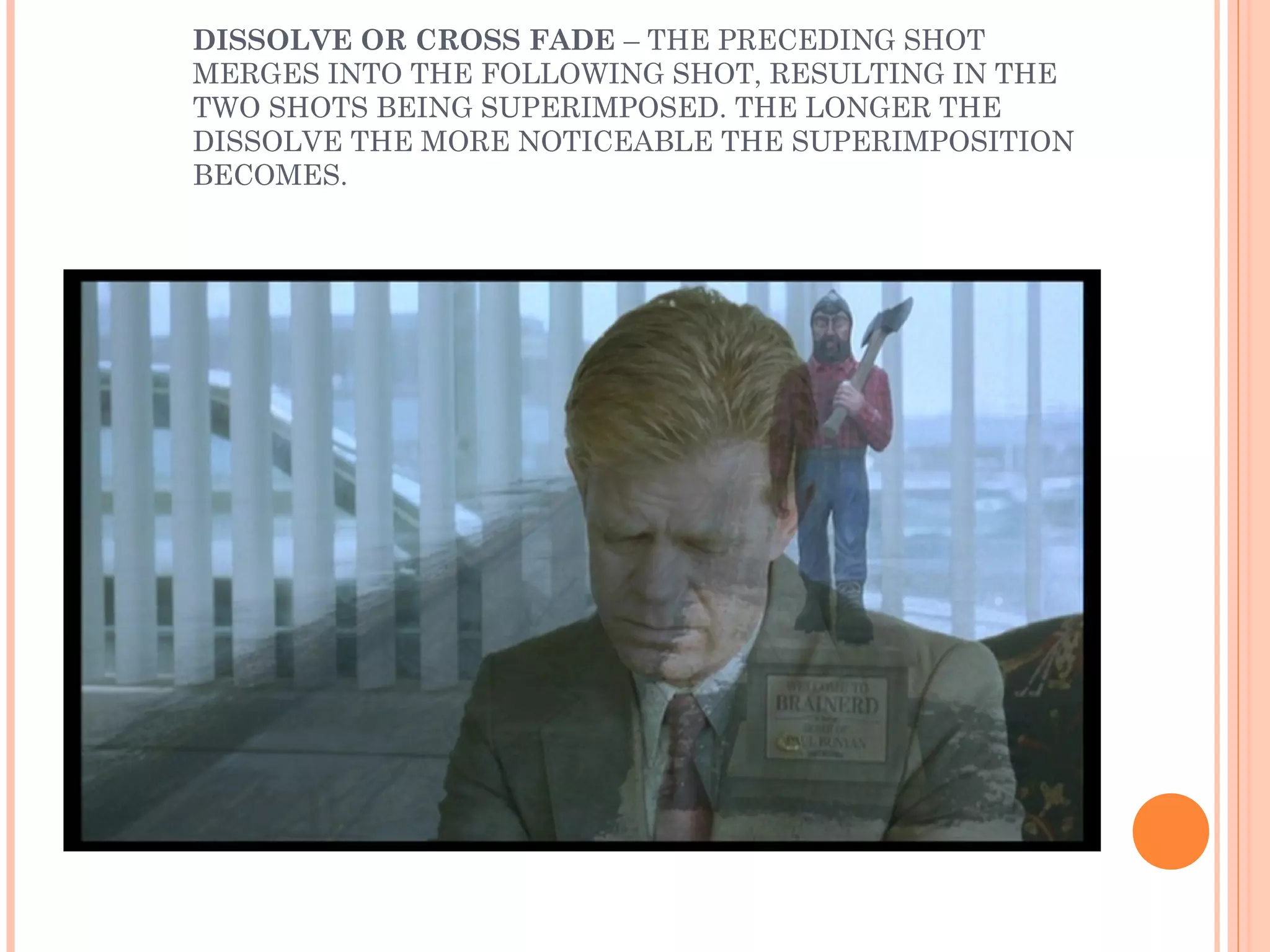
DISSOLVE OR CROSS FADE – THE PRECEDING SHOT 
MERGES INTO THE FOLLOWING SHOT, RESULTING IN THE 
TWO SHOTS BEING SUPERIMPOSED. THE LONGER THE 
DISSOLVE THE MORE NOTICEABLE THE SUPERIMPOSITION 
BECOMES.
DISSOLVE OR CROSS FADE – THE PRECEDING SHOT 
MERGES INTO THE FOLLOWING SHOT, RESULTING IN THE 
TWO SHOTS BEING SUPERIMPOSED. THE LONGER THE 
DISSOLVE THE MORE NOTICEABLE THE SUPERIMPOSITION 
BECOMES.
DISSOLVE OR CROSS FADE – THE PRECEDING SHOT MERGES INTO 
THE FOLLOWING SHOT, RESULTING IN THE TWO SHOTS BEING 
SUPERIMPOSED. THE LONGER THE DISSOLVE THE MORE 
NOTICEABLE THE SUPERIMPOSITION BECOMES.
SHOT DURATION 
 The duration of a shot will usually reflect the 
narrative context. 
 Generally speaking short shot duration 
conveys action and urgency (say in a chase 
sequence). Click here for a chase sequence 
from Die Another Day. 
 Whilst long duration conveys intensity and 
intimacy within the narrative, it allows us to 
focus upon facial expression and other 
aspects of mise en scene which would 
otherwise be missed. Click here for a scene 
with long shot duration from Secrets and 
Lies (Leigh, 1996)
SHOT DURATION 
A shot can be further lengthened or shortened 
by over cranking or under cranking. 
Over cranking involves speeding up the 
camera so that when it is projected at normal 
speed the movement appears slower. Under 
cranking does the opposite slowing down the 
camera speed so that it appears faster when 
projected at normal speed. 
The effects of this process are called slow 
motion and fast motion. Click here to see the 
use of slow motion in Blade Runner 
(Scott,1982)
CONTINUITY 
In Classic Hollywood cinema the purpose 
of editing is to maintain continuity within 
the narrative. In other words the editing 
process is smooth and does not detract 
from the story. There are various 
techniques used by editors in order to 
maintain continuity including: 
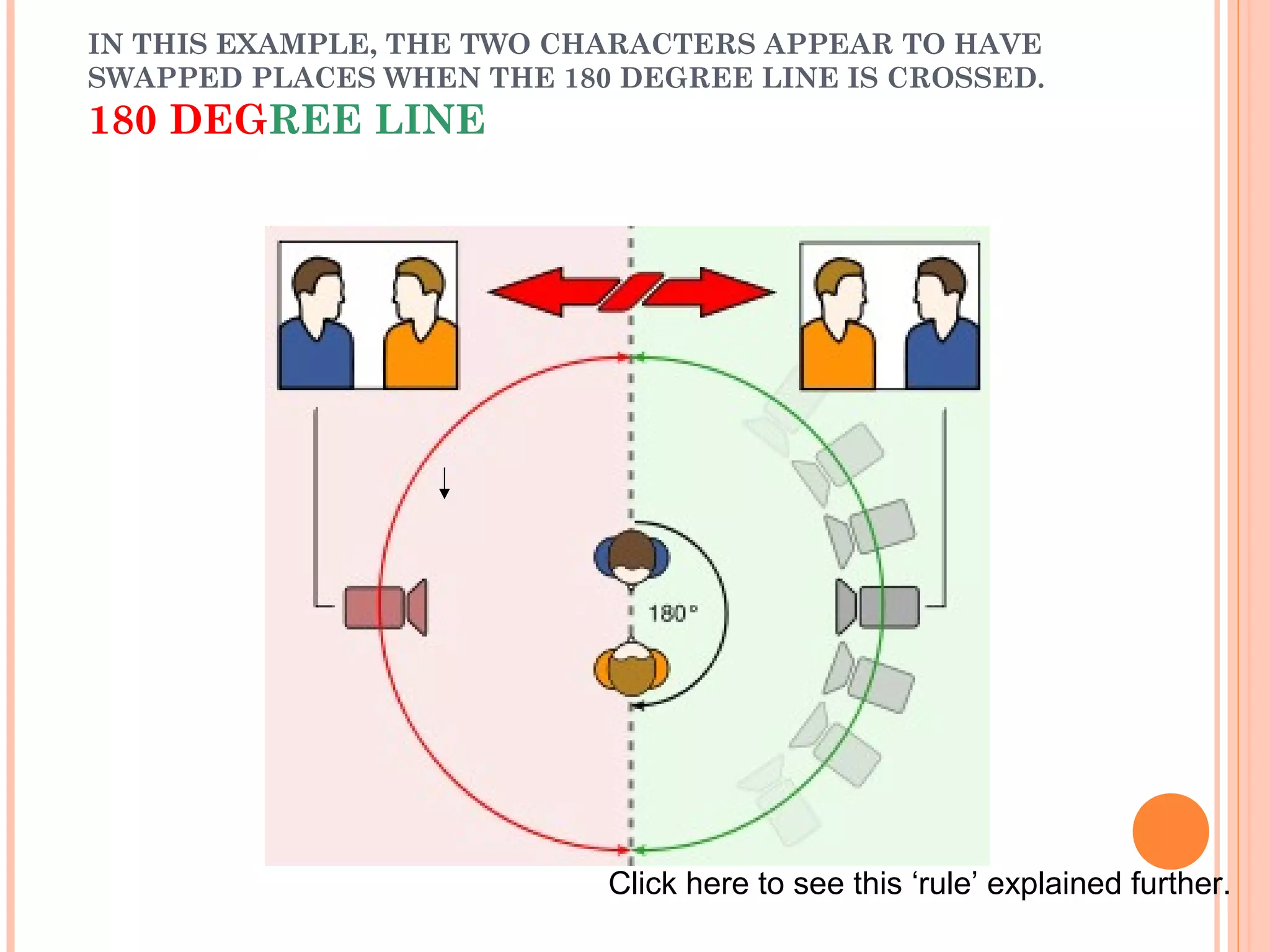
180 degree ‘rule’ – this convention helps 
to maintain continuity by ensuring that 
the action within a sequence takes place 
in front of an imaginary 180 degree line. If 
the line is crossed the change in 
perspective can be disorientating and 
confusing for the audience.
IN THIS EXAMPLE, THE TWO CHARACTERS APPEAR TO HAVE 
SWAPPED PLACES WHEN THE 180 DEGREE LINE IS CROSSED. 
180 DEGREE LINE 
Click here to see this ‘rule’ explained further.
30 DEGREE ‘RULE’ 
 this convention dictates that when film is cut 
the camera should move more than 30 degrees 
otherwise it creates an awkward abrupt cut 
known as a jump cut. Click here for an 
example from Breathless (Godard,1959)
eye line match 
 a common convention to maintain continuity, a 
character looks at something and in the next 
shot we see what they are looking at.
Match on action 
The Maltese Falcon (Huston,1941) 
 a similar technique where 
two shots are linked by an 
action. For example in the 
preceding shot we see 
someone walking towards 
someone and then in the 
next shot they are 
completing the movement. 
Shots can also be matched 
through dialogue, by 
cutting mid sentence.
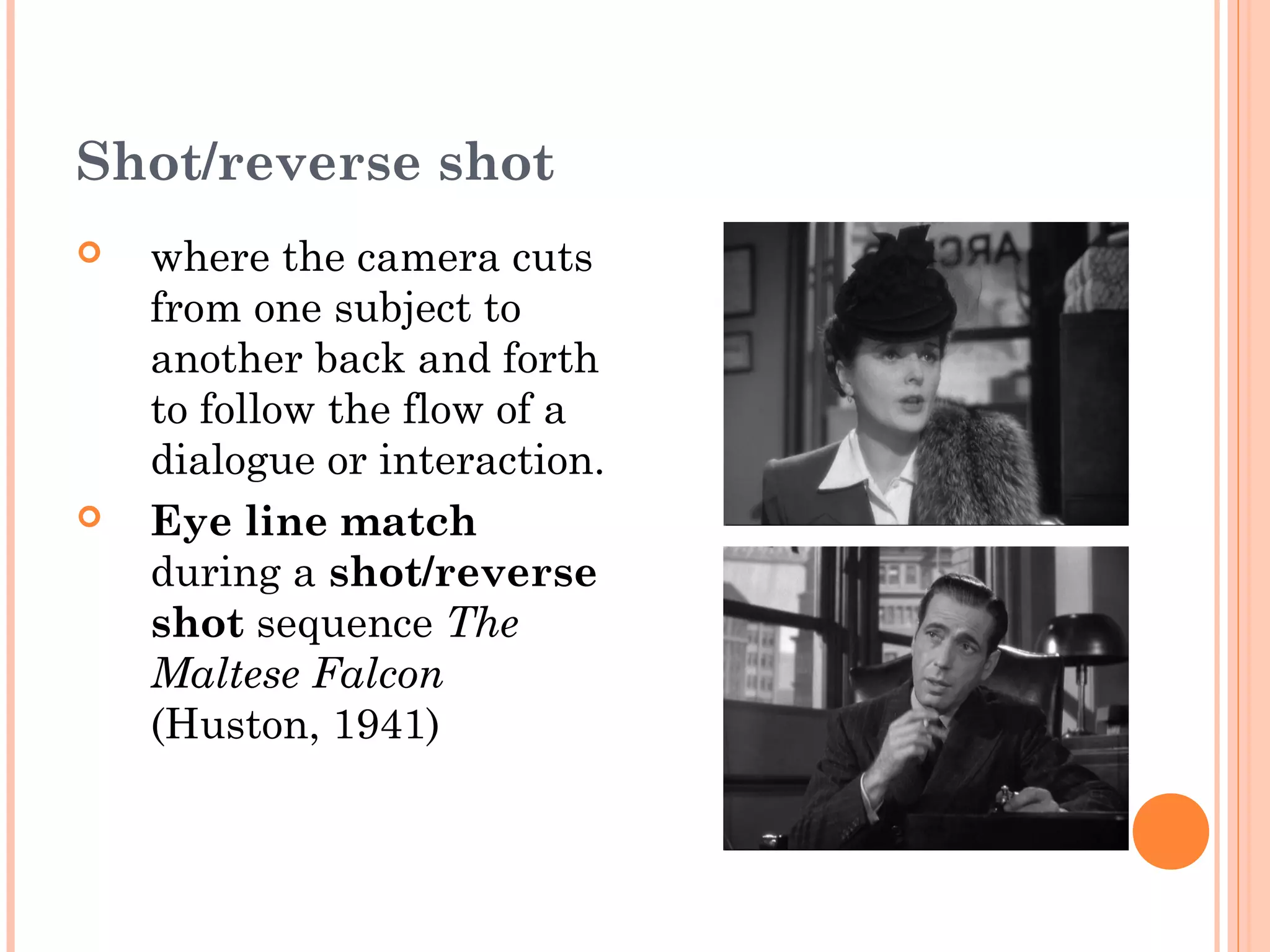
Shot/reverse shot 
 where the camera cuts 
from one subject to 
another back and forth 
to follow the flow of a 
dialogue or interaction. 
 Eye line match 
during a shot/reverse 
shot sequence The 
Maltese Falcon 
(Huston, 1941)
Other continuity devices 
 crosscutting – a devise used to convey the 
impression that two or more events are 
occurring simultaneously. This involves 
cutting back and forth between different 
locations. 
 split screen – where the frame is split into 
sections so that we can see different events 
occurring at the same time. This technique 
was used recently on the TV series 24. 
 sound bridge – playing the same soundtrack 
over two or more shots is sometimes used to 
aid continuity. Sometimes a cut may coincide 
with a particular sound and then a similar 
sound occurs in the next shot. 
 Click here for more on continuity editing in 
the film V for Vendetta (McTeigue, 2005)
MONTAGE 
 Montage involves a rapid succession of shots 
used in conventional cinema to show specific 
detail within a context, show a rapid passage of 
time or to convey frenzy or panic. Sometimes 
used in alternative filmmaking to break 
continuity, or to build thematic and/or symbolic 
links between shots.
SOUND 
 Sound has existed in film since 1927. 
 Sound is used conventionally to create a more 
involving and believable narrative. 
 http://www.theidentgallery.com/player.php? 
id=E4-2007-ID-BARN 
There are two main types of sound in film:
Diegetic 
 Diegetic – ‘diegesis’ is the Greek term for 
‘world’ and is used in film analysis to describe 
the ‘narrative world’ of a film. 
 Diegetic sound is any sound we would expect 
to hear if we were part of the ‘narrative world’, 
footsteps, doors opening and closing etc. 
Diegetic sound can be subdivided into: 
 dialogue – speech 
 sound effects – footsteps, doors closing, 
gun shots etc. 
 ambient sound – background noise, 
distant chatter, wind, traffic etc.
Non- Diegetic 
 Non-diegetic sound is sound which has been added to 
support the mood and atmosphere that the filmmaker is trying 
to convey. 
 This is usually in the form of added music, e.g. the ominous 
music that signals the approach of the shark in Jaws. Jaws 
(click here). 
 Non-diegetic sound is usually used to support what is going on 
in the narrative (parallel) although sometimes non-diegetic 
sound is used which contrasts the images (contrapuntal). 
Click here for an example of contrapuntal sound from A Clockwork 
Orange (Kubrick,1971) 
 Don’t confuse this distinction between sound that is 
recorded in production and sound that is added in post 
production! Sound effects e.g. the sound of gunfire, is often 
added in post production but it is still diegetic, i.e. we would 
here gunfire if we were there. 
Click here for more on Sound

Film Techniques Revision

  • 1.
  • 2.
    Mise en Scene  Mise en scene is a French term meaning ‘everything in the frame.’ Elements that make up mise en scene include:  Setting and Location  Props  Costume  Performance and Movement
  • 3.
    Cinematography  Refersto the visual aspects of a films language.  Camera shots and movements can give us clear indicators of emotion, motive and give audiences clues as to things that may be about to happen.  It is important that you can identify shots and consider how the choices made impact on the narrative.
  • 4.
    PERFORMANCE AND MOVEMENT. This refers to the meanings conveyed by actors through their physical performance. Meaning can be conveyed through the following means: Facial expression Gaze Gesture Posture Body Contact Appearance Spatial behaviour
  • 5.
    Analyse the Miseen Scene of this image
  • 6.
    Analyse the Miseen Scene of this image
  • 7.
    LIGHTING There aretwo main approaches to the use of lighting in film these are: Realistic lighting (high key). This involves the use of a key light (the main source of light), fill light and back lighting to create a natural look to the scene (this is called three point lighting). Lighting can be adapted to suggest different times of day eliminate shadow and pick the subject out from the background
  • 8.
    Lighting Expressive lightingis predominately low key. A key light is used with little or no fill to create high contrast and shadow to convey a dark expressive mood. Subjects are sometimes back lit only to create a silhouetted figure. Expressive lighting may also involve the use of single hue ‘gels’, filters and other optical effects to create a specific mood.
  • 9.
    three point lighting Click here for more on three point lighting
  • 10.
    High key lighting The Virgin Suicides (Coppola, 1999)
  • 11.
    Low key lightingCitizen Kane (Welles, 1941)
  • 12.
    Red hue MeanStreets (Scorsese, 1973)
  • 13.
    Camera In lookingat camera work the following areas need to be considered:  Angle  Movement  Position  Composition  Depth of field
  • 14.
    ANGLE  Highand low angle shots can be used by a filmmaker in order to convey meaning. A filmmaker may also use a titled angle (sometimes called ‘dutch’ or ‘canted’) to create a skewed frame.
  • 15.
    High angle Fargo(Coen Bros, 1996)
  • 16.
    Low angle CitizenKane (Welles, 1941)
  • 17.
    Dutch angle FallenAngels (Wong Kar-Wai, 1995)
  • 18.
    MOVEMENT  Theuse of camera movement allows the filmmaker to alter the framing of an image whilst filming. Different types of camera movement include:  pan – horizontal movement of the camera from a static position.  tracking – camera moves on tracks to follow a subject at close proximity. This effect can also be created using a dolly (a platform on wheels) or a steadicam (a camera mounted on the body which uses weights and balances to create smooth movement). Click here to see a steadicam used in The Shining (Kubrick, 1980)  tilt – a subtle movement on the vertical (up or down)
  • 19.
    MOVEMENT  crab– a subtle movement on the horizontal (left or right)  crane – the camera is mounted on to a crane so that it can move dramatically up or down and from side to side. Sometimes cranes are put on tracks to create spectacular tracking and craning movement. Click here to see a tracking and craning shot from Touch of Evil (Welles,1958)  handheld – a shaky movement the follows the movement of the camera operator. Often used to create realism, urgent and sudden figure movement or to create a point of view shot (we are seeing things through the eyes of a character). Click here to see the use of handheld camera in The Blair Witch Project (Myrick/Sanchez,1999)  zoom lens – creates the illusion of movement by altering the lens length.
  • 20.
    Position Position The distance between the camera and the subject. The position selected relates to the information the filmmaker is trying to communicate. Camera distances can be defined as follows. All the examples below are from Fargo.
  • 21.
  • 22.
  • 23.
  • 24.
  • 25.
  • 26.
    COMPOSITION  Theway a frame is composed can help to convey important information. A basic convention of composition dictates that a framing should be balanced according to the principle of the rule of thirds. The rule of thirds is a compositional rule of thumb in photography.  The rule states that an image can be divided into nine equal parts by two equally-spaced horizontal lines and two equally-spaced vertical lines.  The four points formed by the intersections of these lines can be used to align features in the photograph.  Proponents of this technique claim that aligning a photograph with these points in mind creates more tension, energy and interest in the image than simply centering the subject would. Click here to find out more about this technique.
  • 27.
    Rule of thirdsDead Man (Jarmusch, 1995)
  • 28.
    DEPTH OF FIELD  A frame’s depth of field refers to the focal length.  Where a frame shows everything sharp or in focus this is called deep focus.  When a particular part of the frame is picked out and the rest of the frame is blurred or indistinct it is called selective focus.  When the focal point changes within the frame this is called pull or ‘rack’ focus.  To get an idea of how this works put your finger in front of your face and concentrate on it. The finger will appear in focus and the background blurred. Now concentrate on the background, the human eye ‘pulls’ focus from the foreground to the background.
  • 29.
    Selective focus Elephant(Van Sant, 2002)
  • 30.
    Deep focus CitizenKane (Welles, 1941)
  • 31.
    EDITING  Editingin film is a process of cutting and assembling film footage to produce a finished product.  The role of the film editor includes organising transitions between shots making decisions about shot duration and maintaining continuity.
  • 32.
    TRANSITION The processof cutting from one shot to another usually involves a simple straight cut. However there are other means of transition available to a film editor Fade to black Dissolve/cross fade Wipe
  • 33.
    FADE – THEPRECEDING SHOT FADES INTO BLACK FROM WHICH THE FOLLOWING SHOT EMERGES.
  • 34.
    FADE – THEPRECEDING SHOT FADES INTO BLACK FROM WHICH THE FOLLOWING SHOT EMERGES.
  • 35.
    FADE – THEPRECEDING SHOT FADES INTO BLACK FROM WHICH THE FOLLOWING SHOT EMERGES.
  • 36.
    DISSOLVE OR CROSSFADE – THE PRECEDING SHOT MERGES INTO THE FOLLOWING SHOT, RESULTING IN THE TWO SHOTS BEING SUPERIMPOSED. THE LONGER THE DISSOLVE THE MORE NOTICEABLE THE SUPERIMPOSITION BECOMES.
  • 37.
    DISSOLVE OR CROSSFADE – THE PRECEDING SHOT MERGES INTO THE FOLLOWING SHOT, RESULTING IN THE TWO SHOTS BEING SUPERIMPOSED. THE LONGER THE DISSOLVE THE MORE NOTICEABLE THE SUPERIMPOSITION BECOMES.
  • 38.
    DISSOLVE OR CROSSFADE – THE PRECEDING SHOT MERGES INTO THE FOLLOWING SHOT, RESULTING IN THE TWO SHOTS BEING SUPERIMPOSED. THE LONGER THE DISSOLVE THE MORE NOTICEABLE THE SUPERIMPOSITION BECOMES.
  • 39.
    SHOT DURATION The duration of a shot will usually reflect the narrative context.  Generally speaking short shot duration conveys action and urgency (say in a chase sequence). Click here for a chase sequence from Die Another Day.  Whilst long duration conveys intensity and intimacy within the narrative, it allows us to focus upon facial expression and other aspects of mise en scene which would otherwise be missed. Click here for a scene with long shot duration from Secrets and Lies (Leigh, 1996)
  • 40.
    SHOT DURATION Ashot can be further lengthened or shortened by over cranking or under cranking. Over cranking involves speeding up the camera so that when it is projected at normal speed the movement appears slower. Under cranking does the opposite slowing down the camera speed so that it appears faster when projected at normal speed. The effects of this process are called slow motion and fast motion. Click here to see the use of slow motion in Blade Runner (Scott,1982)
  • 41.
    CONTINUITY In ClassicHollywood cinema the purpose of editing is to maintain continuity within the narrative. In other words the editing process is smooth and does not detract from the story. There are various techniques used by editors in order to maintain continuity including: 180 degree ‘rule’ – this convention helps to maintain continuity by ensuring that the action within a sequence takes place in front of an imaginary 180 degree line. If the line is crossed the change in perspective can be disorientating and confusing for the audience.
  • 42.
    IN THIS EXAMPLE,THE TWO CHARACTERS APPEAR TO HAVE SWAPPED PLACES WHEN THE 180 DEGREE LINE IS CROSSED. 180 DEGREE LINE Click here to see this ‘rule’ explained further.
  • 43.
    30 DEGREE ‘RULE’  this convention dictates that when film is cut the camera should move more than 30 degrees otherwise it creates an awkward abrupt cut known as a jump cut. Click here for an example from Breathless (Godard,1959)
  • 44.
    eye line match  a common convention to maintain continuity, a character looks at something and in the next shot we see what they are looking at.
  • 45.
    Match on action The Maltese Falcon (Huston,1941)  a similar technique where two shots are linked by an action. For example in the preceding shot we see someone walking towards someone and then in the next shot they are completing the movement. Shots can also be matched through dialogue, by cutting mid sentence.
  • 46.
    Shot/reverse shot where the camera cuts from one subject to another back and forth to follow the flow of a dialogue or interaction.  Eye line match during a shot/reverse shot sequence The Maltese Falcon (Huston, 1941)
  • 47.
    Other continuity devices  crosscutting – a devise used to convey the impression that two or more events are occurring simultaneously. This involves cutting back and forth between different locations.  split screen – where the frame is split into sections so that we can see different events occurring at the same time. This technique was used recently on the TV series 24.  sound bridge – playing the same soundtrack over two or more shots is sometimes used to aid continuity. Sometimes a cut may coincide with a particular sound and then a similar sound occurs in the next shot.  Click here for more on continuity editing in the film V for Vendetta (McTeigue, 2005)
  • 48.
    MONTAGE  Montageinvolves a rapid succession of shots used in conventional cinema to show specific detail within a context, show a rapid passage of time or to convey frenzy or panic. Sometimes used in alternative filmmaking to break continuity, or to build thematic and/or symbolic links between shots.
  • 49.
    SOUND  Soundhas existed in film since 1927.  Sound is used conventionally to create a more involving and believable narrative.  http://www.theidentgallery.com/player.php? id=E4-2007-ID-BARN There are two main types of sound in film:
  • 50.
    Diegetic  Diegetic– ‘diegesis’ is the Greek term for ‘world’ and is used in film analysis to describe the ‘narrative world’ of a film.  Diegetic sound is any sound we would expect to hear if we were part of the ‘narrative world’, footsteps, doors opening and closing etc. Diegetic sound can be subdivided into:  dialogue – speech  sound effects – footsteps, doors closing, gun shots etc.  ambient sound – background noise, distant chatter, wind, traffic etc.
  • 51.
    Non- Diegetic Non-diegetic sound is sound which has been added to support the mood and atmosphere that the filmmaker is trying to convey.  This is usually in the form of added music, e.g. the ominous music that signals the approach of the shark in Jaws. Jaws (click here).  Non-diegetic sound is usually used to support what is going on in the narrative (parallel) although sometimes non-diegetic sound is used which contrasts the images (contrapuntal). Click here for an example of contrapuntal sound from A Clockwork Orange (Kubrick,1971)  Don’t confuse this distinction between sound that is recorded in production and sound that is added in post production! Sound effects e.g. the sound of gunfire, is often added in post production but it is still diegetic, i.e. we would here gunfire if we were there. Click here for more on Sound