Camerawork
Media Studies
Framing/Distance
There are many techniques when it comes to shooting a scene, such as the ‘long shot’, ‘medium shot’ and
the ‘close up’.
In framing the ‘Long shot’ is used for the opening a scene in the beginning of the movie, this can be used
to show the location of the storyline and can also set the mood if done right. It is captured in a wide angle
lens, this provides the ability to get a large view of the field of where the location is. It is also called a
‘longshot’ because it is filmed while the camera is from a liong range in order to fit the desired text.
This could be used while tracking a plane, helicopter or even a car scene which gives the audience
context of what is going on. This could also be used at the end of the scene where the camera pans out to
show the audience the final scene or destination of the plot,. Commonly used to end movies with a wide
view of the location
Framing/Distance
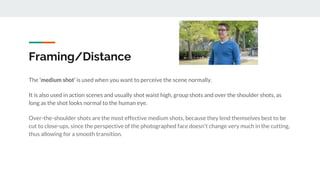
The ‘medium shot’ is used when you want to perceive the scene normally.
It is also used in action scenes and usually shot waist high, group shots and over the shoulder shots, as
long as the shot looks normal to the human eye.
Over-the-shoulder shots are the most effective medium shots, because they lend themselves best to be
cut to close-ups, since the perspective of the photographed face doesn't change very much in the cutting,
thus allowing for a smooth transition.
Framing/Distance
The ‘close up’ is an essential element of a movie. The close up should be used after a medium shot and
should be smooth and technically unnoticeable
The close up shots can allow the audience to show the characters emotion without the use of speech, if
done right the audience should feel the way the director wanted them to feel.
It can also help the audience understand what the character is about to do or see how he reacted to a
stimulus from the other scene by reading his facial expressions.
Shots
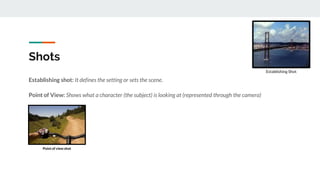
Establishing shot: It defines the setting or sets the scene.
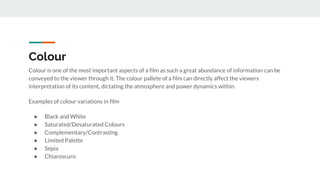
Point of View: Shows what a character (the subject) is looking at (represented through the camera)
Establishing Shot
Point of view shot
Colour
Colour is one of the most important aspects of a film as such a great abundance of information can be
conveyed to the viewer through it. The colour pallete of a film can directly affect the viewers
interpretation of its content, dictating the atmosphere and power dynamics within.
Examples of colour variations in film
● Black and White
● Saturated/Desaturated Colours
● Complementary/Contrasting
● Limited Palette
● Sepia
● Chiaroscuro
Black and White
COLOUR
To this day black and white filmmakers still
utilise a black and white colour a pallet as it
allows them to create a theme and
atmosphere is not possible with colour.
The most important fact about black and
white film is it is never just black and white.
Hundreds of shades black,grey,white,silver
and beige are incorporated.
Chiaroscuro
COLOUR
Chiaroscuro describes how light is displayed
within an image. It translates to light-dark. It
effects can be utilised to direct the viewer's
attention to certain aspects of the frame. Using
this lighting effect can cause the viewers to feel
more emotions during a scene, hence why its
most commonly used during important
moments within the film.
Complementary/
Contrasting
COLOUR
Complementary colours are when the images
two primary colours are from opposite sides of
the colour wheel, creating a clear contrast
between them. Most commonly used is orange
and blue, blue usually being the sky and
orange the skin of the characters.
Contrasting colours are when the difference
between them is strong, such as black and
white. It can be utilised similar to
complementary colours to highlight certain
parts of the image.
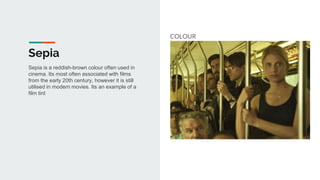
Sepia
COLOUR
Sepia is a reddish-brown colour often used in
cinema. Its most often associated with films
from the early 20th century, however it is still
utilised in modern movies. Its an example of a
film tint
Limited Palette
COLOUR
A limited palette is one that is limited to only
the bare essential colours. Using a limited
palette allows for simplicity and minimalism
within the work, creating a unique aesthetic.
Wes Anderson is a director famous for his use
of limited palettes.
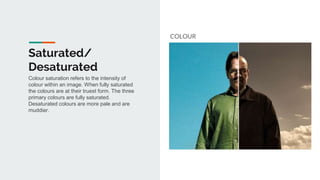
Saturated/
Desaturated
COLOUR
Colour saturation refers to the intensity of
colour within an image. When fully saturated
the colours are at their truest form. The three
primary colours are fully saturated.
Desaturated colours are more pale and are
muddier.
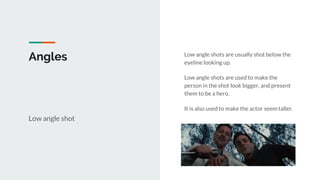
Angles
Low angle shot
Low angle shots are usually shot below the
eyeline looking up.
Low angle shots are used to make the
person in the shot look bigger, and present
them to be a hero.
It is also used to make the actor seem taller.
Angles
High angle
A ‘high angle shot’ is often used when a
person is on something and is talking to
someone who of which is at a lower level.
It could also be used to belittle a person
when being faced with a larger opponent or
villain.
Angles
Canted shot
A canted angle is the camera rotated onto
its side.
This is usually used to portray unease,
disorientation or intoxication
This is used to give the audience a better
insight on how the character feels or what
state he is in
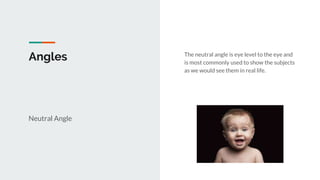
Angles
Neutral Angle
The neutral angle is eye level to the eye and
is most commonly used to show the subjects
as we would see them in real life.
Effects
Front and Rear projection
Rear projection was widely used for many years in
driving scenes.
A front/rear projection effect is an in-camera visual
effects process for combining foreground performance
with pre-filmed background footage.
Effects 2.0
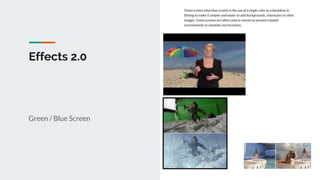
Green / Blue Screen
Green screen (also blue screen) is the use of a single color as a backdrop in
filming to make it simpler and easier to add backgrounds, charactersor other
images. Green screens are often used in movies to present created
environments or simulate real locations.
Focus
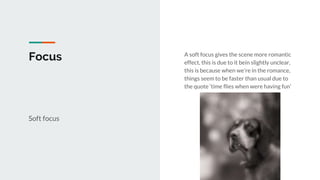
Soft focus
A soft focus gives the scene more romantic
effect, this is due to it bein slightly unclear,
this is because when we’re in the romance,
things seem to be faster than usual due to
the quote ‘time flies when were having fun’
Focus 2.0
Sharp focus
Sharp focus is when a shot is getting the
details of the text and shows every harp
detail
Focus v3
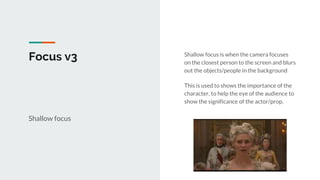
Shallow focus
Shallow focus is when the camera focuses
on the closest person to the screen and blurs
out the objects/people in the background
This is used to shows the importance of the
character, to help the eye of the audience to
show the significance of the actor/prop.
Focus IV
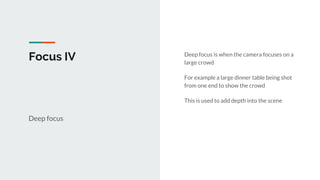
Deep focus
Deep focus is when the camera focuses on a
large crowd
For example a large dinner table being shot
from one end to show the crowd
This is used to add depth into the scene
Focus §
Fixed focus
Fixed Focus is when you can’t adjust the lens
any further.
This is used for close ups and is usually very
precise and sharp.
This is also used when the camera zooms
into a specific object.
Focus VI
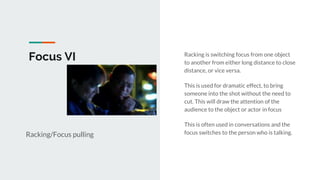
Racking/Focus pulling
Racking is switching focus from one object
to another from either long distance to close
distance, or vice versa.
This is used for dramatic effect, to bring
someone into the shot without the need to
cut. This will draw the attention of the
audience to the object or actor in focus
This is often used in conversations and the
focus switches to the person who is talking.
Movement
Whip Panning
A whip pan is a type of pan shot in which the camera pans
so quickly that the picture blurs into indistinct streaks. It is
commonly used as a transition between shots, and can
indicate the passage of time or a frenetic pace of action.
MOvement 2
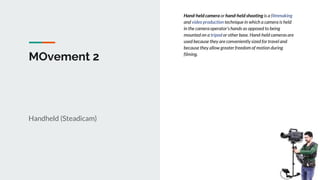
Handheld (Steadicam)
Hand-held camera or hand-held shooting is a filmmaking
and video production technique in which a camera is held
in the camera operator's hands as opposed to being
mounted on a tripod or other base. Hand-held cameras are
used because they are conveniently sized for travel and
because they allow greater freedom of motion during
filming.

Media studies camerawork

  • 1.
  • 2.
    Framing/Distance There are manytechniques when it comes to shooting a scene, such as the ‘long shot’, ‘medium shot’ and the ‘close up’. In framing the ‘Long shot’ is used for the opening a scene in the beginning of the movie, this can be used to show the location of the storyline and can also set the mood if done right. It is captured in a wide angle lens, this provides the ability to get a large view of the field of where the location is. It is also called a ‘longshot’ because it is filmed while the camera is from a liong range in order to fit the desired text. This could be used while tracking a plane, helicopter or even a car scene which gives the audience context of what is going on. This could also be used at the end of the scene where the camera pans out to show the audience the final scene or destination of the plot,. Commonly used to end movies with a wide view of the location
  • 3.
    Framing/Distance The ‘medium shot’is used when you want to perceive the scene normally. It is also used in action scenes and usually shot waist high, group shots and over the shoulder shots, as long as the shot looks normal to the human eye. Over-the-shoulder shots are the most effective medium shots, because they lend themselves best to be cut to close-ups, since the perspective of the photographed face doesn't change very much in the cutting, thus allowing for a smooth transition.
  • 4.
    Framing/Distance The ‘close up’is an essential element of a movie. The close up should be used after a medium shot and should be smooth and technically unnoticeable The close up shots can allow the audience to show the characters emotion without the use of speech, if done right the audience should feel the way the director wanted them to feel. It can also help the audience understand what the character is about to do or see how he reacted to a stimulus from the other scene by reading his facial expressions.
  • 5.
    Shots Establishing shot: Itdefines the setting or sets the scene. Point of View: Shows what a character (the subject) is looking at (represented through the camera) Establishing Shot Point of view shot
  • 6.
    Colour Colour is oneof the most important aspects of a film as such a great abundance of information can be conveyed to the viewer through it. The colour pallete of a film can directly affect the viewers interpretation of its content, dictating the atmosphere and power dynamics within. Examples of colour variations in film ● Black and White ● Saturated/Desaturated Colours ● Complementary/Contrasting ● Limited Palette ● Sepia ● Chiaroscuro
  • 7.
    Black and White COLOUR Tothis day black and white filmmakers still utilise a black and white colour a pallet as it allows them to create a theme and atmosphere is not possible with colour. The most important fact about black and white film is it is never just black and white. Hundreds of shades black,grey,white,silver and beige are incorporated.
  • 8.
    Chiaroscuro COLOUR Chiaroscuro describes howlight is displayed within an image. It translates to light-dark. It effects can be utilised to direct the viewer's attention to certain aspects of the frame. Using this lighting effect can cause the viewers to feel more emotions during a scene, hence why its most commonly used during important moments within the film.
  • 9.
    Complementary/ Contrasting COLOUR Complementary colours arewhen the images two primary colours are from opposite sides of the colour wheel, creating a clear contrast between them. Most commonly used is orange and blue, blue usually being the sky and orange the skin of the characters. Contrasting colours are when the difference between them is strong, such as black and white. It can be utilised similar to complementary colours to highlight certain parts of the image.
  • 10.
    Sepia COLOUR Sepia is areddish-brown colour often used in cinema. Its most often associated with films from the early 20th century, however it is still utilised in modern movies. Its an example of a film tint
  • 11.
    Limited Palette COLOUR A limitedpalette is one that is limited to only the bare essential colours. Using a limited palette allows for simplicity and minimalism within the work, creating a unique aesthetic. Wes Anderson is a director famous for his use of limited palettes.
  • 12.
    Saturated/ Desaturated COLOUR Colour saturation refersto the intensity of colour within an image. When fully saturated the colours are at their truest form. The three primary colours are fully saturated. Desaturated colours are more pale and are muddier.
  • 13.
    Angles Low angle shot Lowangle shots are usually shot below the eyeline looking up. Low angle shots are used to make the person in the shot look bigger, and present them to be a hero. It is also used to make the actor seem taller.
  • 14.
    Angles High angle A ‘highangle shot’ is often used when a person is on something and is talking to someone who of which is at a lower level. It could also be used to belittle a person when being faced with a larger opponent or villain.
  • 15.
    Angles Canted shot A cantedangle is the camera rotated onto its side. This is usually used to portray unease, disorientation or intoxication This is used to give the audience a better insight on how the character feels or what state he is in
  • 16.
    Angles Neutral Angle The neutralangle is eye level to the eye and is most commonly used to show the subjects as we would see them in real life.
  • 17.
    Effects Front and Rearprojection Rear projection was widely used for many years in driving scenes. A front/rear projection effect is an in-camera visual effects process for combining foreground performance with pre-filmed background footage.
  • 18.
    Effects 2.0 Green /Blue Screen Green screen (also blue screen) is the use of a single color as a backdrop in filming to make it simpler and easier to add backgrounds, charactersor other images. Green screens are often used in movies to present created environments or simulate real locations.
  • 19.
    Focus Soft focus A softfocus gives the scene more romantic effect, this is due to it bein slightly unclear, this is because when we’re in the romance, things seem to be faster than usual due to the quote ‘time flies when were having fun’
  • 20.
    Focus 2.0 Sharp focus Sharpfocus is when a shot is getting the details of the text and shows every harp detail
  • 21.
    Focus v3 Shallow focus Shallowfocus is when the camera focuses on the closest person to the screen and blurs out the objects/people in the background This is used to shows the importance of the character, to help the eye of the audience to show the significance of the actor/prop.
  • 22.
    Focus IV Deep focus Deepfocus is when the camera focuses on a large crowd For example a large dinner table being shot from one end to show the crowd This is used to add depth into the scene
  • 23.
    Focus § Fixed focus FixedFocus is when you can’t adjust the lens any further. This is used for close ups and is usually very precise and sharp. This is also used when the camera zooms into a specific object.
  • 24.
    Focus VI Racking/Focus pulling Rackingis switching focus from one object to another from either long distance to close distance, or vice versa. This is used for dramatic effect, to bring someone into the shot without the need to cut. This will draw the attention of the audience to the object or actor in focus This is often used in conversations and the focus switches to the person who is talking.
  • 25.
    Movement Whip Panning A whippan is a type of pan shot in which the camera pans so quickly that the picture blurs into indistinct streaks. It is commonly used as a transition between shots, and can indicate the passage of time or a frenetic pace of action.
  • 26.
    MOvement 2 Handheld (Steadicam) Hand-heldcamera or hand-held shooting is a filmmaking and video production technique in which a camera is held in the camera operator's hands as opposed to being mounted on a tripod or other base. Hand-held cameras are used because they are conveniently sized for travel and because they allow greater freedom of motion during filming.