Learn to find the experimental probability
of an event.
Course 1
11-2 Experimental Probability
Vocabulary
experiment
outcome
sample space
experimental probability
Insert Lesson Title Here
Course 1
11-2 Experimental Probability
An experiment is an activity involving chance
that can have different results. Flipping a coin and
rolling a number cube are examples of
experiments.
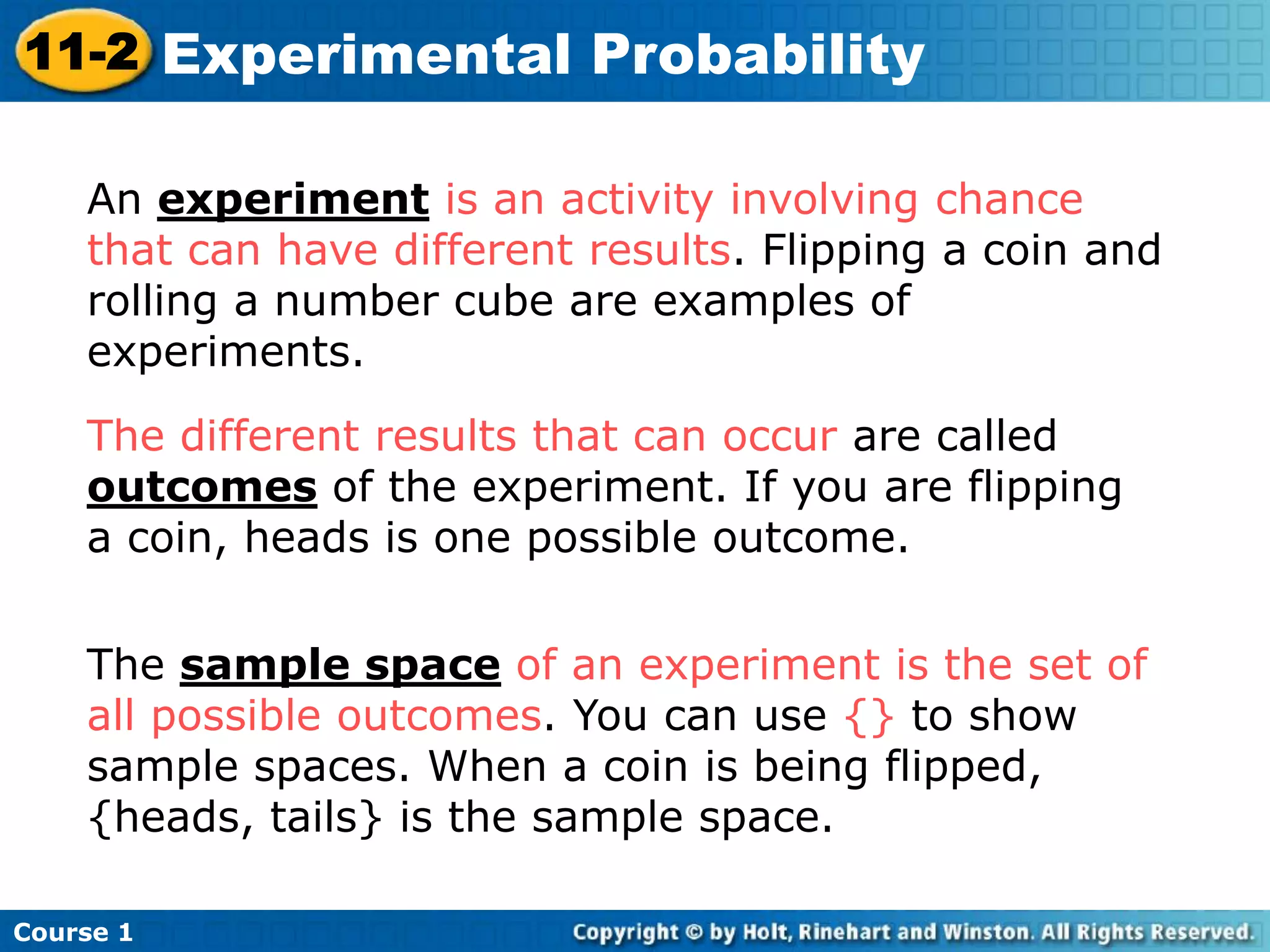
The different results that can occur are called
outcomes of the experiment. If you are flipping
a coin, heads is one possible outcome.
The sample space of an experiment is the set of
all possible outcomes. You can use {} to show
sample spaces. When a coin is being flipped,
{heads, tails} is the sample space.
Course 1
11-2 Experimental Probability
Additional Example 1A: Identifying Outcomes
and Sample Spaces
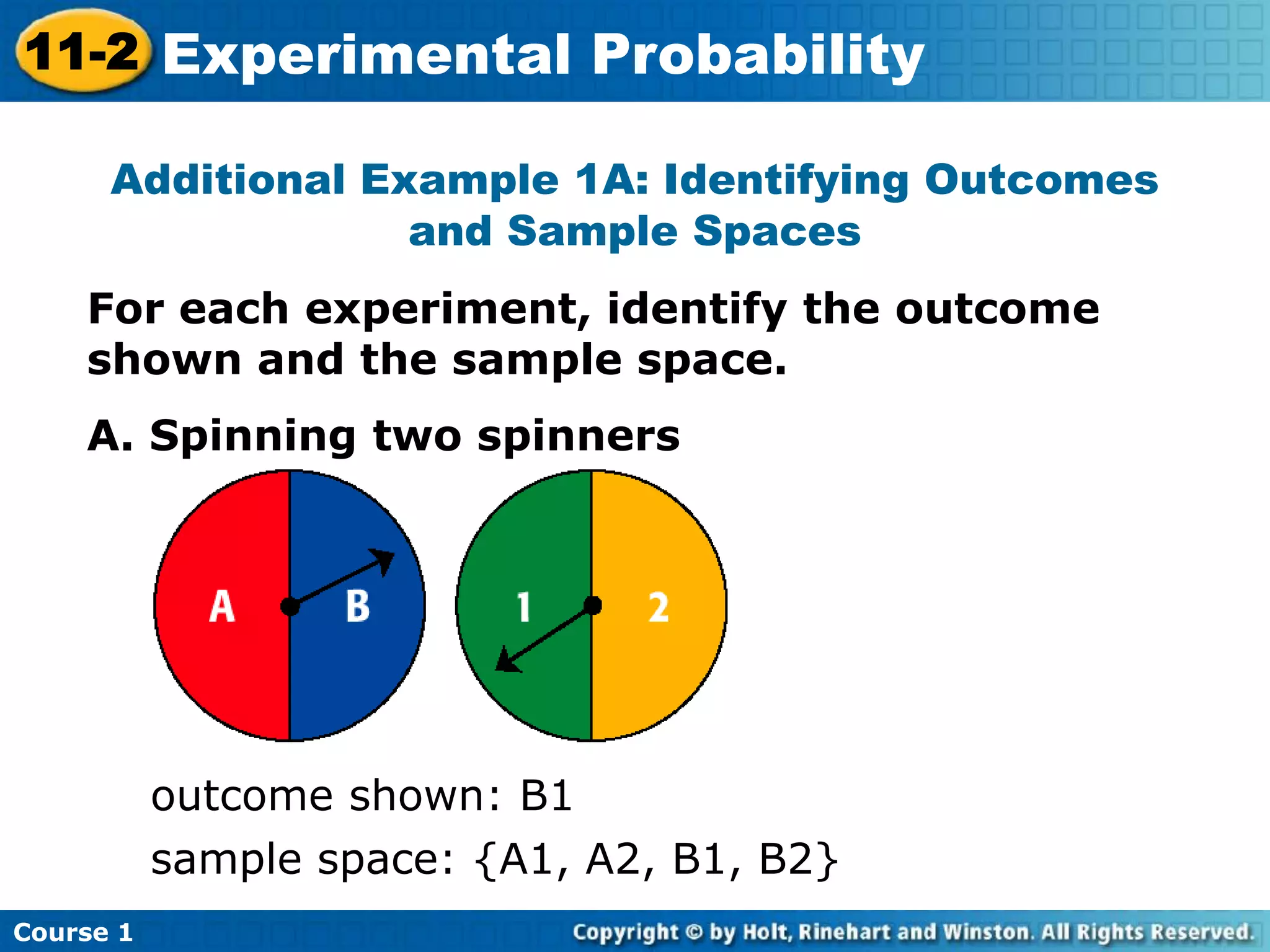
For each experiment, identify the outcome
shown and the sample space.
A. Spinning two spinners
outcome shown: B1
sample space: {A1, A2, B1, B2}
Course 1
11-2 Experimental Probability
Additional Example 1B: Identifying Outcomes
and Sample Spaces
For each experiment, identify the outcome
shown and the sample space.
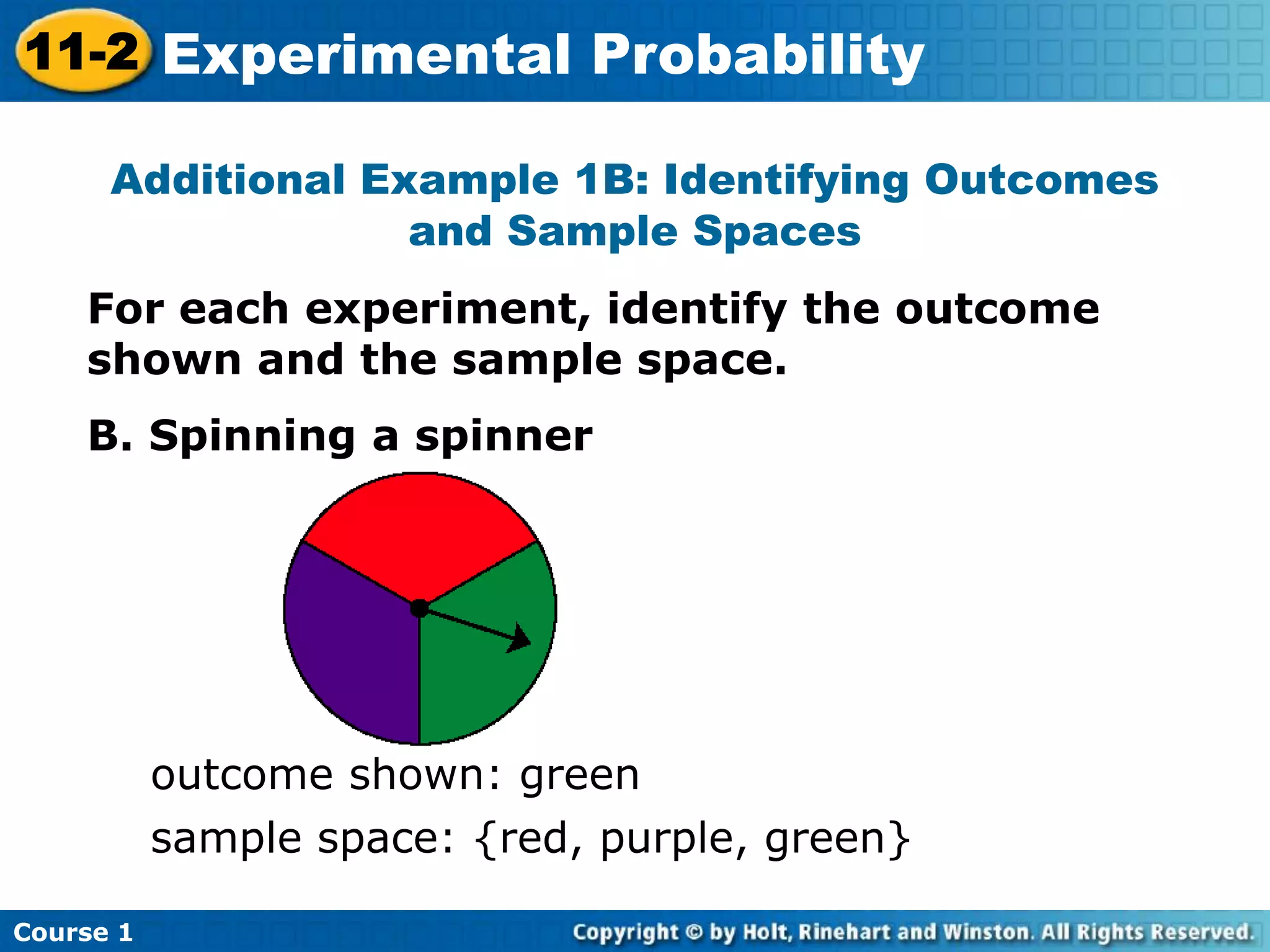
B. Spinning a spinner
outcome shown: green
sample space: {red, purple, green}
Course 1
11-2 Experimental Probability
Try This: Example 1A
For each experiment, identify the outcome
shown and the sample space.
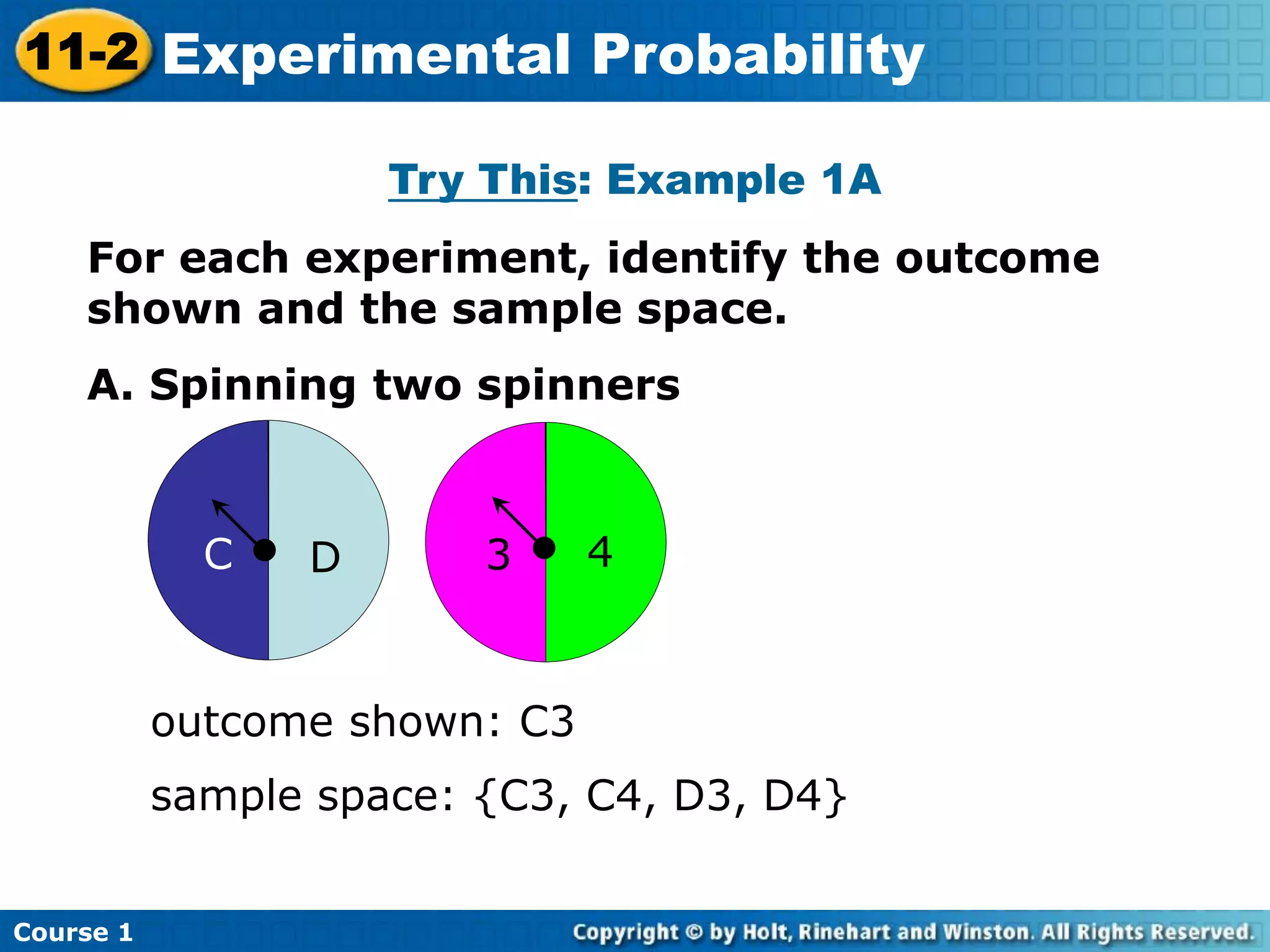
A. Spinning two spinners
outcome shown: C3
sample space: {C3, C4, D3, D4}
C D 3 4
Course 1
11-2 Experimental Probability
Try This: Example 1B
For each experiment, identify the outcome
shown and the sample space.
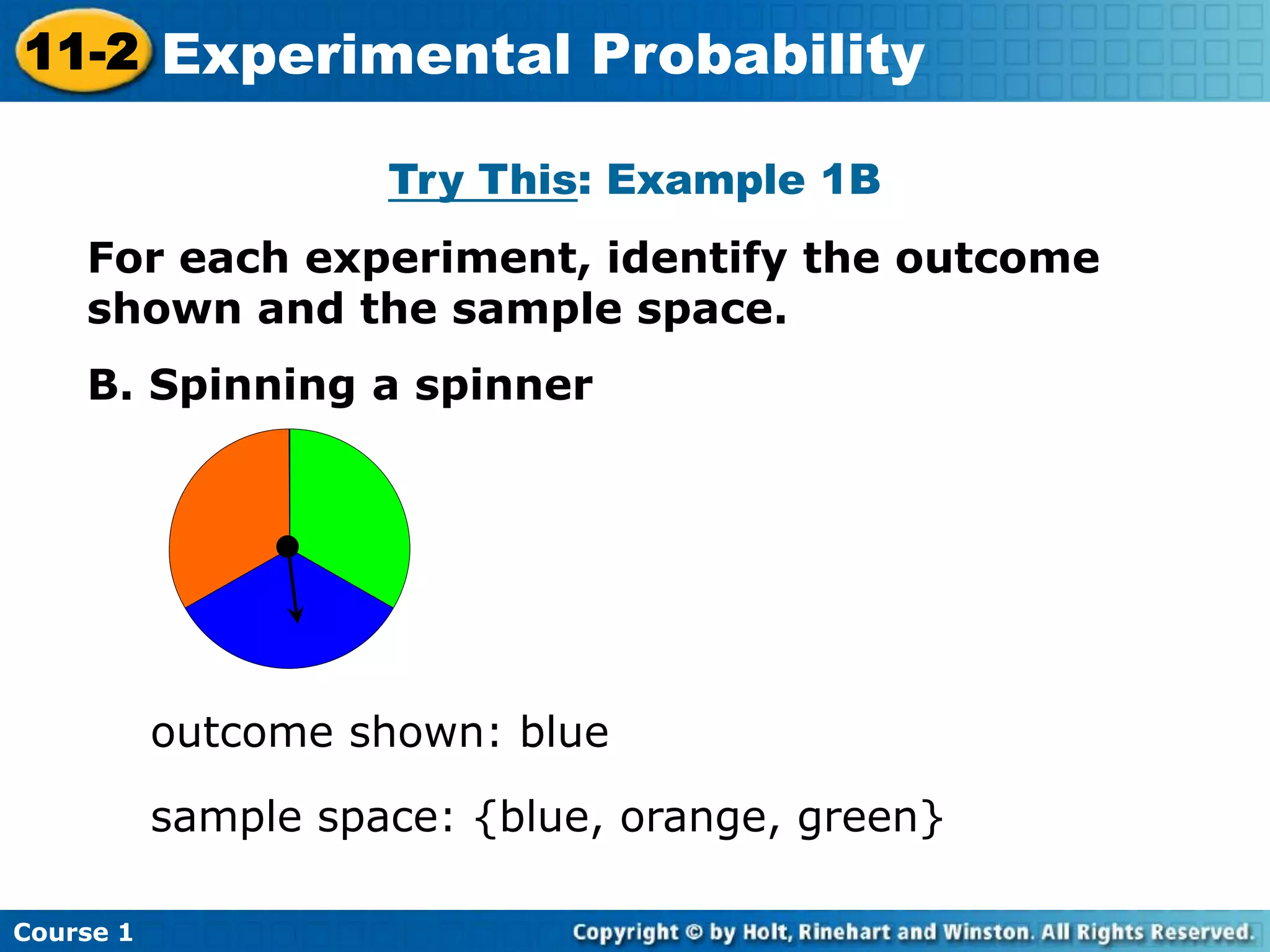
B. Spinning a spinner
outcome shown: blue
sample space: {blue, orange, green}
Course 1
11-2 Experimental Probability
Performing an experiment is one way to estimate
the probability of an event. If an experiment is
repeated many times, the experimental
probability of an event is the ratio of the
number of times the event occurs to the total
number of times the experiment is performed.
Course 1
11-2 Experimental Probability
P (Basketball Throws) ~
The probability of an event can be written
as P(event). P(blue) means “the
probability that blue will be the outcome.”
Writing Math
Course 1
11-2 Experimental Probability
Additional Example 2: Finding Experimental
Probability
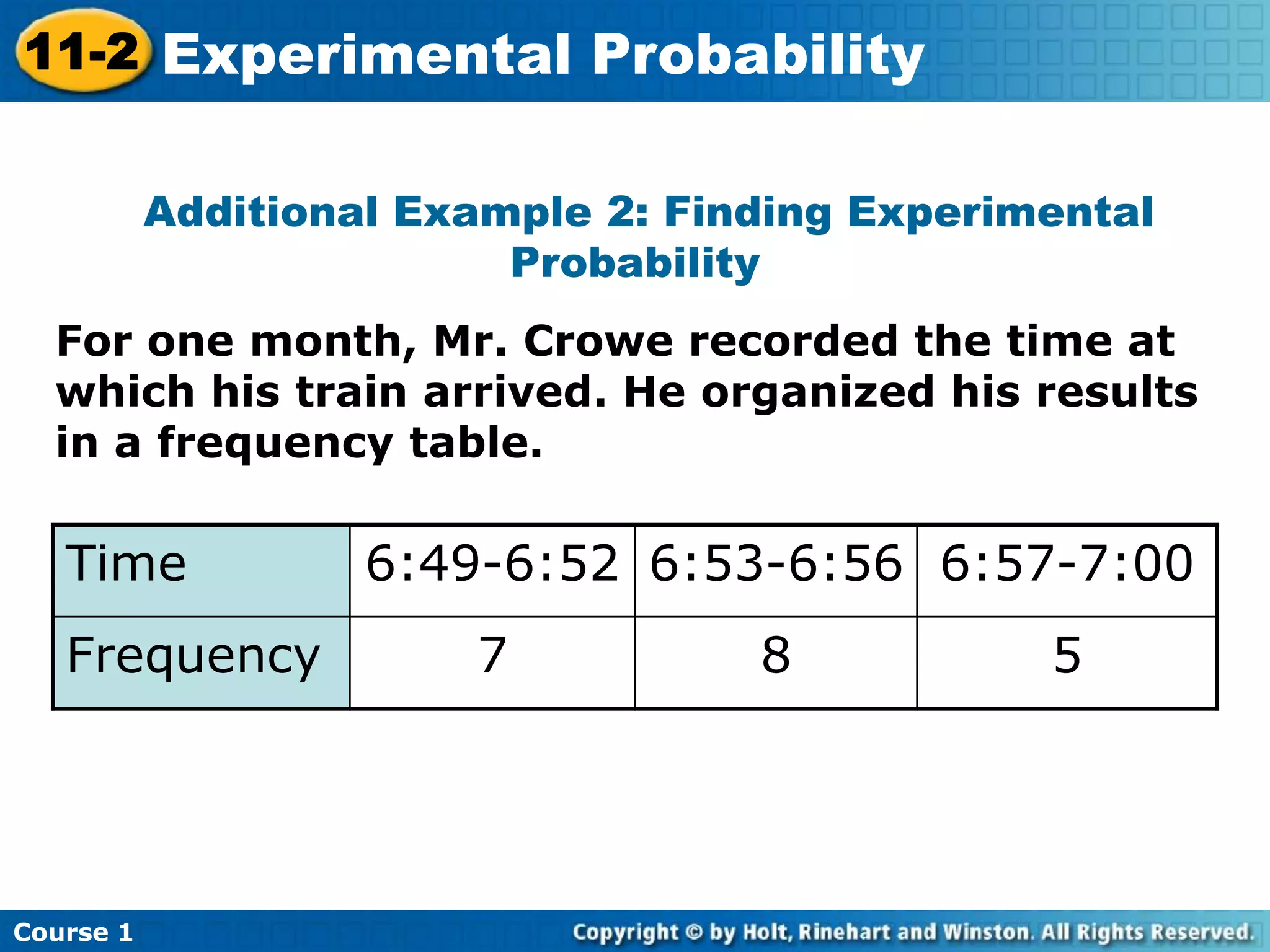
For one month, Mr. Crowe recorded the time at
which his train arrived. He organized his results
in a frequency table.
Time 6:49-6:52 6:53-6:56 6:57-7:00
Frequency 7 8 5
Course 1
11-2 Experimental Probability
Additional Example 2A Continued
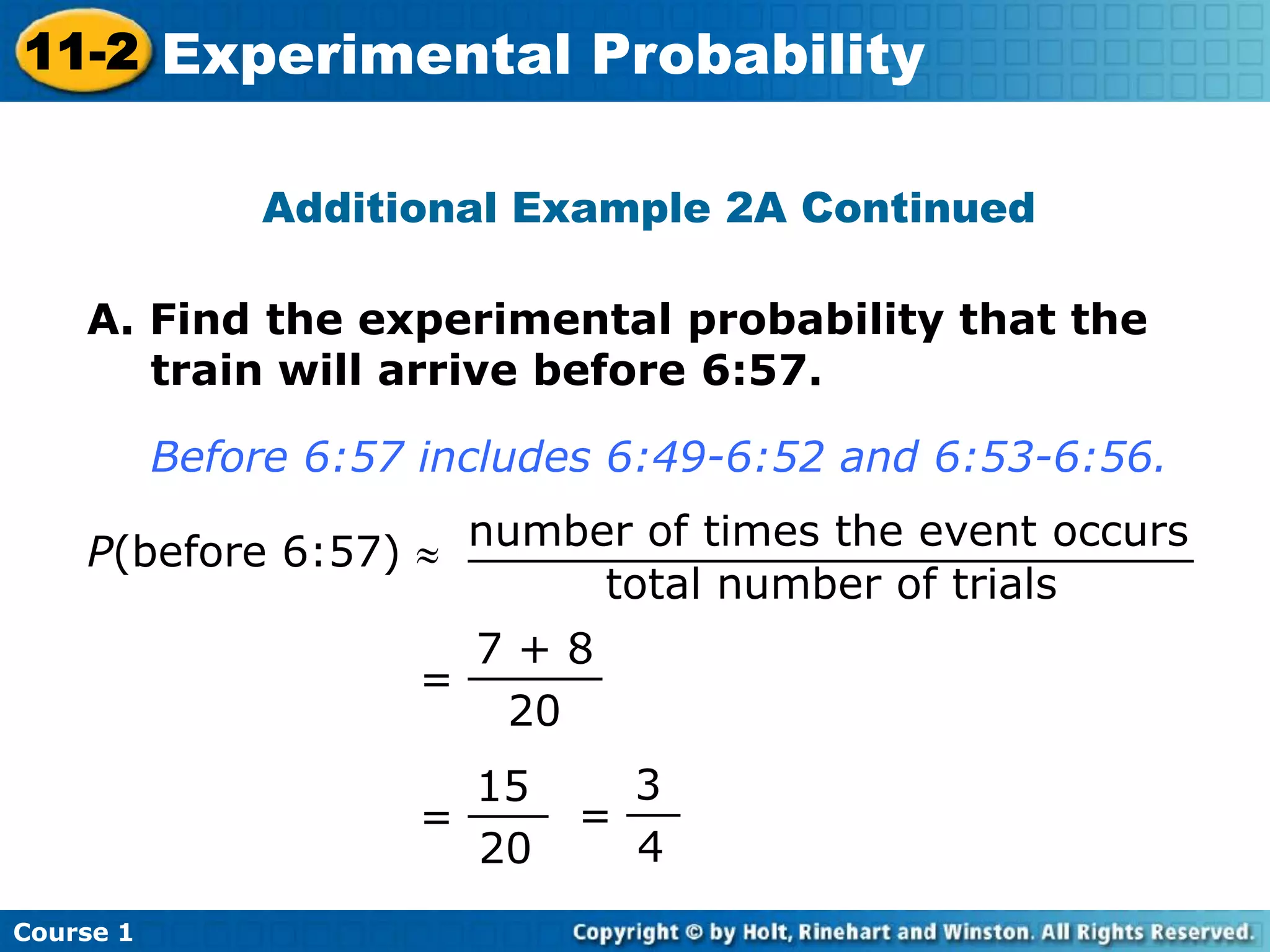
=
7 + 8
20
_____
=
15
20
___ =
3
4
__
Before 6:57 includes 6:49-6:52 and 6:53-6:56.
P(before 6:57) number of times the event occurs
total number of trials
___________________________
A. Find the experimental probability that the
train will arrive before 6:57.
Course 1
11-2 Experimental Probability
Additional Example 2B: Finding Experimental
Probability
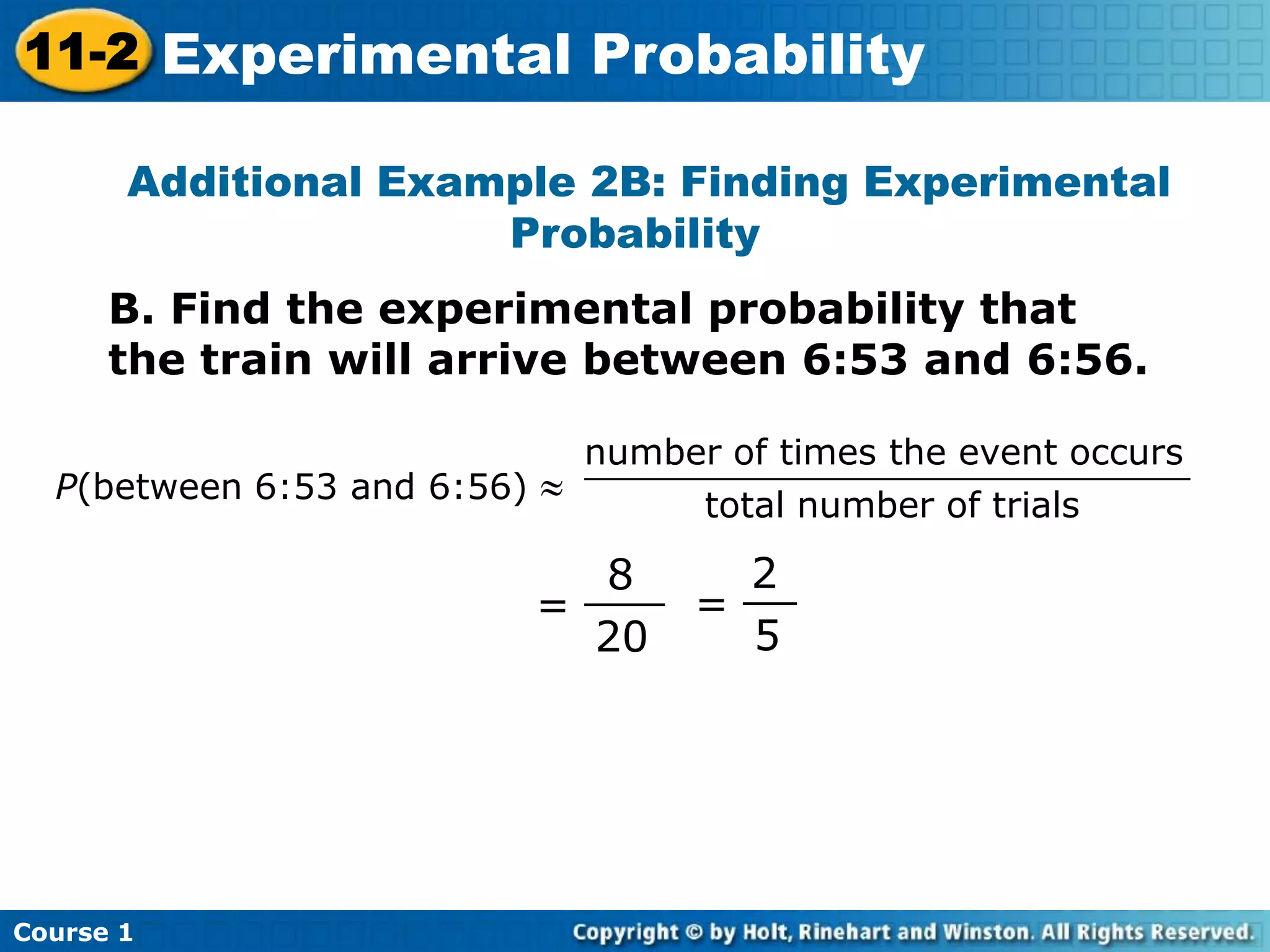
=
8
20
___ =
2
5
__
P(between 6:53 and 6:56)
number of times the event occurs
total number of trials
___________________________
B. Find the experimental probability that
the train will arrive between 6:53 and 6:56.
Course 1
11-2 Experimental Probability
Additional Example 3: Comparing
Experimental Probabilities
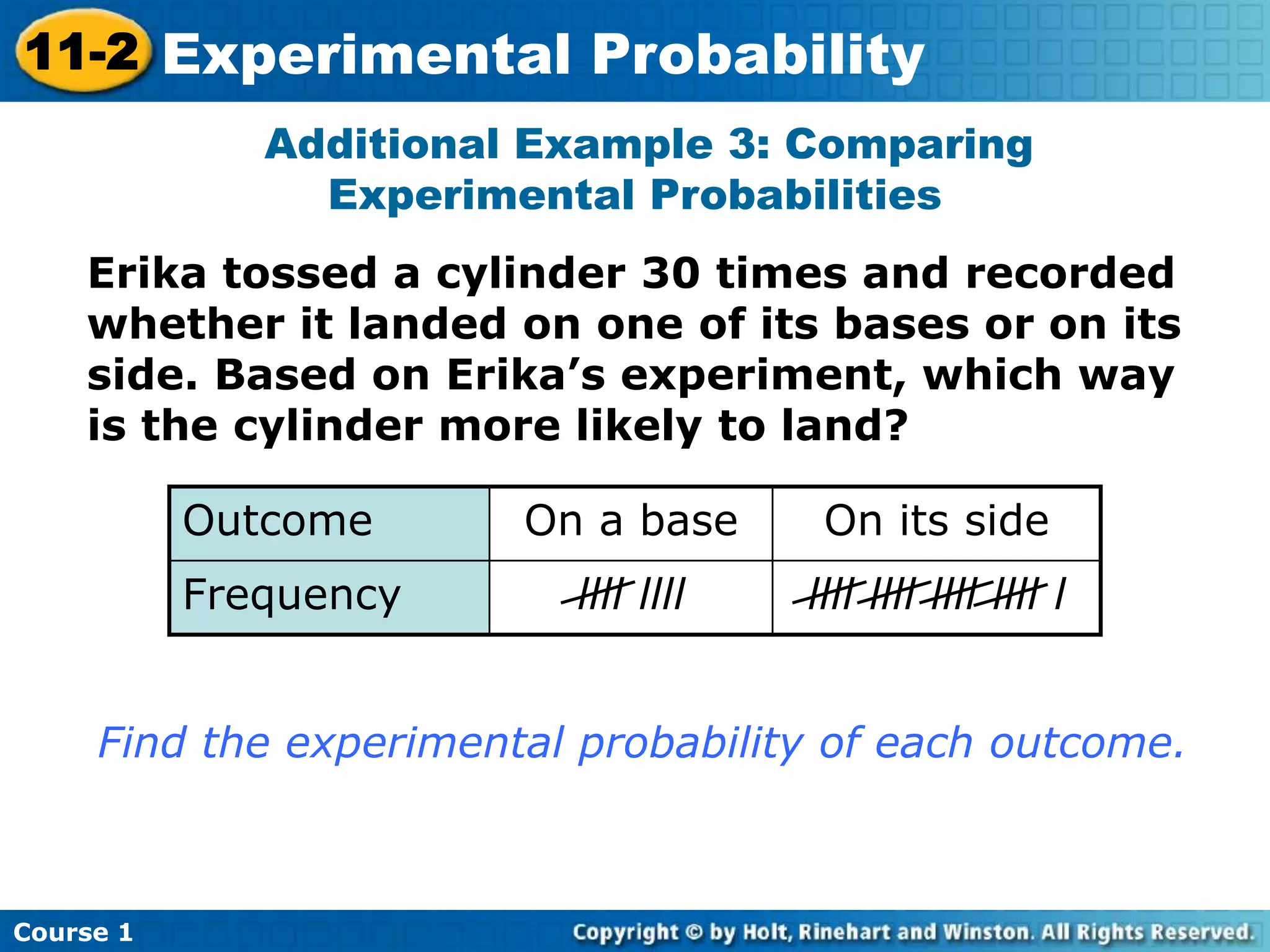
Erika tossed a cylinder 30 times and recorded
whether it landed on one of its bases or on its
side. Based on Erika’s experiment, which way
is the cylinder more likely to land?
Outcome On a base On its side
Frequency llll llll llll llll llll llll l
Find the experimental probability of each outcome.
Course 1
11-2 Experimental Probability
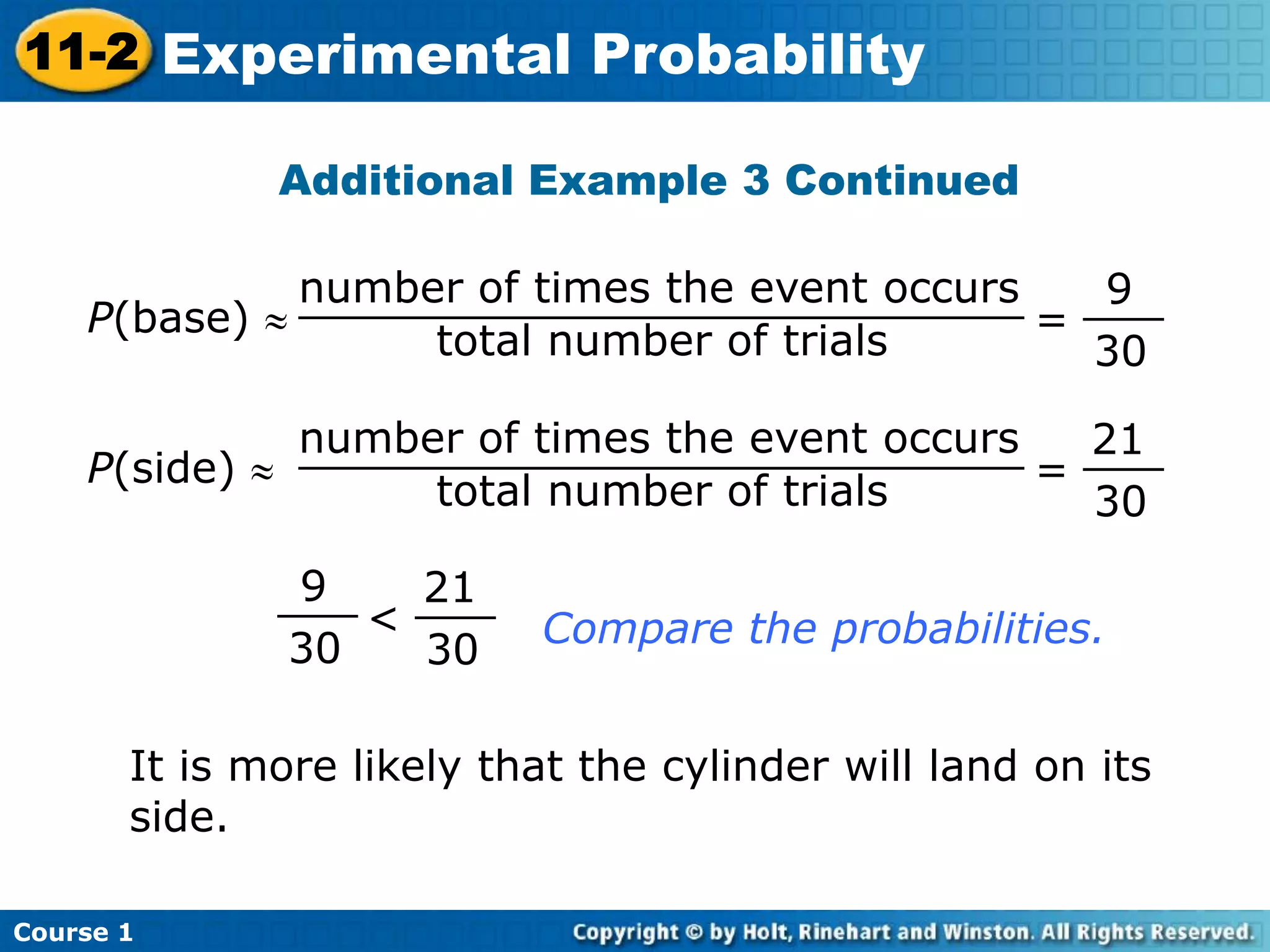
Additional Example 3 Continued
=
21
30
___P(side)
number of times the event occurs
total number of trials
___________________________
Compare the probabilities.
9
30
___
<
21
30
___
It is more likely that the cylinder will land on its
side.
=
9
30
___P(base)
number of times the event occurs
total number of trials
___________________________
Course 1
11-2 Experimental Probability
Try This: Example 3
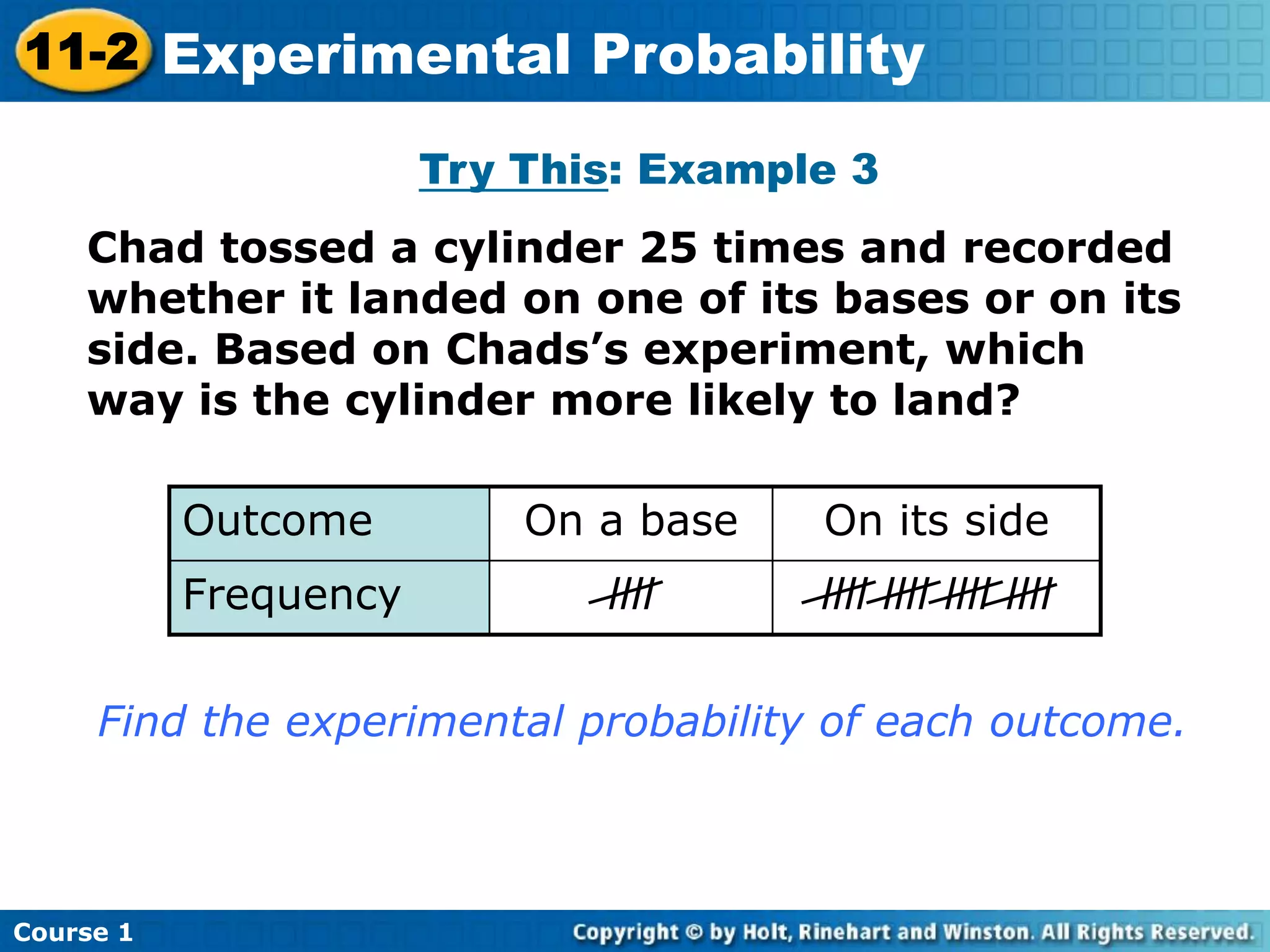
Chad tossed a cylinder 25 times and recorded
whether it landed on one of its bases or on its
side. Based on Chads’s experiment, which
way is the cylinder more likely to land?
Outcome On a base On its side
Frequency llll llll llll llll llll
Find the experimental probability of each outcome.
Course 1
11-2 Experimental Probability
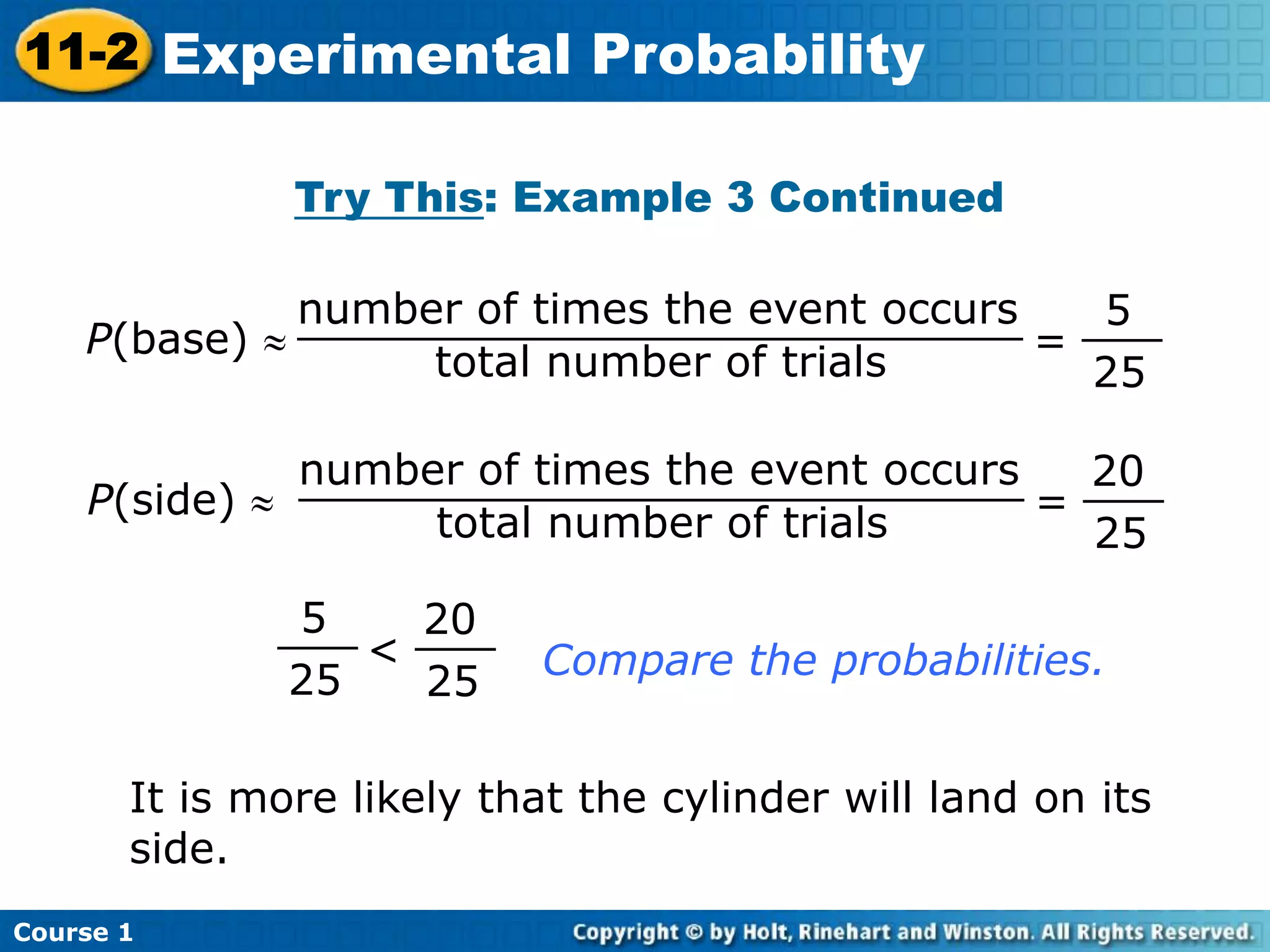
Try This: Example 3 Continued
=
20
25
___P(side)
number of times the event occurs
total number of trials
___________________________
Compare the probabilities.
5
25
___
<
20
25
___
It is more likely that the cylinder will land on its
side.
=
5
25
___P(base)
number of times the event occurs
total number of trials
___________________________
Course 1
11-2 Experimental Probability
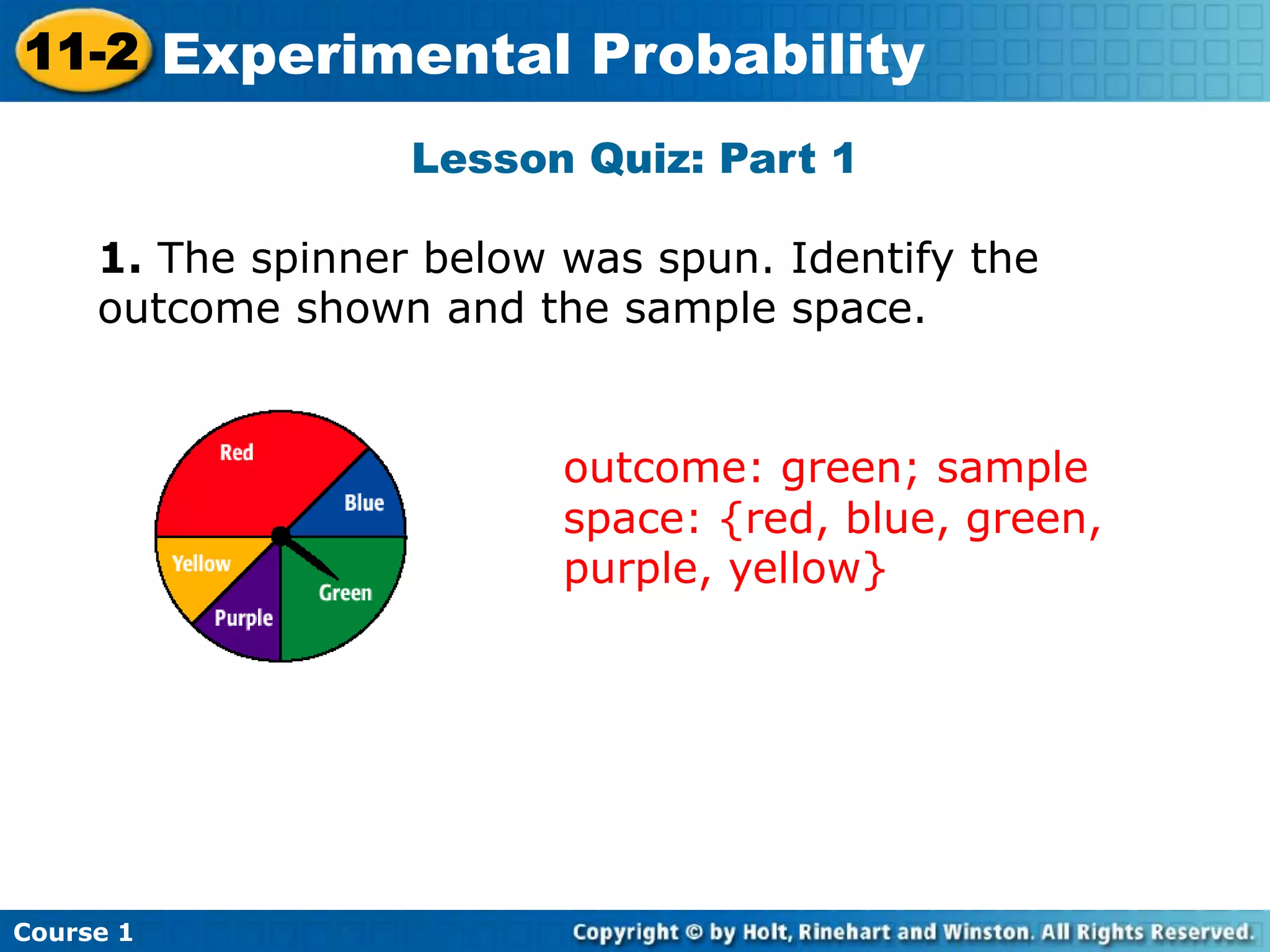
Lesson Quiz: Part 1
1. The spinner below was spun. Identify the
outcome shown and the sample space.
outcome: green; sample
space: {red, blue, green,
purple, yellow}
Insert Lesson Title Here
Course 1
11-2 Experimental Probability
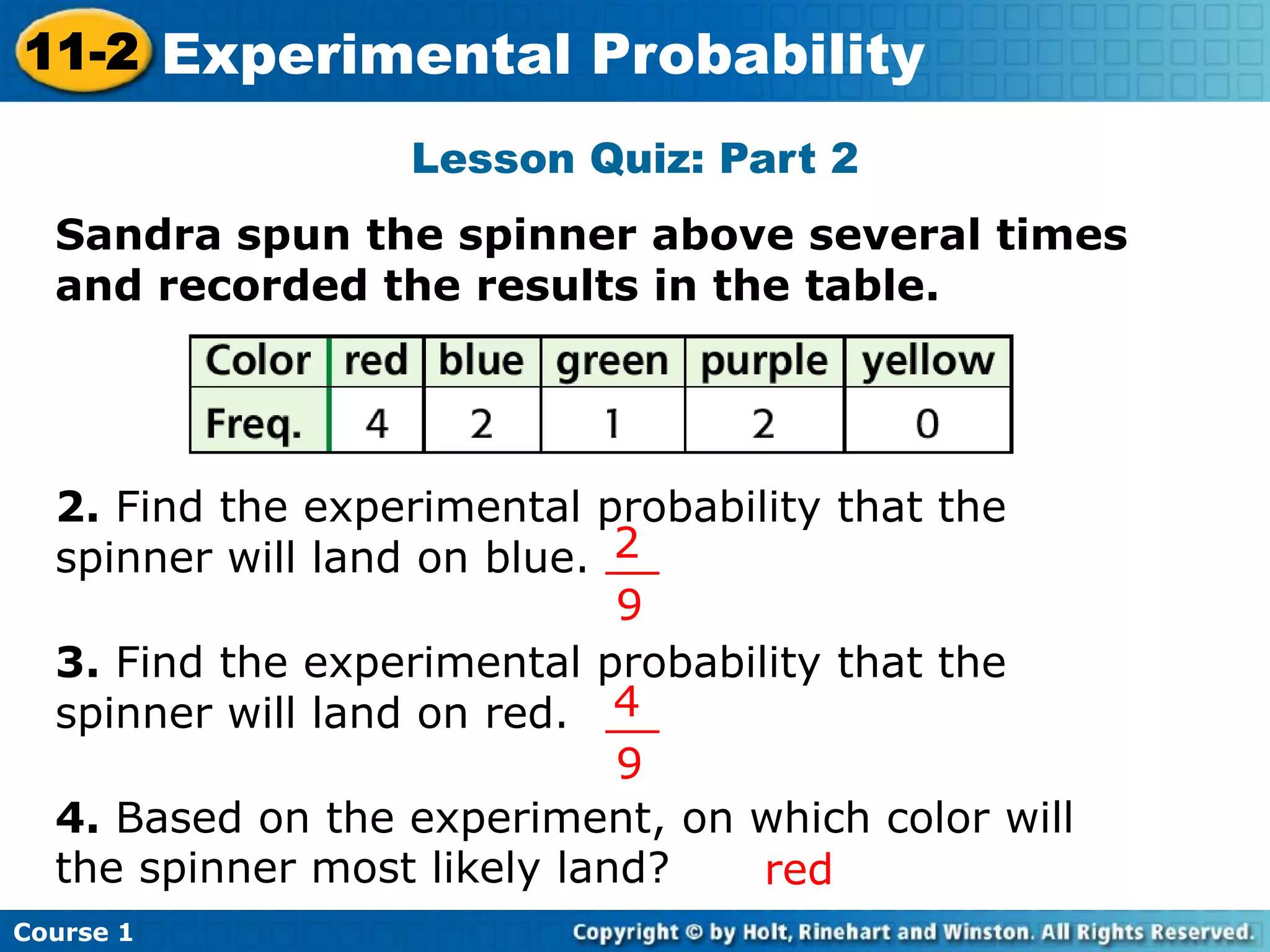
Lesson Quiz: Part 2
2. Find the experimental probability that the
spinner will land on blue.
3. Find the experimental probability that the
spinner will land on red.
4. Based on the experiment, on which color will
the spinner most likely land?
Insert Lesson Title Here
red
2
9
__
4
9
__
Sandra spun the spinner above several times
and recorded the results in the table.
Course 1
11-2 Experimental Probability

11.2 experimental probability

  • 1.
    Learn to findthe experimental probability of an event. Course 1 11-2 Experimental Probability
  • 2.
    Vocabulary experiment outcome sample space experimental probability InsertLesson Title Here Course 1 11-2 Experimental Probability
  • 3.
    An experiment isan activity involving chance that can have different results. Flipping a coin and rolling a number cube are examples of experiments. The different results that can occur are called outcomes of the experiment. If you are flipping a coin, heads is one possible outcome. The sample space of an experiment is the set of all possible outcomes. You can use {} to show sample spaces. When a coin is being flipped, {heads, tails} is the sample space. Course 1 11-2 Experimental Probability
  • 4.
    Additional Example 1A:Identifying Outcomes and Sample Spaces For each experiment, identify the outcome shown and the sample space. A. Spinning two spinners outcome shown: B1 sample space: {A1, A2, B1, B2} Course 1 11-2 Experimental Probability
  • 5.
    Additional Example 1B:Identifying Outcomes and Sample Spaces For each experiment, identify the outcome shown and the sample space. B. Spinning a spinner outcome shown: green sample space: {red, purple, green} Course 1 11-2 Experimental Probability
  • 6.
    Try This: Example1A For each experiment, identify the outcome shown and the sample space. A. Spinning two spinners outcome shown: C3 sample space: {C3, C4, D3, D4} C D 3 4 Course 1 11-2 Experimental Probability
  • 7.
    Try This: Example1B For each experiment, identify the outcome shown and the sample space. B. Spinning a spinner outcome shown: blue sample space: {blue, orange, green} Course 1 11-2 Experimental Probability
  • 8.
    Performing an experimentis one way to estimate the probability of an event. If an experiment is repeated many times, the experimental probability of an event is the ratio of the number of times the event occurs to the total number of times the experiment is performed. Course 1 11-2 Experimental Probability P (Basketball Throws) ~
  • 9.
    The probability ofan event can be written as P(event). P(blue) means “the probability that blue will be the outcome.” Writing Math Course 1 11-2 Experimental Probability
  • 10.
    Additional Example 2:Finding Experimental Probability For one month, Mr. Crowe recorded the time at which his train arrived. He organized his results in a frequency table. Time 6:49-6:52 6:53-6:56 6:57-7:00 Frequency 7 8 5 Course 1 11-2 Experimental Probability
  • 11.
    Additional Example 2AContinued = 7 + 8 20 _____ = 15 20 ___ = 3 4 __ Before 6:57 includes 6:49-6:52 and 6:53-6:56. P(before 6:57) number of times the event occurs total number of trials ___________________________ A. Find the experimental probability that the train will arrive before 6:57. Course 1 11-2 Experimental Probability
  • 12.
    Additional Example 2B:Finding Experimental Probability = 8 20 ___ = 2 5 __ P(between 6:53 and 6:56) number of times the event occurs total number of trials ___________________________ B. Find the experimental probability that the train will arrive between 6:53 and 6:56. Course 1 11-2 Experimental Probability
  • 13.
    Additional Example 3:Comparing Experimental Probabilities Erika tossed a cylinder 30 times and recorded whether it landed on one of its bases or on its side. Based on Erika’s experiment, which way is the cylinder more likely to land? Outcome On a base On its side Frequency llll llll llll llll llll llll l Find the experimental probability of each outcome. Course 1 11-2 Experimental Probability
  • 14.
    Additional Example 3Continued = 21 30 ___P(side) number of times the event occurs total number of trials ___________________________ Compare the probabilities. 9 30 ___ < 21 30 ___ It is more likely that the cylinder will land on its side. = 9 30 ___P(base) number of times the event occurs total number of trials ___________________________ Course 1 11-2 Experimental Probability
  • 15.
    Try This: Example3 Chad tossed a cylinder 25 times and recorded whether it landed on one of its bases or on its side. Based on Chads’s experiment, which way is the cylinder more likely to land? Outcome On a base On its side Frequency llll llll llll llll llll Find the experimental probability of each outcome. Course 1 11-2 Experimental Probability
  • 16.
    Try This: Example3 Continued = 20 25 ___P(side) number of times the event occurs total number of trials ___________________________ Compare the probabilities. 5 25 ___ < 20 25 ___ It is more likely that the cylinder will land on its side. = 5 25 ___P(base) number of times the event occurs total number of trials ___________________________ Course 1 11-2 Experimental Probability
  • 17.
    Lesson Quiz: Part1 1. The spinner below was spun. Identify the outcome shown and the sample space. outcome: green; sample space: {red, blue, green, purple, yellow} Insert Lesson Title Here Course 1 11-2 Experimental Probability
  • 18.
    Lesson Quiz: Part2 2. Find the experimental probability that the spinner will land on blue. 3. Find the experimental probability that the spinner will land on red. 4. Based on the experiment, on which color will the spinner most likely land? Insert Lesson Title Here red 2 9 __ 4 9 __ Sandra spun the spinner above several times and recorded the results in the table. Course 1 11-2 Experimental Probability