EXPERIMENTAL
PROBABILITY
Q4-Week 8 & 9
G4 MELC Q4
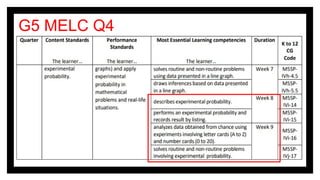
G5 MELC Q4
WARM-UP ACTIVITY
4
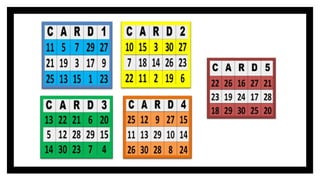
“MATH-HUHULA”
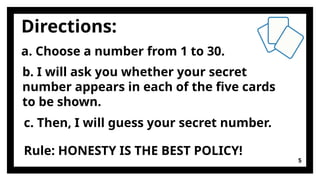
Directions:
5
a. Choose a number from 1 to 30.
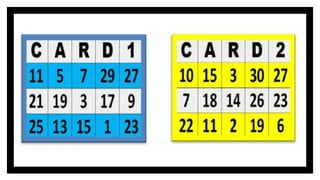
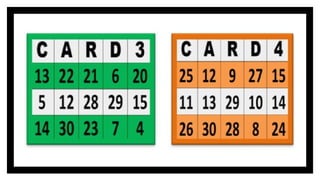
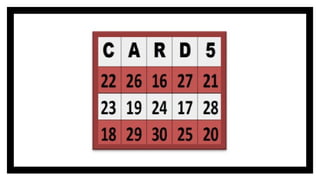
b. I will ask you whether your secret
number appears in each of the five cards
to be shown.
c. Then, I will guess your secret number.
Rule: HONESTY IS THE BEST POLICY!
WEEK 8
▪Describe experimental
probability.
▪Perform an experimental
probability and record
result by listing.
10
11
ACTIVITY 2: Watch and
LEARN!
12
Guide Questions:
1. What is the video all about?
___________________________________________________
2. What are the possible outcomes if a person
learns how to save money?
___________________________________________________
3. How sure are you that when you save money you
will achieve your goal?
___________________________________________________
WHAT IS
PROBABILITY?
13
14
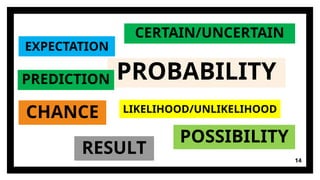
PROBABILITY
CHANCE
POSSIBILITY
CERTAIN/UNCERTAIN
RESULT
LIKELIHOOD/UNLIKELIHOOD
EXPECTATION
PREDICTION
15
• Probability is the mathematics of chance.
• It comes from the word probable which
means possible.
• It is a guide used to know how events are
likely to happen.
PROBABILITY
16
can be described as
• FRACTIONS
• DECIMALS
• PERCENTAGE
PROBABILITY
17
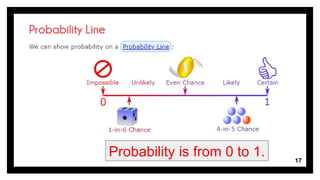
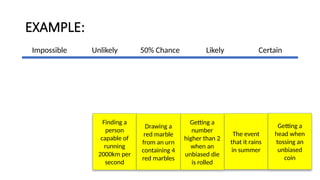
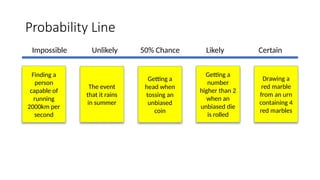
Probability is from 0 to 1.
EXAMPLE:
Impossible Unlikely 50% Chance Likely Certain
Finding a
person
capable of
running
2000km per
second
The event
that it rains
in summer
Getting a
head when
tossing an
unbiased
coin
Getting a
number
higher than 2
when an
unbiased die
is rolled
Drawing a
red marble
from an urn
containing 4
red marbles
Probability Line
Impossible Unlikely 50% Chance Likely Certain
Finding a
person
capable of
running
2000km per
second
The event
that it rains
in summer
Getting a
head when
tossing an
unbiased
coin
Getting a
number
higher than 2
when an
unbiased die
is rolled
Drawing a
red marble
from an urn
containing 4
red marbles
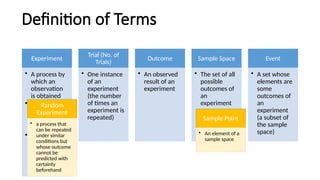
Definition of Terms
Experiment
• A process by
which an
observation
is obtained
• is an action
where the
result is
uncertain
• a repeatable
procedure
with a set of
possible
results.
Trial (No. of
Trials)
• One instance
of an
experiment
(the number
of times an
experiment is
repeated)
Outcome
• An observed
result of an
experiment
Sample Space
• The set of all
possible
outcomes of
an
experiment
Event
• A set whose
elements are
some
outcomes of
an
experiment
(a subset of
the sample
space)
Random
Experiment
• a process that
can be repeated
under similar
conditions but
whose outcome
cannot be
predicted with
certainty
beforehand
Sample Point
• An element of a
sample space
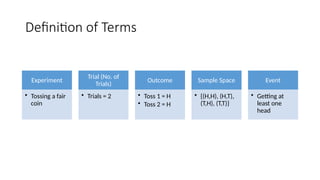
Definition of Terms
Experiment
• Tossing a fair
coin
Trial (No. of
Trials)
• Trials = 2
Outcome
• Toss 1 = H
• Toss 2 = H
Sample Space
• {(H,H), (H,T),
(T,H), (T,T)}
Event
• Getting at
least one
head
EXPERIMENTAL
PROBABILITY
22
 is found by repeating an experiment
and observing the outcomes.
23
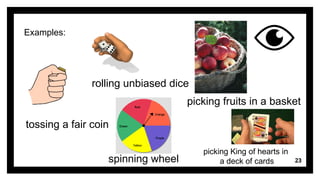
Examples:
tossing a fair coin
rolling unbiased dice
picking fruits in a basket
spinning wheel
picking King of hearts in
a deck of cards
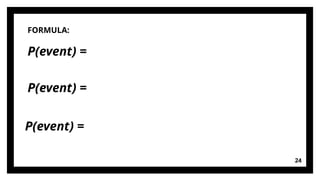
FORMULA:
24
P(event) =
P(event) =
P(event) =
EXAMPLES:
25
Given the experiments, list all the
possible outcomes on the sample
space column.
EXAMPLES:
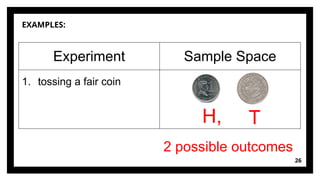
26
Experiment Sample Space
1. tossing a fair coin
H, T
2 possible outcomes
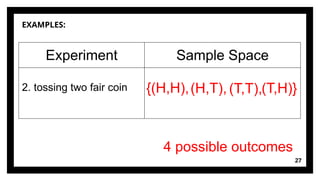
EXAMPLES:
27
Experiment Sample Space
2. tossing two fair coin {(H,H),(H,T), (T,T),(T,H)}
4 possible outcomes
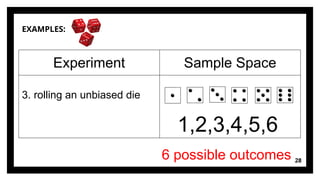
EXAMPLES:
28
Experiment Sample Space
3. rolling an unbiased die
1,2,3,4,5,6
6 possible outcomes
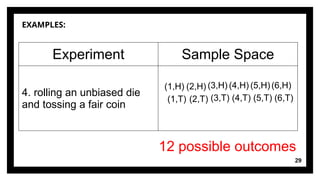
EXAMPLES:
29
Experiment Sample Space
4. rolling an unbiased die
and tossing a fair coin
(1,H) (2,H) (3,H) (4,H) (5,H)(6,H)
(1,T) (2,T) (3,T) (4,T) (5,T) (6,T)
12 possible outcomes
EXAMPLES:
30
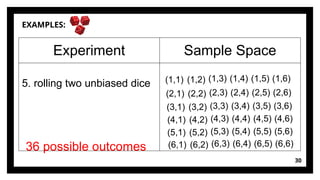
Experiment Sample Space
5. rolling two unbiased dice (1,1) (1,2) (1,3) (1,4) (1,5) (1,6)
(2,1) (2,2) (2,3) (2,4) (2,5) (2,6)
(3,1) (3,2) (3,3) (3,4) (3,5) (3,6)
(4,1) (4,2) (4,3) (4,4) (4,5) (4,6)
(5,1) (5,2) (5,3) (5,4) (5,5) (5,6)
(6,1) (6,2) (6,3) (6,4) (6,5) (6,6)
36 possible outcomes
P(event) =
FORMULA:
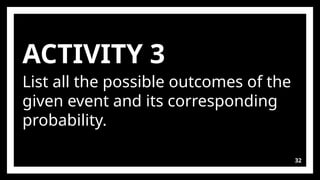
ACTIVITY 3
List all the possible outcomes of the
given event and its corresponding
probability.
32
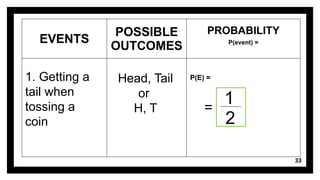
33
EVENTS
POSSIBLE
OUTCOMES
PROBABILITY
P(event) =
1. Getting a
tail when
tossing a
coin
Head, Tail
or
H, T
P(E) =
=
1
2
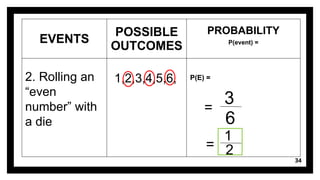
34
EVENTS
POSSIBLE
OUTCOMES
PROBABILITY
P(event) =
2. Rolling an
“even
number” with
a die
1,2,3,4,5,6, P(E) =
=
3
6
=
1
2
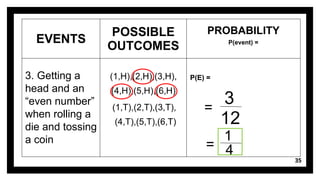
35
EVENTS
POSSIBLE
OUTCOMES
PROBABILITY
P(event) =
3. Getting a
head and an
“even number”
when rolling a
die and tossing
a coin
(1,H),(2,H),(3,H),
(4,H),(5,H),(6,H)
P(E) =
=
3
12
=
1
4
(1,T),(2,T),(3,T),
(4,T),(5,T),(6,T)
36
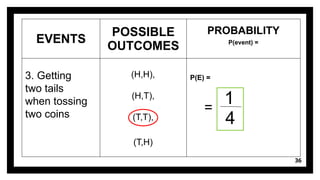
EVENTS
POSSIBLE
OUTCOMES
PROBABILITY
P(event) =
3. Getting
two tails
when tossing
two coins
(H,H),
(H,T),
(T,T),
(T,H)
P(E) =
=
1
4
37
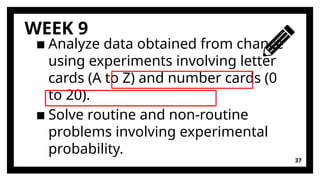
WEEK 9
▪ Analyze data obtained from chance
using experiments involving letter
cards (A to Z) and number cards (0
to 20).
▪ Solve routine and non-routine
problems involving experimental
probability.
38
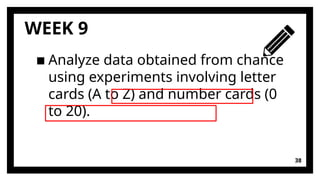
WEEK 9
▪ Analyze data obtained from chance
using experiments involving letter
cards (A to Z) and number cards (0
to 20).
39
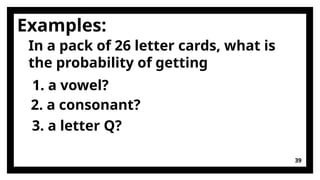
Examples:
1. a vowel?
In a pack of 26 letter cards, what is
the probability of getting
2. a consonant?
3. a letter Q?
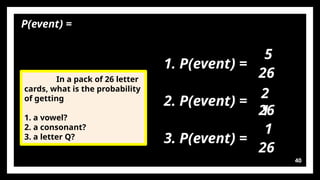
40
P(event) =
1. P(event) =
5
26
2. P(event) =
2
1
26
3. P(event) =
1
26
In a pack of 26 letter
cards, what is the probability
of getting
1. a vowel?
2. a consonant?
3. a letter Q?
41
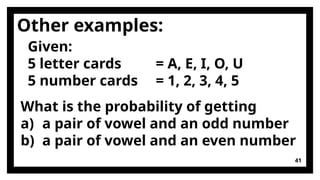
Other examples:
Given:
5 letter cards = A, E, I, O, U
5 number cards = 1, 2, 3, 4, 5
What is the probability of getting
a) a pair of vowel and an odd number
b) a pair of vowel and an even number
42
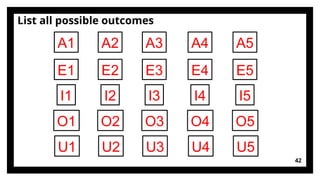
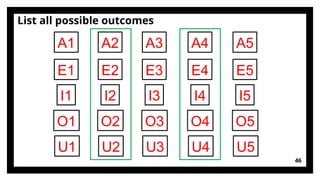
List all possible outcomes
A1
E1
I1
O1
U1
A2
E2
I2
O2
U2
A3
E3
I3
O3
U3
A4
E4
I4
O4
U4
A5
E5
I5
O5
U5
43
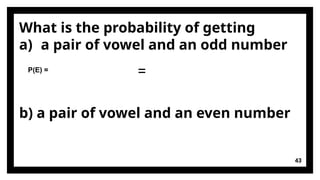
What is the probability of getting
a) a pair of vowel and an odd number
b) a pair of vowel and an even number
P(E) =
=
44
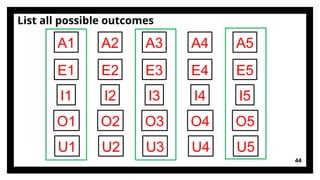
List all possible outcomes
A1
E1
I1
O1
U1
A2
E2
I2
O2
U2
A3
E3
I3
O3
U3
A4
E4
I4
O4
U4
A5
E5
I5
O5
U5
45
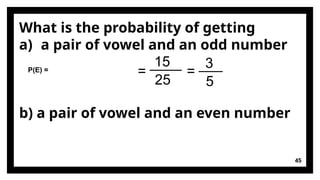
What is the probability of getting
a) a pair of vowel and an odd number
b) a pair of vowel and an even number
P(E) =
=
____
15
25
= ___
3
5
46
List all possible outcomes
A1
E1
I1
O1
U1
A2
E2
I2
O2
U2
A3
E3
I3
O3
U3
A4
E4
I4
O4
U4
A5
E5
I5
O5
U5
47
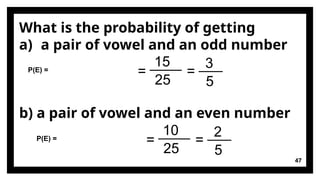
What is the probability of getting
a) a pair of vowel and an odd number
b) a pair of vowel and an even number
P(E) =
=
____
15
25
= ___
3
5
P(E) =
=
____
10
25
= ___
2
5
ACTIVITY:
MAGIC PENCIL!
What’s My Probability?
48
What’s my probability?
START
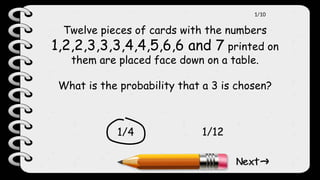
Twelve pieces of cards with the numbers
1,2,2,3,3,3,4,4,5,6,6 and 7 printed on
them are placed face down on a table.
What is the probability that a 3 is chosen?
1/4 1/12
1/10
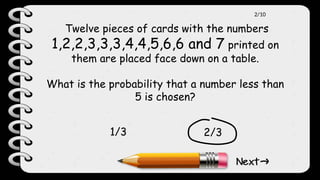
Twelve pieces of cards with the numbers
1,2,2,3,3,3,4,4,5,6,6 and 7 printed on
them are placed face down on a table.
What is the probability that a number less than
5 is chosen?
2/3
1/3
2/10
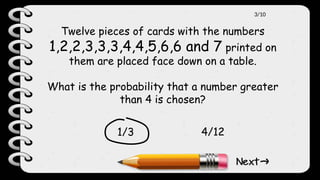
Twelve pieces of cards with the numbers
1,2,2,3,3,3,4,4,5,6,6 and 7 printed on
them are placed face down on a table.
What is the probability that a number greater
than 4 is chosen?
1/3 4/12
3/10
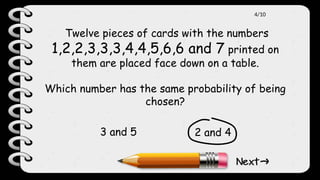
Twelve pieces of cards with the numbers
1,2,2,3,3,3,4,4,5,6,6 and 7 printed on
them are placed face down on a table.
Which number has the same probability of being
chosen?
2 and 4
3 and 5
4/10
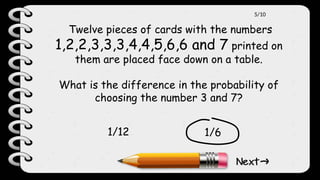
Twelve pieces of cards with the numbers
1,2,2,3,3,3,4,4,5,6,6 and 7 printed on
them are placed face down on a table.
What is the difference in the probability of
choosing the number 3 and 7?
1/6
1/12
5/10
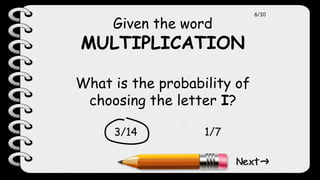
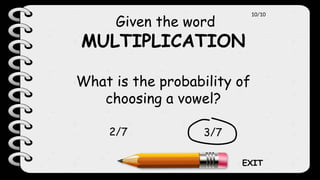
Given the word
MULTIPLICATION
What is the probability of
choosing the letter I?
3/14 1/7
6/10
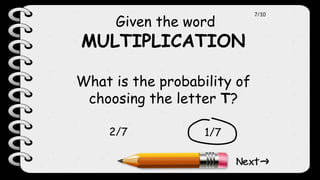
Given the word
MULTIPLICATION
What is the probability of
choosing the letter T?
1/7
2/7
7/10
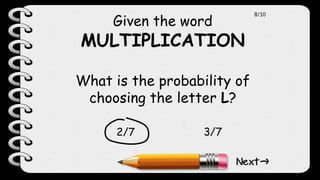
Given the word
MULTIPLICATION
What is the probability of
choosing the letter L?
2/7 3/7
8/10
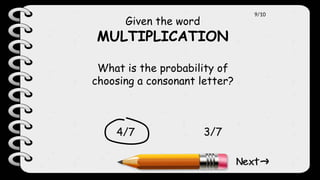
Given the word
MULTIPLICATION
What is the probability of
choosing a consonant letter?
4/7 3/7
9/10
Given the word
MULTIPLICATION
What is the probability of
choosing a vowel?
3/7
2/7
10/10
EXIT
60
WEEK 9
▪ Solve routine and non-routine
problems involving experimental
probability.
61
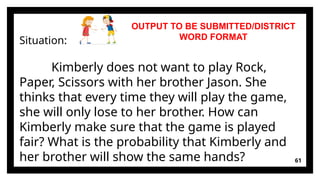
Situation:
Kimberly does not want to play Rock,
Paper, Scissors with her brother Jason. She
thinks that every time they will play the game,
she will only lose to her brother. How can
Kimberly make sure that the game is played
fair? What is the probability that Kimberly and
her brother will show the same hands?
OUTPUT TO BE SUBMITTED/DISTRICT
WORD FORMAT
Suggested activity for learners during face-to-face.
JACK EN POY w/ a TWIST
DIRECTIONS:
1. Give each LEARNER a one peso coin/candy.
2. Ask the LEARNERS to find a pair.
3. They will play JACK EN POY. Whoever lose will
hand his/her candy/coin to the winner and sit down.
4. The winner will then find another pair. Same
process will continue until the last winner.
63
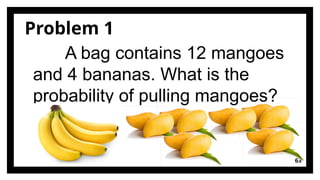
Problem 1
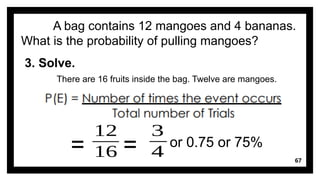
A bag contains 12 mangoes
and 4 bananas. What is the
probability of pulling mangoes?
64
To solve problems involving experimental
probability, a 4-Step Plan is used:
- Understand
- Plan
- Solve
- Check
65
A bag contains 12 mangoes and 4 bananas.
What is the probability of pulling mangoes?
1. Understand.
a. Know what is asked
The probability of pulling mangoes
b. Know the given fact
There are 16 fruits in the bag
66
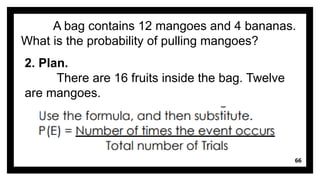
A bag contains 12 mangoes and 4 bananas.
What is the probability of pulling mangoes?
2. Plan.
There are 16 fruits inside the bag. Twelve
are mangoes.
67
A bag contains 12 mangoes and 4 bananas.
What is the probability of pulling mangoes?
3. Solve.
There are 16 fruits inside the bag. Twelve are mangoes.
=
12
16 =
3
4
or 0.75 or 75%
68
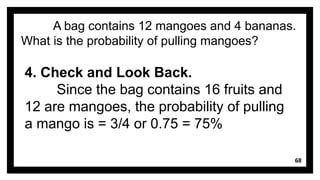
A bag contains 12 mangoes and 4 bananas.
What is the probability of pulling mangoes?
4. Check and Look Back.
Since the bag contains 16 fruits and
12 are mangoes, the probability of pulling
a mango is = 3/4 or 0.75 = 75%
69
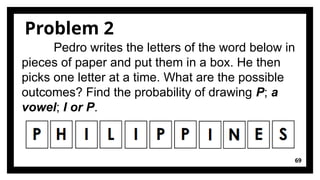
Problem 2
Pedro writes the letters of the word below in
pieces of paper and put them in a box. He then
picks one letter at a time. What are the possible
outcomes? Find the probability of drawing P; a
vowel; I or P.
Solution:
70
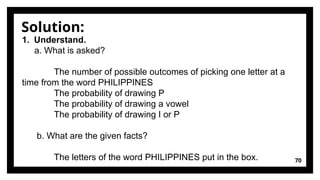
1. Understand.
a. What is asked?
The number of possible outcomes of picking one letter at a
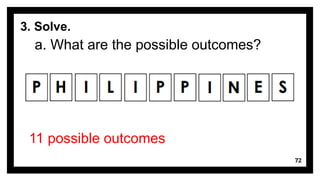
time from the word PHILIPPINES
The probability of drawing P
The probability of drawing a vowel
The probability of drawing I or P
b. What are the given facts?
The letters of the word PHILIPPINES put in the box.
71
2. Plan.
What strategy can we use to solve the problem?
We can do an experiment of drawing a letter from the box.
P(E) =
72
3. Solve.
a. What are the possible outcomes?
11 possible outcomes
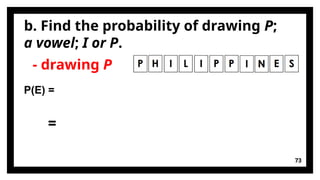
b. Find the probability of drawing P;
a vowel; I or P.
73
- drawing P
P(E) =
=
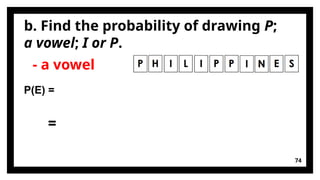
b. Find the probability of drawing P;
a vowel; I or P.
74
- a vowel
P(E) =
=
b. Find the probability of drawing P;
a vowel; I or P.
75
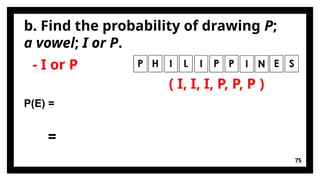
- I or P
P(E) =
=
( I, I, I, P, P, P )
76
4. Check.
By conducting the experiment of drawing
a letter from a box, we can actually check
if our answers are correct.
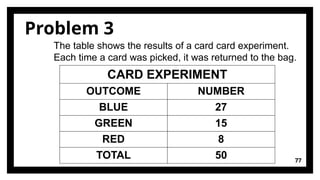
77
Problem 3
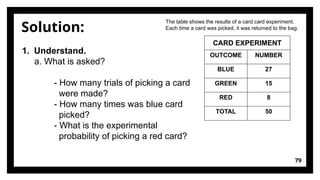
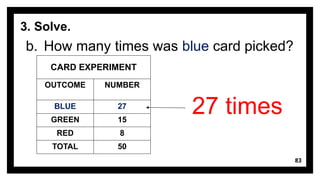
The table shows the results of a card card experiment.
Each time a card was picked, it was returned to the bag.
CARD EXPERIMENT
OUTCOME NUMBER
BLUE 27
GREEN 15
RED 8
TOTAL 50
78
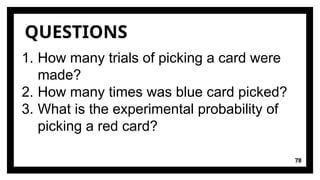
QUESTIONS
1. How many trials of picking a card were
made?
2. How many times was blue card picked?
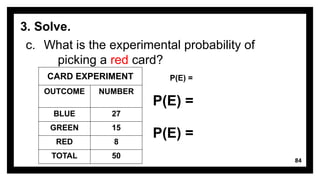
3. What is the experimental probability of
picking a red card?
Solution:
79
1. Understand.
a. What is asked?
- How many trials of picking a card
were made?
- How many times was blue card
picked?
- What is the experimental
probability of picking a red card?
The table shows the results of a card card experiment.
Each time a card was picked, it was returned to the bag.
CARD EXPERIMENT
OUTCOME NUMBER
BLUE 27
GREEN 15
RED 8
TOTAL 50
Solution:
80
1. Understand.
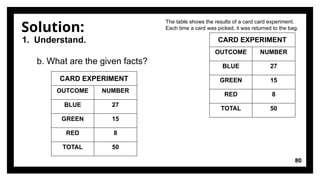
b. What are the given facts?
The table shows the results of a card card experiment.
Each time a card was picked, it was returned to the bag.
CARD EXPERIMENT
OUTCOME NUMBER
BLUE 27
GREEN 15
RED 8
TOTAL 50
CARD EXPERIMENT
OUTCOME NUMBER
BLUE 27
GREEN 15
RED 8
TOTAL 50
81
2. Plan.
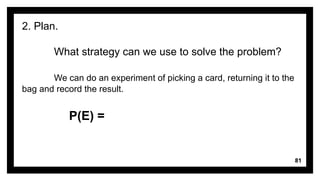
What strategy can we use to solve the problem?
We can do an experiment of picking a card, returning it to the
bag and record the result.
P(E) =
82
3. Solve.
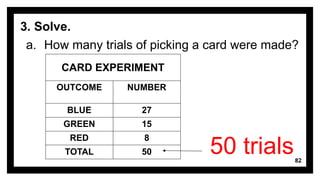
a. How many trials of picking a card were made?
CARD EXPERIMENT
OUTCOME NUMBER
BLUE 27
GREEN 15
RED 8
TOTAL 50 50 trials
83
3. Solve.
b. How many times was blue card picked?
CARD EXPERIMENT
OUTCOME NUMBER
BLUE 27
GREEN 15
RED 8
TOTAL 50
27 times
84
3. Solve.
c. What is the experimental probability of
picking a red card?
CARD EXPERIMENT
OUTCOME NUMBER
BLUE 27
GREEN 15
RED 8
TOTAL 50
P(E) =
P(E) =
P(E) =
85
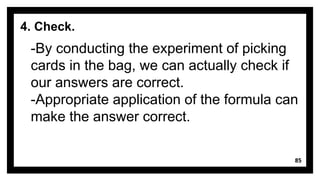
4. Check.
-By conducting the experiment of picking
cards in the bag, we can actually check if
our answers are correct.
-Appropriate application of the formula can
make the answer correct.
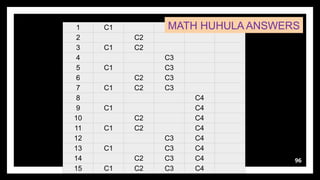
94
95
THANK YOU FOR LISTENING!!!
96
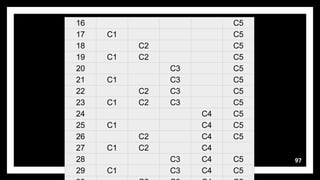
1 C1
2 C2
3 C1 C2
4 C3
5 C1 C3
6 C2 C3
7 C1 C2 C3
8 C4
9 C1 C4
10 C2 C4
11 C1 C2 C4
12 C3 C4
13 C1 C3 C4
14 C2 C3 C4
15 C1 C2 C3 C4
MATH HUHULA ANSWERS
97
16 C5
17 C1 C5
18 C2 C5
19 C1 C2 C5
20 C3 C5
21 C1 C3 C5
22 C2 C3 C5
23 C1 C2 C3 C5
24 C4 C5
25 C1 C4 C5
26 C2 C4 C5
27 C1 C2 C4
28 C3 C4 C5
29 C1 C3 C4 C5
98
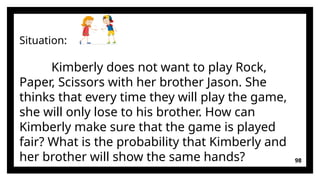
Situation:
Kimberly does not want to play Rock,
Paper, Scissors with her brother Jason. She
thinks that every time they will play the game,
she will only lose to his brother. How can
Kimberly make sure that the game is played
fair? What is the probability that Kimberly and
her brother will show the same hands?
99
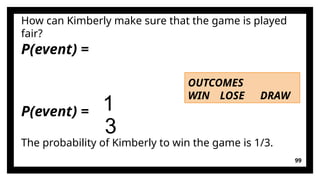
P(event) =
How can Kimberly make sure that the game is played
fair?
OUTCOMES
WIN LOSE DRAW
P(event) = 1
3
The probability of Kimberly to win the game is 1/3.
100
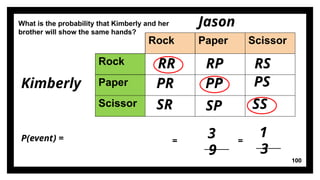
Rock Paper Scissor
Rock
Paper
Scissor
Jason
Kimberly
RR RP RS
PR
SR
PP
SP
PS
SS
P(event) = =
What is the probability that Kimberly and her
brother will show the same hands?
3
9
=
1
3

G8_Math_Q4-_Week_9-_Experimental_and_Theoretical_Probability.pptx

  • 1.
  • 2.
  • 3.
  • 4.
  • 5.
    Directions: 5 a. Choose anumber from 1 to 30. b. I will ask you whether your secret number appears in each of the five cards to be shown. c. Then, I will guess your secret number. Rule: HONESTY IS THE BEST POLICY!
  • 10.
    WEEK 8 ▪Describe experimental probability. ▪Performan experimental probability and record result by listing. 10
  • 11.
  • 12.
    12 Guide Questions: 1. Whatis the video all about? ___________________________________________________ 2. What are the possible outcomes if a person learns how to save money? ___________________________________________________ 3. How sure are you that when you save money you will achieve your goal? ___________________________________________________
  • 13.
  • 14.
  • 15.
    15 • Probability isthe mathematics of chance. • It comes from the word probable which means possible. • It is a guide used to know how events are likely to happen. PROBABILITY
  • 16.
    16 can be describedas • FRACTIONS • DECIMALS • PERCENTAGE PROBABILITY
  • 17.
  • 18.
    EXAMPLE: Impossible Unlikely 50%Chance Likely Certain Finding a person capable of running 2000km per second The event that it rains in summer Getting a head when tossing an unbiased coin Getting a number higher than 2 when an unbiased die is rolled Drawing a red marble from an urn containing 4 red marbles
  • 19.
    Probability Line Impossible Unlikely50% Chance Likely Certain Finding a person capable of running 2000km per second The event that it rains in summer Getting a head when tossing an unbiased coin Getting a number higher than 2 when an unbiased die is rolled Drawing a red marble from an urn containing 4 red marbles
  • 20.
    Definition of Terms Experiment •A process by which an observation is obtained • is an action where the result is uncertain • a repeatable procedure with a set of possible results. Trial (No. of Trials) • One instance of an experiment (the number of times an experiment is repeated) Outcome • An observed result of an experiment Sample Space • The set of all possible outcomes of an experiment Event • A set whose elements are some outcomes of an experiment (a subset of the sample space) Random Experiment • a process that can be repeated under similar conditions but whose outcome cannot be predicted with certainty beforehand Sample Point • An element of a sample space

  • 21.
    Definition of Terms Experiment •Tossing a fair coin Trial (No. of Trials) • Trials = 2 Outcome • Toss 1 = H • Toss 2 = H Sample Space • {(H,H), (H,T), (T,H), (T,T)} Event • Getting at least one head
  • 22.
    EXPERIMENTAL PROBABILITY 22  is foundby repeating an experiment and observing the outcomes.
  • 23.
    23 Examples: tossing a faircoin rolling unbiased dice picking fruits in a basket spinning wheel picking King of hearts in a deck of cards
  • 24.
  • 25.
    EXAMPLES: 25 Given the experiments,list all the possible outcomes on the sample space column.
  • 26.
    EXAMPLES: 26 Experiment Sample Space 1.tossing a fair coin H, T 2 possible outcomes
  • 27.
    EXAMPLES: 27 Experiment Sample Space 2.tossing two fair coin {(H,H),(H,T), (T,T),(T,H)} 4 possible outcomes
  • 28.
    EXAMPLES: 28 Experiment Sample Space 3.rolling an unbiased die 1,2,3,4,5,6 6 possible outcomes
  • 29.
    EXAMPLES: 29 Experiment Sample Space 4.rolling an unbiased die and tossing a fair coin (1,H) (2,H) (3,H) (4,H) (5,H)(6,H) (1,T) (2,T) (3,T) (4,T) (5,T) (6,T) 12 possible outcomes
  • 30.
    EXAMPLES: 30 Experiment Sample Space 5.rolling two unbiased dice (1,1) (1,2) (1,3) (1,4) (1,5) (1,6) (2,1) (2,2) (2,3) (2,4) (2,5) (2,6) (3,1) (3,2) (3,3) (3,4) (3,5) (3,6) (4,1) (4,2) (4,3) (4,4) (4,5) (4,6) (5,1) (5,2) (5,3) (5,4) (5,5) (5,6) (6,1) (6,2) (6,3) (6,4) (6,5) (6,6) 36 possible outcomes
  • 31.
  • 32.
    ACTIVITY 3 List allthe possible outcomes of the given event and its corresponding probability. 32
  • 33.
    33 EVENTS POSSIBLE OUTCOMES PROBABILITY P(event) = 1. Gettinga tail when tossing a coin Head, Tail or H, T P(E) = = 1 2
  • 34.
    34 EVENTS POSSIBLE OUTCOMES PROBABILITY P(event) = 2. Rollingan “even number” with a die 1,2,3,4,5,6, P(E) = = 3 6 = 1 2
  • 35.
    35 EVENTS POSSIBLE OUTCOMES PROBABILITY P(event) = 3. Gettinga head and an “even number” when rolling a die and tossing a coin (1,H),(2,H),(3,H), (4,H),(5,H),(6,H) P(E) = = 3 12 = 1 4 (1,T),(2,T),(3,T), (4,T),(5,T),(6,T)
  • 36.
    36 EVENTS POSSIBLE OUTCOMES PROBABILITY P(event) = 3. Getting twotails when tossing two coins (H,H), (H,T), (T,T), (T,H) P(E) = = 1 4
  • 37.
    37 WEEK 9 ▪ Analyzedata obtained from chance using experiments involving letter cards (A to Z) and number cards (0 to 20). ▪ Solve routine and non-routine problems involving experimental probability.
  • 38.
    38 WEEK 9 ▪ Analyzedata obtained from chance using experiments involving letter cards (A to Z) and number cards (0 to 20).
  • 39.
    39 Examples: 1. a vowel? Ina pack of 26 letter cards, what is the probability of getting 2. a consonant? 3. a letter Q?
  • 40.
    40 P(event) = 1. P(event)= 5 26 2. P(event) = 2 1 26 3. P(event) = 1 26 In a pack of 26 letter cards, what is the probability of getting 1. a vowel? 2. a consonant? 3. a letter Q?
  • 41.
    41 Other examples: Given: 5 lettercards = A, E, I, O, U 5 number cards = 1, 2, 3, 4, 5 What is the probability of getting a) a pair of vowel and an odd number b) a pair of vowel and an even number
  • 42.
    42 List all possibleoutcomes A1 E1 I1 O1 U1 A2 E2 I2 O2 U2 A3 E3 I3 O3 U3 A4 E4 I4 O4 U4 A5 E5 I5 O5 U5
  • 43.
    43 What is theprobability of getting a) a pair of vowel and an odd number b) a pair of vowel and an even number P(E) = =
  • 44.
    44 List all possibleoutcomes A1 E1 I1 O1 U1 A2 E2 I2 O2 U2 A3 E3 I3 O3 U3 A4 E4 I4 O4 U4 A5 E5 I5 O5 U5
  • 45.
    45 What is theprobability of getting a) a pair of vowel and an odd number b) a pair of vowel and an even number P(E) = = ____ 15 25 = ___ 3 5
  • 46.
    46 List all possibleoutcomes A1 E1 I1 O1 U1 A2 E2 I2 O2 U2 A3 E3 I3 O3 U3 A4 E4 I4 O4 U4 A5 E5 I5 O5 U5
  • 47.
    47 What is theprobability of getting a) a pair of vowel and an odd number b) a pair of vowel and an even number P(E) = = ____ 15 25 = ___ 3 5 P(E) = = ____ 10 25 = ___ 2 5
  • 48.
  • 49.
  • 50.
    Twelve pieces ofcards with the numbers 1,2,2,3,3,3,4,4,5,6,6 and 7 printed on them are placed face down on a table. What is the probability that a 3 is chosen? 1/4 1/12 1/10
  • 51.
    Twelve pieces ofcards with the numbers 1,2,2,3,3,3,4,4,5,6,6 and 7 printed on them are placed face down on a table. What is the probability that a number less than 5 is chosen? 2/3 1/3 2/10
  • 52.
    Twelve pieces ofcards with the numbers 1,2,2,3,3,3,4,4,5,6,6 and 7 printed on them are placed face down on a table. What is the probability that a number greater than 4 is chosen? 1/3 4/12 3/10
  • 53.
    Twelve pieces ofcards with the numbers 1,2,2,3,3,3,4,4,5,6,6 and 7 printed on them are placed face down on a table. Which number has the same probability of being chosen? 2 and 4 3 and 5 4/10
  • 54.
    Twelve pieces ofcards with the numbers 1,2,2,3,3,3,4,4,5,6,6 and 7 printed on them are placed face down on a table. What is the difference in the probability of choosing the number 3 and 7? 1/6 1/12 5/10
  • 55.
    Given the word MULTIPLICATION Whatis the probability of choosing the letter I? 3/14 1/7 6/10
  • 56.
    Given the word MULTIPLICATION Whatis the probability of choosing the letter T? 1/7 2/7 7/10
  • 57.
    Given the word MULTIPLICATION Whatis the probability of choosing the letter L? 2/7 3/7 8/10
  • 58.
    Given the word MULTIPLICATION Whatis the probability of choosing a consonant letter? 4/7 3/7 9/10
  • 59.
    Given the word MULTIPLICATION Whatis the probability of choosing a vowel? 3/7 2/7 10/10 EXIT
  • 60.
    60 WEEK 9 ▪ Solveroutine and non-routine problems involving experimental probability.
  • 61.
    61 Situation: Kimberly does notwant to play Rock, Paper, Scissors with her brother Jason. She thinks that every time they will play the game, she will only lose to her brother. How can Kimberly make sure that the game is played fair? What is the probability that Kimberly and her brother will show the same hands? OUTPUT TO BE SUBMITTED/DISTRICT WORD FORMAT
  • 62.
    Suggested activity forlearners during face-to-face. JACK EN POY w/ a TWIST DIRECTIONS: 1. Give each LEARNER a one peso coin/candy. 2. Ask the LEARNERS to find a pair. 3. They will play JACK EN POY. Whoever lose will hand his/her candy/coin to the winner and sit down. 4. The winner will then find another pair. Same process will continue until the last winner.
  • 63.
    63 Problem 1 A bagcontains 12 mangoes and 4 bananas. What is the probability of pulling mangoes?
  • 64.
    64 To solve problemsinvolving experimental probability, a 4-Step Plan is used: - Understand - Plan - Solve - Check
  • 65.
    65 A bag contains12 mangoes and 4 bananas. What is the probability of pulling mangoes? 1. Understand. a. Know what is asked The probability of pulling mangoes b. Know the given fact There are 16 fruits in the bag
  • 66.
    66 A bag contains12 mangoes and 4 bananas. What is the probability of pulling mangoes? 2. Plan. There are 16 fruits inside the bag. Twelve are mangoes.
  • 67.
    67 A bag contains12 mangoes and 4 bananas. What is the probability of pulling mangoes? 3. Solve. There are 16 fruits inside the bag. Twelve are mangoes. = 12 16 = 3 4 or 0.75 or 75%
  • 68.
    68 A bag contains12 mangoes and 4 bananas. What is the probability of pulling mangoes? 4. Check and Look Back. Since the bag contains 16 fruits and 12 are mangoes, the probability of pulling a mango is = 3/4 or 0.75 = 75%
  • 69.
    69 Problem 2 Pedro writesthe letters of the word below in pieces of paper and put them in a box. He then picks one letter at a time. What are the possible outcomes? Find the probability of drawing P; a vowel; I or P.
  • 70.
    Solution: 70 1. Understand. a. Whatis asked? The number of possible outcomes of picking one letter at a time from the word PHILIPPINES The probability of drawing P The probability of drawing a vowel The probability of drawing I or P b. What are the given facts? The letters of the word PHILIPPINES put in the box.
  • 71.
    71 2. Plan. What strategycan we use to solve the problem? We can do an experiment of drawing a letter from the box. P(E) =
  • 72.
    72 3. Solve. a. Whatare the possible outcomes? 11 possible outcomes
  • 73.
    b. Find theprobability of drawing P; a vowel; I or P. 73 - drawing P P(E) = =
  • 74.
    b. Find theprobability of drawing P; a vowel; I or P. 74 - a vowel P(E) = =
  • 75.
    b. Find theprobability of drawing P; a vowel; I or P. 75 - I or P P(E) = = ( I, I, I, P, P, P )
  • 76.
    76 4. Check. By conductingthe experiment of drawing a letter from a box, we can actually check if our answers are correct.
  • 77.
    77 Problem 3 The tableshows the results of a card card experiment. Each time a card was picked, it was returned to the bag. CARD EXPERIMENT OUTCOME NUMBER BLUE 27 GREEN 15 RED 8 TOTAL 50
  • 78.
    78 QUESTIONS 1. How manytrials of picking a card were made? 2. How many times was blue card picked? 3. What is the experimental probability of picking a red card?
  • 79.
    Solution: 79 1. Understand. a. Whatis asked? - How many trials of picking a card were made? - How many times was blue card picked? - What is the experimental probability of picking a red card? The table shows the results of a card card experiment. Each time a card was picked, it was returned to the bag. CARD EXPERIMENT OUTCOME NUMBER BLUE 27 GREEN 15 RED 8 TOTAL 50
  • 80.
    Solution: 80 1. Understand. b. Whatare the given facts? The table shows the results of a card card experiment. Each time a card was picked, it was returned to the bag. CARD EXPERIMENT OUTCOME NUMBER BLUE 27 GREEN 15 RED 8 TOTAL 50 CARD EXPERIMENT OUTCOME NUMBER BLUE 27 GREEN 15 RED 8 TOTAL 50
  • 81.
    81 2. Plan. What strategycan we use to solve the problem? We can do an experiment of picking a card, returning it to the bag and record the result. P(E) =
  • 82.
    82 3. Solve. a. Howmany trials of picking a card were made? CARD EXPERIMENT OUTCOME NUMBER BLUE 27 GREEN 15 RED 8 TOTAL 50 50 trials
  • 83.
    83 3. Solve. b. Howmany times was blue card picked? CARD EXPERIMENT OUTCOME NUMBER BLUE 27 GREEN 15 RED 8 TOTAL 50 27 times
  • 84.
    84 3. Solve. c. Whatis the experimental probability of picking a red card? CARD EXPERIMENT OUTCOME NUMBER BLUE 27 GREEN 15 RED 8 TOTAL 50 P(E) = P(E) = P(E) =
  • 85.
    85 4. Check. -By conductingthe experiment of picking cards in the bag, we can actually check if our answers are correct. -Appropriate application of the formula can make the answer correct.
  • 88.
  • 89.
    95 THANK YOU FORLISTENING!!!
  • 90.
    96 1 C1 2 C2 3C1 C2 4 C3 5 C1 C3 6 C2 C3 7 C1 C2 C3 8 C4 9 C1 C4 10 C2 C4 11 C1 C2 C4 12 C3 C4 13 C1 C3 C4 14 C2 C3 C4 15 C1 C2 C3 C4 MATH HUHULA ANSWERS
  • 91.
    97 16 C5 17 C1C5 18 C2 C5 19 C1 C2 C5 20 C3 C5 21 C1 C3 C5 22 C2 C3 C5 23 C1 C2 C3 C5 24 C4 C5 25 C1 C4 C5 26 C2 C4 C5 27 C1 C2 C4 28 C3 C4 C5 29 C1 C3 C4 C5
  • 92.
    98 Situation: Kimberly does notwant to play Rock, Paper, Scissors with her brother Jason. She thinks that every time they will play the game, she will only lose to his brother. How can Kimberly make sure that the game is played fair? What is the probability that Kimberly and her brother will show the same hands?
  • 93.
    99 P(event) = How canKimberly make sure that the game is played fair? OUTCOMES WIN LOSE DRAW P(event) = 1 3 The probability of Kimberly to win the game is 1/3.
  • 94.
    100 Rock Paper Scissor Rock Paper Scissor Jason Kimberly RRRP RS PR SR PP SP PS SS P(event) = = What is the probability that Kimberly and her brother will show the same hands? 3 9 = 1 3