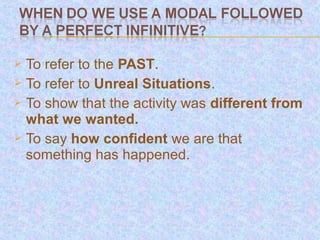
 To refer to the PAST.
 To refer to Unreal Situations.
 To show that the activity was different from
  what we wanted.
 To say how confident we are that
  something has happened.
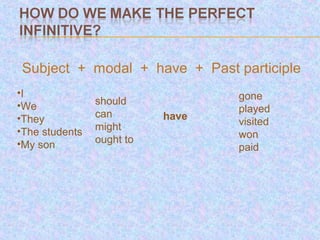
Subject + modal + have + Past participle
•I                                gone
•We             should
                can               played
•They                      have
                might             visited
•The students                     won
•My son         ought to
                                  paid
   It expresses deduction, a logical conclusion,
    probability:
       It’s very cold; it must have snowed in the mountains.
       I saw him leaving. He must have finished the test.
   It expresses past reference about something
    that was not carried out.
     She could have called the doctor early in the
      morning.
     They could have danced in the party.
   It expresses negative deduction, impossibility
    or disbelief:
     She can’t have passed the exam. It was too
      difficult.
     The boy couldn’t have given a better answer
      than this one.
     Bryan can’t have missed the bus.
   It expresses the possibility that an action took place
    in the past (past possibility).
       The little boy may have lost the key.
       The little boy might have lost the key.

       Our neighbours may have heard some noises when our
        car was stolen.
       Our neighbours might have heard some noises when
        our car was stolen.

     With “may”, action is more probable than with might.
   The action was not performed because of
    external reasons.
       I would have played football but I had a strong pain
        in my leg.
   Past Unreal Conditional.
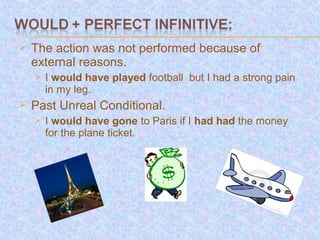
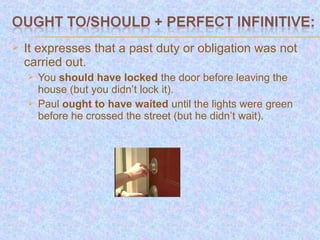
       I would have gone to Paris if I had had the money
        for the plane ticket.
   It expresses an unnecessary action, which was
    performed.
       I needn’t have knocked at the door in this way. I awoke
        the baby.
       You needn’t have bought the flowers for me.


In contrast, “didn’t need to” shows that the
action was not necessary but it wasn’t
performed either.
     I didn’t need to knock at the door because it was
     open (so I didn’t knock)
   It expresses that a past duty or obligation was not
    carried out.
       You should have locked the door before leaving the
        house (but you didn’t lock it).
       Paul ought to have waited until the lights were green
        before he crossed the street (but he didn’t wait).
Modals followed by perfect infinitive

Modals followed by perfect infinitive

  • 2.
     To referto the PAST.  To refer to Unreal Situations.  To show that the activity was different from what we wanted.  To say how confident we are that something has happened.
  • 3.
    Subject + modal+ have + Past participle •I gone •We should can played •They have might visited •The students won •My son ought to paid
  • 4.
    It expresses deduction, a logical conclusion, probability:  It’s very cold; it must have snowed in the mountains.  I saw him leaving. He must have finished the test.
  • 5.
    It expresses past reference about something that was not carried out.  She could have called the doctor early in the morning.  They could have danced in the party.
  • 6.
    It expresses negative deduction, impossibility or disbelief:  She can’t have passed the exam. It was too difficult.  The boy couldn’t have given a better answer than this one.  Bryan can’t have missed the bus.
  • 7.
    It expresses the possibility that an action took place in the past (past possibility).  The little boy may have lost the key.  The little boy might have lost the key.  Our neighbours may have heard some noises when our car was stolen.  Our neighbours might have heard some noises when our car was stolen. With “may”, action is more probable than with might.
  • 8.
    The action was not performed because of external reasons.  I would have played football but I had a strong pain in my leg.  Past Unreal Conditional.  I would have gone to Paris if I had had the money for the plane ticket.
  • 9.
    It expresses an unnecessary action, which was performed.  I needn’t have knocked at the door in this way. I awoke the baby.  You needn’t have bought the flowers for me. In contrast, “didn’t need to” shows that the action was not necessary but it wasn’t performed either. I didn’t need to knock at the door because it was open (so I didn’t knock)
  • 10.
    It expresses that a past duty or obligation was not carried out.  You should have locked the door before leaving the house (but you didn’t lock it).  Paul ought to have waited until the lights were green before he crossed the street (but he didn’t wait).