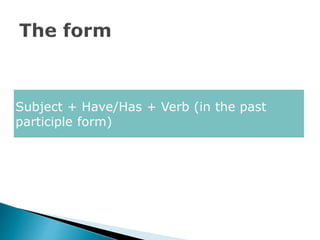
Subject + Have/Has + Verb (in the past
participle form)
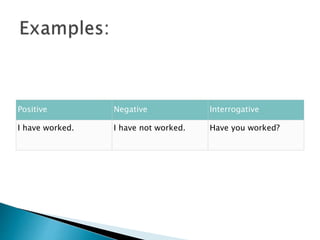
Positive Negative Interrogative
I have worked. I have not worked. Have you worked?
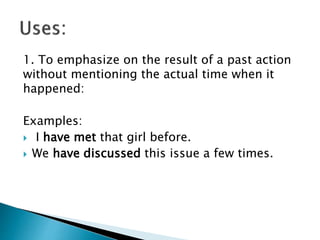
1. To emphasize on the result of a past action
without mentioning the actual time when it
happened:
Examples:
 I have met that girl before.
 We have discussed this issue a few times.
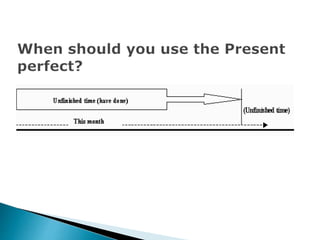
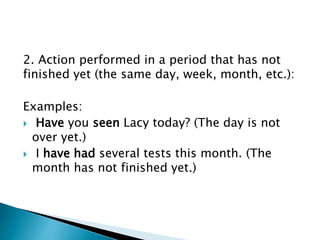
2. Action performed in a period that has not
finished yet (the same day, week, month, etc.):
Examples:
 Have you seen Lacy today? (The day is not
over yet.)
 I have had several tests this month. (The
month has not finished yet.)
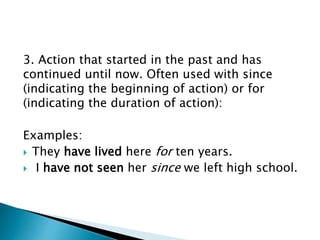
3. Action that started in the past and has
continued until now. Often used with since
(indicating the beginning of action) or for
(indicating the duration of action):
Examples:
 They have lived here for ten years.
 I have not seen her since we left high school.
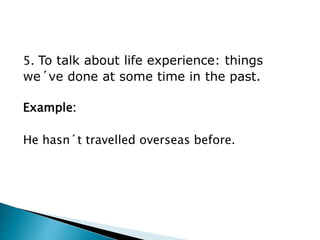
5. To talk about life experience: things
we´ve done at some time in the past.
Example:
He hasn´t travelled overseas before.
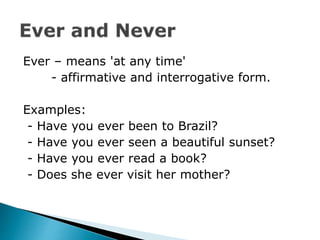
Ever – means 'at any time'
- affirmative and interrogative form.
Examples:
- Have you ever been to Brazil?
- Have you ever seen a beautiful sunset?
- Have you ever read a book?
- Does she ever visit her mother?
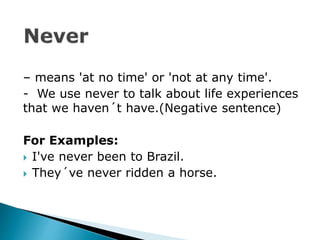
– means 'at no time' or 'not at any time'.
- We use never to talk about life experiences
that we haven´t have.(Negative sentence)
For Examples:
 I've never been to Brazil.
 They´ve never ridden a horse.

Present perfect with ever and never

  • 2.
    Subject + Have/Has+ Verb (in the past participle form)
  • 3.
    Positive Negative Interrogative Ihave worked. I have not worked. Have you worked?
  • 5.
    1. To emphasizeon the result of a past action without mentioning the actual time when it happened: Examples:  I have met that girl before.  We have discussed this issue a few times.
  • 6.
    2. Action performedin a period that has not finished yet (the same day, week, month, etc.): Examples:  Have you seen Lacy today? (The day is not over yet.)  I have had several tests this month. (The month has not finished yet.)
  • 7.
    3. Action thatstarted in the past and has continued until now. Often used with since (indicating the beginning of action) or for (indicating the duration of action): Examples:  They have lived here for ten years.  I have not seen her since we left high school.
  • 8.
    5. To talkabout life experience: things we´ve done at some time in the past. Example: He hasn´t travelled overseas before.
  • 9.
    Ever – means'at any time' - affirmative and interrogative form. Examples: - Have you ever been to Brazil? - Have you ever seen a beautiful sunset? - Have you ever read a book? - Does she ever visit her mother?
  • 10.
    – means 'atno time' or 'not at any time'. - We use never to talk about life experiences that we haven´t have.(Negative sentence) For Examples:  I've never been to Brazil.  They´ve never ridden a horse.