PRESENT DEDUCTIONS,
SPECULATIONS,
POSSIBILITIES AND
EXPECTATIONS
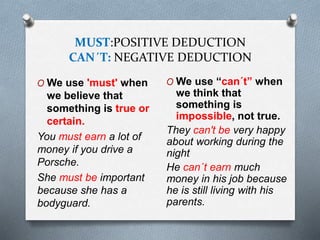
MUST:POSITIVE DEDUCTION
CAN´T: NEGATIVE DEDUCTION
O We use 'must' when
we believe that
something is true or
certain.
You must earn a lot of
money if you drive a
Porsche.
She must be important
because she has a
bodyguard.
O We use “can´t” when
we think that
something is
impossible, not true.
They can't be very happy
about working during the
night
He can´t earn much
money in his job because
he is still living with his
parents.
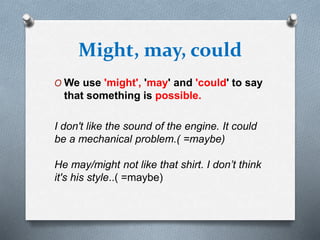
Might, may, could
O We use 'might', 'may' and 'could' to say
that something is possible.
I don't like the sound of the engine. It could
be a mechanical problem.( =maybe)
He may/might not like that shirt. I don’t think
it's his style..( =maybe)
Should/ought to
O We use “should” and “ought to” +
infinitive to say that we expect a
situation to happen.
O The operation went ok so if the doctor
sees my father today, he ought to go/he
should go home .
PAST DEDUCTIONS,
SPECULATIONS,
POSSIBILITIES AND
EXPECTATIONS
must have + past participle: + deduction
can´t /couldn´t have+ past participle :
- deduction
MUST HAVE+
PP
CAN´T/COULDN´T
HAVE+PP
O when we are sure
something was
true in the past
O Sue must have
arrived in Manchester
by now
O (=I´m sure she
arrived)
O When we are sure
something was
impossible or not true
in the past,:
O He can´t /couldn´t
have stolen the purse
as he was not in the
classroom (=I´m sure
he didn´t do it)
POSSIBILITY OF PAST
EVENTS
O We use may have/might have/ could
have+ past participle when we think
something was possible in the past.
O I didn´t see John last night at the party.
O He may have been sick. (=Maybe)
O He might have been sick.
O He could have been sick.
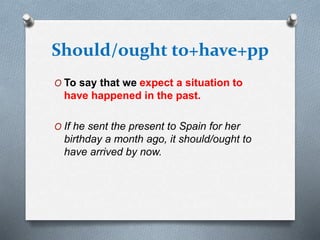
Should/ought to+have+pp
O To say that we expect a situation to
have happened in the past.
O If he sent the present to Spain for her
birthday a month ago, it should/ought to
have arrived by now.
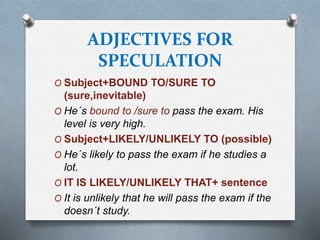
ADJECTIVES FOR
SPECULATION
O Subject+BOUND TO/SURE TO
(sure,inevitable)
O He´s bound to /sure to pass the exam. His
level is very high.
O Subject+LIKELY/UNLIKELY TO (possible)
O He´s likely to pass the exam if he studies a
lot.
O IT IS LIKELY/UNLIKELY THAT+ sentence
O It is unlikely that he will pass the exam if the
doesn´t study.
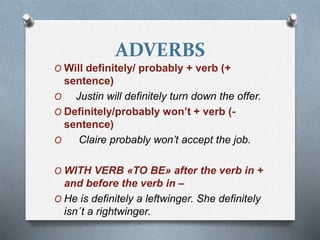
ADVERBS
O Will definitely/ probably + verb (+
sentence)
O Justin will definitely turn down the offer.
O Definitely/probably won’t + verb (-
sentence)
O Claire probably won’t accept the job.
O WITH VERB «TO BE» after the verb in +
and before the verb in –
O He is definitely a leftwinger. She definitely
isn´t a rightwinger.

Modals and expressions of deduction

  • 1.
  • 2.
    MUST:POSITIVE DEDUCTION CAN´T: NEGATIVEDEDUCTION O We use 'must' when we believe that something is true or certain. You must earn a lot of money if you drive a Porsche. She must be important because she has a bodyguard. O We use “can´t” when we think that something is impossible, not true. They can't be very happy about working during the night He can´t earn much money in his job because he is still living with his parents.
  • 3.
    Might, may, could OWe use 'might', 'may' and 'could' to say that something is possible. I don't like the sound of the engine. It could be a mechanical problem.( =maybe) He may/might not like that shirt. I don’t think it's his style..( =maybe)
  • 4.
    Should/ought to O Weuse “should” and “ought to” + infinitive to say that we expect a situation to happen. O The operation went ok so if the doctor sees my father today, he ought to go/he should go home .
  • 5.
  • 6.
    must have +past participle: + deduction can´t /couldn´t have+ past participle : - deduction MUST HAVE+ PP CAN´T/COULDN´T HAVE+PP O when we are sure something was true in the past O Sue must have arrived in Manchester by now O (=I´m sure she arrived) O When we are sure something was impossible or not true in the past,: O He can´t /couldn´t have stolen the purse as he was not in the classroom (=I´m sure he didn´t do it)
  • 7.
    POSSIBILITY OF PAST EVENTS OWe use may have/might have/ could have+ past participle when we think something was possible in the past. O I didn´t see John last night at the party. O He may have been sick. (=Maybe) O He might have been sick. O He could have been sick.
  • 8.
    Should/ought to+have+pp O Tosay that we expect a situation to have happened in the past. O If he sent the present to Spain for her birthday a month ago, it should/ought to have arrived by now.
  • 9.
    ADJECTIVES FOR SPECULATION O Subject+BOUNDTO/SURE TO (sure,inevitable) O He´s bound to /sure to pass the exam. His level is very high. O Subject+LIKELY/UNLIKELY TO (possible) O He´s likely to pass the exam if he studies a lot. O IT IS LIKELY/UNLIKELY THAT+ sentence O It is unlikely that he will pass the exam if the doesn´t study.
  • 10.
    ADVERBS O Will definitely/probably + verb (+ sentence) O Justin will definitely turn down the offer. O Definitely/probably won’t + verb (- sentence) O Claire probably won’t accept the job. O WITH VERB «TO BE» after the verb in + and before the verb in – O He is definitely a leftwinger. She definitely isn´t a rightwinger.