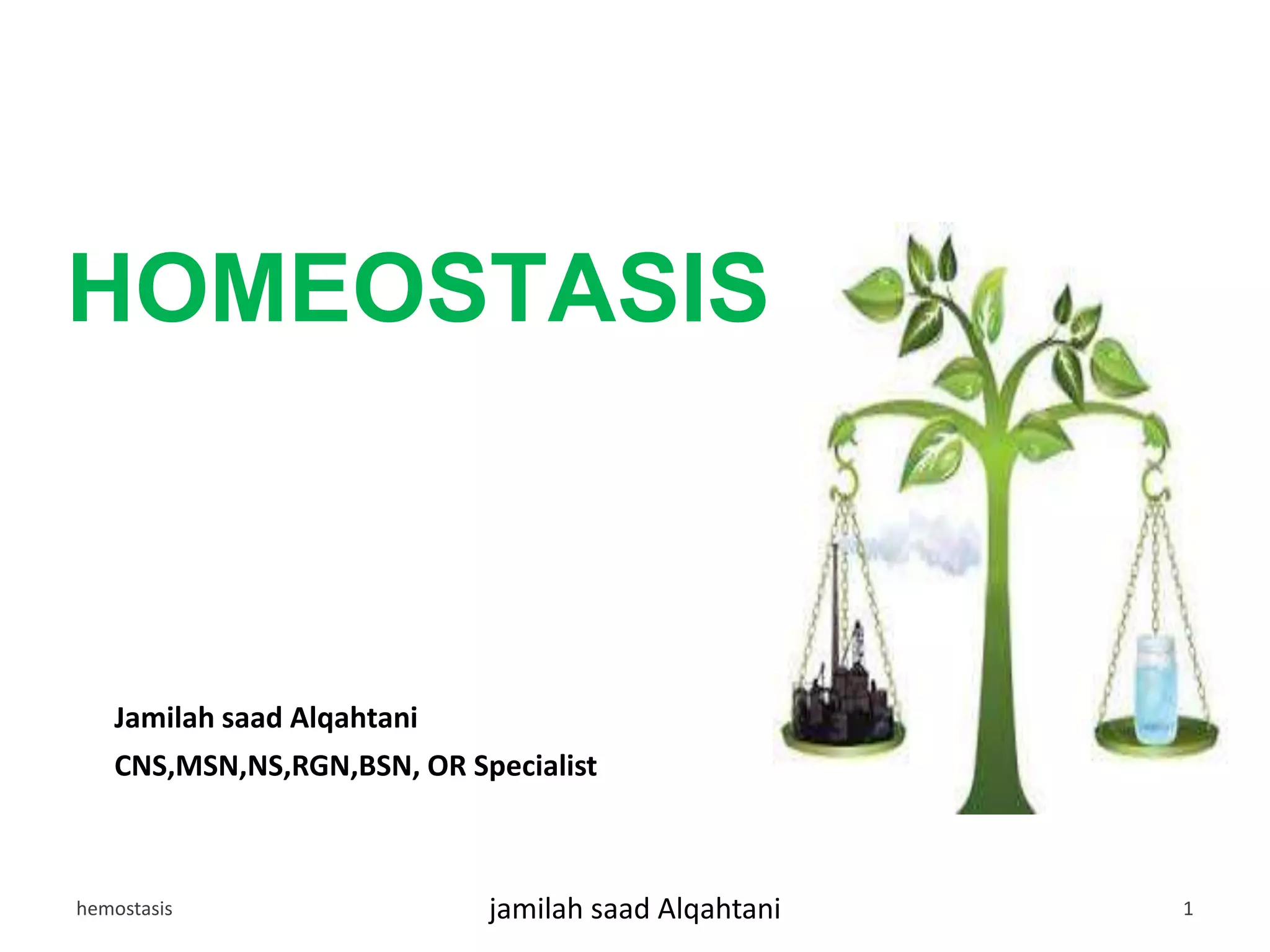
HOMEOSTASIS
Jamilah saad Alqahtani
CNS,MSN,NS,RGN,BSN, OR Specialist
hemostasis jamilah saad Alqahtani 1
hemostasis jamilah saad Alqahtani 2
Objectives
The student will be able to
understand:
1.Def homeostasis
2.The scope of human physiology
3.Homeostasis: defining feature of
physiology
4.General characteristics of
homeostatic control system:
5.Homeostasis Control system
6.Feedback system
7.Components of homeostasis
control system
8.Process related to homeostasis
9.Nursing and homeostasis
Outlines
Introduction
Def homeostasis
The scope of human physiology
Homeostasis: defining feature of
physiology
General characteristics of homeostatic
control system:
1.Homeostasis Control system
2.Feedback system
Components of homeostasis control
system
Process related to homeostasis
Nursing and homeostasis
Summary
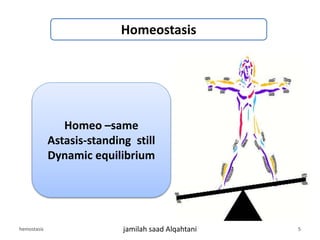
Homeostasis
Homeo –same
Astasis-standing still
Dynamic equilibrium
hemostasis jamilah saad Alqahtani 5
Homeostasis
Is the most
fundamental of
physiology
Homeostasis
 Homeostasis is the maintenance of the
body's internal environment within a narrow
range of normal values. It is an ongoing
process, with changes constantly occurring in
the body.
 In health, normal homeostatic mechanisms
function to maintain fluid, electrolyte, and
acid-base balance.
 In illness, one or more of the regulating
mechanisms may be affected, or an
imbalance
 may become too great for the body to
correct without treatment.
hemostasis jamilah saad Alqahtani 7
hemostasis jamilah saad Alqahtani 8
The scope of human physiology
how is the body organized ?
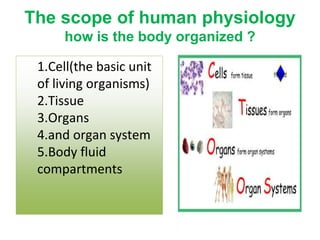
1.Cell(the basic unit
of living organisms)
2.Tissue
3.Organs
4.and organ system
5.Body fluid
compartments
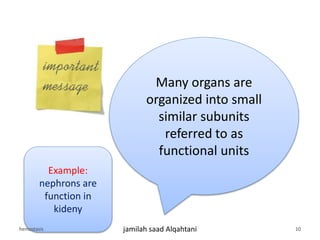
Many organs are
organized into small
similar subunits
referred to as
functional units
Example:
nephrons are
function in
kideny
hemostasis jamilah saad Alqahtani 10
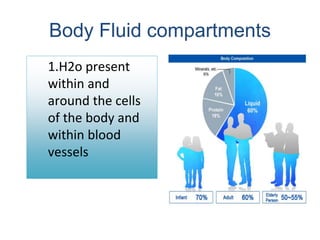
Body Fluid compartments
1.H2o present
within and
around the cells
of the body and
within blood
vessels
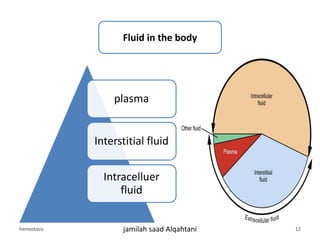
Fluid in the body
plasma
Interstitial fluid
Intracelluer
fluid
hemostasis jamilah saad Alqahtani 12
This led to concept
that homeostasis is
state of dynamic
constancy
hemostasis jamilah saad Alqahtani 13
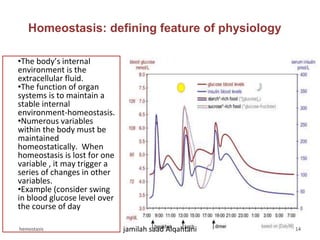
Homeostasis: defining feature of physiology
•The body’s internal
environment is the
extracellular fluid.
•The function of organ
systems is to maintain a
stable internal
environment-homeostasis.
•Numerous variables
within the body must be
maintained
homeostatically. When
homeostasis is lost for one
variable , it may trigger a
series of changes in other
variables.
•Example (consider swing
in blood glucose level over
the course of day
hemostasis jamilah saad Alqahtani 14
•Homeostasis denotes the stable condition
of the internal environment that results
from operation of compensatory
homeostatic control system.
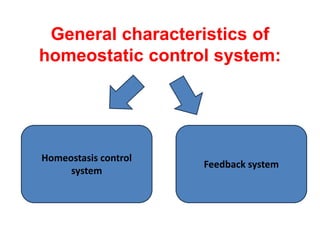
General characteristics of
homeostatic control system:
General characteristics of
homeostatic control system:
Homeostasis control
system
Feedback system
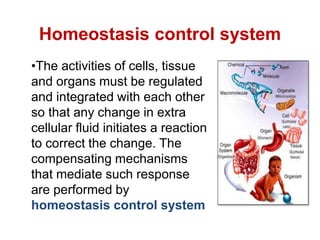
Homeostasis control system
•The activities of cells, tissue
and organs must be regulated
and integrated with each other
so that any change in extra
cellular fluid initiates a reaction
to correct the change. The
compensating mechanisms
that mediate such response
are performed by
homeostasis control system
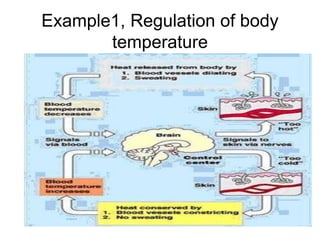
Example1, Regulation of body
temperature
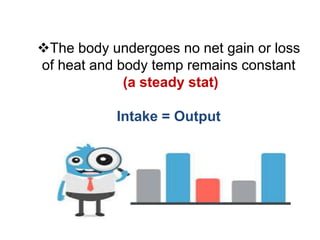
The body undergoes no net gain or loss
of heat and body temp remains constant
(a steady stat)
Intake = Output
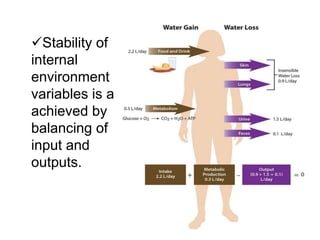
Stability of
internal
environment
variables is a
achieved by
balancing of
input and
outputs.
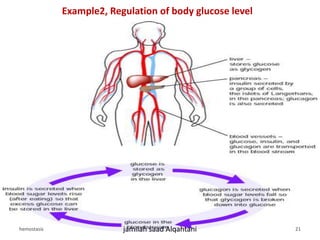
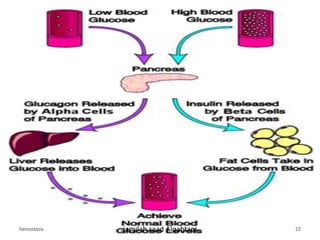
Example2, Regulation of body glucose level
hemostasis jamilah saad Alqahtani 21
hemostasis jamilah saad Alqahtani 22
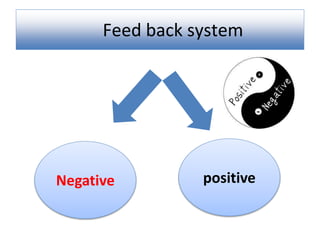
Feed back system
Negative positive
hemostasis jamilah saad Alqahtani 24
Negative feedback
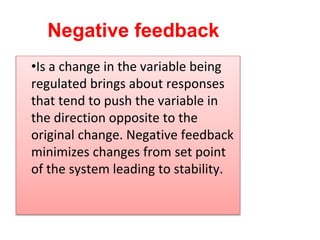
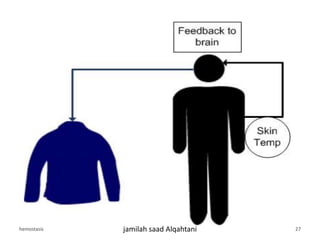
•Is a change in the variable being
regulated brings about responses
that tend to push the variable in
the direction opposite to the
original change. Negative feedback
minimizes changes from set point
of the system leading to stability.
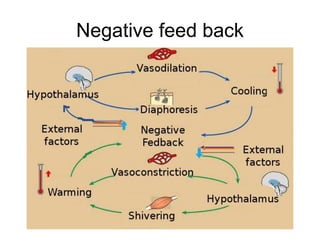
Negative feed back
hemostasis jamilah saad Alqahtani 27
Positive feedback
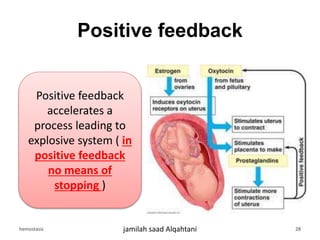
Positive feedback
accelerates a
process leading to
explosive system ( in
positive feedback
no means of
stopping )
hemostasis jamilah saad Alqahtani 28
Resetting of set point
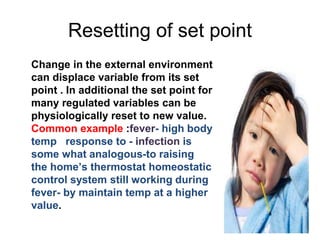
Change in the external environment
can displace variable from its set
point . In additional the set point for
many regulated variables can be
physiologically reset to new value.
Common example :fever- high body
temp response to - infection is
some what analogous-to raising
the home’s thermostat homeostatic
control system still working during
fever- by maintain temp at a higher
value.
That is why
•This regulated rise in
the body temp is
adaptive for fighting the
infection, because
elevated temp inhibits
proliferation of some
pathogens . In fact; this
is why fever often
preceded by chills and
shivering.
•In fact the points
can be reset
adaptive as in the
case of fever . Highly
important
challenges for
medicine
Some important generalizations about homeostatic control systems
1- stability of an internal environmental variable is achieved by balancing inputs and
outputs. It is not the absolute magnitudes of the inputs and outputs that matter but
the balance between them.
2-in negative feedback systems a change in variable being regulated brings about
responses that end to move the variable in the direction opposite the original
change- that Is back toward the initial value (set point)
3-homeostasis control systems cannot maintain complete constancy of any given
feature of internal environment. Therefore, any regulated variable will have a more-
or – less narrow range of normal values depending on the external environmental
conditions
4-the set point of some variables regulated by homeostatic control systems can be
reset—that is physiologically raised or lowered
5-it is not always possible for homeostasis control systems to maintain constancy in
every variable in response to an environmental challenges. There is hierarchy of
importance so that the constancy of certain variables may be altered marked to
maintain others within their normal range
Feed forward regulation
It anticipates changes in regulated
variable, improves the speed of the
body’s homeostatic responses and
minimizes fluctuations in the level
of the variable being regulated.
Work in conjunction with feedback
system
Feed forward regulation
•Example temp sensitive nerve cells trigger
negative feedback regulation of body temp
when it beings to fails are located inside
the body . In additional there are temp
sensitive nerve cells in skin and it is in
effect.
Components of homeostatic
control system
1.Reflexes
2.Local homeostatic responses
3.Intercellular chemical
messengers
Components of homeostatic
control system
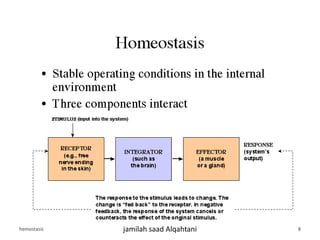
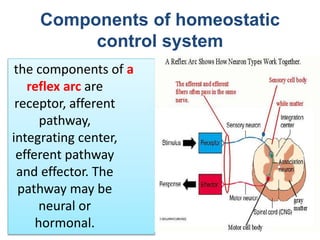
the components of a
reflex arc are
receptor, afferent
pathway,
integrating center,
efferent pathway
and effector. The
pathway may be
neural or
hormonal.
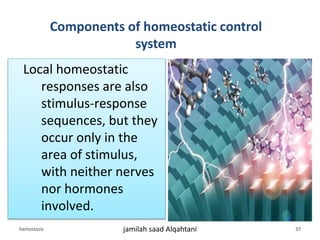
Local homeostatic
responses are also
stimulus-response
sequences, but they
occur only in the
area of stimulus,
with neither nerves
nor hormones
involved.
Components of homeostatic control
system
hemostasis jamilah saad Alqahtani 37
Components of homeostatic
control system
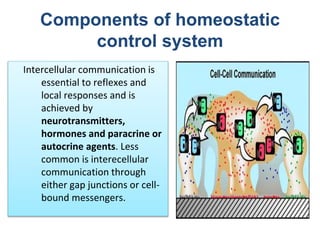
Intercellular communication is
essential to reflexes and
local responses and is
achieved by
neurotransmitters,
hormones and paracrine or
autocrine agents. Less
common is interecellular
communication through
either gap junctions or cell-
bound messengers.
Processes related to
homeostasis
1.Acclimatization
2.Biological rhythms
3.Balance in homeostasis of
chemical substances in the body
Acclimatization
Acclimatization is an improved ability to
respond to an environmental stress.
1.The improvement is induced by prolonged
exposure to the stress with no change in
genetic endowment.
2.If acclimatization occurs early in life, it may
be irreversible and is known as
developmental acclimatization.
Biological rhythms
Provide a feed forward component to
homeostatic control systems.
1.The rhythms are internally driven by brain
pacemakers, but are entrained by
environmental cues, such as light, which also
serve to phase-shift (reset)the rhythms when
necessary.
2.In the absence of cues, rhythms free run.
Balance in homeostasis of
chemical substances in the body
•Is achieved by matching inputs and outputs.
•Total-body balance of substance may be
negative, positive, or stable.
Nursing and homeostasis
Homeostasis is important in nursing because the body
mobilizes its fight-or-flight reaction in an attempt to maintain
homeostasis. This can result in sweating, breathlessness, rapid
heartbeat, shivering, and trembling. The internal equilibrium
of the body is the gauge of whether it is functioning properly
or not. With homeostasis, the body's systems are stable and
self-perpetuating. Many of the tests that a nurse performs on
a patient, such as taking a temperature or a blood pressure,
are tests to determine whether the patient's body is in
homeostasis or in distress. Homeostasis is highly desirable,
because it keeps the body functioning as it should be.
hemostasis jamilah saad Alqahtani 43
The body as a homeostatic system maintains its
structure and functions by means of:
a multiplicity of dynamic equilibriums rigorously
controlled by interdependent regulation
mechanisms. Such a system reacts to every
change in the environment, or to every random
disturbance, through a series of modifications of
equal size and opposite direction to those that
created.
hemostasis jamilah saad Alqahtani 44
hemostasis jamilah saad Alqahtani 45
Summary
We have discuss Definition of homeostasis which is
state of balance .then The scope of human
physiology in homeostasis means the feature and
characteristics of homeostasis control system and
feedback system. Negative and positive feedback
when and where it place . Also components of
homeostasis control system which include reflex arc,
local homeostatic response . And intercellular
chemical messengers .
Process related to homeostasis like acclimatization ,
biological rhythms and the balance of substances in
the body .At last Nursing and homeostasis
hemostasis jamilah saad Alqahtani 46
Any questions
hemostasis jamilah saad Alqahtani 47
hemostasis jamilah saad Alqahtani 48
Thank you
hemostasis jamilah saad Alqahtani 49

Homeostasis

  • 1.
    HOMEOSTASIS Jamilah saad Alqahtani CNS,MSN,NS,RGN,BSN,OR Specialist hemostasis jamilah saad Alqahtani 1
  • 2.
  • 3.
    Objectives The student willbe able to understand: 1.Def homeostasis 2.The scope of human physiology 3.Homeostasis: defining feature of physiology 4.General characteristics of homeostatic control system: 5.Homeostasis Control system 6.Feedback system 7.Components of homeostasis control system 8.Process related to homeostasis 9.Nursing and homeostasis
  • 4.
    Outlines Introduction Def homeostasis The scopeof human physiology Homeostasis: defining feature of physiology General characteristics of homeostatic control system: 1.Homeostasis Control system 2.Feedback system Components of homeostasis control system Process related to homeostasis Nursing and homeostasis Summary
  • 5.
    Homeostasis Homeo –same Astasis-standing still Dynamicequilibrium hemostasis jamilah saad Alqahtani 5
  • 6.
  • 7.
    Homeostasis  Homeostasis isthe maintenance of the body's internal environment within a narrow range of normal values. It is an ongoing process, with changes constantly occurring in the body.  In health, normal homeostatic mechanisms function to maintain fluid, electrolyte, and acid-base balance.  In illness, one or more of the regulating mechanisms may be affected, or an imbalance  may become too great for the body to correct without treatment. hemostasis jamilah saad Alqahtani 7
  • 8.
  • 9.
    The scope ofhuman physiology how is the body organized ? 1.Cell(the basic unit of living organisms) 2.Tissue 3.Organs 4.and organ system 5.Body fluid compartments
  • 10.
    Many organs are organizedinto small similar subunits referred to as functional units Example: nephrons are function in kideny hemostasis jamilah saad Alqahtani 10
  • 11.
    Body Fluid compartments 1.H2opresent within and around the cells of the body and within blood vessels
  • 12.
    Fluid in thebody plasma Interstitial fluid Intracelluer fluid hemostasis jamilah saad Alqahtani 12
  • 13.
    This led toconcept that homeostasis is state of dynamic constancy hemostasis jamilah saad Alqahtani 13
  • 14.
    Homeostasis: defining featureof physiology •The body’s internal environment is the extracellular fluid. •The function of organ systems is to maintain a stable internal environment-homeostasis. •Numerous variables within the body must be maintained homeostatically. When homeostasis is lost for one variable , it may trigger a series of changes in other variables. •Example (consider swing in blood glucose level over the course of day hemostasis jamilah saad Alqahtani 14
  • 15.
    •Homeostasis denotes thestable condition of the internal environment that results from operation of compensatory homeostatic control system. General characteristics of homeostatic control system:
  • 16.
    General characteristics of homeostaticcontrol system: Homeostasis control system Feedback system
  • 17.
    Homeostasis control system •Theactivities of cells, tissue and organs must be regulated and integrated with each other so that any change in extra cellular fluid initiates a reaction to correct the change. The compensating mechanisms that mediate such response are performed by homeostasis control system
  • 18.
    Example1, Regulation ofbody temperature
  • 19.
    The body undergoesno net gain or loss of heat and body temp remains constant (a steady stat) Intake = Output
  • 20.
    Stability of internal environment variables isa achieved by balancing of input and outputs.
  • 21.
    Example2, Regulation ofbody glucose level hemostasis jamilah saad Alqahtani 21
  • 22.
  • 23.
  • 24.
  • 25.
    Negative feedback •Is achange in the variable being regulated brings about responses that tend to push the variable in the direction opposite to the original change. Negative feedback minimizes changes from set point of the system leading to stability.
  • 26.
  • 27.
  • 28.
    Positive feedback Positive feedback acceleratesa process leading to explosive system ( in positive feedback no means of stopping ) hemostasis jamilah saad Alqahtani 28
  • 29.
    Resetting of setpoint Change in the external environment can displace variable from its set point . In additional the set point for many regulated variables can be physiologically reset to new value. Common example :fever- high body temp response to - infection is some what analogous-to raising the home’s thermostat homeostatic control system still working during fever- by maintain temp at a higher value.
  • 30.
    That is why •Thisregulated rise in the body temp is adaptive for fighting the infection, because elevated temp inhibits proliferation of some pathogens . In fact; this is why fever often preceded by chills and shivering.
  • 31.
    •In fact thepoints can be reset adaptive as in the case of fever . Highly important challenges for medicine
  • 32.
    Some important generalizationsabout homeostatic control systems 1- stability of an internal environmental variable is achieved by balancing inputs and outputs. It is not the absolute magnitudes of the inputs and outputs that matter but the balance between them. 2-in negative feedback systems a change in variable being regulated brings about responses that end to move the variable in the direction opposite the original change- that Is back toward the initial value (set point) 3-homeostasis control systems cannot maintain complete constancy of any given feature of internal environment. Therefore, any regulated variable will have a more- or – less narrow range of normal values depending on the external environmental conditions 4-the set point of some variables regulated by homeostatic control systems can be reset—that is physiologically raised or lowered 5-it is not always possible for homeostasis control systems to maintain constancy in every variable in response to an environmental challenges. There is hierarchy of importance so that the constancy of certain variables may be altered marked to maintain others within their normal range
  • 33.
    Feed forward regulation Itanticipates changes in regulated variable, improves the speed of the body’s homeostatic responses and minimizes fluctuations in the level of the variable being regulated. Work in conjunction with feedback system
  • 34.
    Feed forward regulation •Exampletemp sensitive nerve cells trigger negative feedback regulation of body temp when it beings to fails are located inside the body . In additional there are temp sensitive nerve cells in skin and it is in effect.
  • 35.
    Components of homeostatic controlsystem 1.Reflexes 2.Local homeostatic responses 3.Intercellular chemical messengers
  • 36.
    Components of homeostatic controlsystem the components of a reflex arc are receptor, afferent pathway, integrating center, efferent pathway and effector. The pathway may be neural or hormonal.
  • 37.
    Local homeostatic responses arealso stimulus-response sequences, but they occur only in the area of stimulus, with neither nerves nor hormones involved. Components of homeostatic control system hemostasis jamilah saad Alqahtani 37
  • 38.
    Components of homeostatic controlsystem Intercellular communication is essential to reflexes and local responses and is achieved by neurotransmitters, hormones and paracrine or autocrine agents. Less common is interecellular communication through either gap junctions or cell- bound messengers.
  • 39.
    Processes related to homeostasis 1.Acclimatization 2.Biologicalrhythms 3.Balance in homeostasis of chemical substances in the body
  • 40.
    Acclimatization Acclimatization is animproved ability to respond to an environmental stress. 1.The improvement is induced by prolonged exposure to the stress with no change in genetic endowment. 2.If acclimatization occurs early in life, it may be irreversible and is known as developmental acclimatization.
  • 41.
    Biological rhythms Provide afeed forward component to homeostatic control systems. 1.The rhythms are internally driven by brain pacemakers, but are entrained by environmental cues, such as light, which also serve to phase-shift (reset)the rhythms when necessary. 2.In the absence of cues, rhythms free run.
  • 42.
    Balance in homeostasisof chemical substances in the body •Is achieved by matching inputs and outputs. •Total-body balance of substance may be negative, positive, or stable.
  • 43.
    Nursing and homeostasis Homeostasisis important in nursing because the body mobilizes its fight-or-flight reaction in an attempt to maintain homeostasis. This can result in sweating, breathlessness, rapid heartbeat, shivering, and trembling. The internal equilibrium of the body is the gauge of whether it is functioning properly or not. With homeostasis, the body's systems are stable and self-perpetuating. Many of the tests that a nurse performs on a patient, such as taking a temperature or a blood pressure, are tests to determine whether the patient's body is in homeostasis or in distress. Homeostasis is highly desirable, because it keeps the body functioning as it should be. hemostasis jamilah saad Alqahtani 43
  • 44.
    The body asa homeostatic system maintains its structure and functions by means of: a multiplicity of dynamic equilibriums rigorously controlled by interdependent regulation mechanisms. Such a system reacts to every change in the environment, or to every random disturbance, through a series of modifications of equal size and opposite direction to those that created. hemostasis jamilah saad Alqahtani 44
  • 45.
  • 46.
    Summary We have discussDefinition of homeostasis which is state of balance .then The scope of human physiology in homeostasis means the feature and characteristics of homeostasis control system and feedback system. Negative and positive feedback when and where it place . Also components of homeostasis control system which include reflex arc, local homeostatic response . And intercellular chemical messengers . Process related to homeostasis like acclimatization , biological rhythms and the balance of substances in the body .At last Nursing and homeostasis hemostasis jamilah saad Alqahtani 46
  • 47.
  • 48.
  • 49.

Editor's Notes

  • #25 Does negative mean bad , so Which one is good ?????
  • #30 Analogous adj describing organs or parts that have similar functions in different organism although they do not have the same evalutionary origin or development compare homologyus
  • #39 Paracrine autocrine
  • #44 self-perpetuatingHaving the power to renew or perpetuate oneself or itself for an indefinite length of time.