DISASTER
VULNERABILITY
DEFINITION & CONCEPT
IVAN REGIS ARCENA
GRADE 12 STEM-URIEL
VULNERABILITY IN DIFFERENT PERSPECTIVES
According to the International Federation of Red Cross and
Red Crescent Societies (2019) vulnerability in this context can be
defined as the diminished capacity of an individual or group to
anticipate, cope with, resist and recover from the impact of a
natural or man-made hazard.
Vulnerability refers to the inability (of a system or a unit)
to withstand the effects of a hostile environment
(Wikipedia,2019).
The characteristics determined by physical, social,
economic and environmental factors or processes which increase
the susceptibility of an individual, a community, assets or
systems to the impacts of hazards.
WHAT IS VULNERABILITY ?
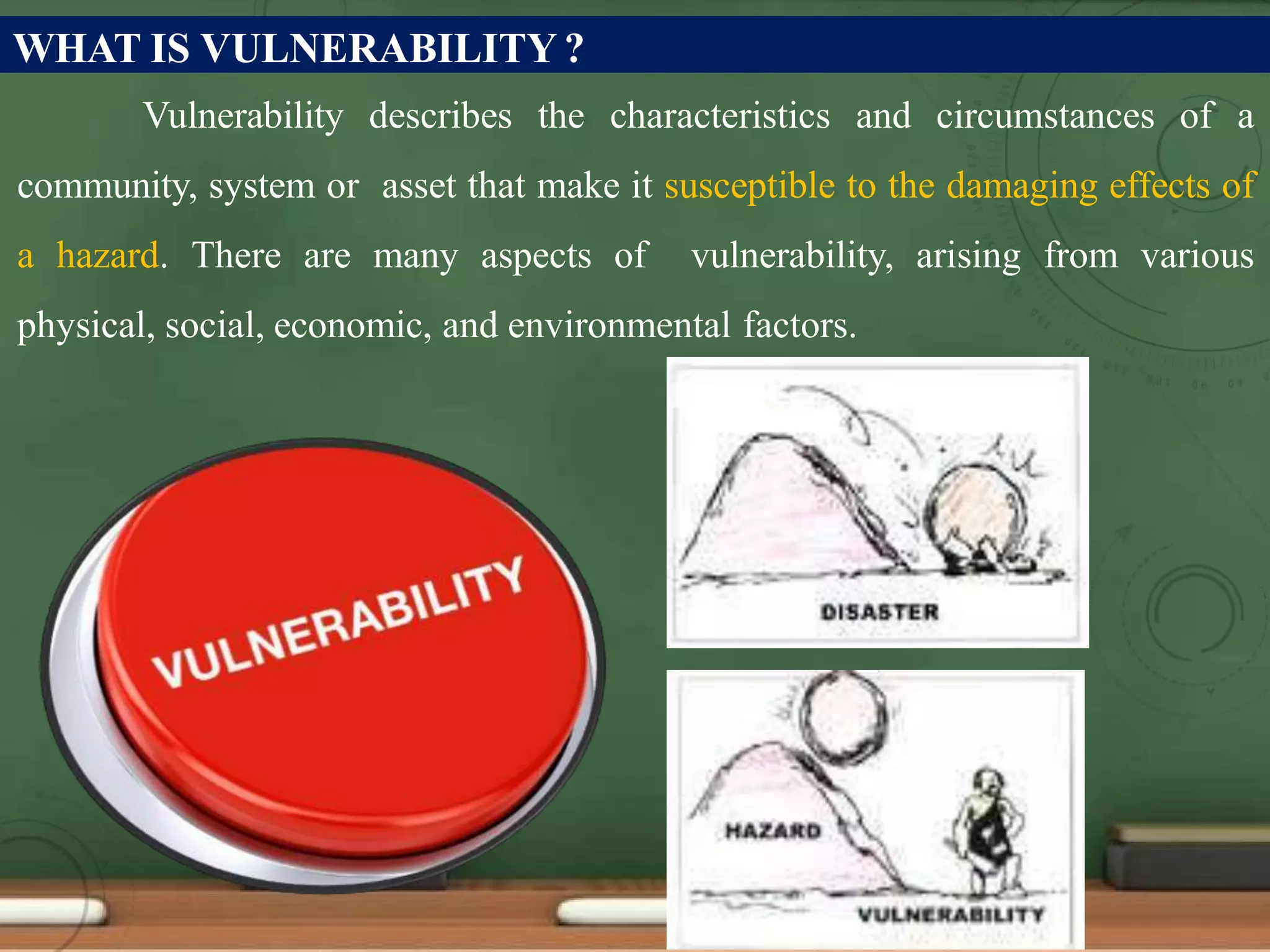
Vulnerability describes the characteristics and circumstances of a
community, system or asset that make it susceptible to the damaging effects of
a hazard. There are many aspects of vulnerability, arising from various
physical, social, economic, and environmental factors.
WHAT IS VULNERABILITY ?
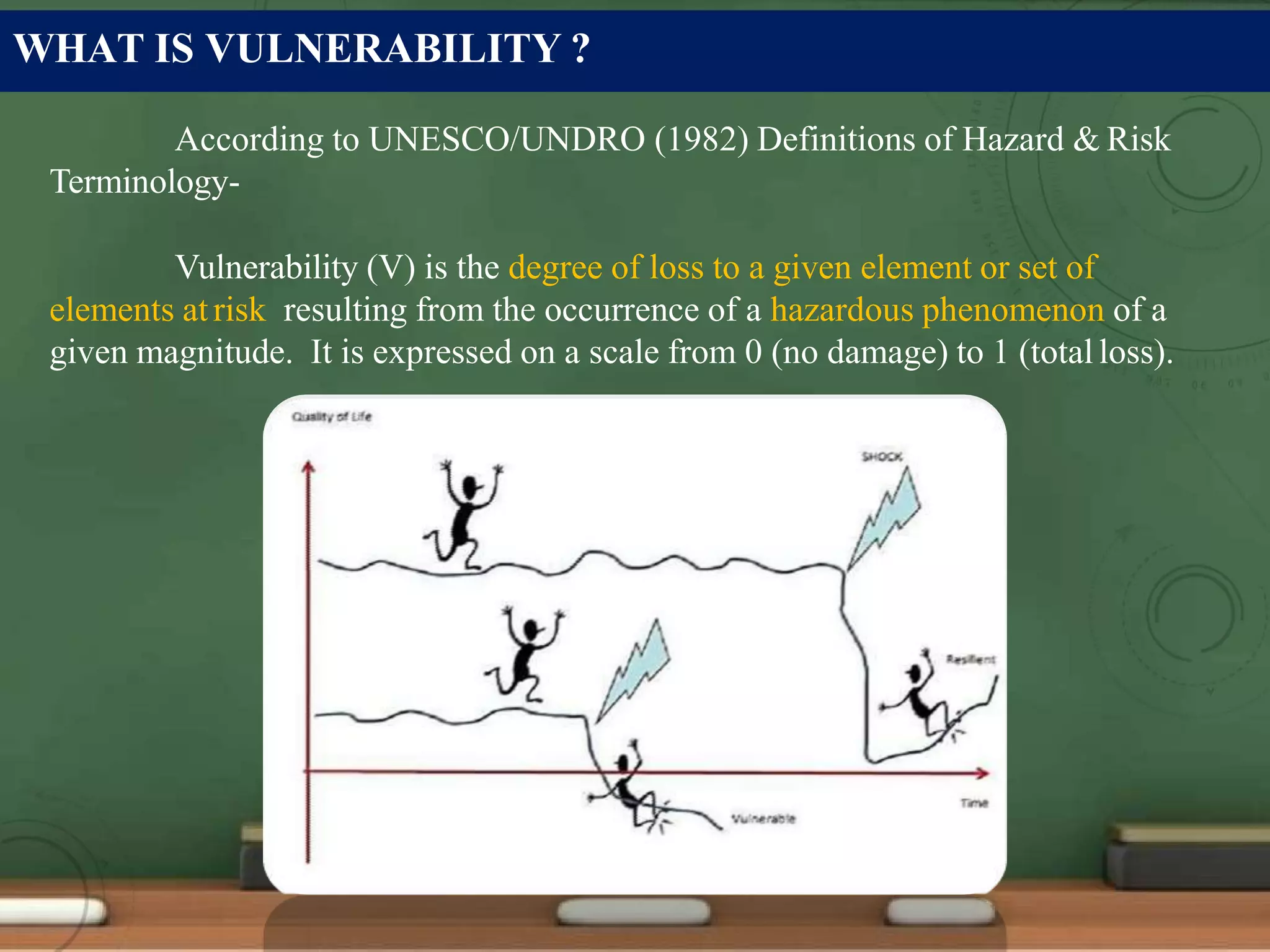
According to UNESCO/UNDRO (1982) Definitions of Hazard & Risk
Terminology-
Vulnerability (V) is the degree of loss to a given element or set of
elements atrisk resulting from the occurrence of a hazardous phenomenon of a
given magnitude. It is expressed on a scale from 0 (no damage) to 1 (total loss).
KEY CONCEPT OF VULNERABILITY?
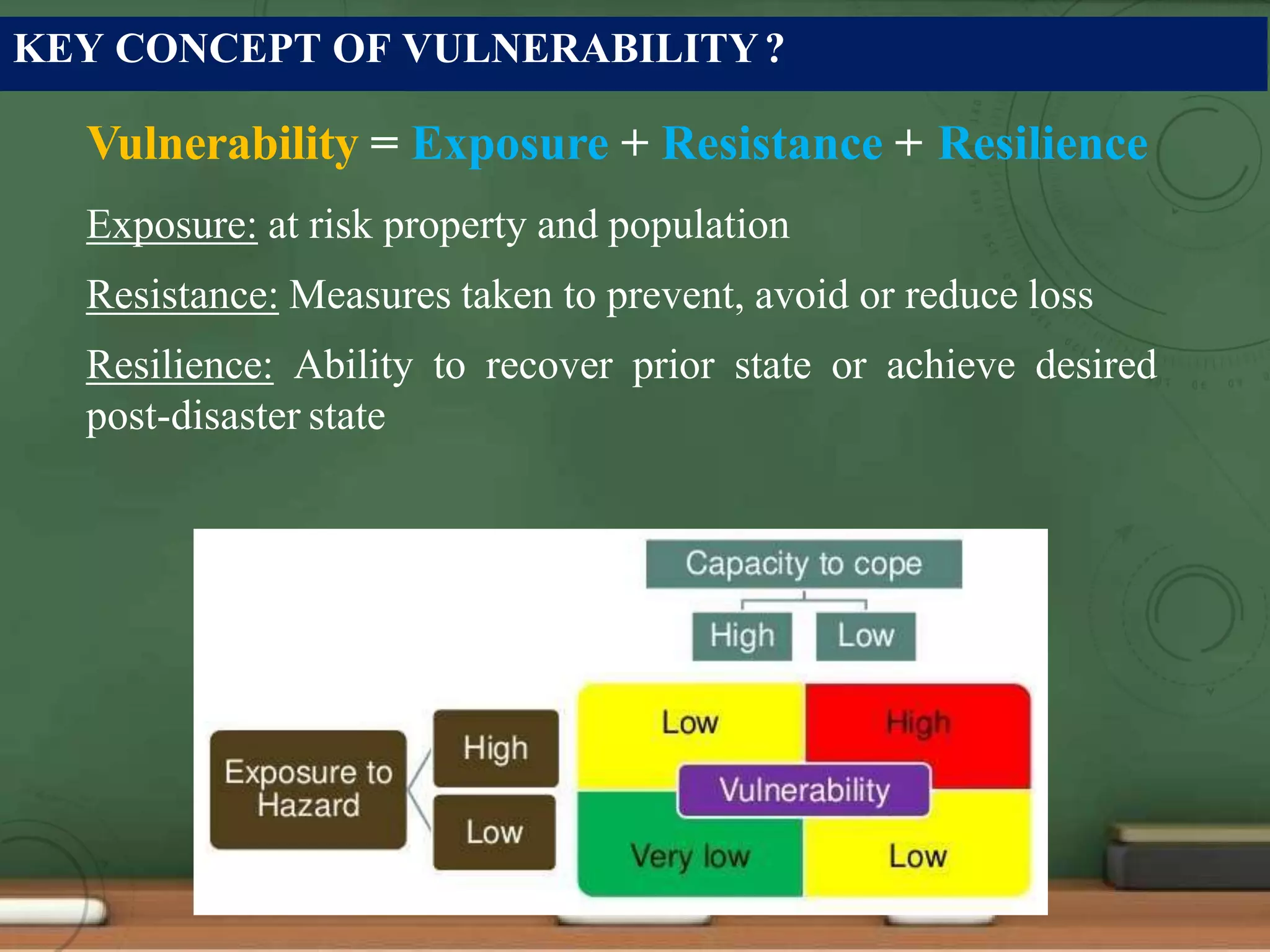
Vulnerability = Exposure + Resistance + Resilience
Exposure: at risk property and population
Resistance: Measures taken to prevent, avoid or reduce loss
Resilience: Ability to recover prior state or achieve desired
post-disaster state
EXAMPLE OF VULNERABILITY?
The people of the Eastern part of
Philippines are more vulnerable to
typhoons because of:
-High Exposure of Typhoon
-Low Resistance (lack of proper
management)
-Low Resilience (Economic limitation)
WHAT MAKES PEOPLE VULNERABLE?
Some definitions of vulnerability have included exposure in
addition to susceptibility to harm. However, it is now understood that
exposure is separate to the ‘susceptibility’ element of vulnerability
since it is possible to be exposed, whilst at the same time not
susceptible to natural hazards.
Despite some divergence over the meaning of vulnerability,
most experts agree that understanding vulnerability requires more than
analysing the direct impacts of a hazard. Vulnerability also concerns
the wider environmental and social conditions that limit people and
communities to cope with the impact of hazard (Birkmann, 2006).
TYPES OR SECTORS OF VULNERABILITY ?
There are four (4) main types of vulnerability:
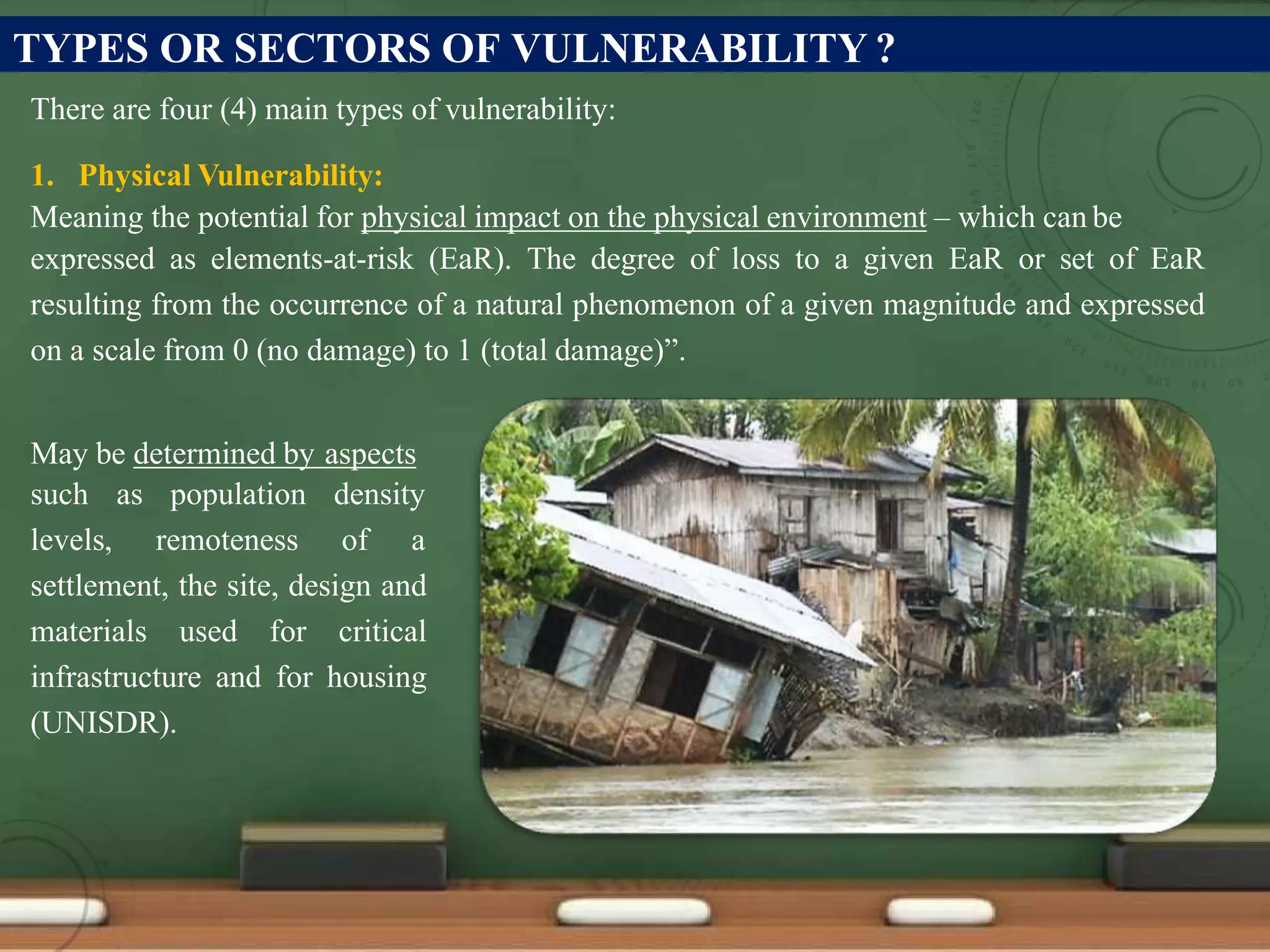
1. Physical Vulnerability:
Meaning the potential for physical impact on the physical environment – which can be
expressed as elements-at-risk (EaR). The degree of loss to a given EaR or set of EaR
resulting from the occurrence of a natural phenomenon of a given magnitude and expressed
on a scale from 0 (no damage) to 1 (total damage)”.
May be determined by aspects
such
levels,
as population density
remoteness of a
settlement, the site, design and
materials used for critical
infrastructure and for housing
(UNISDR).
TYPES OR SECTORS OF VULNERABILITY ?
2.Economic Vulnerability:
The potential impacts of hazards on economic assets and processes (i.e.
business interruption secondary effects such as increased poverty and job loss)
Vulnerability of different economic sectors.
The poor are usually more vulnerable to disasters because they lack the
resources to build sturdy structures and put other engineering measures in place to
protect themselves from being negatively impacted by disasters.
TYPES OR SECTORS OF VULNERABILITY ?
3.Social Vulnerability:
Refers to the inability of people, organizations and societies to withstand
adverse impacts to hazards due to characteristics inherent in social interactions,
institutions and systems of cultural values. It includes aspects related to levels of
literacy and education, the existence of peace and security, access to basic human
rights, systems of good governance, social equity, positive traditional values,
customs and ideological beliefs and overall collective organizational systems
(UNISDR).
Example- When flooding occurs some citizens, such as children, elderly and
differently-able, may be unable to protect themselves or evacuate if necessary.
TYPES OR SECTORS OF VULNERABILITY?
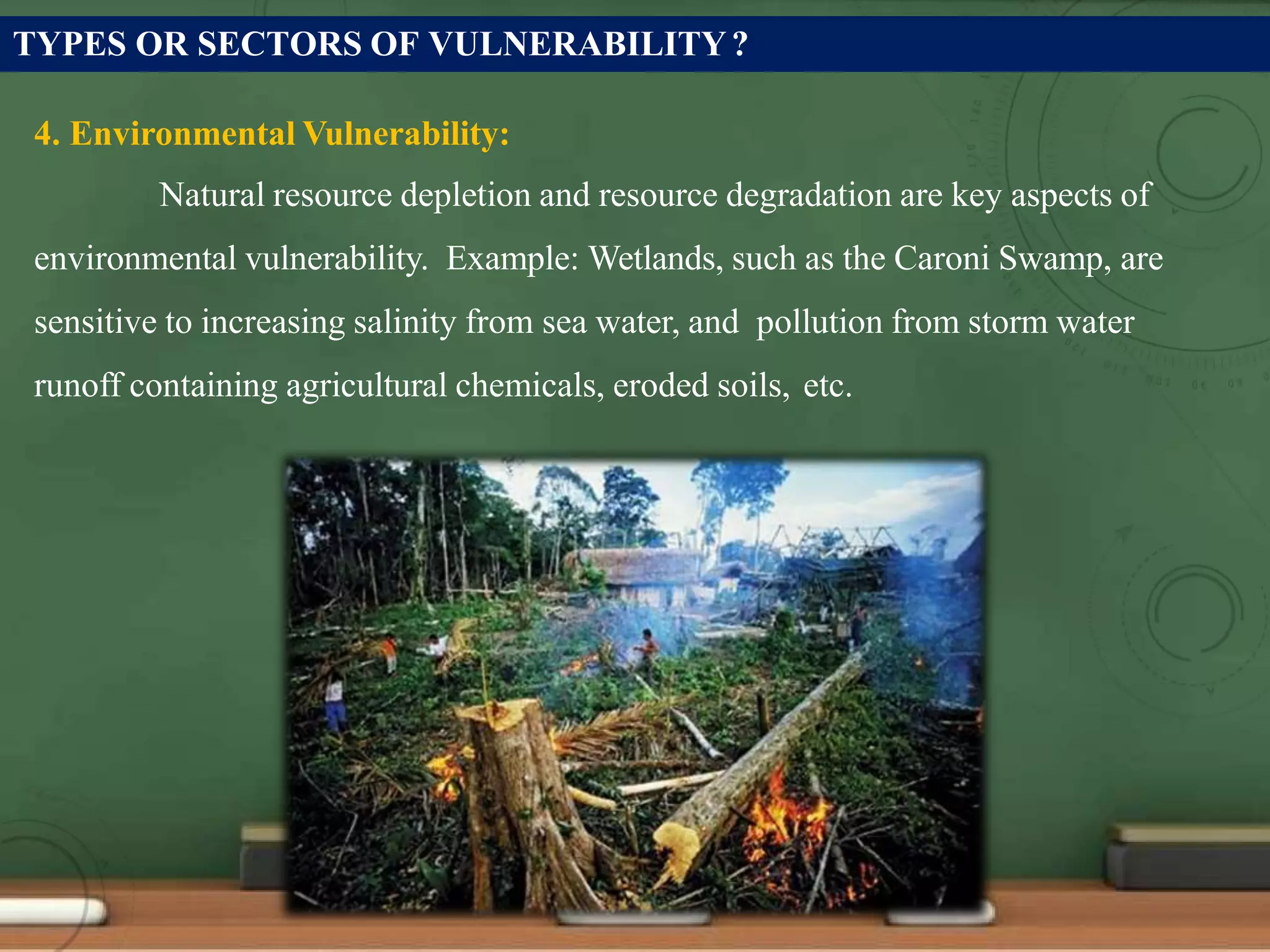
4. Environmental Vulnerability:
Natural resource depletion and resource degradation are key aspects of
environmental vulnerability. Example: Wetlands, such as the Caroni Swamp, are
sensitive to increasing salinity from sea water, and pollution from storm water
runoff containing agricultural chemicals, eroded soils, etc.
WHY DOES VULNERABILITY MATTER?
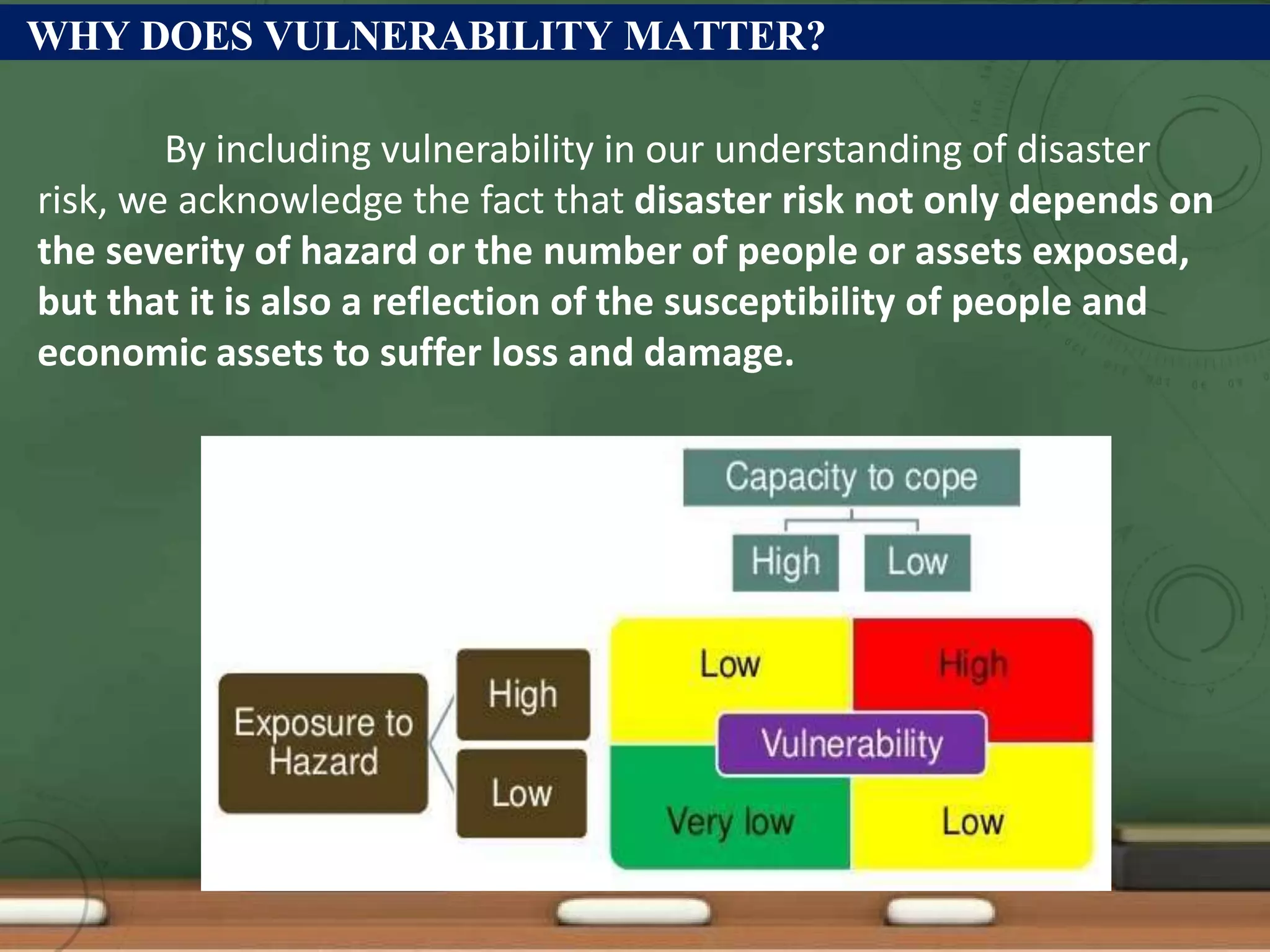
By including vulnerability in our understanding of disaster
risk, we acknowledge the fact that disaster risk not only depends on
the severity of hazard or the number of people or assets exposed,
but that it is also a reflection of the susceptibility of people and
economic assets to suffer loss and damage.
HOW DO WE REDUCE VULNERABILITY?
Approaches to vulnerability reduction include:
 Implementing building codes
 Insurance and social protection (risk )
 Emphasising economic diversity and resilient livelihoods
 Knowledge and awareness raising
 Preparedness measures
WHAT IS RISK ?
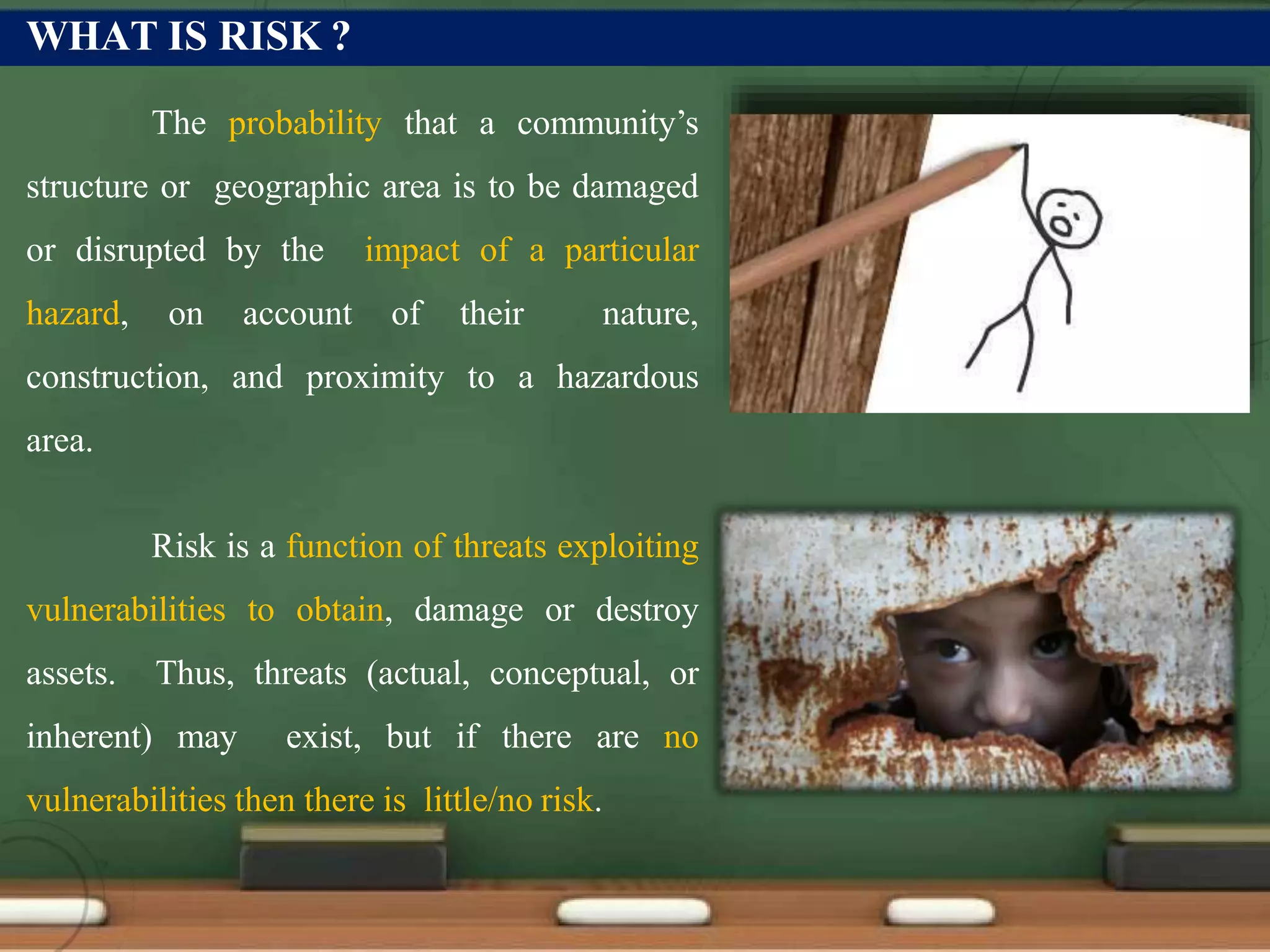
The probability that a community’s
structure or geographic area is to be damaged
or disrupted by the impact of a particular
hazard, on account of their nature,
construction, and proximity to a hazardous
area.
Risk is a function of threats exploiting
vulnerabilities to obtain, damage or destroy
assets. Thus, threats (actual, conceptual, or
inherent) may exist, but if there are no
vulnerabilities then there is little/no risk.
KEY CONCEPT OFRISK
Hazard Vulnerabilityx
Disaster Risk
Capacity
=
Vulnerability

Vulnerability

  • 1.
    DISASTER VULNERABILITY DEFINITION & CONCEPT IVANREGIS ARCENA GRADE 12 STEM-URIEL
  • 2.
    VULNERABILITY IN DIFFERENTPERSPECTIVES According to the International Federation of Red Cross and Red Crescent Societies (2019) vulnerability in this context can be defined as the diminished capacity of an individual or group to anticipate, cope with, resist and recover from the impact of a natural or man-made hazard. Vulnerability refers to the inability (of a system or a unit) to withstand the effects of a hostile environment (Wikipedia,2019). The characteristics determined by physical, social, economic and environmental factors or processes which increase the susceptibility of an individual, a community, assets or systems to the impacts of hazards.
  • 3.
    WHAT IS VULNERABILITY? Vulnerability describes the characteristics and circumstances of a community, system or asset that make it susceptible to the damaging effects of a hazard. There are many aspects of vulnerability, arising from various physical, social, economic, and environmental factors.
  • 4.
    WHAT IS VULNERABILITY? According to UNESCO/UNDRO (1982) Definitions of Hazard & Risk Terminology- Vulnerability (V) is the degree of loss to a given element or set of elements atrisk resulting from the occurrence of a hazardous phenomenon of a given magnitude. It is expressed on a scale from 0 (no damage) to 1 (total loss).
  • 5.
    KEY CONCEPT OFVULNERABILITY? Vulnerability = Exposure + Resistance + Resilience Exposure: at risk property and population Resistance: Measures taken to prevent, avoid or reduce loss Resilience: Ability to recover prior state or achieve desired post-disaster state
  • 6.
    EXAMPLE OF VULNERABILITY? Thepeople of the Eastern part of Philippines are more vulnerable to typhoons because of: -High Exposure of Typhoon -Low Resistance (lack of proper management) -Low Resilience (Economic limitation)
  • 7.
    WHAT MAKES PEOPLEVULNERABLE? Some definitions of vulnerability have included exposure in addition to susceptibility to harm. However, it is now understood that exposure is separate to the ‘susceptibility’ element of vulnerability since it is possible to be exposed, whilst at the same time not susceptible to natural hazards. Despite some divergence over the meaning of vulnerability, most experts agree that understanding vulnerability requires more than analysing the direct impacts of a hazard. Vulnerability also concerns the wider environmental and social conditions that limit people and communities to cope with the impact of hazard (Birkmann, 2006).
  • 8.
    TYPES OR SECTORSOF VULNERABILITY ? There are four (4) main types of vulnerability: 1. Physical Vulnerability: Meaning the potential for physical impact on the physical environment – which can be expressed as elements-at-risk (EaR). The degree of loss to a given EaR or set of EaR resulting from the occurrence of a natural phenomenon of a given magnitude and expressed on a scale from 0 (no damage) to 1 (total damage)”. May be determined by aspects such levels, as population density remoteness of a settlement, the site, design and materials used for critical infrastructure and for housing (UNISDR).
  • 9.
    TYPES OR SECTORSOF VULNERABILITY ? 2.Economic Vulnerability: The potential impacts of hazards on economic assets and processes (i.e. business interruption secondary effects such as increased poverty and job loss) Vulnerability of different economic sectors. The poor are usually more vulnerable to disasters because they lack the resources to build sturdy structures and put other engineering measures in place to protect themselves from being negatively impacted by disasters.
  • 10.
    TYPES OR SECTORSOF VULNERABILITY ? 3.Social Vulnerability: Refers to the inability of people, organizations and societies to withstand adverse impacts to hazards due to characteristics inherent in social interactions, institutions and systems of cultural values. It includes aspects related to levels of literacy and education, the existence of peace and security, access to basic human rights, systems of good governance, social equity, positive traditional values, customs and ideological beliefs and overall collective organizational systems (UNISDR). Example- When flooding occurs some citizens, such as children, elderly and differently-able, may be unable to protect themselves or evacuate if necessary.
  • 11.
    TYPES OR SECTORSOF VULNERABILITY? 4. Environmental Vulnerability: Natural resource depletion and resource degradation are key aspects of environmental vulnerability. Example: Wetlands, such as the Caroni Swamp, are sensitive to increasing salinity from sea water, and pollution from storm water runoff containing agricultural chemicals, eroded soils, etc.
  • 12.
    WHY DOES VULNERABILITYMATTER? By including vulnerability in our understanding of disaster risk, we acknowledge the fact that disaster risk not only depends on the severity of hazard or the number of people or assets exposed, but that it is also a reflection of the susceptibility of people and economic assets to suffer loss and damage.
  • 13.
    HOW DO WEREDUCE VULNERABILITY? Approaches to vulnerability reduction include:  Implementing building codes  Insurance and social protection (risk )  Emphasising economic diversity and resilient livelihoods  Knowledge and awareness raising  Preparedness measures
  • 14.
    WHAT IS RISK? The probability that a community’s structure or geographic area is to be damaged or disrupted by the impact of a particular hazard, on account of their nature, construction, and proximity to a hazardous area. Risk is a function of threats exploiting vulnerabilities to obtain, damage or destroy assets. Thus, threats (actual, conceptual, or inherent) may exist, but if there are no vulnerabilities then there is little/no risk.
  • 15.
    KEY CONCEPT OFRISK HazardVulnerabilityx Disaster Risk Capacity =