Ophthalmic products Kushal
Page
1
Ophthalmic products
Ophthalmic products:
Ophthalmic products are the sterile products, meant for instillation into the eye in the space
between the eye lids and the eye balls. These products are must be sterile and are prepared
under the same conditions and by the same methods as other parenteral products.
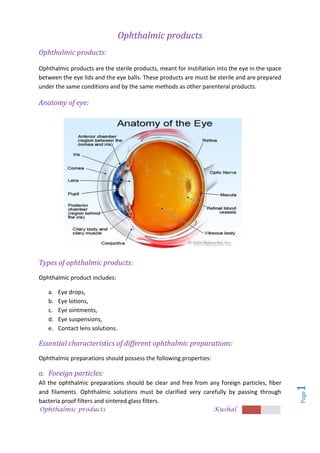
Anatomy of eye:
Types of ophthalmic products:
Ophthalmic product includes:
a. Eye drops,
b. Eye lotions,
c. Eye ointments,
d. Eye suspensions,
e. Contact lens solutions.
Essential characteristics of different ophthalmic preparations:
Ophthalmic preparations should possess the following properties:
a. Foreign particles:
All the ophthalmic preparations should be clear and free from any foreign particles, fiber
and filaments. Ophthalmic solutions must be clarified very carefully by passing through
bacteria proof filters and sintered glass filters.
Ophthalmic products Kushal
Page
2
b. Viscosity:
In order to prolong the contact time of the drug in the eye, various thickening agents are
added in the ophthalmic preparations. Polyvinyl alcohol, polyethylene glycol, methyl
cellulose, carboxymethylcellulose are some of the common thickening agents. These agents
improve the viscosity of the preparations. The thickening agents are not needed in the
formulation of eye drops and eye solutions.
An ideal thickening agent should possess the following properties:
It should be easy to filter,
It should be easy to sterilize,
It should be compatible with other ingredients,
It should possess requisite refractive index and clarity level.
c. Tonicity:
Ophthalmic products must be isotonic with lachrymal secretions to avoid discomfort and
irritation. It has been observed that eye can tolerate a range of tonicity from 0.5-2% NaCl.
There are certain isotonic vehicles which are used to prepare ophthalmic products like 1.9%
boric acid, sodium acid phosphate buffer.
d. pH of the solution:
pH plays an important role in therapeutic activity, solubility, stability and comfort to the
patient. Tears have pH of about 7.4. Eye can tolerate solution having wide range of pH
providing they are not strongly buffered, since the tears will rapidly restore the normal pH
value of the eye. Alkaloidal salt solutions are stable at pH 2-3 but this pH is irritant to the
eye.
e. Sterility:
Ophthalmic preparation must be sterile when prepared. Pseudomonas aeruginosa is very
common gram negative bacteria which are found to be present in the ophthalmic products.
It may cause serious infection in the cornea.
f. Surface activity:
Vehicles are used in ophthalmic preparation must have good wetting ability to penetrate
cornea and other tissues. Certain surfactant and wetting agents are added which are found
suitable for ophthalmic products. Benzokonium chloride, polysorbate 20 etc. are commonly
used surfactants in the ophthalmic preparations.
Ophthalmic products Kushal
Page
3
Eye drops:
Eye drops are sterile aqueous or oily solutions or suspensions of drugs that are instilled into
the eye with a dropper. They are used both for diagnostic and therapeutic purposes and
contain drugs which act on the anterior segment of the eye: the cornea, the conjunctive and
anterior uvea. They usually contain drugs used as
Antimicrobial agents (antibacterial, antifungals and antiviral)
Anti-inflammatory agents,
Anesthetics,
Mydriatics,
Miotics,
Cyclopledgics,
Diagnostic stains,
Corticosteroids,
Artificial tears.
Eye drops are mainly applied into the space between the eye balls and eye leads or on the
corneal surface. The characteristics of eye drops are:
They should be sterile,
They should be isotonic with lachrymal secretions,
They should be free from foreign particles, fibers and filaments,
They should have almost neutral pH,
They should be preserved with a suitable bactericide,
They should remain stable during storage.
Formulation of eye drops:
Most of the eye drops contain aqueous vehicle rather than oily vehicles. Aqueous eye drop
may support the bacterial and fungal growth therefore they must be preserved by adding a
suitable preservative. For this purpose phenyl mercuric nitrate or acetate 0.002%,
benzalkonium chloride 0.01%, chlorhexidine acetate 0.01% may be used.
The medicaments are dissolved in a aqueous vehicle containing suitable antimicrobial
agents. The adjacent are also dissolved in the vehicle at the stage to form a stable
preparation.
Eye drops are clarified by passing the solution through membrane filter having filter pore
size 0.8 µm. The clarified solution is immediately transferred into the final containers and
sealed to exclude microorganism.
Eye drops are then sterilized by autoclaving or heating with bactericide at 98o
C to 100o
C for
30min. or filtration through bacteria proof filter. Then it is packed into neutral glass
containers or in a suitable glass container.
Ophthalmic products Kushal
Page
4
Adjacent used in eye drops:
Thickening agent,
Buffers,
Antioxidants,
Chelating agents,
Wetting agents,
Isotonicity adjacent substances.
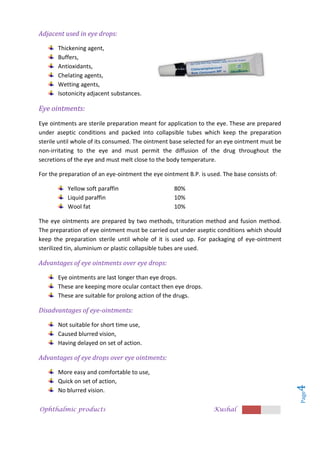
Eye ointments:
Eye ointments are sterile preparation meant for application to the eye. These are prepared
under aseptic conditions and packed into collapsible tubes which keep the preparation
sterile until whole of its consumed. The ointment base selected for an eye ointment must be
non-irritating to the eye and must permit the diffusion of the drug throughout the
secretions of the eye and must melt close to the body temperature.
For the preparation of an eye-ointment the eye ointment B.P. is used. The base consists of:
Yellow soft paraffin 80%
Liquid paraffin 10%
Wool fat 10%
The eye ointments are prepared by two methods, trituration method and fusion method.
The preparation of eye ointment must be carried out under aseptic conditions which should
keep the preparation sterile until whole of it is used up. For packaging of eye-ointment
sterilized tin, aluminium or plastic collapsible tubes are used.
Advantages of eye ointments over eye drops:
Eye ointments are last longer than eye drops.
These are keeping more ocular contact then eye drops.
These are suitable for prolong action of the drugs.
Disadvantages of eye-ointments:
Not suitable for short time use,
Caused blurred vision,
Having delayed on set of action.
Advantages of eye drops over eye ointments:
More easy and comfortable to use,
Quick on set of action,
No blurred vision.
Ophthalmic products Kushal
Page
5
Eye lotions:
Eye lotions are sterile aqueous solutions used for washing the eye. The eye lotions are
supplied in concentrated form and are required to be diluted with warm water immediately
before use. They are usually applied with a clean eye-bath or sterilized fabric dressings and a
large volume of solution is allowed to flow quickly over the eye.
Eye lotions should be isotonic and free from foreign particles to avoid the irritation to the
eye. The drugs used for preparing eye lotions are NaCl, NaHCO3, Boric acid, Borax and ZnS.
Why eye lotions are used:
After eye surgery it is need to irrigate the eye by eye lotions,
In several eye infection eye lotions are used,
As steroidal anti-inflammatory drug eye lotions are used.
Eye suspensions:
Eye suspensions are sterile suspensions used as ophthalmic product. These are not as
commonly used as the eye drops. They are only prepared when the drug is insoluble in the
desired vehicle or unstable in solution form. They are also used to produce sustained action
of the preparation.
Eye solutions should have following preparations:
They should be sterile,
They should be isotonic, buffered and suitably preserved,
They should be of the desired viscosity,
They should be packaged in dropper type containers,
The particle size ranges within 5µm (90%) - 15µm (10%).
The supplied particles must not agglomerate,
They should be shaken thoroughly before use in order to distribute the particle
uniformly.
Ophthalmic suspension includes:
1. Dexamethasone ophthalmic suspension,
2. Hydrocortisone ophthalmic suspension,
3. Tetracycline hydrochloride ophthalmic suspension.
Contact lens solutions:
Contact lenses are usually made from polymethyl methacrylate which is a hard hydrophobic
plastic. Now-a-days some softer hydrophilic lenses are also used.
Ophthalmic products Kushal
Page
6
The wearers of hard contact lens generally use two types of solutions:
a. One before inserting the lenses into the eye which is known as wetting solution,
b. The other one used for overnight cleaning, soaking and storage which is known as
storage solution.
1. Wetting solution:
It is used primary for treating the lenses before insertion. Due to the hydrophobic nature,
polymethyl methacrylate is poorly wetted by the lachrymal fluid of the eye. Hence, the
contact lens requires moistening with a wetting agent to make the insertion easy and
comfortable.
The formulation of contact solution may contain:
Wetting agent,
Antimicrobial agent,
Isotonicity adjuster,
Buffering agent,
Thickening agent.
2. Storage solutions:
The contact lens must be clean after use. After removing from the eye they are cleaned with
wetting solution and rinsed with purified water. Then they are stored in a soaking solution
with the intension continue the cleaning process and prevent dehydration.
The formulation of storage solutions generally contains:
A non-ionic surface active agent which will help in cleaning the lenses.
A blend of preservatives to prevent the bacterial growth. The solution should be
changed after every few days because the preservatives may be practically
inactivated by the organic materials present in the form of debris.
Ophthalmic inserts:
Ophthalmic inserts are new drug delivery systems for administering drug into the eyes.
These are designed in such a way that they release the drug at predetermined and
predictable rates thus eliminating the frequent administration of the drugs by the patients.
Generally the inserts are elliptical in shape having the dimensions 13.4×5.7×0.3mm. They
are sterile and do not contain any preservatives. They are flexible in nature and consist of
multilayered structure the innermost being the core containing the medicament.
The pilocarpine inserts have proved quiet useful and effective in glaucoma therapy. It is
allowed to release the drug at desired rates for about seven days after which it is removed
and replaced with new ones.
Ophthalmic products Kushal
Page
7
Why pH of the ophthalmic product should be adjusted:
The pH of eye drop should be adjusted for three main reasons:
a. To reduce discomfort,
b. To maintain chemical stability,
c. To improve clinical response,
d. To improve the tonicity of the preparation.
Write down the microorganisms that causes eye infections:
Staphylococcus aerues,
Asparagus species,
Proteus vulgaris,
Adeno virus,
Retro virus,
Bacillus subtilis,
Pseudomonas aeruginosa.
Why ophthalmic products recognized as sterile products:
As eyes are too sensitive to the microorganisms, the ophthalmic products must be 100%
microorganism free. For this reason they must be formulate in aseptic technic and the
product must pass sterility test during formulation. For this reason these are known as
sterile products.

Ophthalmic Products

  • 1.
    Ophthalmic products Kushal Page 1 Ophthalmicproducts Ophthalmic products: Ophthalmic products are the sterile products, meant for instillation into the eye in the space between the eye lids and the eye balls. These products are must be sterile and are prepared under the same conditions and by the same methods as other parenteral products. Anatomy of eye: Types of ophthalmic products: Ophthalmic product includes: a. Eye drops, b. Eye lotions, c. Eye ointments, d. Eye suspensions, e. Contact lens solutions. Essential characteristics of different ophthalmic preparations: Ophthalmic preparations should possess the following properties: a. Foreign particles: All the ophthalmic preparations should be clear and free from any foreign particles, fiber and filaments. Ophthalmic solutions must be clarified very carefully by passing through bacteria proof filters and sintered glass filters.
  • 2.
    Ophthalmic products Kushal Page 2 b.Viscosity: In order to prolong the contact time of the drug in the eye, various thickening agents are added in the ophthalmic preparations. Polyvinyl alcohol, polyethylene glycol, methyl cellulose, carboxymethylcellulose are some of the common thickening agents. These agents improve the viscosity of the preparations. The thickening agents are not needed in the formulation of eye drops and eye solutions. An ideal thickening agent should possess the following properties: It should be easy to filter, It should be easy to sterilize, It should be compatible with other ingredients, It should possess requisite refractive index and clarity level. c. Tonicity: Ophthalmic products must be isotonic with lachrymal secretions to avoid discomfort and irritation. It has been observed that eye can tolerate a range of tonicity from 0.5-2% NaCl. There are certain isotonic vehicles which are used to prepare ophthalmic products like 1.9% boric acid, sodium acid phosphate buffer. d. pH of the solution: pH plays an important role in therapeutic activity, solubility, stability and comfort to the patient. Tears have pH of about 7.4. Eye can tolerate solution having wide range of pH providing they are not strongly buffered, since the tears will rapidly restore the normal pH value of the eye. Alkaloidal salt solutions are stable at pH 2-3 but this pH is irritant to the eye. e. Sterility: Ophthalmic preparation must be sterile when prepared. Pseudomonas aeruginosa is very common gram negative bacteria which are found to be present in the ophthalmic products. It may cause serious infection in the cornea. f. Surface activity: Vehicles are used in ophthalmic preparation must have good wetting ability to penetrate cornea and other tissues. Certain surfactant and wetting agents are added which are found suitable for ophthalmic products. Benzokonium chloride, polysorbate 20 etc. are commonly used surfactants in the ophthalmic preparations.
  • 3.
    Ophthalmic products Kushal Page 3 Eyedrops: Eye drops are sterile aqueous or oily solutions or suspensions of drugs that are instilled into the eye with a dropper. They are used both for diagnostic and therapeutic purposes and contain drugs which act on the anterior segment of the eye: the cornea, the conjunctive and anterior uvea. They usually contain drugs used as Antimicrobial agents (antibacterial, antifungals and antiviral) Anti-inflammatory agents, Anesthetics, Mydriatics, Miotics, Cyclopledgics, Diagnostic stains, Corticosteroids, Artificial tears. Eye drops are mainly applied into the space between the eye balls and eye leads or on the corneal surface. The characteristics of eye drops are: They should be sterile, They should be isotonic with lachrymal secretions, They should be free from foreign particles, fibers and filaments, They should have almost neutral pH, They should be preserved with a suitable bactericide, They should remain stable during storage. Formulation of eye drops: Most of the eye drops contain aqueous vehicle rather than oily vehicles. Aqueous eye drop may support the bacterial and fungal growth therefore they must be preserved by adding a suitable preservative. For this purpose phenyl mercuric nitrate or acetate 0.002%, benzalkonium chloride 0.01%, chlorhexidine acetate 0.01% may be used. The medicaments are dissolved in a aqueous vehicle containing suitable antimicrobial agents. The adjacent are also dissolved in the vehicle at the stage to form a stable preparation. Eye drops are clarified by passing the solution through membrane filter having filter pore size 0.8 µm. The clarified solution is immediately transferred into the final containers and sealed to exclude microorganism. Eye drops are then sterilized by autoclaving or heating with bactericide at 98o C to 100o C for 30min. or filtration through bacteria proof filter. Then it is packed into neutral glass containers or in a suitable glass container.
  • 4.
    Ophthalmic products Kushal Page 4 Adjacentused in eye drops: Thickening agent, Buffers, Antioxidants, Chelating agents, Wetting agents, Isotonicity adjacent substances. Eye ointments: Eye ointments are sterile preparation meant for application to the eye. These are prepared under aseptic conditions and packed into collapsible tubes which keep the preparation sterile until whole of its consumed. The ointment base selected for an eye ointment must be non-irritating to the eye and must permit the diffusion of the drug throughout the secretions of the eye and must melt close to the body temperature. For the preparation of an eye-ointment the eye ointment B.P. is used. The base consists of: Yellow soft paraffin 80% Liquid paraffin 10% Wool fat 10% The eye ointments are prepared by two methods, trituration method and fusion method. The preparation of eye ointment must be carried out under aseptic conditions which should keep the preparation sterile until whole of it is used up. For packaging of eye-ointment sterilized tin, aluminium or plastic collapsible tubes are used. Advantages of eye ointments over eye drops: Eye ointments are last longer than eye drops. These are keeping more ocular contact then eye drops. These are suitable for prolong action of the drugs. Disadvantages of eye-ointments: Not suitable for short time use, Caused blurred vision, Having delayed on set of action. Advantages of eye drops over eye ointments: More easy and comfortable to use, Quick on set of action, No blurred vision.
  • 5.
    Ophthalmic products Kushal Page 5 Eyelotions: Eye lotions are sterile aqueous solutions used for washing the eye. The eye lotions are supplied in concentrated form and are required to be diluted with warm water immediately before use. They are usually applied with a clean eye-bath or sterilized fabric dressings and a large volume of solution is allowed to flow quickly over the eye. Eye lotions should be isotonic and free from foreign particles to avoid the irritation to the eye. The drugs used for preparing eye lotions are NaCl, NaHCO3, Boric acid, Borax and ZnS. Why eye lotions are used: After eye surgery it is need to irrigate the eye by eye lotions, In several eye infection eye lotions are used, As steroidal anti-inflammatory drug eye lotions are used. Eye suspensions: Eye suspensions are sterile suspensions used as ophthalmic product. These are not as commonly used as the eye drops. They are only prepared when the drug is insoluble in the desired vehicle or unstable in solution form. They are also used to produce sustained action of the preparation. Eye solutions should have following preparations: They should be sterile, They should be isotonic, buffered and suitably preserved, They should be of the desired viscosity, They should be packaged in dropper type containers, The particle size ranges within 5µm (90%) - 15µm (10%). The supplied particles must not agglomerate, They should be shaken thoroughly before use in order to distribute the particle uniformly. Ophthalmic suspension includes: 1. Dexamethasone ophthalmic suspension, 2. Hydrocortisone ophthalmic suspension, 3. Tetracycline hydrochloride ophthalmic suspension. Contact lens solutions: Contact lenses are usually made from polymethyl methacrylate which is a hard hydrophobic plastic. Now-a-days some softer hydrophilic lenses are also used.
  • 6.
    Ophthalmic products Kushal Page 6 Thewearers of hard contact lens generally use two types of solutions: a. One before inserting the lenses into the eye which is known as wetting solution, b. The other one used for overnight cleaning, soaking and storage which is known as storage solution. 1. Wetting solution: It is used primary for treating the lenses before insertion. Due to the hydrophobic nature, polymethyl methacrylate is poorly wetted by the lachrymal fluid of the eye. Hence, the contact lens requires moistening with a wetting agent to make the insertion easy and comfortable. The formulation of contact solution may contain: Wetting agent, Antimicrobial agent, Isotonicity adjuster, Buffering agent, Thickening agent. 2. Storage solutions: The contact lens must be clean after use. After removing from the eye they are cleaned with wetting solution and rinsed with purified water. Then they are stored in a soaking solution with the intension continue the cleaning process and prevent dehydration. The formulation of storage solutions generally contains: A non-ionic surface active agent which will help in cleaning the lenses. A blend of preservatives to prevent the bacterial growth. The solution should be changed after every few days because the preservatives may be practically inactivated by the organic materials present in the form of debris. Ophthalmic inserts: Ophthalmic inserts are new drug delivery systems for administering drug into the eyes. These are designed in such a way that they release the drug at predetermined and predictable rates thus eliminating the frequent administration of the drugs by the patients. Generally the inserts are elliptical in shape having the dimensions 13.4×5.7×0.3mm. They are sterile and do not contain any preservatives. They are flexible in nature and consist of multilayered structure the innermost being the core containing the medicament. The pilocarpine inserts have proved quiet useful and effective in glaucoma therapy. It is allowed to release the drug at desired rates for about seven days after which it is removed and replaced with new ones.
  • 7.
    Ophthalmic products Kushal Page 7 WhypH of the ophthalmic product should be adjusted: The pH of eye drop should be adjusted for three main reasons: a. To reduce discomfort, b. To maintain chemical stability, c. To improve clinical response, d. To improve the tonicity of the preparation. Write down the microorganisms that causes eye infections: Staphylococcus aerues, Asparagus species, Proteus vulgaris, Adeno virus, Retro virus, Bacillus subtilis, Pseudomonas aeruginosa. Why ophthalmic products recognized as sterile products: As eyes are too sensitive to the microorganisms, the ophthalmic products must be 100% microorganism free. For this reason they must be formulate in aseptic technic and the product must pass sterility test during formulation. For this reason these are known as sterile products.