Introduction
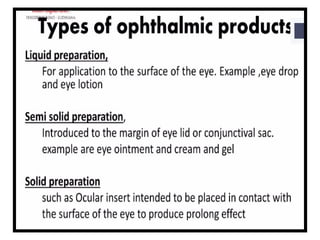
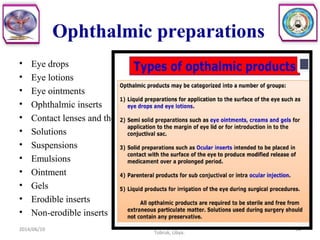
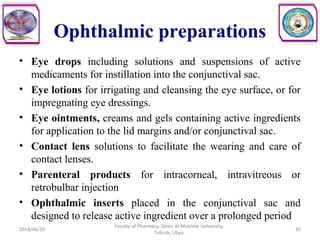
Ophthalmic preparations (eyepreparations) are sterile, liquid, semisolid, or
solid preparations that may contain one or more active pharmaceutical
ingredient(s) intended for application to the conjunctiva, the conjunctival sac
or the eyelids.
The choice of base and any excipients used for the preparation of ophthalmic
preparations must be proven through product development studies not to affect
adversely either the stability of the final product or the availability of the active
ingredients at the site of action.
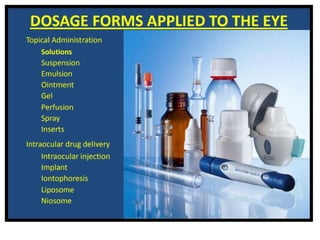
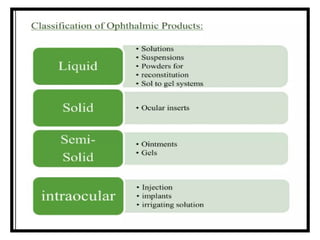
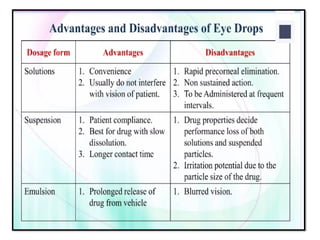
The most commonly employed ophthalmic dosage forms are solutions,
suspensions, and ointments.
But these preparations when instilled into the eye are rapidly drained away
from the ocular cavity due to tear flow and lachrymal nasal drainage.
3.
• Eye isthe most easily accessible site for topical administration of a
medication.
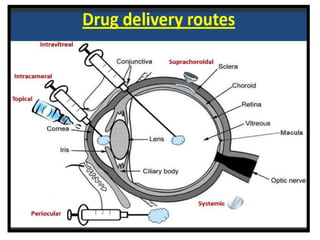
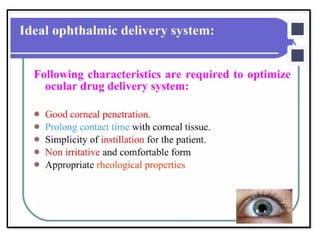
• Ideal ophthalmic drug delivery must be able to sustain the drug release and
to remain in the vicinity of front of the eye for prolong period.
• The newest dosage forms for ophthalmic drug delivery are: gels, gelforming
solutions, ocular inserts, intravitreal injections and implants.
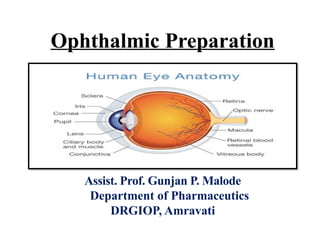
• (The eye sits in a protective bony socket called the orbit.
• Six extraocular muscles in the orbit are attached to the eye.
• These muscles move the eye up and down, side to side, and rotate the eye.
• The extraocular muscles are attached to the white part of the eye called the
sclera.)
Formulation of eyedrops:
Ophthalmic solutions are sterile solutions intended for instillation in the eye.
In addition to sterility, these dosage forms require the careful consideration of
such other pharmaceutical factors as the need for antimicrobial agents, osmolarity,
buffering, viscosity, and proper packaging.
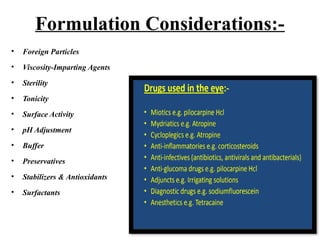
An eye drop formulation comprises of the following:
a) Active ingredients to produce desired therapeutic effect.
b) Vehicle(Aquous or Oily).
c) Inert antimicrobial preservatives to prevent microbial contamination and to
maintain sterility.
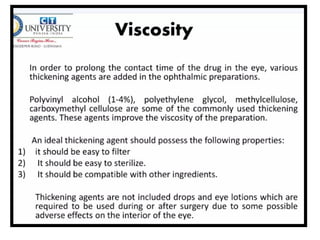
d) Inert adjuvants for adjusting tonicity, Viscosity and PH to increase the stability
of active ingredients.
22.
e) Suitable containerto maintain the preparation in a stable form and provide
protection against contamination during preparation, storage and use.
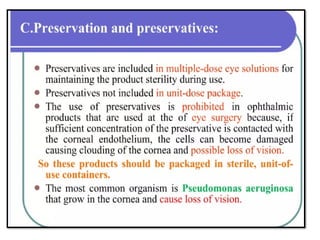
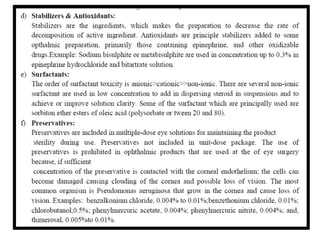
f) Multi dose eye drops are added with an effective antimicrobial preservative
system(a single substance cannot be successfully used as a preservative in
ophthalmic solution) that should pass the test for efficacy of antimicrobial
preservative. This ensures that the eye drops are sterile and non-contaminated.
27.
Formulation of EyeOintments:
Ophthalmic ointments must be sterile.
Like suspensions, ointments can be more difficult to manufacture in sterile
form.
They can be terminally sterilized, or, alternatively, they must be manufactured
from sterile ingredients in an aseptic environment.
Filtration through a suitable membrane or dry heat sterilization is often used.
The ointment base selected for an ophthalmic ointment must be non-irritating
to the eye and must permit the diffusion of the active ingredient throughout the
secretions bathing the eye.
Ointment bases utilized for ophthalmics have a melting or softening point close
to body temperature.
Ophthalmic ointments have a longer ocular contact time when compared to
many ophthalmic solutions.
28.
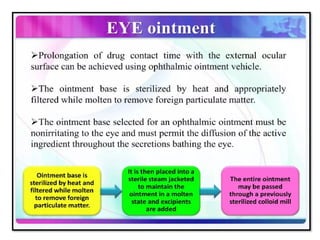
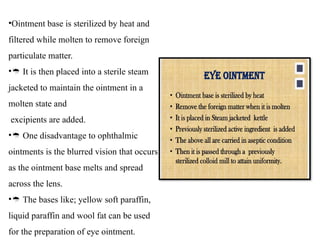
•Ointment base issterilized by heat and
filtered while molten to remove foreign
particulate matter.
• It is then placed into a sterile steam
jacketed to maintain the ointment in a
molten state and
excipients are added.
• One disadvantage to ophthalmic
ointments is the blurred vision that occurs
as the ointment base melts and spread
across the lens.
• The bases like; yellow soft paraffin,
liquid paraffin and wool fat can be used
for the preparation of eye ointment.
29.
Formulation of EyeLotions:-
Eye lotions are undiluted aqueous solutions, applied to an eye bath, which for
first aid purposes. It is may allow a large volume of fluid to flow quickly over the
eye.
It is iso-osmotic to tears, because compared to eye drops, lotions cause much
greater dilution of the lachrymal fluid, hence cause discomfort if not adjusted.e.g.
Sodium chloride (NaCl) eye lotion .
B.P.C. is used to remove foreign substance from the eye. Thus these preparations
should be very simple as well as the most common eye lotion consists of sterile
normal saline.
This preparation demonstrate the requirements of an eye lotion which are:
Sterile as well as usually containing no preservative.
Isotonic to lachrymal fluid
Natural pH
Large volume but not greater than 200ml
30.
Methods of Preparation:
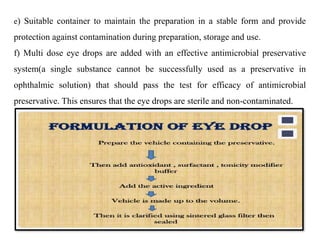
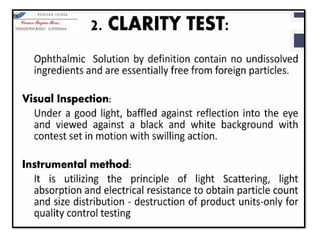
1)Preparation of the Solution: The aqueous eye drops vehicle containing suitable
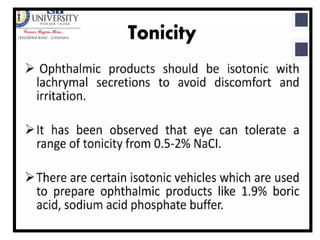
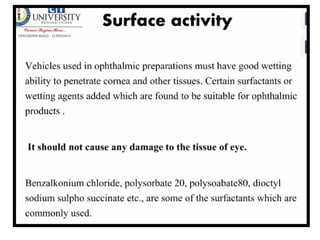
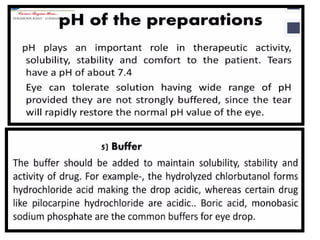
preservative, antioxidant , stabilizer, tonicity modifier , viscosity modifier, or buffer should
be prepared, and added with the active ingredient and the vehicle to make up the volume.
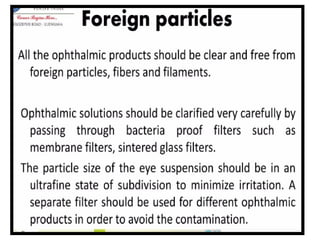
2) Clarification: sintered glass filters or membrane filters having 0.45-1.2 μm pore sizes
should be used. The clarified solution is either fillied directly into the final containers
which are sealed before heat sterilisation or is temporarily filled into a suitable
container before filtration. Clarified containers vehicle is used to prepare eye drop
suspensions filled into final containers and sealed before sterilisation.
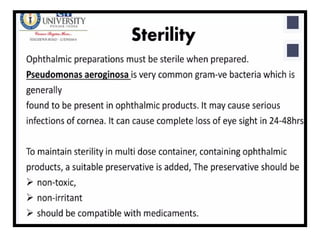
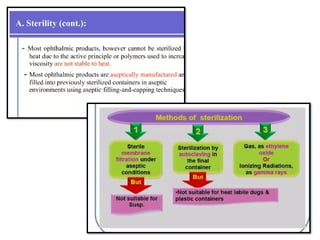
3) Sterilisation: This can be achieved by autoclaving at 115oC temperature for 30 minutes or
121o
C temperature for 15 minutes . Filtration into sterile containers through a membrane
filter having 0.22μm pore size is also a suitable method for sterililisation.Dry heat
sterilisation at 160o
C temperature for 2 hours is best suited for non-aqueous preparations
such as liquid paraffin eye drops.
4) After sterilisation, the eye drop containers should be covered with a readily breakable
seal to distinguish between opened and unopened containers.
31.
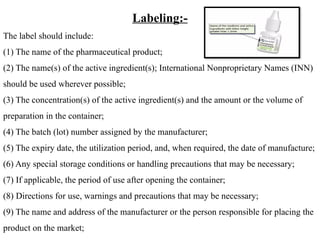
Labeling:-
The label shouldinclude:
(1) The name of the pharmaceutical product;
(2) The name(s) of the active ingredient(s); International Nonproprietary Names (INN)
should be used wherever possible;
(3) The concentration(s) of the active ingredient(s) and the amount or the volume of
preparation in the container;
(4) The batch (lot) number assigned by the manufacturer;
(5) The expiry date, the utilization period, and, when required, the date of manufacture;
(6) Any special storage conditions or handling precautions that may be necessary;
(7) If applicable, the period of use after opening the container;
(8) Directions for use, warnings and precautions that may be necessary;
(9) The name and address of the manufacturer or the person responsible for placing the
product on the market;
32.
10. If applicable,the name(s) and concentration(s) of antimicrobial agent(s)
and/or antioxidant(s)
incorporated in the preparation; and
(11) The statement "This preparation is sterile".
Storage:
•Ophthalmic preparations should maintain their integrity throughout their
shelf-life when stored at the temperature indicated on the label.
•Special storage recommendations
or limitations are indicated in individual
monographs.
33.
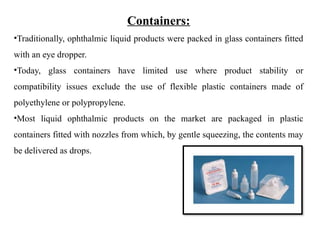
Containers:
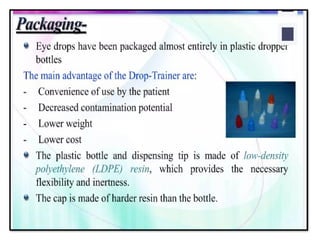
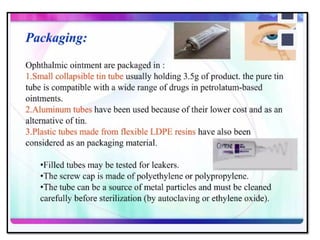
•Traditionally, ophthalmic liquidproducts were packed in glass containers fitted
with an eye dropper.
•Today, glass containers have limited use where product stability or
compatibility issues exclude the use of flexible plastic containers made of
polyethylene or polypropylene.
•Most liquid ophthalmic products on the market are packaged in plastic
containers fitted with nozzles from which, by gentle squeezing, the contents may
be delivered as drops.
35.
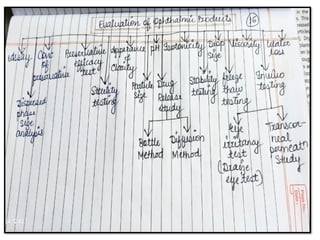
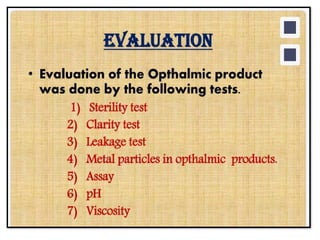
Evaluation of ophthalmicpreparations:-
Ophthalmic preparations are evaluated as follows:
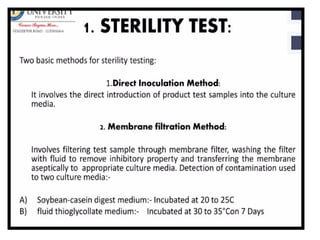
1) Sterility: The ophthalmic products should meet the standard requirements. If
the ingredients used do not lend themselves to routine sterilization, ingredients
that meet the sterility requirements should be used. The container for ophthalmic
preparations should be sterilized at the time of filing and closing. They should be
sealed and tamper-proof to maintain their sterility.
2) Antimicrobial preservatives: These should be added to multiple-dose
containers, unless there are different directions provided in the individual
monograph for multiple product withdrawal, the substance contains a
radionuclide with a physical half of less than 24hours, the product itself is
sufficiently microbicidal, or the added ingredients meet the requirements of
antimicrobial agent content. Thus, acceptance criteria for the content of
antimicrobial preservative in multiple-unit products should be established.
36.
3) Uniformity ofDosage Units: This test should be performed for single-dose
containers to evaluate the mass of dosage form as well as the content of the drug
substance(s) in the dosages form. The test is performed by either content uniformity
or weight variation.
4) Uniformity in Containers: Semisolid drug products undergo physical separation
during manufacturing and /or during the storage period. To ensure the drug product
integrity, the uniformity of the finished product at the time of batch release and
throughout its shelf-life should be evaluated.
5) Leachable and Extractables: The packaging system and the preparation should
not undergo any physical or chemical interaction to alter the strength, quality, or
purity of the drug product. The packaging system should meet the requirements in
elastomeric closures for injection, and glass or plastic containers.
6)Container Closure Integrity: The packaging system should be closed or sealed to
prevent contamination or loss of contents. It should also be tamper-proof.
37.
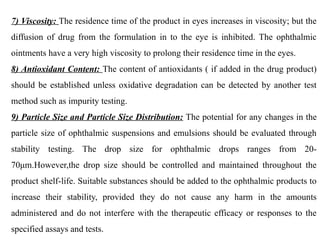
7) Viscosity: Theresidence time of the product in eyes increases in viscosity; but the
diffusion of drug from the formulation in to the eye is inhibited. The ophthalmic
ointments have a very high viscosity to prolong their residence time in the eyes.
8) Antioxidant Content: The content of antioxidants ( if added in the drug product)
should be established unless oxidative degradation can be detected by another test
method such as impurity testing.
9) Particle Size and Particle Size Distribution: The potential for any changes in the
particle size of ophthalmic suspensions and emulsions should be evaluated through
stability testing. The drop size for ophthalmic drops ranges from 20-
70μm.However,the drop size should be controlled and maintained throughout the
product shelf-life. Suitable substances should be added to the ophthalmic products to
increase their stability, provided they do not cause any harm in the amounts
administered and do not interfere with the therapeutic efficacy or responses to the
specified assays and tests.