Topic- Ophthalmic Preparation
Presented by
Hariom Jaiswal
Asst. Pro. B.PH 3rd
Year
Industrial Pharmacy
Rajiv Gandhi College of Pharmacy Nautanwa Maharajganj
UP 273164
CONTENT
1. Introduction
2. Ideal characteristics
3. Advantage and disadvantage
4. Types
5. Formulation considerations
6. Eye Drops
7. Eye Lotion
8. Eye Onitment
9. Container and Clouser
10. Quality Control of Opthalmic Products
INTRODUCTION
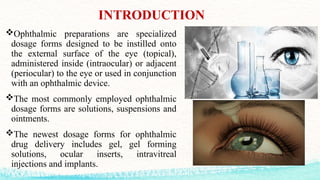
Ophthalmic preparations are specialized
dosage forms designed to be instilled onto
the external surface of the eye (topical),
administered inside (intraocular) or adjacent
(periocular) to the eye or used in conjunction
with an ophthalmic device.
The most commonly employed ophthalmic
dosage forms are solutions, suspensions and
ointments.
The newest dosage forms for ophthalmic
drug delivery includes gel, gel forming
solutions, ocular inserts, intravitreal
injections and implants.
IDEAL CHARACTERISTICS
Following characteristics are required to optimize ocular drug delivery
systems-
Good corneal penetration.
Prolong contact time with corneal tissue.
Non irritative and comfortable form.
Appropriate rheological properties.
The buffer system must be considered with tonicity and comfort in
mind.
pH must be optimum.
Must be free from foreign particles.
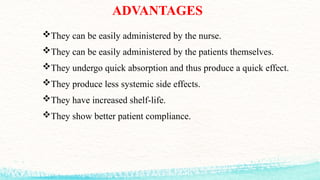
ADVANTAGES
They can be easily administered by the nurse.
They can be easily administered by the patients themselves.
They undergo quick absorption and thus produce a quick effect.
They produce less systemic side effects.
They have increased shelf-life.
They show better patient compliance.
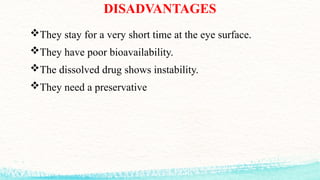
DISADVANTAGES
They stay for a very short time at the eye surface.
They have poor bioavailability.
The dissolved drug shows instability.
They need a preservative
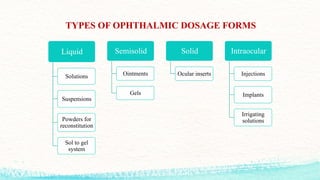
TYPES OF OPHTHALMIC DOSAGE FORMS
Liquid
Solutions
Suspensions
Powders for
reconstitution
Sol to gel
system
Semisolid
Ointments
Gels
Solid
Ocular inserts
Intraocular
Injections
Implants
Irrigating
solutions
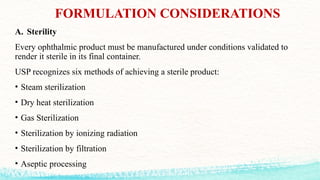
FORMULATION CONSIDERATIONS
A. Sterility
Every ophthalmic product must be manufactured under conditions validated to
render it sterile in its final container.
USP recognizes six methods of achieving a sterile product:
• Steam sterilization
• Dry heat sterilization
• Gas Sterilization
• Sterilization by ionizing radiation
• Sterilization by filtration
• Aseptic processing
B. Ocular toxicity and Irritation
• Albino rabbits are used to test the ocular toxicity and irritation of
ophthalmic formulations.
The procedure based on the examination of the conjunctiva, cornea or
the iris.
• USP procedure for plastic containers-
i. Containers are cleaned and sterilized as in the final packaged product.
ii. Extracted by submersion in saline and cottonseed oil.
iii. Topical ocular instillation of the extracts and blanks in rabbits is
completed and ocular changes examined.
C. Preservation and Preservatives
• Preservatives are included in multiple dose eye solutions for
maintaining the product sterility during use.
• The use of preservatives is prohibited in ophthalmic products that are
used at eye surgery because, if the sufficient amount of preservative
is contacted with the corneal endothelium, the cells can become
damage and possible loss of vision.
• The most common organism is Pseudomonas aeruginosa that grow
in the cornea and cause loss of vision.
D. Drug and Excipient interaction
• The formulator should predetermine the extent and nature of the
interactions between the drug and excipients and conduct sufficient
testing to develop an effective formulation.
E. Foreign Particles
All the ophthalmic products should be clear and free from foreign
particles, fibres and filaments.
Ophthalmic solutions should be clarified very carefully by passing
through bacteria proof filters such as membrane filters, sintered glass
filters.
The particle size of the eye suspension should be in an ultrafine state to
minimize irritation.
F. pH
pH plays an important role in therapeutic activity, solubility, stability
and comfort to the patient.
G. Viscosity
In order to prolong the contact time of the drug in the eye, various
thickening agents are added in the ophthalmic preparations.
Polyvinyl alcohol (1-4%), polyethylene glycol, methyl cellulose,
carboxy methyl cellulose are some of the commonly used thickening
agents.
An ideal thickening agent should possess the following properties-
• It should be easy to filter
• It should be easy to sterilize
• It should be compatible with the other ingredients
H. Sterility
Ophthalmic preparations must be sterile when prepared.
Pseudomonas aeruginosa is a very common gram –ve bacteria which
is generally found to be present in ophthalmic products. It can cause
complete loss of eye sight in 24-48 hrs.
To maintain sterility in multidose containers, preservatives are added-
• Non-toxic
• Non-irritant
• Should be compatible with medicaments.
I. Tonicity
• Ophthalmic products should be isotonic with lachrymal secretions to
avoid discomfort and irritation.
• A range of 0.2-2% NaCl equivalency does not cause any noticeable
pain and a range of about 0.2-0.7% should be acceptable for most
persons. e.g.- NaCl, KCl, Buffer salt, propylene glycol and mannitol.
J. Surface Activity
Vehicles used in the ophthalmic preparations must have good wetting
ability to penetrate cornea and other tissues.
It should not cause any damage to the tissue of eye.
e.g.- Benzalkonium chloride, polysorbate 20, polysorbate 80 are some
surfactants which are commonly used.
EYE DROPS
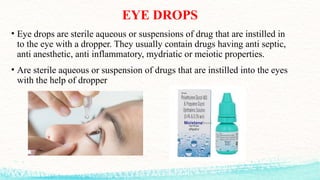
• Eye drops are sterile aqueous or suspensions of drug that are instilled in
to the eye with a dropper. They usually contain drugs having anti septic,
anti anesthetic, anti inflammatory, mydriatic or meiotic properties.
• Are sterile aqueous or suspension of drugs that are instilled into the eyes
with the help of dropper
METHOD OF PREPARION OF EYE DROPS
The eye drops are prepared in 4 stages.
1)Preparation of bactericidal and fungicidal vehicle:
The aqueous or oily vehicle is used in preparation of eye drops. The
aqueous vehicle may support bacterial or fungal growth,
so one of the following bactericide may be used to prepare the eye
drops,
I. Phenyl mercuric nitrate/ acetate 002%
II. Benzalkonium chloride 0.01%
III. Chlorhexidine acetate-0.01%
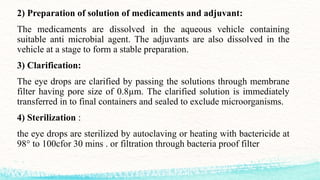
2) Preparation of solution of medicaments and adjuvant:
The medicaments are dissolved in the aqueous vehicle containing
suitable anti microbial agent. The adjuvants are also dissolved in the
vehicle at a stage to form a stable preparation.
3) Clarification:
The eye drops are clarified by passing the solutions through membrane
filter having pore size of 0.8µm. The clarified solution is immediately
transferred in to final containers and sealed to exclude microorganisms.
4) Sterilization :
the eye drops are sterilized by autoclaving or heating with bactericide at
98° to 100cfor 30 mins . or filtration through bacteria proof filter
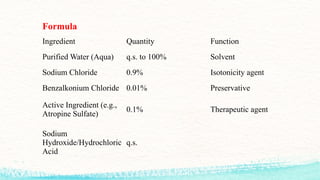
Formula
Ingredient Quantity Function
Purified Water (Aqua) q.s. to 100% Solvent
Sodium Chloride 0.9% Isotonicity agent
Benzalkonium Chloride 0.01% Preservative
Active Ingredient (e.g.,
Atropine Sulfate)
0.1% Therapeutic agent
Sodium
Hydroxide/Hydrochloric
Acid
q.s.
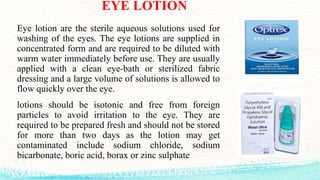
EYE LOTION
Eye lotion are the sterile aqueous solutions used for
washing of the eyes. The eye lotions are supplied in
concentrated form and are required to be diluted with
warm water immediately before use. They are usually
applied with a clean eye-bath or sterilized fabric
dressing and a large volume of solutions is allowed to
flow quickly over the eye.
lotions should be isotonic and free from foreign
particles to avoid irritation to the eye. They are
required to be prepared fresh and should not be stored
for more than two days as the lotion may get
contaminated include sodium chloride, sodium
bicarbonate, boric acid, borax or zinc sulphate
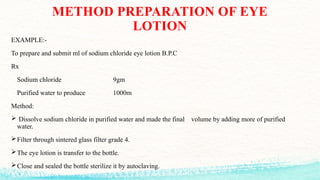
METHOD PREPARATION OF EYE
LOTION
EXAMPLE:-
To prepare and submit ml of sodium chloride eye lotion B.P.C
Rx
Sodium chloride 9gm
Purified water to produce 1000m
Method:
 Dissolve sodium chloride in purified water and made the final volume by adding more of purified
water.
Filter through sintered glass filter grade 4.
The eye lotion is transfer to the bottle.
Close and sealed the bottle sterilize it by autoclaving.
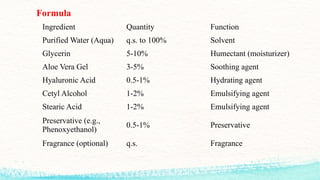
Formula
Ingredient Quantity Function
Purified Water (Aqua) q.s. to 100% Solvent
Glycerin 5-10% Humectant (moisturizer)
Aloe Vera Gel 3-5% Soothing agent
Hyaluronic Acid 0.5-1% Hydrating agent
Cetyl Alcohol 1-2% Emulsifying agent
Stearic Acid 1-2% Emulsifying agent
Preservative (e.g.,
Phenoxyethanol)
0.5-1% Preservative
Fragrance (optional) q.s. Fragrance
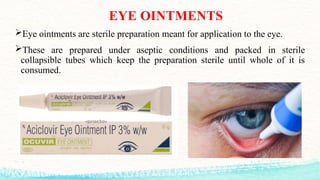
EYE OINTMENTS
Eye ointments are sterile preparation meant for application to the eye.
These are prepared under aseptic conditions and packed in sterile
collapsible tubes which keep the preparation sterile until whole of it is
consumed.
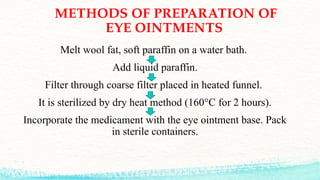
METHODS OF PREPARATION OF
EYE OINTMENTS
Melt wool fat, soft paraffin on a water bath.
Add liquid paraffin.
Filter through coarse filter placed in heated funnel.
It is sterilized by dry heat method (160°C for 2 hours).
Incorporate the medicament with the eye ointment base. Pack
in sterile containers.
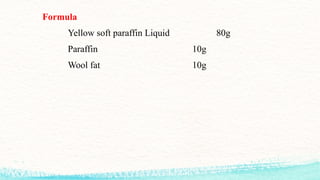
Formula
Yellow soft paraffin Liquid 80g
Paraffin 10g
Wool fat 10g
CONTAINERS USED IN OPHTHALMIC
PRODUCTS
Currently almost all commercially available ophthalmic products are
packaged in plastic containers.
advantages
ease of use,
less spillage,
little breakage-
have led to universal acceptance of these plastic packaging components,
The plastic bottles for packaging of ophthalmic products are
generally made of Low Density Polyethylene(LDPE), either with or
without any colorants or with opacifying agents. Polypropylene(PP) or
high density polyethylene(HDPE) are also used to meet specific product
requirements.
Eye drops (Single- dose containers):
Plastic bottles(LDPE) are widely used.
Eye drops(Multiple- dose containers):
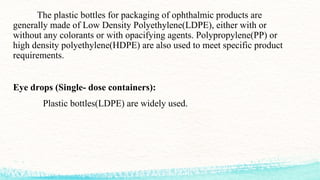
Traditionally, glass bottles with rubber teat dropper were widely
used. Now- a-days, plastic bottles(LDPE) are widely used.
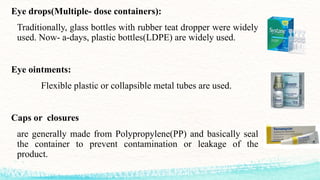
Eye ointments:
Flexible plastic or collapsible metal tubes are used.
Caps or closures
are generally made from Polypropylene(PP) and basically seal
the container to prevent contamination or leakage of the
product.
Glass container
• Neutral, Boro-silicate type glass(Type 1 glass) were widely
used as a container for ophthalmic preparations,
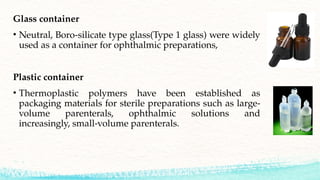
Plastic container
• Thermoplastic polymers have been established as
packaging materials for sterile preparations such as large-
volume parenterals, ophthalmic solutions and
increasingly, small-volume parenterals.
LABLLEING
The name of the pharmaceutical product.
The name(s) of the active ingredient(s).
The concentration of the active ingredients and the amount or the
volume of preparation in the container.
The batch number assigned by the manufacturer.
The expiry date, the utilization period, and, when required, the date of
manufacture.
 Any special storage conditions or handling precautions that may be
necessary.
If applicable, the period of use after opening the container.
EVALUATION OF OPHTHALMIC
PREPARATIONS
QUALITY CONTROL TESTS:
A. STERILITY TEST:
Two basic methods for sterility testing-
• Direct Inoculation Method
It involves the direct introduction of product test samples into the culture media.
• Membrane filtration Method
It involves filtering test sample through membrane filter, washing the filter with fluid to remove
inhibitory property and transferring the membrane aseptically to appropriate culture media.
Detection of contamination used to two culture media-
A. Soyabean-casein digest medium- Incubated at 20-25°C
B. Fluid thioglycolate medium- Incubated at 30-35°C on 7 days
B. CLARITY TEST:
This is done by two methods-
• Visual Inspection
Under a good light, baffled against reflection into the eye and viewed
against a black and white background.
• Instrumental Method
It is based on the principle of light scattering, light absorption and
electrical resistance to obtain particle count and size distribution-
destruction of product units for quality control testing.
Instrumental method utilizing video image projection detects moving
particles without destruction of product units.
C. LEAKER TEST:
• Select 10 tubes of the ointment with seals applied when specified.
• Thoroughly clean and dry the exterior surface of each tube with an
absorbent cloth.
• Place the tubes in horizontal position on a sheet of absorbent blotting
paper in an oven maintained at temperature of 60± 3°C for 8 hours.
• If leakage is observed from one, but more than one of the tubes repeat
the test with 20 additional tubes of the ointment.
• The requirement is met if no leakage is observed from the first 10
tubes tested or if leakage is observed from not more than one of 30
tubes tested.
D. METAL PARTICLES IN OPHTHALMIC OINTMENT:
• Extrude as completely as practicable the content of 10 tubes individually into
separate, clear, flat-bottom, 60mm petri dishes that are free from scratches.
• Cover the dishes and heat at 85°C for 2 hours, increasing the temperature slightly if
necessary to ensure that a fully fluid state is obtained.
• Taking precautions against disturbing the melted sample, allow each to cool to
room temperature and to solidify.
• Remove the cover and examine the bottom of petri dish for metal particles with
microscope with 30 time magnification equipped with an eye piece micrometer
disk.
• Count the number of metal particles that are 50μm or large.
• The requirements are met if the total number of metal particles in all 10 tubes does
not exceed 50 and if not more than 1 tube is found to contain more than 8 particles.
THANK
YOU

Ophtalmic Preparation. pptx

  • 1.
    Topic- Ophthalmic Preparation Presentedby Hariom Jaiswal Asst. Pro. B.PH 3rd Year Industrial Pharmacy Rajiv Gandhi College of Pharmacy Nautanwa Maharajganj UP 273164
  • 2.
    CONTENT 1. Introduction 2. Idealcharacteristics 3. Advantage and disadvantage 4. Types 5. Formulation considerations 6. Eye Drops 7. Eye Lotion 8. Eye Onitment 9. Container and Clouser 10. Quality Control of Opthalmic Products
  • 3.
    INTRODUCTION Ophthalmic preparations arespecialized dosage forms designed to be instilled onto the external surface of the eye (topical), administered inside (intraocular) or adjacent (periocular) to the eye or used in conjunction with an ophthalmic device. The most commonly employed ophthalmic dosage forms are solutions, suspensions and ointments. The newest dosage forms for ophthalmic drug delivery includes gel, gel forming solutions, ocular inserts, intravitreal injections and implants.
  • 4.
    IDEAL CHARACTERISTICS Following characteristicsare required to optimize ocular drug delivery systems- Good corneal penetration. Prolong contact time with corneal tissue. Non irritative and comfortable form. Appropriate rheological properties. The buffer system must be considered with tonicity and comfort in mind. pH must be optimum. Must be free from foreign particles.
  • 5.
    ADVANTAGES They can beeasily administered by the nurse. They can be easily administered by the patients themselves. They undergo quick absorption and thus produce a quick effect. They produce less systemic side effects. They have increased shelf-life. They show better patient compliance.
  • 6.
    DISADVANTAGES They stay fora very short time at the eye surface. They have poor bioavailability. The dissolved drug shows instability. They need a preservative
  • 7.
    TYPES OF OPHTHALMICDOSAGE FORMS Liquid Solutions Suspensions Powders for reconstitution Sol to gel system Semisolid Ointments Gels Solid Ocular inserts Intraocular Injections Implants Irrigating solutions
  • 8.
    FORMULATION CONSIDERATIONS A. Sterility Everyophthalmic product must be manufactured under conditions validated to render it sterile in its final container. USP recognizes six methods of achieving a sterile product: • Steam sterilization • Dry heat sterilization • Gas Sterilization • Sterilization by ionizing radiation • Sterilization by filtration • Aseptic processing
  • 9.
    B. Ocular toxicityand Irritation • Albino rabbits are used to test the ocular toxicity and irritation of ophthalmic formulations. The procedure based on the examination of the conjunctiva, cornea or the iris. • USP procedure for plastic containers- i. Containers are cleaned and sterilized as in the final packaged product. ii. Extracted by submersion in saline and cottonseed oil. iii. Topical ocular instillation of the extracts and blanks in rabbits is completed and ocular changes examined.
  • 10.
    C. Preservation andPreservatives • Preservatives are included in multiple dose eye solutions for maintaining the product sterility during use. • The use of preservatives is prohibited in ophthalmic products that are used at eye surgery because, if the sufficient amount of preservative is contacted with the corneal endothelium, the cells can become damage and possible loss of vision. • The most common organism is Pseudomonas aeruginosa that grow in the cornea and cause loss of vision. D. Drug and Excipient interaction • The formulator should predetermine the extent and nature of the interactions between the drug and excipients and conduct sufficient testing to develop an effective formulation.
  • 11.
    E. Foreign Particles Allthe ophthalmic products should be clear and free from foreign particles, fibres and filaments. Ophthalmic solutions should be clarified very carefully by passing through bacteria proof filters such as membrane filters, sintered glass filters. The particle size of the eye suspension should be in an ultrafine state to minimize irritation. F. pH pH plays an important role in therapeutic activity, solubility, stability and comfort to the patient.
  • 12.
    G. Viscosity In orderto prolong the contact time of the drug in the eye, various thickening agents are added in the ophthalmic preparations. Polyvinyl alcohol (1-4%), polyethylene glycol, methyl cellulose, carboxy methyl cellulose are some of the commonly used thickening agents. An ideal thickening agent should possess the following properties- • It should be easy to filter • It should be easy to sterilize • It should be compatible with the other ingredients
  • 13.
    H. Sterility Ophthalmic preparationsmust be sterile when prepared. Pseudomonas aeruginosa is a very common gram –ve bacteria which is generally found to be present in ophthalmic products. It can cause complete loss of eye sight in 24-48 hrs. To maintain sterility in multidose containers, preservatives are added- • Non-toxic • Non-irritant • Should be compatible with medicaments.
  • 14.
    I. Tonicity • Ophthalmicproducts should be isotonic with lachrymal secretions to avoid discomfort and irritation. • A range of 0.2-2% NaCl equivalency does not cause any noticeable pain and a range of about 0.2-0.7% should be acceptable for most persons. e.g.- NaCl, KCl, Buffer salt, propylene glycol and mannitol. J. Surface Activity Vehicles used in the ophthalmic preparations must have good wetting ability to penetrate cornea and other tissues. It should not cause any damage to the tissue of eye. e.g.- Benzalkonium chloride, polysorbate 20, polysorbate 80 are some surfactants which are commonly used.
  • 15.
    EYE DROPS • Eyedrops are sterile aqueous or suspensions of drug that are instilled in to the eye with a dropper. They usually contain drugs having anti septic, anti anesthetic, anti inflammatory, mydriatic or meiotic properties. • Are sterile aqueous or suspension of drugs that are instilled into the eyes with the help of dropper
  • 16.
    METHOD OF PREPARIONOF EYE DROPS The eye drops are prepared in 4 stages. 1)Preparation of bactericidal and fungicidal vehicle: The aqueous or oily vehicle is used in preparation of eye drops. The aqueous vehicle may support bacterial or fungal growth, so one of the following bactericide may be used to prepare the eye drops, I. Phenyl mercuric nitrate/ acetate 002% II. Benzalkonium chloride 0.01% III. Chlorhexidine acetate-0.01%
  • 17.
    2) Preparation ofsolution of medicaments and adjuvant: The medicaments are dissolved in the aqueous vehicle containing suitable anti microbial agent. The adjuvants are also dissolved in the vehicle at a stage to form a stable preparation. 3) Clarification: The eye drops are clarified by passing the solutions through membrane filter having pore size of 0.8µm. The clarified solution is immediately transferred in to final containers and sealed to exclude microorganisms. 4) Sterilization : the eye drops are sterilized by autoclaving or heating with bactericide at 98° to 100cfor 30 mins . or filtration through bacteria proof filter
  • 18.
    Formula Ingredient Quantity Function PurifiedWater (Aqua) q.s. to 100% Solvent Sodium Chloride 0.9% Isotonicity agent Benzalkonium Chloride 0.01% Preservative Active Ingredient (e.g., Atropine Sulfate) 0.1% Therapeutic agent Sodium Hydroxide/Hydrochloric Acid q.s.
  • 19.
    EYE LOTION Eye lotionare the sterile aqueous solutions used for washing of the eyes. The eye lotions are supplied in concentrated form and are required to be diluted with warm water immediately before use. They are usually applied with a clean eye-bath or sterilized fabric dressing and a large volume of solutions is allowed to flow quickly over the eye. lotions should be isotonic and free from foreign particles to avoid irritation to the eye. They are required to be prepared fresh and should not be stored for more than two days as the lotion may get contaminated include sodium chloride, sodium bicarbonate, boric acid, borax or zinc sulphate
  • 20.
    METHOD PREPARATION OFEYE LOTION EXAMPLE:- To prepare and submit ml of sodium chloride eye lotion B.P.C Rx Sodium chloride 9gm Purified water to produce 1000m Method:  Dissolve sodium chloride in purified water and made the final volume by adding more of purified water. Filter through sintered glass filter grade 4. The eye lotion is transfer to the bottle. Close and sealed the bottle sterilize it by autoclaving.
  • 21.
    Formula Ingredient Quantity Function PurifiedWater (Aqua) q.s. to 100% Solvent Glycerin 5-10% Humectant (moisturizer) Aloe Vera Gel 3-5% Soothing agent Hyaluronic Acid 0.5-1% Hydrating agent Cetyl Alcohol 1-2% Emulsifying agent Stearic Acid 1-2% Emulsifying agent Preservative (e.g., Phenoxyethanol) 0.5-1% Preservative Fragrance (optional) q.s. Fragrance
  • 22.
    EYE OINTMENTS Eye ointmentsare sterile preparation meant for application to the eye. These are prepared under aseptic conditions and packed in sterile collapsible tubes which keep the preparation sterile until whole of it is consumed.
  • 23.
    METHODS OF PREPARATIONOF EYE OINTMENTS Melt wool fat, soft paraffin on a water bath. Add liquid paraffin. Filter through coarse filter placed in heated funnel. It is sterilized by dry heat method (160°C for 2 hours). Incorporate the medicament with the eye ointment base. Pack in sterile containers.
  • 24.
    Formula Yellow soft paraffinLiquid 80g Paraffin 10g Wool fat 10g
  • 25.
    CONTAINERS USED INOPHTHALMIC PRODUCTS Currently almost all commercially available ophthalmic products are packaged in plastic containers. advantages ease of use, less spillage, little breakage- have led to universal acceptance of these plastic packaging components,
  • 26.
    The plastic bottlesfor packaging of ophthalmic products are generally made of Low Density Polyethylene(LDPE), either with or without any colorants or with opacifying agents. Polypropylene(PP) or high density polyethylene(HDPE) are also used to meet specific product requirements. Eye drops (Single- dose containers): Plastic bottles(LDPE) are widely used.
  • 27.
    Eye drops(Multiple- dosecontainers): Traditionally, glass bottles with rubber teat dropper were widely used. Now- a-days, plastic bottles(LDPE) are widely used. Eye ointments: Flexible plastic or collapsible metal tubes are used. Caps or closures are generally made from Polypropylene(PP) and basically seal the container to prevent contamination or leakage of the product.
  • 28.
    Glass container • Neutral,Boro-silicate type glass(Type 1 glass) were widely used as a container for ophthalmic preparations, Plastic container • Thermoplastic polymers have been established as packaging materials for sterile preparations such as large- volume parenterals, ophthalmic solutions and increasingly, small-volume parenterals.
  • 29.
    LABLLEING The name ofthe pharmaceutical product. The name(s) of the active ingredient(s). The concentration of the active ingredients and the amount or the volume of preparation in the container. The batch number assigned by the manufacturer. The expiry date, the utilization period, and, when required, the date of manufacture.  Any special storage conditions or handling precautions that may be necessary. If applicable, the period of use after opening the container.
  • 30.
    EVALUATION OF OPHTHALMIC PREPARATIONS QUALITYCONTROL TESTS: A. STERILITY TEST: Two basic methods for sterility testing- • Direct Inoculation Method It involves the direct introduction of product test samples into the culture media. • Membrane filtration Method It involves filtering test sample through membrane filter, washing the filter with fluid to remove inhibitory property and transferring the membrane aseptically to appropriate culture media. Detection of contamination used to two culture media- A. Soyabean-casein digest medium- Incubated at 20-25°C B. Fluid thioglycolate medium- Incubated at 30-35°C on 7 days
  • 31.
    B. CLARITY TEST: Thisis done by two methods- • Visual Inspection Under a good light, baffled against reflection into the eye and viewed against a black and white background. • Instrumental Method It is based on the principle of light scattering, light absorption and electrical resistance to obtain particle count and size distribution- destruction of product units for quality control testing. Instrumental method utilizing video image projection detects moving particles without destruction of product units.
  • 32.
    C. LEAKER TEST: •Select 10 tubes of the ointment with seals applied when specified. • Thoroughly clean and dry the exterior surface of each tube with an absorbent cloth. • Place the tubes in horizontal position on a sheet of absorbent blotting paper in an oven maintained at temperature of 60± 3°C for 8 hours. • If leakage is observed from one, but more than one of the tubes repeat the test with 20 additional tubes of the ointment. • The requirement is met if no leakage is observed from the first 10 tubes tested or if leakage is observed from not more than one of 30 tubes tested.
  • 33.
    D. METAL PARTICLESIN OPHTHALMIC OINTMENT: • Extrude as completely as practicable the content of 10 tubes individually into separate, clear, flat-bottom, 60mm petri dishes that are free from scratches. • Cover the dishes and heat at 85°C for 2 hours, increasing the temperature slightly if necessary to ensure that a fully fluid state is obtained. • Taking precautions against disturbing the melted sample, allow each to cool to room temperature and to solidify. • Remove the cover and examine the bottom of petri dish for metal particles with microscope with 30 time magnification equipped with an eye piece micrometer disk. • Count the number of metal particles that are 50μm or large. • The requirements are met if the total number of metal particles in all 10 tubes does not exceed 50 and if not more than 1 tube is found to contain more than 8 particles.
  • 34.