Layout of Pharmaceutical
Building and Services
Presented by: Guided by:
Himal Barakoti Ananta Choudhury
M. Pharm, 1st Sem Associate Professor
Department of Pharmacy Department of Pharmacy
Assam Down Town University Assam Down Town University
Contents:
 GMP: Introduction
 History and Importance
 Basic requirements
 Layout of Buildings and services
 ISO certification
 References
Department of Pharmacy, Assam Down Town University
2/17/2018
2
Human Life
 Today, we live almost twice longer than the generations living in the beginning
of the last century.
 Our life expectancy has increased 35-70 years in last 100 years.
 Scientist are making new breakthroughs everyday. Better understanding of
Human biology also taught us how to improve sanitation, hygiene and fight
against diseases.
 Food and Drug play very important role in normal physiology.
Department of Pharmacy, Assam Down Town University 2/17/2018
3
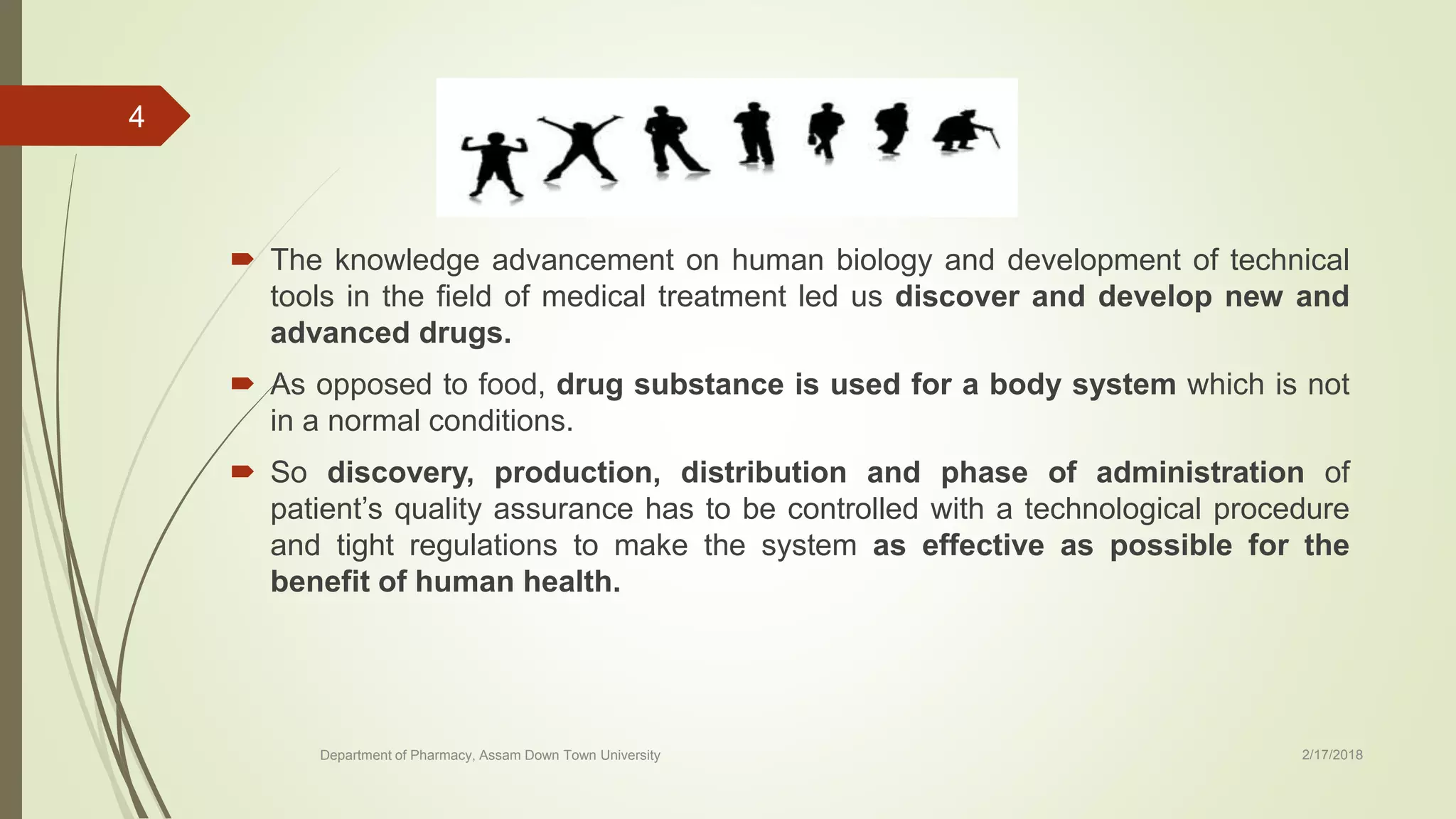
 The knowledge advancement on human biology and development of technical
tools in the field of medical treatment led us discover and develop new and
advanced drugs.
 As opposed to food, drug substance is used for a body system which is not
in a normal conditions.
 So discovery, production, distribution and phase of administration of
patient’s quality assurance has to be controlled with a technological procedure
and tight regulations to make the system as effective as possible for the
benefit of human health.
Department of Pharmacy, Assam Down Town University 2/17/2018
4
2/17/2018Department of Pharmacy, Assam Down Town University
5
cGMP
 Good manufacturing practice is that part of quality assurance which
insures that products are consistently produced and controlled to the
quality standards appropriate to their intended use and as required by
marketing authorization.
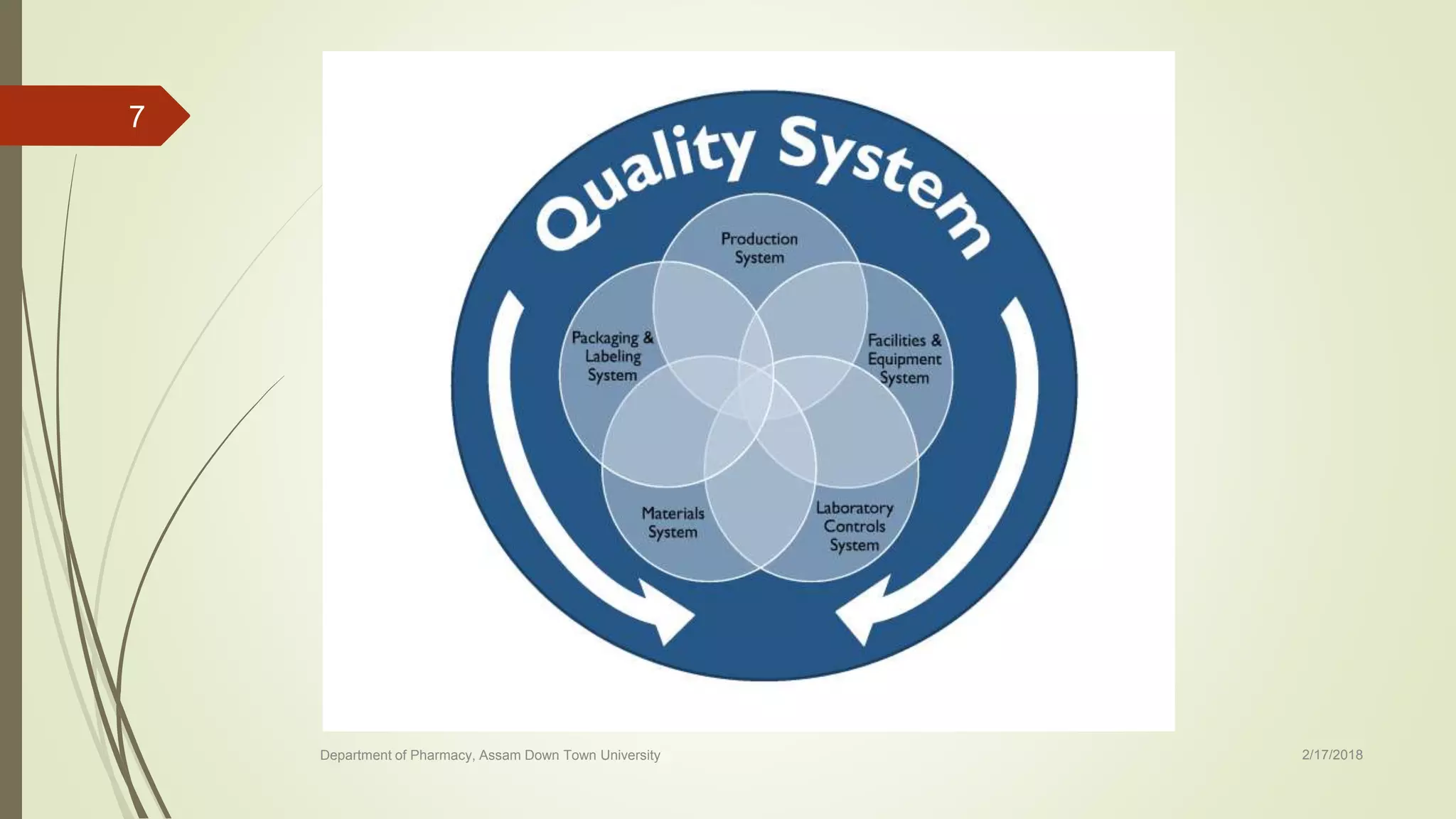
 GMP guideline typically comprise strong recommendations on
quality management, personnel, production facilities and
equipment, documentation and records, production and in-
process controls, validation, complaints and recall.
Department of Pharmacy, Assam Down Town University 2/17/2018
6
2/17/2018Department of Pharmacy, Assam Down Town University
7
A GMP timeline
 1906 pure Food and Drug act
creates one of the first government regulatory agencies (also known as
FDA); the culmination of 25 years of lobbying, this act makes it illegal to sell
“adulterated” or “misbranded” food or drugs.
 1938 federal food, drug and cosmetics (FD&C) Act
Tragedy: sulfanilamide made with poisonous solvent causes 107 death.
Result: requires manufacture to prove the safety of products before marketing
Department of Pharmacy, Assam Down Town University 2/17/2018
8
2/17/2018Department of Pharmacy, Assam Down Town University
9
A GMP timeline
 1941 Two unrelated events
Insulin Amendment requires FDA to test and certify purity and potency of
insulin.
Tragedy: Nearly 300 deaths and injuries from distribution of sulfathiazole
tablets tainted with phenobarbital.
Results: FDA revises manufacturing and quality controls drastically, the
beginning of what will later be called GMPs
Department of Pharmacy, Assam Down Town University 2/17/2018
10
2/17/2018Department of Pharmacy, Assam Down Town University
11
A GMP timeline
 1962 Kefauver-Harris Drug Amendments
Tragedy: Thalidomide catastrophe (10,000 cases worldwide, 40% survived)
Result: Manufacturer must prove efficacy and stricter control over drug testing
was ensured
 1978 cGMP ‘s Final rules for drug and devices
Establishes minimum current GMPs for manufacturing, processing, packaging
or holding drug products and medical devices
Department of Pharmacy, Assam Down Town University 2/17/2018
12
The Thalidomide Tragedy: Lessons for Drug Safety and Regulation
2/17/2018Department of Pharmacy, Assam Down Town University
13
A GMP timeline
 The first version of GMP guidelines was introduced by US FDA in 1963.
 WHO version of GMP prepared in 1967.
 From then, there have been several amendments and extensions of the
guidelines and many countries developed their own GMP guidelines which are
based on WHO guidelines.
Department of Pharmacy, Assam Down Town University 2/17/2018
14
Worldwide Enforcement of GMP
Country Regulatory Body
United states Food and Drug Administration (FDA)
United Kingdom Medicines and Healthcare Products
Regulatory Agency (MHRA)
Australia Therapeutical Goods Administration
(TGA)
India Ministry of Health (MoH)
Nepal Department of Drug Administration (DDA)
Department of Pharmacy, Assam Down Town University 2/17/2018
15
Importance
2/17/2018Department of Pharmacy, Assam Down Town University
16
Why GMP??
 Poor quality medicines are not only a health hazard, but a waste of money for
both governments and individuals.
 A poor quality medicine may contain toxic substances that have been
unintentionally added.
 A medicine that contain little or none of the claimed ingredient will not have the
intended therapeutic effect.
 A consumer usually cannot detect (through smell, touch or sight) that a drug
product is safe/efficacious.
Department of Pharmacy, Assam Down Town University 2/17/2018
17
Ultimate “Quality” goal: Patient Safety
 Therefore, it is important that drugs are manufactured under conditions and
practices required by the cGMP regulations to assure that quality is built into
the design and manufacturing process at every step.
 Facilities that are in good condition, equipment that is properly maintained
and calibrated, employees who are qualified and fully trained and process
that are reliable and reproducible, are few requirements to assure safety and
efficacy.
Department of Pharmacy, Assam Down Town University 2/17/2018
18
Basic requirements of cGMP
 Personnel
 Premises and industrial layout
 Sanitation and Hygiene
 Water Treatment System
 Validation and Qualification
 Equipment Materials
 Documentation
 Self Inspection
 HVAC System ISO 9001:2008
 ISO 14001:2004, 9000 series
Department of Pharmacy, Assam Down Town University 2/17/2018
19
Layout
2/17/2018Department of Pharmacy, Assam Down Town University
20
Layout of building and services
 Means all buildings where manufacture of the products will take place.
 Conditions that’s exist within them and the area of location.
 Important aspect to be kept along to ensure suitability of the operation
 Location
 Design
 Construction
 Adaptation (new processes + future extensions)
 Maintenance
Department of Pharmacy, Assam Down Town University 2/17/2018
21
 Important to understand the manufacturing processes and conduct the facility
programming.
 Facility layout must be an integrated design that
 satisfies the following:
• Process requirements
• Personnel flows
• Material flows (product, component and raw material
movements)
• Equipment layout requirements
• Operational access requirements
• Maintenance access requirements
Department of Pharmacy, Assam Down Town University 2/17/2018
22
 During the programming phase, the firm must define their true needs…they must
separate the “must have” objectives from their “wants” objectives.
 This is often a very time consuming effort, since each department needs to
re-think what is truly mandatory for their operation versus those items that
are desirable, but not essential to successful operations.
Formal decision analysis may need to be performed.
 The designer must first understand the product and process requirements.
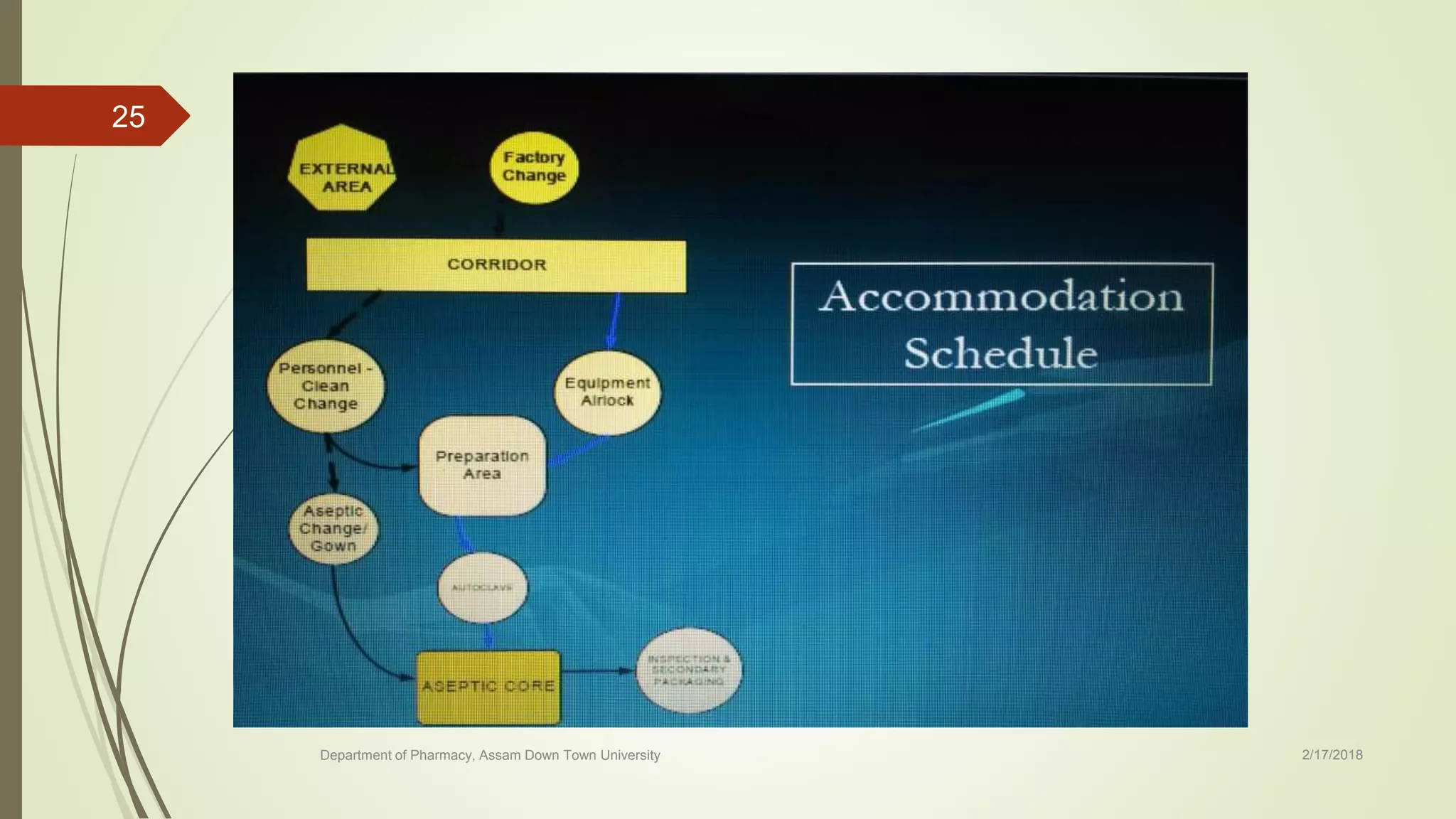
 Accommodation Schedule is the first step
Accommodation conceptual equipment and
schedule layout facility layout
Department of Pharmacy, Assam Down Town University 2/17/2018
23
 Accommodation Schedule:
• Defines all areas that can influence unit operations required for
manufacturing as well as the relationships and flows between them
• Materials and personnel are primary focus
• Can be developed once the process is known
– All process flow diagrams should be complete
• Also referred to as logic diagrams, or bubble diagrams
Department of Pharmacy, Assam Down Town University 2/17/2018
24
Department of Pharmacy, Assam Down Town University 2/17/2018
25
 Conceptual Layout
• Derived from Accommodation Schedule and equipment sizing needs
• Building blocks of equipment lines are developed
• Blocks of rooms are assembled based on necessary process
requirement.
Department of Pharmacy, Assam Down Town University 2/17/2018
26
 Equipment Layout
• Scaled drawing derived from conceptual layout
• Defines precise room sizes, structural grids and access routes
• Building and fire codes are established in this phase. Building blocks of
equipment lines are developed
• Blocks of rooms are assembled based on necessary adjacencies and process
requirements
• Part of detail design phase of project life cycle
Department of Pharmacy, Assam Down Town University 2/17/2018
27
After Equipment Layout Drawings are prepared, establish
 Material and Personnel Flows
• Superimposed on Equipment Layout Drawings
• Typically superimposed with directional arrows
• Primary purpose is to illustrate how to eliminate or minimize the potential for
contamination of the clean room product and personnel.
• Layout should prevent cross contamination
• One-way flow always preferred
• Provide separate entry and exit ways of possible, particularly in changing areas.
Department of Pharmacy, Assam Down Town University 2/17/2018
28
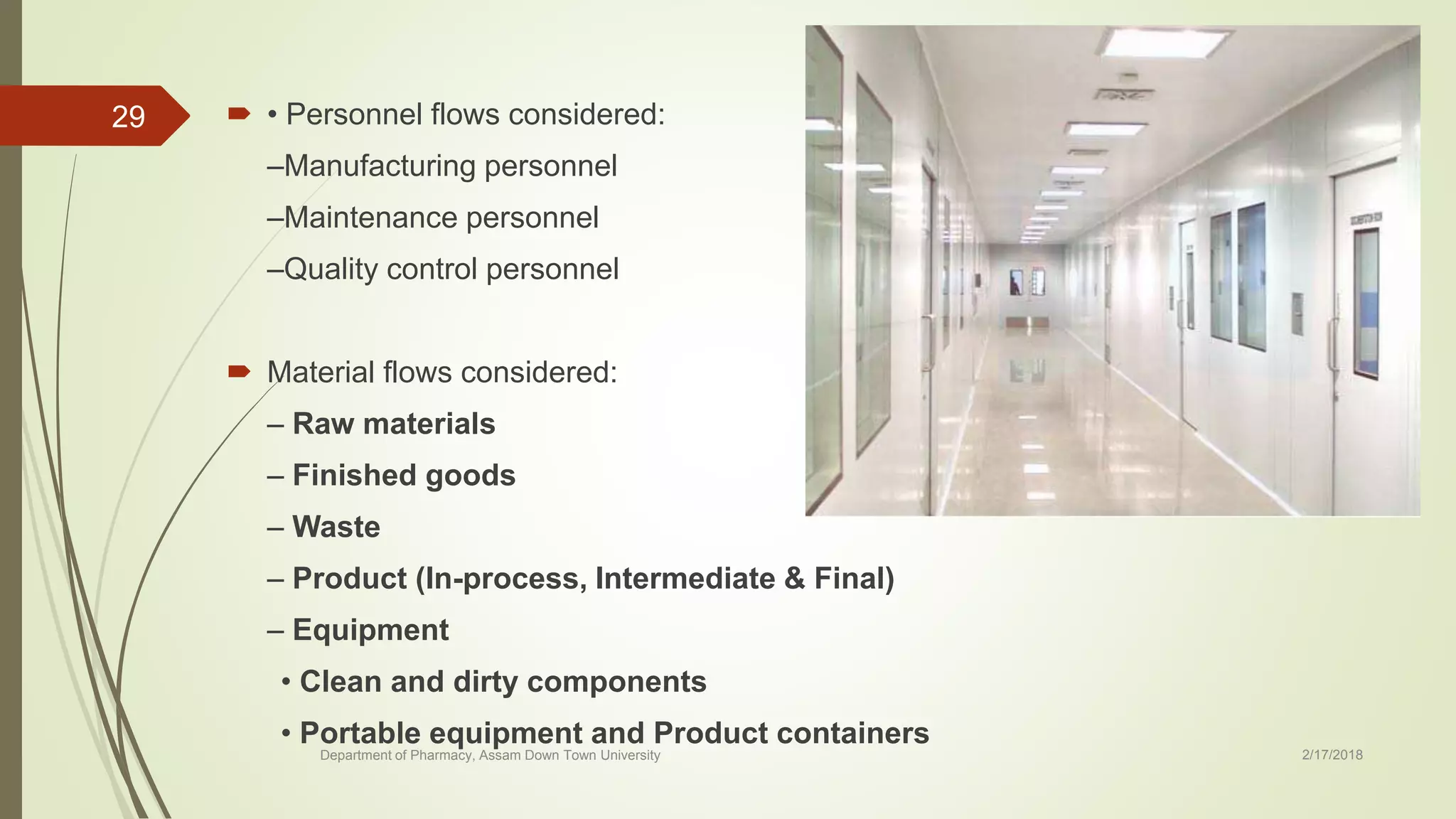
 • Personnel flows considered:
–Manufacturing personnel
–Maintenance personnel
–Quality control personnel
 Material flows considered:
– Raw materials
– Finished goods
– Waste
– Product (In-process, Intermediate & Final)
– Equipment
• Clean and dirty components
• Portable equipment and Product containers
Department of Pharmacy, Assam Down Town University 2/17/2018
29
Considerations
 Provide sufficient space for operations
• Provide sufficient space for movement, equipment access and egress for
life safety code requirements
• Rooms must be sized only after fully understanding what goes into the room,
and the process that takes place between the four walls
• Can’t overlook need for extra space for portable items brought into the room,
such as carts.
• Mechanical and electrical equipment panels also need to be taken into
account.
Department of Pharmacy, Assam Down Town University 2/17/2018
30
 Cost considerations in layout design:
• Layout has significant impact on the amount of materials and therefore facility
cost
• Minimize perimeter vs. internal area, to reduce costs of external load bearing walls
and insulation.
• Simple plan shapes are most economical
– Square maximizes internal area, minimizes perimeter
• Minimize size of clean corridors and staging areas
• Minimize height of building to extent possible.
Height increases cost due to:
– Increase in amount of perimeter wall for a given total floor area
– Increased load on the structure (Heavier load on columns and footings)
– Additional hoisting of materials and extra time taken by operators to reach the
higher floors
Department of Pharmacy, Assam Down Town University 2/17/2018
31
Layout Design
 Adequate space for future extension.
 Availability of water supply (Quality and Quantity), power, fuel sewage and
waste stream removal.
 Availability of public transport.
 Proximity of undesirable activity.
 Accessibility to interrelated operation.
 Advocating for law to restrict undesirable activities while allowing anticipated
development.
Department of Pharmacy, Assam Down Town University 2/17/2018
32
Principle
 The layout and design should aim to:
• minimize risks of error
• Permit effective maintenance
• Avoid cross-contamination, build-up of dirt and dust
• Avoid any adverse effect on the quality of products.
Design……….
 Process flow
 Material flow
People flow
Ensure logical flow
Department of Pharmacy, Assam Down Town University 2/17/2018
33
Department of Pharmacy, Assam Down Town University 2/17/2018
34
2/17/2018Department of Pharmacy, Assam Down Town University
35
2/17/2018Department of Pharmacy, Assam Down Town University
36
2/17/2018Department of Pharmacy, Assam Down Town University
37
construction
 Suitable materials
 Electrical supply
 Suitable lighting
 Temperature and relative humidity control
 Appropriate and effective ventilation
These may affect products during manufacture or storage as well as
functioning of equipment.
Department of Pharmacy, Assam Down Town University 2/17/2018
38
Electricity
 Continuity of electrical supply is essential for a number of systems or processes
(air supply and extraction, particularly for sterile manufacture;
fermentation plants; incubators; stability chambers) and thus backup
systems should be available in the event of mains failure.
 In general, electrical supply is made through concealed wiring with five wires (3
phase wires, one neutral and one ground wire) for three-phase
connections and three wires (only 1 phase wire) for single phase connection
using suitable size wires.
 Usually, red, yellow and blue are used for phase wires , black for neutral and
green for grounded connection.
Department of Pharmacy, Assam Down Town University 2/17/2018
39
Suitable lighting
 Lighting levels should be adequate to permit operators to do their work
properly, accurately and attentively. Lighting of production and packing areas
should be enable good vision.
 To avoid photo degradation, a suitable light using sodium vapor lamp is to be
provided with dispensing/sampling booth for weighing/sampling of highly light
sensitive materials.
Department of Pharmacy, Assam Down Town University 2/17/2018
40
Department of Pharmacy, Assam Down Town University 2/17/2018
41
Suitable lighting level requirements
φ * 1.25 * A
N= η * Lumens per lamp
Where, N= number of lights
φ = required lux
1.25 = maintenance factor
A = Room area in sq. mt.
η = coefficient of utilization ≈ 0.7
Department of Pharmacy, Assam Down Town University 2/17/2018
42
 Example:
Required lux 300
Room size = 4m * 3m = 12 sq. mt
Tube light of 1*40 w gives 2700 lumen at working height
300 * 1.25 * 12
N = η * 2700
= 2.38 ≈ 3 lights
Department of Pharmacy, Assam Down Town University 2/17/2018
43
Specific areas
 5 specific areas:
1. Ancillary areas
2. Storage areas
3. Weighing areas
4. Production areas
5. Quality control areas
Department of Pharmacy, Assam Down Town University 2/17/2018
44
1. Ancillary areas
 Rest and refreshment rooms separate from manufacturing and quality
control areas
 Changing , washing and toilets areas accessible and appropriate numbers
 Maintenance workshops separated from production – if not possible – tools in
reserved areas
 Animal house well isolated – separate handling and entrance
Department of Pharmacy, Assam Down Town University 2/17/2018
45
The recommended number of toilets
Note: 1 additional toilet for each 40 employees above 150 employees above 150
employees or user
Department of Pharmacy, Assam Down Town University
Number of Employees Number of toilets recommended
1-15
16-35
36-55
56-80
81-110
110-150
1
2
3
4
5
6
2/17/2018
46
2. Storage areas
Department of Pharmacy, Assam Down Town University
 Storage areas of sufficient capacity
 Separate and segregated areas: starting materials, packaging materials,
intermediates, bulk, finished products, quarantined, released, rejected,
returned and recalled products and materials
 Appropriate temperature and relative humidity conditions within defined limits
• Provided, controlled, monitored and recorded
• Storage conditions in label
 Normal conditions: 15-30 ˚C
 Cool room: 8-15 ˚C
 Cold: 2-8 ˚C
 Protect from humidity: less than 60% (material kept in hermetically
sealed container)
2/17/2018
47
Storage areas
 Quarantine area: clearly marked and access restricted
 A separate sampling area is the norm: no risk for contamination or cross-
contamination (sampling booth)
 Segregated areas for rejected, recalled and returned materials and products
 Safe and secured areas for highly active, radioactive materials, narcotics
and other materials ( risk of abuse, fire, explosion, hazard)
 Special attention to safe and secure storage for printed packaging material
Department of Pharmacy, Assam Down Town University 2/17/2018
48
3. Weighing areas
 Weighing operation – in separate areas
 Appropriate design
 Provision for dust control
 Smooth, impervious, durable, easy-to-clean finishes
 Cleaning procedure and records
 Documentation eg. SOPs, logs and records
Department of Pharmacy, Assam Down Town University 2/17/2018
49
4. Production areas
 Layout in accordance with sequence of production
 Appropriate cleanliness level
 Adequate work and in-process storage space
 Orderly and logical positioning of equipment
 Specially designed areas for packaging
 Access of maintenance from outside production areas
 Drains of adequate size and equipped to prevent backflow
Department of Pharmacy, Assam Down Town University 2/17/2018
50
Department of Pharmacy, Assam Down Town University 2/17/2018
51
Production areas finishing
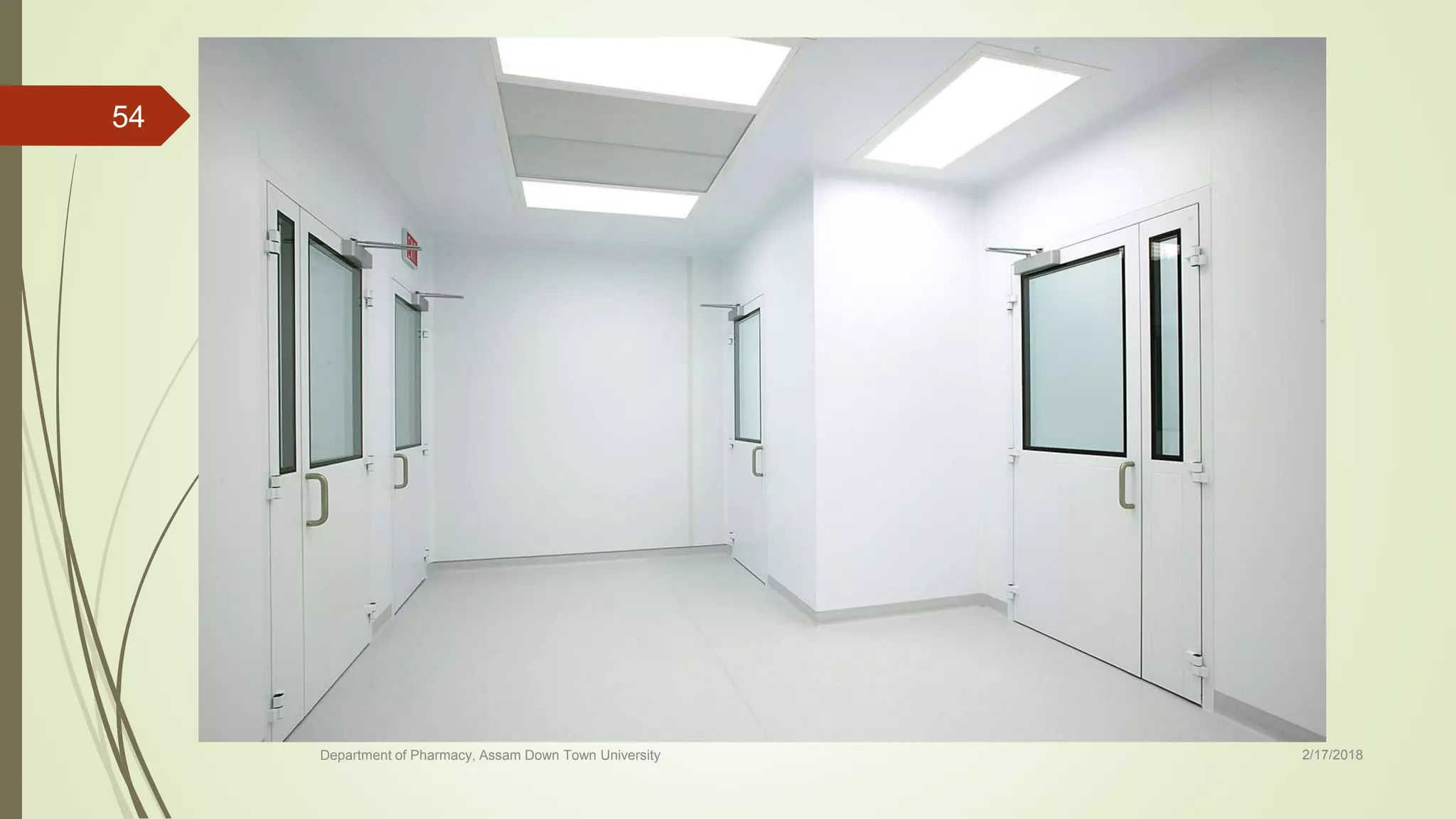
 General: smooth, monolithic, cleanable, chip resistant with minimum seams,
joints and no crevices or moulding
 Floors: kota, sheet vinyl, epoxy or polyester coating with carried up walls
base or raised floor with and without perforations using the above materials
 Walls: Plastic, epoxy or polyester coating with carried up wall base or raised
floor with and without perforations using the above materials
 Ceilings: Enamel, plaster covered with plastic, epoxy or polyester coating or
with plastic-finished acoustical tiles when entire ceiling is not fully HEPA
filtered.
Department of Pharmacy, Assam Down Town University 2/17/2018
52
2/17/2018Department of Pharmacy, Assam Down Town University
53
2/17/2018Department of Pharmacy, Assam Down Town University
54
2/17/2018Department of Pharmacy, Assam Down Town University
55
5. Quality control rooms
 QC laboratories should be separate from production areas
 Separate areas for biological, microbiological and radioisotope methods
 Suitable design with sufficient space to avoid mix-ups and cross-contamination
 Suitable space for storage, samples, reference standards, solvents,
reagents and records
• Prevention of fumes
• Separate air supply
• Well designed ventillation
Department of Pharmacy, Assam Down Town University 2/17/2018
56
Department of Pharmacy, Assam Down Town University 2/17/2018
57
Department of Pharmacy, Assam Down Town University 2/17/2018
58
Department of Pharmacy, Assam Down Town University 2/17/2018
59
ISO certification
 Not solely a quality control tool but a guideline for design, manufacture, sale
and servicing of a products
 Also, meeting the costumers expectations and requirements
 Increase the level of quality and reliability, productivity and safety while
making products and services affordable
 Helps facilitate international trade – “standard for the whole world”
“promotes worldwide, standards for the improvement of quality,
productivity and operating efficiency through a series of standards and
guidelines.”
Department of Pharmacy, Assam Down Town University 2/17/2018
60
References:
 Dr. Shyamala Bhaskaran (2016).“Industrial pharmacy” Birla Publication. 4th ed
 Current Good Manufacturing Practice by FDA
https://www.fda.gov/food/guidanceregulation/cgmp/default.htm
 WHO GMP guidelines by WHO
http://www.who.int/medicines/areas/quality_safety/quality_assurance/productio
n/en/
Department of Pharmacy, Assam Down Town University 2/17/2018
61
Thank you
Department of Pharmacy, Assam Down Town University
2/17/2018
62

Layout of pharmaceutical building and services

  • 1.
    Layout of Pharmaceutical Buildingand Services Presented by: Guided by: Himal Barakoti Ananta Choudhury M. Pharm, 1st Sem Associate Professor Department of Pharmacy Department of Pharmacy Assam Down Town University Assam Down Town University
  • 2.
    Contents:  GMP: Introduction History and Importance  Basic requirements  Layout of Buildings and services  ISO certification  References Department of Pharmacy, Assam Down Town University 2/17/2018 2
  • 3.
    Human Life  Today,we live almost twice longer than the generations living in the beginning of the last century.  Our life expectancy has increased 35-70 years in last 100 years.  Scientist are making new breakthroughs everyday. Better understanding of Human biology also taught us how to improve sanitation, hygiene and fight against diseases.  Food and Drug play very important role in normal physiology. Department of Pharmacy, Assam Down Town University 2/17/2018 3
  • 4.
     The knowledgeadvancement on human biology and development of technical tools in the field of medical treatment led us discover and develop new and advanced drugs.  As opposed to food, drug substance is used for a body system which is not in a normal conditions.  So discovery, production, distribution and phase of administration of patient’s quality assurance has to be controlled with a technological procedure and tight regulations to make the system as effective as possible for the benefit of human health. Department of Pharmacy, Assam Down Town University 2/17/2018 4
  • 5.
    2/17/2018Department of Pharmacy,Assam Down Town University 5
  • 6.
    cGMP  Good manufacturingpractice is that part of quality assurance which insures that products are consistently produced and controlled to the quality standards appropriate to their intended use and as required by marketing authorization.  GMP guideline typically comprise strong recommendations on quality management, personnel, production facilities and equipment, documentation and records, production and in- process controls, validation, complaints and recall. Department of Pharmacy, Assam Down Town University 2/17/2018 6
  • 7.
    2/17/2018Department of Pharmacy,Assam Down Town University 7
  • 8.
    A GMP timeline 1906 pure Food and Drug act creates one of the first government regulatory agencies (also known as FDA); the culmination of 25 years of lobbying, this act makes it illegal to sell “adulterated” or “misbranded” food or drugs.  1938 federal food, drug and cosmetics (FD&C) Act Tragedy: sulfanilamide made with poisonous solvent causes 107 death. Result: requires manufacture to prove the safety of products before marketing Department of Pharmacy, Assam Down Town University 2/17/2018 8
  • 9.
    2/17/2018Department of Pharmacy,Assam Down Town University 9
  • 10.
    A GMP timeline 1941 Two unrelated events Insulin Amendment requires FDA to test and certify purity and potency of insulin. Tragedy: Nearly 300 deaths and injuries from distribution of sulfathiazole tablets tainted with phenobarbital. Results: FDA revises manufacturing and quality controls drastically, the beginning of what will later be called GMPs Department of Pharmacy, Assam Down Town University 2/17/2018 10
  • 11.
    2/17/2018Department of Pharmacy,Assam Down Town University 11
  • 12.
    A GMP timeline 1962 Kefauver-Harris Drug Amendments Tragedy: Thalidomide catastrophe (10,000 cases worldwide, 40% survived) Result: Manufacturer must prove efficacy and stricter control over drug testing was ensured  1978 cGMP ‘s Final rules for drug and devices Establishes minimum current GMPs for manufacturing, processing, packaging or holding drug products and medical devices Department of Pharmacy, Assam Down Town University 2/17/2018 12
  • 13.
    The Thalidomide Tragedy:Lessons for Drug Safety and Regulation 2/17/2018Department of Pharmacy, Assam Down Town University 13
  • 14.
    A GMP timeline The first version of GMP guidelines was introduced by US FDA in 1963.  WHO version of GMP prepared in 1967.  From then, there have been several amendments and extensions of the guidelines and many countries developed their own GMP guidelines which are based on WHO guidelines. Department of Pharmacy, Assam Down Town University 2/17/2018 14
  • 15.
    Worldwide Enforcement ofGMP Country Regulatory Body United states Food and Drug Administration (FDA) United Kingdom Medicines and Healthcare Products Regulatory Agency (MHRA) Australia Therapeutical Goods Administration (TGA) India Ministry of Health (MoH) Nepal Department of Drug Administration (DDA) Department of Pharmacy, Assam Down Town University 2/17/2018 15
  • 16.
    Importance 2/17/2018Department of Pharmacy,Assam Down Town University 16
  • 17.
    Why GMP??  Poorquality medicines are not only a health hazard, but a waste of money for both governments and individuals.  A poor quality medicine may contain toxic substances that have been unintentionally added.  A medicine that contain little or none of the claimed ingredient will not have the intended therapeutic effect.  A consumer usually cannot detect (through smell, touch or sight) that a drug product is safe/efficacious. Department of Pharmacy, Assam Down Town University 2/17/2018 17
  • 18.
    Ultimate “Quality” goal:Patient Safety  Therefore, it is important that drugs are manufactured under conditions and practices required by the cGMP regulations to assure that quality is built into the design and manufacturing process at every step.  Facilities that are in good condition, equipment that is properly maintained and calibrated, employees who are qualified and fully trained and process that are reliable and reproducible, are few requirements to assure safety and efficacy. Department of Pharmacy, Assam Down Town University 2/17/2018 18
  • 19.
    Basic requirements ofcGMP  Personnel  Premises and industrial layout  Sanitation and Hygiene  Water Treatment System  Validation and Qualification  Equipment Materials  Documentation  Self Inspection  HVAC System ISO 9001:2008  ISO 14001:2004, 9000 series Department of Pharmacy, Assam Down Town University 2/17/2018 19
  • 20.
    Layout 2/17/2018Department of Pharmacy,Assam Down Town University 20
  • 21.
    Layout of buildingand services  Means all buildings where manufacture of the products will take place.  Conditions that’s exist within them and the area of location.  Important aspect to be kept along to ensure suitability of the operation  Location  Design  Construction  Adaptation (new processes + future extensions)  Maintenance Department of Pharmacy, Assam Down Town University 2/17/2018 21
  • 22.
     Important tounderstand the manufacturing processes and conduct the facility programming.  Facility layout must be an integrated design that  satisfies the following: • Process requirements • Personnel flows • Material flows (product, component and raw material movements) • Equipment layout requirements • Operational access requirements • Maintenance access requirements Department of Pharmacy, Assam Down Town University 2/17/2018 22
  • 23.
     During theprogramming phase, the firm must define their true needs…they must separate the “must have” objectives from their “wants” objectives.  This is often a very time consuming effort, since each department needs to re-think what is truly mandatory for their operation versus those items that are desirable, but not essential to successful operations. Formal decision analysis may need to be performed.  The designer must first understand the product and process requirements.  Accommodation Schedule is the first step Accommodation conceptual equipment and schedule layout facility layout Department of Pharmacy, Assam Down Town University 2/17/2018 23
  • 24.
     Accommodation Schedule: •Defines all areas that can influence unit operations required for manufacturing as well as the relationships and flows between them • Materials and personnel are primary focus • Can be developed once the process is known – All process flow diagrams should be complete • Also referred to as logic diagrams, or bubble diagrams Department of Pharmacy, Assam Down Town University 2/17/2018 24
  • 25.
    Department of Pharmacy,Assam Down Town University 2/17/2018 25
  • 26.
     Conceptual Layout •Derived from Accommodation Schedule and equipment sizing needs • Building blocks of equipment lines are developed • Blocks of rooms are assembled based on necessary process requirement. Department of Pharmacy, Assam Down Town University 2/17/2018 26
  • 27.
     Equipment Layout •Scaled drawing derived from conceptual layout • Defines precise room sizes, structural grids and access routes • Building and fire codes are established in this phase. Building blocks of equipment lines are developed • Blocks of rooms are assembled based on necessary adjacencies and process requirements • Part of detail design phase of project life cycle Department of Pharmacy, Assam Down Town University 2/17/2018 27
  • 28.
    After Equipment LayoutDrawings are prepared, establish  Material and Personnel Flows • Superimposed on Equipment Layout Drawings • Typically superimposed with directional arrows • Primary purpose is to illustrate how to eliminate or minimize the potential for contamination of the clean room product and personnel. • Layout should prevent cross contamination • One-way flow always preferred • Provide separate entry and exit ways of possible, particularly in changing areas. Department of Pharmacy, Assam Down Town University 2/17/2018 28
  • 29.
     • Personnelflows considered: –Manufacturing personnel –Maintenance personnel –Quality control personnel  Material flows considered: – Raw materials – Finished goods – Waste – Product (In-process, Intermediate & Final) – Equipment • Clean and dirty components • Portable equipment and Product containers Department of Pharmacy, Assam Down Town University 2/17/2018 29
  • 30.
    Considerations  Provide sufficientspace for operations • Provide sufficient space for movement, equipment access and egress for life safety code requirements • Rooms must be sized only after fully understanding what goes into the room, and the process that takes place between the four walls • Can’t overlook need for extra space for portable items brought into the room, such as carts. • Mechanical and electrical equipment panels also need to be taken into account. Department of Pharmacy, Assam Down Town University 2/17/2018 30
  • 31.
     Cost considerationsin layout design: • Layout has significant impact on the amount of materials and therefore facility cost • Minimize perimeter vs. internal area, to reduce costs of external load bearing walls and insulation. • Simple plan shapes are most economical – Square maximizes internal area, minimizes perimeter • Minimize size of clean corridors and staging areas • Minimize height of building to extent possible. Height increases cost due to: – Increase in amount of perimeter wall for a given total floor area – Increased load on the structure (Heavier load on columns and footings) – Additional hoisting of materials and extra time taken by operators to reach the higher floors Department of Pharmacy, Assam Down Town University 2/17/2018 31
  • 32.
    Layout Design  Adequatespace for future extension.  Availability of water supply (Quality and Quantity), power, fuel sewage and waste stream removal.  Availability of public transport.  Proximity of undesirable activity.  Accessibility to interrelated operation.  Advocating for law to restrict undesirable activities while allowing anticipated development. Department of Pharmacy, Assam Down Town University 2/17/2018 32
  • 33.
    Principle  The layoutand design should aim to: • minimize risks of error • Permit effective maintenance • Avoid cross-contamination, build-up of dirt and dust • Avoid any adverse effect on the quality of products. Design……….  Process flow  Material flow People flow Ensure logical flow Department of Pharmacy, Assam Down Town University 2/17/2018 33
  • 34.
    Department of Pharmacy,Assam Down Town University 2/17/2018 34
  • 35.
    2/17/2018Department of Pharmacy,Assam Down Town University 35
  • 36.
    2/17/2018Department of Pharmacy,Assam Down Town University 36
  • 37.
    2/17/2018Department of Pharmacy,Assam Down Town University 37
  • 38.
    construction  Suitable materials Electrical supply  Suitable lighting  Temperature and relative humidity control  Appropriate and effective ventilation These may affect products during manufacture or storage as well as functioning of equipment. Department of Pharmacy, Assam Down Town University 2/17/2018 38
  • 39.
    Electricity  Continuity ofelectrical supply is essential for a number of systems or processes (air supply and extraction, particularly for sterile manufacture; fermentation plants; incubators; stability chambers) and thus backup systems should be available in the event of mains failure.  In general, electrical supply is made through concealed wiring with five wires (3 phase wires, one neutral and one ground wire) for three-phase connections and three wires (only 1 phase wire) for single phase connection using suitable size wires.  Usually, red, yellow and blue are used for phase wires , black for neutral and green for grounded connection. Department of Pharmacy, Assam Down Town University 2/17/2018 39
  • 40.
    Suitable lighting  Lightinglevels should be adequate to permit operators to do their work properly, accurately and attentively. Lighting of production and packing areas should be enable good vision.  To avoid photo degradation, a suitable light using sodium vapor lamp is to be provided with dispensing/sampling booth for weighing/sampling of highly light sensitive materials. Department of Pharmacy, Assam Down Town University 2/17/2018 40
  • 41.
    Department of Pharmacy,Assam Down Town University 2/17/2018 41
  • 42.
    Suitable lighting levelrequirements φ * 1.25 * A N= η * Lumens per lamp Where, N= number of lights φ = required lux 1.25 = maintenance factor A = Room area in sq. mt. η = coefficient of utilization ≈ 0.7 Department of Pharmacy, Assam Down Town University 2/17/2018 42
  • 43.
     Example: Required lux300 Room size = 4m * 3m = 12 sq. mt Tube light of 1*40 w gives 2700 lumen at working height 300 * 1.25 * 12 N = η * 2700 = 2.38 ≈ 3 lights Department of Pharmacy, Assam Down Town University 2/17/2018 43
  • 44.
    Specific areas  5specific areas: 1. Ancillary areas 2. Storage areas 3. Weighing areas 4. Production areas 5. Quality control areas Department of Pharmacy, Assam Down Town University 2/17/2018 44
  • 45.
    1. Ancillary areas Rest and refreshment rooms separate from manufacturing and quality control areas  Changing , washing and toilets areas accessible and appropriate numbers  Maintenance workshops separated from production – if not possible – tools in reserved areas  Animal house well isolated – separate handling and entrance Department of Pharmacy, Assam Down Town University 2/17/2018 45
  • 46.
    The recommended numberof toilets Note: 1 additional toilet for each 40 employees above 150 employees above 150 employees or user Department of Pharmacy, Assam Down Town University Number of Employees Number of toilets recommended 1-15 16-35 36-55 56-80 81-110 110-150 1 2 3 4 5 6 2/17/2018 46
  • 47.
    2. Storage areas Departmentof Pharmacy, Assam Down Town University  Storage areas of sufficient capacity  Separate and segregated areas: starting materials, packaging materials, intermediates, bulk, finished products, quarantined, released, rejected, returned and recalled products and materials  Appropriate temperature and relative humidity conditions within defined limits • Provided, controlled, monitored and recorded • Storage conditions in label  Normal conditions: 15-30 ˚C  Cool room: 8-15 ˚C  Cold: 2-8 ˚C  Protect from humidity: less than 60% (material kept in hermetically sealed container) 2/17/2018 47
  • 48.
    Storage areas  Quarantinearea: clearly marked and access restricted  A separate sampling area is the norm: no risk for contamination or cross- contamination (sampling booth)  Segregated areas for rejected, recalled and returned materials and products  Safe and secured areas for highly active, radioactive materials, narcotics and other materials ( risk of abuse, fire, explosion, hazard)  Special attention to safe and secure storage for printed packaging material Department of Pharmacy, Assam Down Town University 2/17/2018 48
  • 49.
    3. Weighing areas Weighing operation – in separate areas  Appropriate design  Provision for dust control  Smooth, impervious, durable, easy-to-clean finishes  Cleaning procedure and records  Documentation eg. SOPs, logs and records Department of Pharmacy, Assam Down Town University 2/17/2018 49
  • 50.
    4. Production areas Layout in accordance with sequence of production  Appropriate cleanliness level  Adequate work and in-process storage space  Orderly and logical positioning of equipment  Specially designed areas for packaging  Access of maintenance from outside production areas  Drains of adequate size and equipped to prevent backflow Department of Pharmacy, Assam Down Town University 2/17/2018 50
  • 51.
    Department of Pharmacy,Assam Down Town University 2/17/2018 51
  • 52.
    Production areas finishing General: smooth, monolithic, cleanable, chip resistant with minimum seams, joints and no crevices or moulding  Floors: kota, sheet vinyl, epoxy or polyester coating with carried up walls base or raised floor with and without perforations using the above materials  Walls: Plastic, epoxy or polyester coating with carried up wall base or raised floor with and without perforations using the above materials  Ceilings: Enamel, plaster covered with plastic, epoxy or polyester coating or with plastic-finished acoustical tiles when entire ceiling is not fully HEPA filtered. Department of Pharmacy, Assam Down Town University 2/17/2018 52
  • 53.
    2/17/2018Department of Pharmacy,Assam Down Town University 53
  • 54.
    2/17/2018Department of Pharmacy,Assam Down Town University 54
  • 55.
    2/17/2018Department of Pharmacy,Assam Down Town University 55
  • 56.
    5. Quality controlrooms  QC laboratories should be separate from production areas  Separate areas for biological, microbiological and radioisotope methods  Suitable design with sufficient space to avoid mix-ups and cross-contamination  Suitable space for storage, samples, reference standards, solvents, reagents and records • Prevention of fumes • Separate air supply • Well designed ventillation Department of Pharmacy, Assam Down Town University 2/17/2018 56
  • 57.
    Department of Pharmacy,Assam Down Town University 2/17/2018 57
  • 58.
    Department of Pharmacy,Assam Down Town University 2/17/2018 58
  • 59.
    Department of Pharmacy,Assam Down Town University 2/17/2018 59
  • 60.
    ISO certification  Notsolely a quality control tool but a guideline for design, manufacture, sale and servicing of a products  Also, meeting the costumers expectations and requirements  Increase the level of quality and reliability, productivity and safety while making products and services affordable  Helps facilitate international trade – “standard for the whole world” “promotes worldwide, standards for the improvement of quality, productivity and operating efficiency through a series of standards and guidelines.” Department of Pharmacy, Assam Down Town University 2/17/2018 60
  • 61.
    References:  Dr. ShyamalaBhaskaran (2016).“Industrial pharmacy” Birla Publication. 4th ed  Current Good Manufacturing Practice by FDA https://www.fda.gov/food/guidanceregulation/cgmp/default.htm  WHO GMP guidelines by WHO http://www.who.int/medicines/areas/quality_safety/quality_assurance/productio n/en/ Department of Pharmacy, Assam Down Town University 2/17/2018 61
  • 62.
    Thank you Department ofPharmacy, Assam Down Town University 2/17/2018 62