K.B.H SS TRUST’S INSTITUTE OF PHARMACY
MALEGAON,NASHIK
OBJECTIVES AND POLICIES OF CURRENT GOOD MANUFACTURING
PRACTICES,LAYOUT OF BUILDINGS,SERVICES,EQUIPMRNT’S AND
THEIR MAINTANANCE
Presented By:
Osama Tauseef
Roll. No: 06
M.Pharm 1st semester
Guided By:
Dr. A.B Gangurde
Head of Department
Department of pharmaceutics
CONTENTS:
• INTRODUCTION
• IMPORTANCE OF CGMP
• OBJECTIVES
• POLICIES OF CGMP
• POLICIES OF CGMPACCORDING TO SCH-M
• LAYOUT OF BUILDINGS, SERVICES, EQUIPMENT’S AND THEIR
MAINTANANCE
• BIBLIOGRAPHY
 CGMP refers to the Current Good Manufacturing Practice regulations imposed by the
FDA.
 CGMP assures proper design, monitoring and control of manufacturing processes and
facilities in the industry.
 It also includes; establishing strong quality management systems, obtaining the right
quality of raw materials, establishing operating procedures, detecting and investigating
product quality and maintaining reliable testing laboratories.
 This type of control method at a pharmaceutical company, if put into practice helps to
prevent contamination, mix-ups, deviations, failures and errors.
 Thus assures that drug products meet the Current Good Manufacturing Practice
regulations.
INTRODUCTION
 Current good manufacturing practice" is nowhere defined in the Act or in the regulations,
the regulations concern themselves with specific criteria for buildings, equipment,
personal, components, master formula and batch pro- duction records, production and
control procedures, product containers, packaging and labeling, laboratory controls,
distribution records, stability, and complaint files.
The most significant addition to the law is the concept of "current good manufacturing
practice" (GMP).
 This is a requirement that drugs, and the methods used in, the facilities or controls used in
their manufacture, processing, packing, or holding conform with those practices that will
assure that such drugs meet the requirements of the Act as to safety, and have the identity,
strength, quality, and purity characteristics that they purport or are represented to possess. If
they do not, they are adulterated.
IMPORTANCE OF CGMP
A consumer usually cannot detect that the product is safe or efficacious.
Poor quality medicines are not only a health hazard, but a waste of money.
Therefore, it is important that a drugs are manufactured under conditions and practices required
by the CGMP regulations to assure that the quality is built into the design and manufacturing
process at every step.
►Facilities that are in good conditions;
• equipment are calibrated.
• employees are qualified and fully trained.
• process are reproducible.
• requirements to assure safety and efficacy.
OBJECTIVES
The quality of a product depends on the starting materials, production and quality control processes, building,
equipment and personnel involved.
1) Conducting planned and periodic audits.
2) Clearly defining and following the SOPs.
3) CGMP regulations assure that quality is built into the design and manufacturing process at every step.
4) CGMP regulations assures the identity, strength, quality and purity of drug products.
5) Ensure that products are consistently manufactured and controlled to the specified quality.
6) Assures that identity, strength, purity and quality of products Protecting against the contamination.
7) Ensure that the consumer receives products of specified quality.
A) POLICIES OF CGMP
The purpose of this policy is to ensure compliance with current good manufacturing practice regulations
of products . It is the responsibility of all the involved personnel at every level of the organization.
Layout Of Buildings And Services And Equipment.
o LAYOUT DESIGN
o ORGANISATION AND PERSONNEL
o BUILDINGS AND FACILITIES
o EQUIPMENT
o PRODUCTION AND PROCESS CONTROL
o PACKAGING AND LABELING CONTROL
B) POLICIES OF CGMPACCORDING TO SCH-M
Personnel Premises Equipment
SOP's Raw
Materials
Self Inspection
And Audit
Master Formula
Warehousing
Area
Batch
Manufacturing
Records
Reference
Samples Validation
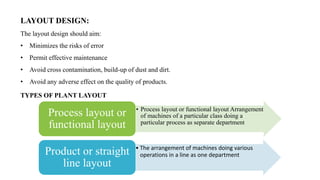
LAYOUT DESIGN:
The layout design should aim:
• Minimizes the risks of error
• Permit effective maintenance
• Avoid cross contamination, build-up of dust and dirt.
• Avoid any adverse effect on the quality of products.
• Process layout or functional layout Arrangement
of machines of a particular class doing a
particular process as separate department
Process layout or
functional layout
• The arrangement of machines doing various
operations in a line as one department
Product or straight
line layout
TYPES OF PLANT LAYOUT
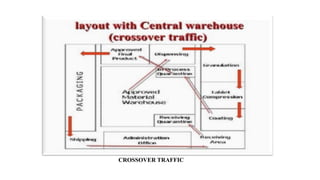
TYPES OF FLOW:
CIRCULAR FLOW
CROSSOVER TRAFFIC
PARALLEL FLOW
ORGANISATION AND PERSONNEL
The establishment and maintenance of a satisfactory system of QA and the correct manufacture
and control of pharmaceutical products and active ingredients rely upon people.
chairman
Managing
director
President
production
President
marketing
President
QA
President
Finance
President
personal
• All personnel, during employment should undergo health examination.
• A personnel must be trained in the practice of personal hygiene.
• Direct contact should be avoided between the operator's hands and materials or products.
• Personal hygiene procedures including the use of protective clothing should apply to all persons
entering production area.
PERSONAL HYGIENE:
Personnel must be adequate in number and back- ground of education, training, and experience
or combination to ensure that the drug has the safety, identity, strength, quality, and purity that it
purports to possess, and they must also be in good health
BUILDINGS AND FACILITIES
DESIGN AND CONSTRUCTION FEATURES
 Storage of release components, drug product containers, closures, and labelling;
 Storage of in process materials;
 Manufacturing and processing operations;
 Packaging and labelling operations;
 Quarantine storage before release of drug products;
 Storage of drug products after release;
 Control and laboratory operations;
 Aseptic processing;
 Buildings shall be maintained in a clean and or manner and shall be of suitable size,
construction and location to facilitate adequate cleaning and maintenance and proper
operation in the manufacturing, processing, packing, labeling, or holding of a drug.
LIGHTING:
Adequate lighting shall be provided in all areas
AIR FILTRATION,AIR HEATING AND COOLING:
• Adequate ventilation shall be provided.
• Equipment for adequate control over air pressure, micro- organisms, dust, humidity, and
temperature.
• To be provided appropriate for the manufacture, processing, packing, or holding of a drug product.
• Air filtration systems, including prefilters and particulate matter air filters, shall be used on air
supplies to production areas.
PLUMBING:
Potable water shall be supplied under continuous positive pressure in plumbing system free of
defects that could contribute to contamination to any drug product.
WASHING AND TOILET FACILITIES:
Adequate washing facilities shall be provided including hot and cold water, soap
detergent, air driers or single-service towels, and clean toilet facilities easily accessible
to working areas.
SEWAGE:
Sewage, trash and other refuse in and from the building and immediate premises shall be
disposed in safe and sanitary manner.
Any building used in the manufacture, processing, packaging or holding of a drug product shall
be maintained in clean and sanitary condition.
There shall be written procedures assigning responsibility for sanitation and describing in
sufficient detail.
The cleaning schedules, methods, equipment and material to be used in cleaning building and
facilities, such written procedures should be followed.
Insecticides and fungicides shall be not used unless registered.
SANITATION:
Equipment should be designed and located to suit the production of the product.
EQUIPMENTS & MAINTENANCE:
Equipment design,
size and locations
Equipment
construction
Equipment
cleaning and
maintenance
Automatic,
mechanical and
electronic
equipment
EQUIPMENTS
 The equipment surfaces coming into contact with any material should not react with the
materials being processed.
 Equipment should not adversely affect the product through leaking valves, lubricant
drips and through inappropriate modifications.
 Equipment should be easily cleaned.
 Equipment used for flammable substances should be explosion proof.
EQUIPMENT DESIGN, SIZE AND LOCATION:
EQUIPMENT CONSTRUCTION
 Equipment used for the manufacture, processing. packing, labeling, holding, testing, or control
of drugs shall be maintained in a clean and orderly manner and shall be of suitable design, size,
construction, and location to facilitate cleaning, maintenance, and operation.
 Equipment should be properly identified to assure that products do not become
admixed with another.
 Water, steam and pressure or vacuum lines, should be installed so as to be easily
accessible during all phases of operation.
 They should be clearly identified. Support systems such as heating, ventilation, air
conditioning, water, steam, compressed air and gases should function as designed.
INSTALLATION AND LOCATION
EQUIPMENT CLEANING AND MAINTENANCE:
 Components and other materials used in the manufacture, processing, and packaging of
drug products and materials necessary for building.
 Equipment maintenance must be stored and handled in a safe, sanitary, and orderly
manner, with adequate measures taken to prevent mix-ups and cross-contamination
affecting drugs and drug products.
RAW MATERIALS:
• An Inventory should be maintained for Raw materials to be used at
any stage of manufacture.
• Records should be maintain as per Schedule U.
• Should be purchased from approved sources.
• Must be checked by QC department on receipt.
• Should be labeled.
AUTOMATIC, MECHANICALAND ELECTRONIC EQUIPMENTS:
• Computers or related systems, may be used in the manufacturing. processing,
packing, and holding of a drug.
• It such equipment is used, it shall be routinely calibrated, inspected or checked
according to written program designed to assure proper performance.
PRODUCTION AREAS:
 Production and control procedures shall include all reasonable precautions to assure that the
drugs produced have the safety, identity, strength, quality, and purity.
 The addition of ingredients during the process proper identification of all containers, lines, and
equipment, adequate cleaning facilities to prevent contamination and appropriate precautions to
minimize microbiological and other contamination of the drug .
 Adequate in-process checking of weights, measures, and counts at appropriate intervals, and
the taking and maintaining of representative samples in process.
PACKAGING AND LABELING:
 All operations shall be adequately controlled to assure that only those drug products
that have met the standards and specifications established in their master production
and control records shall be distributed.
 To prevent mix-ups between drugs during filling, packaging, and labeling operations.
 To assure that correct labeling for the drug and to identify the finished product with a
lot or control number that permits determination of the history of the manufacture and
control of the batch.
 Laboratory controls must include that establishment of scientifically sound
and appropriate specifications, standards and test procedures to assure that
components, in-process drugs, and finished products, product containers.
 Their components must be tested conform to appropriate standards of
identity, strength, quality, and purity.
TEST FACILITIES:
 Warehousing area should be designed and adapted to ensure good storage conditions.
 Should be Clean, dry and maintained with acceptable temperature limits.
 Should have appropriate house-keeping, pests control.
 Separate sampling area for active raw material and excipients.
 Every Material stored should be labeled properly.
 Fire Prevention.
WAREHOUSING AREAS:
DOCUMENTATION:
Distribution records must be kept so that the distribution of each lot of drug can be
readily determined to facilitate its recall if necessary, and so that a first-in, first-out
warehouse system can be used.
BATCH MANUFACTURING RECORD:
 There shall be Batch processing record for each product.
 During Manufacturing or Processing the following:
information shall be recorded It include...
 The name of the product.
 The number of Batch being manufactured.
 Dates and time of commencement of batch and completion.
There shall be MFR relating to all manufacturing procedures for each product and batch
size to be manufacture
It should include;
 The name of the product
 Quantity of all starting materials to be used
 A statement of the expected final yield with acceptable limits
 Principal equipment to be used
 Detailed stepwise processing instructions and the time taken for each step
 Any special precautions
 Packing details and Specimen labels
MASTER FORMULA RECORD:
COMPLAINT FACILITIES:
 Complaint files must be maintained, carrying records of all written and oral complaints
regarding each product, and an investigation of each complaint must be made and
recorded in writing.
BIBLIOGRAPHY
 Lachman L , Lieberman H.A, The Theory and Practice of Industrial Pharmacy, 2009
edition, page 869-870.
 https://www.fda.gov/drugs/pharmaceutical-quality-resources/current-good-
manufacturing-practice-comp-regulations.
 Current Good Manufacturing Practices by FDA.
http://www.fda.gov/food/guidanceregulation/comp/default.htm
 ICH Q7 Good Manufacturing Practice Guide For Active Pharmaceutical Ingredients.
Current step 4 version; November 2000 Website. Available from:
http://www.ich.org/LOB/media/MEDIA433.pdf [Last cited on 2010 Jan 1]
 https://www.slideshare.net/SharwariSapate/objectives-and-policies-of-c-gmp-layout-of-
building-and-services
Current good manufacturing practice .pptx

Current good manufacturing practice .pptx

  • 1.
    K.B.H SS TRUST’SINSTITUTE OF PHARMACY MALEGAON,NASHIK OBJECTIVES AND POLICIES OF CURRENT GOOD MANUFACTURING PRACTICES,LAYOUT OF BUILDINGS,SERVICES,EQUIPMRNT’S AND THEIR MAINTANANCE Presented By: Osama Tauseef Roll. No: 06 M.Pharm 1st semester Guided By: Dr. A.B Gangurde Head of Department Department of pharmaceutics
  • 2.
    CONTENTS: • INTRODUCTION • IMPORTANCEOF CGMP • OBJECTIVES • POLICIES OF CGMP • POLICIES OF CGMPACCORDING TO SCH-M • LAYOUT OF BUILDINGS, SERVICES, EQUIPMENT’S AND THEIR MAINTANANCE • BIBLIOGRAPHY
  • 3.
     CGMP refersto the Current Good Manufacturing Practice regulations imposed by the FDA.  CGMP assures proper design, monitoring and control of manufacturing processes and facilities in the industry.  It also includes; establishing strong quality management systems, obtaining the right quality of raw materials, establishing operating procedures, detecting and investigating product quality and maintaining reliable testing laboratories.  This type of control method at a pharmaceutical company, if put into practice helps to prevent contamination, mix-ups, deviations, failures and errors.  Thus assures that drug products meet the Current Good Manufacturing Practice regulations. INTRODUCTION
  • 4.
     Current goodmanufacturing practice" is nowhere defined in the Act or in the regulations, the regulations concern themselves with specific criteria for buildings, equipment, personal, components, master formula and batch pro- duction records, production and control procedures, product containers, packaging and labeling, laboratory controls, distribution records, stability, and complaint files. The most significant addition to the law is the concept of "current good manufacturing practice" (GMP).  This is a requirement that drugs, and the methods used in, the facilities or controls used in their manufacture, processing, packing, or holding conform with those practices that will assure that such drugs meet the requirements of the Act as to safety, and have the identity, strength, quality, and purity characteristics that they purport or are represented to possess. If they do not, they are adulterated.
  • 5.
    IMPORTANCE OF CGMP Aconsumer usually cannot detect that the product is safe or efficacious. Poor quality medicines are not only a health hazard, but a waste of money. Therefore, it is important that a drugs are manufactured under conditions and practices required by the CGMP regulations to assure that the quality is built into the design and manufacturing process at every step. ►Facilities that are in good conditions; • equipment are calibrated. • employees are qualified and fully trained. • process are reproducible. • requirements to assure safety and efficacy.
  • 6.
    OBJECTIVES The quality ofa product depends on the starting materials, production and quality control processes, building, equipment and personnel involved. 1) Conducting planned and periodic audits. 2) Clearly defining and following the SOPs. 3) CGMP regulations assure that quality is built into the design and manufacturing process at every step. 4) CGMP regulations assures the identity, strength, quality and purity of drug products. 5) Ensure that products are consistently manufactured and controlled to the specified quality. 6) Assures that identity, strength, purity and quality of products Protecting against the contamination. 7) Ensure that the consumer receives products of specified quality.
  • 7.
    A) POLICIES OFCGMP The purpose of this policy is to ensure compliance with current good manufacturing practice regulations of products . It is the responsibility of all the involved personnel at every level of the organization. Layout Of Buildings And Services And Equipment. o LAYOUT DESIGN o ORGANISATION AND PERSONNEL o BUILDINGS AND FACILITIES o EQUIPMENT o PRODUCTION AND PROCESS CONTROL o PACKAGING AND LABELING CONTROL
  • 8.
    B) POLICIES OFCGMPACCORDING TO SCH-M Personnel Premises Equipment SOP's Raw Materials Self Inspection And Audit Master Formula Warehousing Area Batch Manufacturing Records Reference Samples Validation
  • 9.
    LAYOUT DESIGN: The layoutdesign should aim: • Minimizes the risks of error • Permit effective maintenance • Avoid cross contamination, build-up of dust and dirt. • Avoid any adverse effect on the quality of products. • Process layout or functional layout Arrangement of machines of a particular class doing a particular process as separate department Process layout or functional layout • The arrangement of machines doing various operations in a line as one department Product or straight line layout TYPES OF PLANT LAYOUT
  • 10.
  • 11.
  • 12.
  • 13.
    ORGANISATION AND PERSONNEL Theestablishment and maintenance of a satisfactory system of QA and the correct manufacture and control of pharmaceutical products and active ingredients rely upon people. chairman Managing director President production President marketing President QA President Finance President personal
  • 14.
    • All personnel,during employment should undergo health examination. • A personnel must be trained in the practice of personal hygiene. • Direct contact should be avoided between the operator's hands and materials or products. • Personal hygiene procedures including the use of protective clothing should apply to all persons entering production area. PERSONAL HYGIENE: Personnel must be adequate in number and back- ground of education, training, and experience or combination to ensure that the drug has the safety, identity, strength, quality, and purity that it purports to possess, and they must also be in good health
  • 15.
    BUILDINGS AND FACILITIES DESIGNAND CONSTRUCTION FEATURES  Storage of release components, drug product containers, closures, and labelling;  Storage of in process materials;  Manufacturing and processing operations;  Packaging and labelling operations;  Quarantine storage before release of drug products;  Storage of drug products after release;  Control and laboratory operations;  Aseptic processing;  Buildings shall be maintained in a clean and or manner and shall be of suitable size, construction and location to facilitate adequate cleaning and maintenance and proper operation in the manufacturing, processing, packing, labeling, or holding of a drug.
  • 16.
    LIGHTING: Adequate lighting shallbe provided in all areas AIR FILTRATION,AIR HEATING AND COOLING: • Adequate ventilation shall be provided. • Equipment for adequate control over air pressure, micro- organisms, dust, humidity, and temperature. • To be provided appropriate for the manufacture, processing, packing, or holding of a drug product. • Air filtration systems, including prefilters and particulate matter air filters, shall be used on air supplies to production areas.
  • 17.
    PLUMBING: Potable water shallbe supplied under continuous positive pressure in plumbing system free of defects that could contribute to contamination to any drug product. WASHING AND TOILET FACILITIES: Adequate washing facilities shall be provided including hot and cold water, soap detergent, air driers or single-service towels, and clean toilet facilities easily accessible to working areas. SEWAGE: Sewage, trash and other refuse in and from the building and immediate premises shall be disposed in safe and sanitary manner.
  • 18.
    Any building usedin the manufacture, processing, packaging or holding of a drug product shall be maintained in clean and sanitary condition. There shall be written procedures assigning responsibility for sanitation and describing in sufficient detail. The cleaning schedules, methods, equipment and material to be used in cleaning building and facilities, such written procedures should be followed. Insecticides and fungicides shall be not used unless registered. SANITATION:
  • 19.
    Equipment should bedesigned and located to suit the production of the product. EQUIPMENTS & MAINTENANCE: Equipment design, size and locations Equipment construction Equipment cleaning and maintenance Automatic, mechanical and electronic equipment EQUIPMENTS
  • 20.
     The equipmentsurfaces coming into contact with any material should not react with the materials being processed.  Equipment should not adversely affect the product through leaking valves, lubricant drips and through inappropriate modifications.  Equipment should be easily cleaned.  Equipment used for flammable substances should be explosion proof. EQUIPMENT DESIGN, SIZE AND LOCATION: EQUIPMENT CONSTRUCTION  Equipment used for the manufacture, processing. packing, labeling, holding, testing, or control of drugs shall be maintained in a clean and orderly manner and shall be of suitable design, size, construction, and location to facilitate cleaning, maintenance, and operation.
  • 21.
     Equipment shouldbe properly identified to assure that products do not become admixed with another.  Water, steam and pressure or vacuum lines, should be installed so as to be easily accessible during all phases of operation.  They should be clearly identified. Support systems such as heating, ventilation, air conditioning, water, steam, compressed air and gases should function as designed. INSTALLATION AND LOCATION
  • 22.
    EQUIPMENT CLEANING ANDMAINTENANCE:  Components and other materials used in the manufacture, processing, and packaging of drug products and materials necessary for building.  Equipment maintenance must be stored and handled in a safe, sanitary, and orderly manner, with adequate measures taken to prevent mix-ups and cross-contamination affecting drugs and drug products.
  • 23.
    RAW MATERIALS: • AnInventory should be maintained for Raw materials to be used at any stage of manufacture. • Records should be maintain as per Schedule U. • Should be purchased from approved sources. • Must be checked by QC department on receipt. • Should be labeled. AUTOMATIC, MECHANICALAND ELECTRONIC EQUIPMENTS: • Computers or related systems, may be used in the manufacturing. processing, packing, and holding of a drug. • It such equipment is used, it shall be routinely calibrated, inspected or checked according to written program designed to assure proper performance.
  • 24.
    PRODUCTION AREAS:  Productionand control procedures shall include all reasonable precautions to assure that the drugs produced have the safety, identity, strength, quality, and purity.  The addition of ingredients during the process proper identification of all containers, lines, and equipment, adequate cleaning facilities to prevent contamination and appropriate precautions to minimize microbiological and other contamination of the drug .  Adequate in-process checking of weights, measures, and counts at appropriate intervals, and the taking and maintaining of representative samples in process.
  • 25.
    PACKAGING AND LABELING: All operations shall be adequately controlled to assure that only those drug products that have met the standards and specifications established in their master production and control records shall be distributed.  To prevent mix-ups between drugs during filling, packaging, and labeling operations.  To assure that correct labeling for the drug and to identify the finished product with a lot or control number that permits determination of the history of the manufacture and control of the batch.
  • 26.
     Laboratory controlsmust include that establishment of scientifically sound and appropriate specifications, standards and test procedures to assure that components, in-process drugs, and finished products, product containers.  Their components must be tested conform to appropriate standards of identity, strength, quality, and purity. TEST FACILITIES:
  • 27.
     Warehousing areashould be designed and adapted to ensure good storage conditions.  Should be Clean, dry and maintained with acceptable temperature limits.  Should have appropriate house-keeping, pests control.  Separate sampling area for active raw material and excipients.  Every Material stored should be labeled properly.  Fire Prevention. WAREHOUSING AREAS:
  • 28.
    DOCUMENTATION: Distribution records mustbe kept so that the distribution of each lot of drug can be readily determined to facilitate its recall if necessary, and so that a first-in, first-out warehouse system can be used. BATCH MANUFACTURING RECORD:  There shall be Batch processing record for each product.  During Manufacturing or Processing the following: information shall be recorded It include...  The name of the product.  The number of Batch being manufactured.  Dates and time of commencement of batch and completion.
  • 29.
    There shall beMFR relating to all manufacturing procedures for each product and batch size to be manufacture It should include;  The name of the product  Quantity of all starting materials to be used  A statement of the expected final yield with acceptable limits  Principal equipment to be used  Detailed stepwise processing instructions and the time taken for each step  Any special precautions  Packing details and Specimen labels MASTER FORMULA RECORD:
  • 30.
    COMPLAINT FACILITIES:  Complaintfiles must be maintained, carrying records of all written and oral complaints regarding each product, and an investigation of each complaint must be made and recorded in writing.
  • 31.
    BIBLIOGRAPHY  Lachman L, Lieberman H.A, The Theory and Practice of Industrial Pharmacy, 2009 edition, page 869-870.  https://www.fda.gov/drugs/pharmaceutical-quality-resources/current-good- manufacturing-practice-comp-regulations.  Current Good Manufacturing Practices by FDA. http://www.fda.gov/food/guidanceregulation/comp/default.htm  ICH Q7 Good Manufacturing Practice Guide For Active Pharmaceutical Ingredients. Current step 4 version; November 2000 Website. Available from: http://www.ich.org/LOB/media/MEDIA433.pdf [Last cited on 2010 Jan 1]  https://www.slideshare.net/SharwariSapate/objectives-and-policies-of-c-gmp-layout-of- building-and-services