Clinical and Consumer
Applications using Microarrays
and other Genotyping
Technologies
BY: ALEXANDER AXT
Overview
Introduction
Genotyping 101
Technologies
Applications
Consumer Market
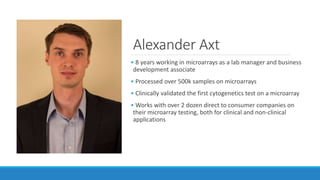
Alexander Axt
• 8 years working in microarrays as a lab manager and business
development associate
• Processed over 500k samples on microarrays
• Clinically validated the first cytogenetics test on a microarray
• Works with over 2 dozen direct to consumer companies on
their microarray testing, both for clinical and non-clinical
applications
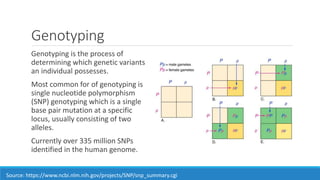
Genotyping
Genotyping is the process of
determining which genetic variants
an individual possesses.

Most common for of genotyping is
single nucleotide polymorphism
(SNP) genotyping which is a single
base pair mutation at a specific
locus, usually consisting of two
alleles.
Currently over 335 million SNPs
identified in the human genome.
Source: https://www.ncbi.nlm.nih.gov/projects/SNP/snp_summary.cgi
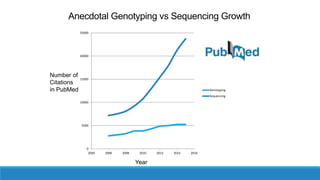
Anecdotal Genotyping vs Sequencing Growth
0
5000
10000
15000
20000
25000
2004 2006 2008 2010 2012 2014 2016
Genotyping
Sequencing
Year
Number of
Citations
in PubMed
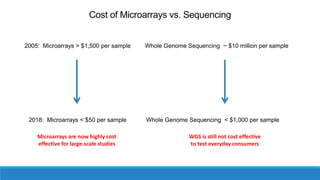
Cost of Microarrays vs. Sequencing
2005: Microarrays > $1,500 per sample
2018: Microarrays < $50 per sample
Microarrays are now highly cost
effective for large-scale studies
Whole Genome Sequencing ~ $10 million per sample
Whole Genome Sequencing < $1,000 per sample
WGS is still not cost effective
to test everyday consumers
Microarrays in a Sequencing World
•Mature Technology
•Low Cost
•Covers millions of markers in a single assay
•High Accuracy
•High Reproducibility
•High Throughput
•Smaller Data Sets
•Easier Analysis
•Used for a number of applications including: SNP
genotyping, copy number variations, gene expression,
microbiome, and methylation
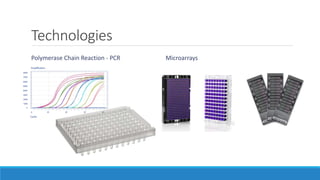
Technologies
Polymerase Chain Reaction - PCR Microarrays
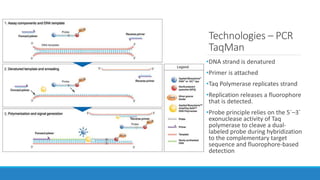
Technologies – PCR
TaqMan
•DNA strand is denatured
•Primer is attached
•Taq Polymerase replicates strand
•Replication releases a fluorophore
that is detected.
•Probe principle relies on the 5´–3´
exonuclease activity of Taq
polymerase to cleave a dual-
labeled probe during hybridization
to the complementary target
sequence and fluorophore-based
detection
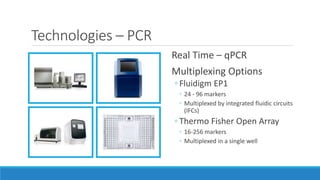
Technologies – PCR
Real Time – qPCR
Multiplexing Options
◦ Fluidigm EP1
◦ 24 - 96 markers
◦ Multiplexed by integrated fluidic circuits
(IFCs)
◦ Thermo Fisher Open Array
◦ 16-256 markers
◦ Multiplexed in a single well
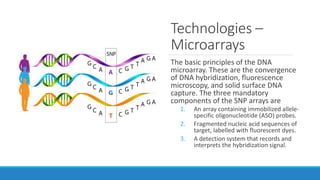
Technologies –
Microarrays
The basic principles of the DNA
microarray. These are the convergence
of DNA hybridization, fluorescence
microscopy, and solid surface DNA
capture. The three mandatory
components of the SNP arrays are
1. An array containing immobilized allele-
specific oligonucleotide (ASO) probes.
2. Fragmented nucleic acid sequences of
target, labelled with fluorescent dyes.
3. A detection system that records and
interprets the hybridization signal.
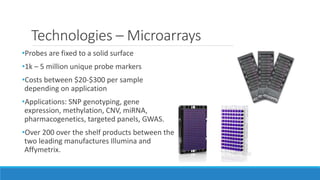
Technologies – Microarrays
•Probes are fixed to a solid surface
•1k – 5 million unique probe markers
•Costs between $20-$300 per sample
depending on application
•Applications: SNP genotyping, gene
expression, methylation, CNV, miRNA,
pharmacogenetics, targeted panels, GWAS.
•Over 200 over the shelf products between the
two leading manufactures Illumina and
Affymetrix.
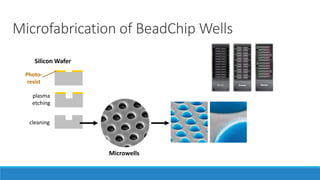
plasma
etching
cleaning
Photo-
resist
Silicon Wafer
Microfabrication of BeadChip Wells
Microwells
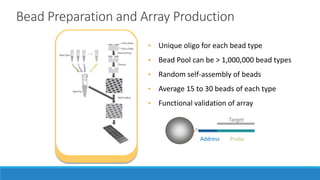
Bead Preparation and Array Production
• Unique oligo for each bead type
• Bead Pool can be > 1,000,000 bead types
• Random self-assembly of beads
• Average 15 to 30 beads of each type
• Functional validation of array
ProbeAddress
Target
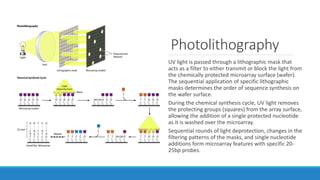
Photolithography
UV light is passed through a lithographic mask that
acts as a filter to either transmit or block the light from
the chemically protected microarray surface (wafer).
The sequential application of specific lithographic
masks determines the order of sequence synthesis on
the wafer surface.
During the chemical synthesis cycle, UV light removes
the protecting groups (squares) from the array surface,
allowing the addition of a single protected nucleotide
as it is washed over the microarray.
Sequential rounds of light deprotection, changes in the
filtering patterns of the masks, and single nucleotide
additions form microarray features with specific 20-
25bp probes.
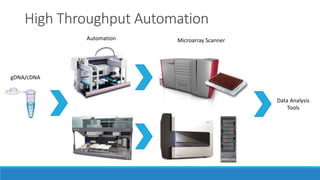
High Throughput Automation
gDNA/cDNA
Automation Microarray Scanner
Data Analysis
Tools
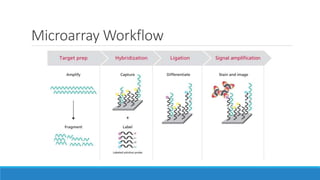
Microarray Workflow
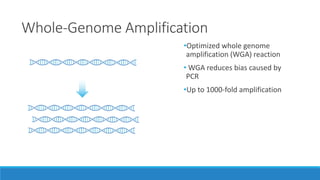
Whole-Genome Amplification
•Optimized whole genome
amplification (WGA) reaction
• WGA reduces bias caused by
PCR
•Up to 1000-fold amplification
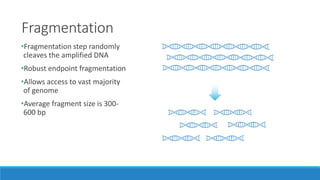
Fragmentation
•Fragmentation step randomly
cleaves the amplified DNA
•Robust endpoint fragmentation
•Allows access to vast majority
of genome
•Average fragment size is 300-
600 bp
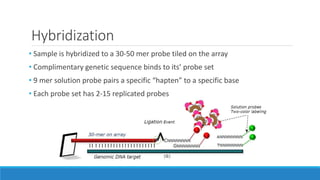
Hybridization
• Sample is hybridized to a 30-50 mer probe tiled on the array
• Complimentary genetic sequence binds to its’ probe set
• 9 mer solution probe pairs a specific “hapten” to a specific base
• Each probe set has 2-15 replicated probes
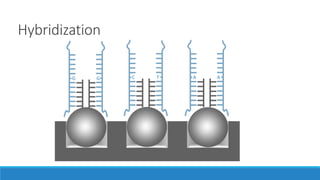
Hybridization
G G C T A A
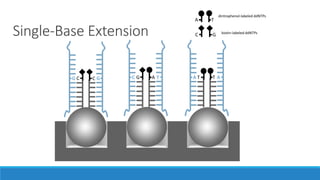
Single-Base Extension
G G C T A AC C G A TT
C
A
G
T
dintrophenol-labeled ddNTPs
biotin-labeled ddNTPs
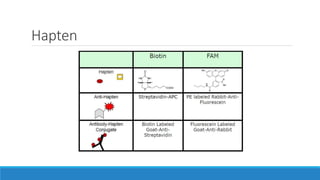
Hapten
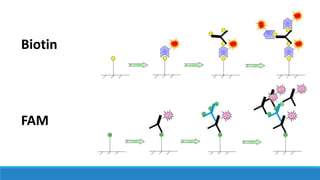
Biotin
FAM
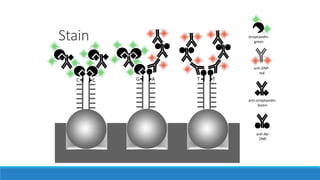
Stain
C C G A TT
streptavidin-
green
anti-DNP-
red
anti-streptavidin-
biotin
anti-Ab-
DNP
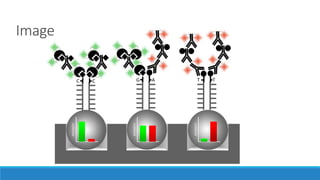
Image
C C G A TT
INTENSITY
INTENSITY
INTENSITY
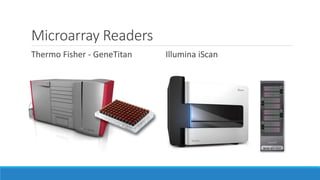
Microarray Readers
Thermo Fisher - GeneTitan Illumina iScan
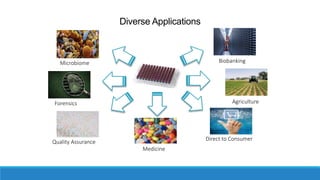
Diverse Applications
Microbiome
Medicine
Agriculture
Biobanking
Forensics
Quality Assurance
Direct to Consumer
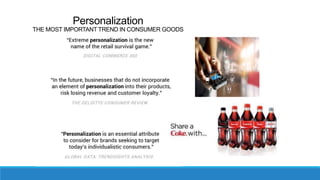
Personalization
THE MOST IMPORTANT TREND IN CONSUMER GOODS
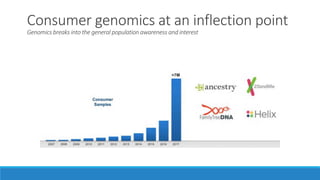
Consumer genomics at an inflection point
Genomics breaks into the general population awareness and interest
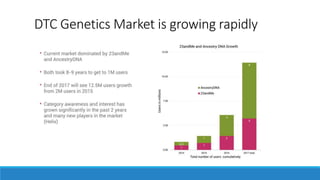
DTC Genetics Market is growing rapidly
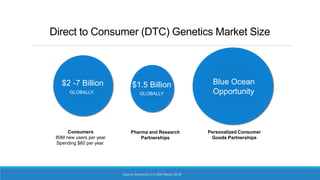
Direct to Consumer (DTC) Genetics Market Size
GLOBALLY GLOBALLY
Blue Ocean
Opportunity
$2 -7 Billion $1.5 Billion
Consumers
80M new users per year
Spending $60 per year
Pharma and Research
Partnerships
Personalized Consumer
Goods Partnerships
Source Genomics 2.0 UBS Report 2016
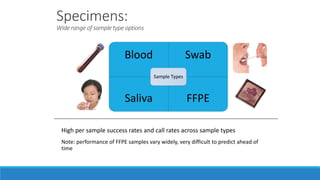
Specimens:
Wide range of sample type options
High per sample success rates and call rates across sample types
Note: performance of FFPE samples vary widely, very difficult to predict ahead of
time
Blood Swab
Saliva FFPE
Sample Types
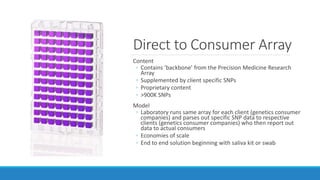
Direct to Consumer Array
Content
◦ Contains ‘backbone’ from the Precision Medicine Research
Array
◦ Supplemented by client specific SNPs
◦ Proprietary content
◦ >900K SNPs
Model
◦ Laboratory runs same array for each client (genetics consumer
companies) and parses out specific SNP data to respective
clients (genetics consumer companies) who then report out
data to actual consumers
◦ Economies of scale
◦ End to end solution beginning with saliva kit or swab
Clinical Applications:
Dementia Array
Identify individuals at risk of cognitive decline,
Alzheimer’s disease and other dementias
>130,000 SNPs
Utilization of genotyping array on Axiom GeneTitan
platform
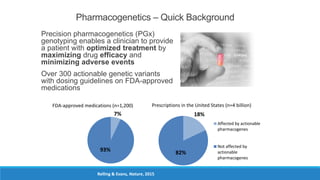
Pharmacogenetics – Quick Background
Precision pharmacogenetics (PGx)
genotyping enables a clinician to provide
a patient with optimized treatment by
maximizing drug efficacy and
minimizing adverse events
Over 300 actionable genetic variants
with dosing guidelines on FDA-approved
medications
18%
82%
Affected by actionable
pharmacogenes
Not affected by
actionable
pharmacogenes
7%
93%
FDA-approved medications (n=1,200) Prescriptions in the United States (n=4 billion)
Relling & Evans, Nature, 2015
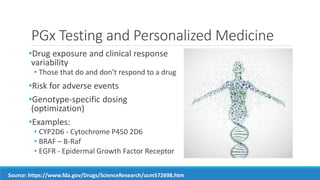
PGx Testing and Personalized Medicine
•Drug exposure and clinical response
variability
• Those that do and don’t respond to a drug
•Risk for adverse events
•Genotype-specific dosing
(optimization)
•Examples:
• CYP2D6 - Cytochrome P450 2D6
• BRAF – B-Raf
• EGFR - Epidermal Growth Factor Receptor
Source: https://www.fda.gov/Drugs/ScienceResearch/ucm572698.htm
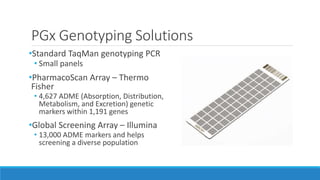
PGx Genotyping Solutions
•Standard TaqMan genotyping PCR
• Small panels
•PharmacoScan Array – Thermo
Fisher
• 4,627 ADME (Absorption, Distribution,
Metabolism, and Excretion) genetic
markers within 1,191 genes
•Global Screening Array – Illumina
• 13,000 ADME markers and helps
screening a diverse population
Challenges
• Logistics – how are
collection kits handled
• Quality Assurance – how to
insure proper sample
collection and processing at
higher volumes
•Reporting – unique to each
company and their
interpretation of the results
What Should Clinicians
Do?
•Work WITH the companies that do the reporting!
•Seek out a Genetic Counselor
• Trained and specializes in talking with patients
about their genetic data/reports
• Quality time in depth time with patients one on
one to discuss results
• National Society of Genetic Counselors
• https://www.nsgc.org
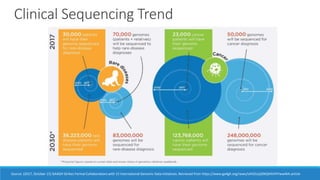
Clinical Sequencing Trend
Source: (2017, October 15) GA4GH Strikes Formal Collaborations with 15 International Genomic Data Initiatives. Retrieved from https://www.ga4gh.org/news/sAhZCeJjS96QHhVPIYwwWA.article
Clinically Relevant Variants
•The American College of Medical Genetics and
Genomics (ACMG) recommended that clinical
laboratories report back secondary findings
from 56 genes.
• Variants that are known to cause severe disease but
have clinically relevant actions
•Examples include
• Breast and Ovarian Cancer – BRAC1 and BRAC2
• Lynch Syndrome – MLH1, MSH2, MSH6, and PSM2
• Wilson’s Disease – ATP7B
Source: https://www.nature.com/articles/gim2016190
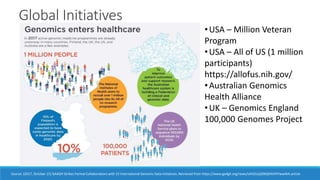
Global Initiatives
Source: (2017, October 15) GA4GH Strikes Formal Collaborations with 15 International Genomic Data Initiatives. Retrieved from https://www.ga4gh.org/news/sAhZCeJjS96QHhVPIYwwWA.article
•USA – Million Veteran
Program
•USA – All of US (1 million
participants)
https://allofus.nih.gov/
•Australian Genomics
Health Alliance
•UK – Genomics England
100,000 Genomes Project
Summary
•Microarrays are an important tool for large scale
genotyping studies
•Disruptive pricing allowing investigators to consider novel
large scale experiments
•New generation of Axiom and Infinium arrays enable
innovative approaches to precision medicine research
•Quality, costing, and turnaround time are crucial aspects
that ensure microarrays continue to be a critical cutting
edge tool for genomics and precision medicine research
Contact
Alexander Axt
aaxt@akesogen.com
Tel: (770) 542 0890
Dir: (470) 767-8055

Axt microarrays

  • 1.
    Clinical and Consumer Applicationsusing Microarrays and other Genotyping Technologies BY: ALEXANDER AXT
  • 2.
  • 3.
    Alexander Axt • 8years working in microarrays as a lab manager and business development associate • Processed over 500k samples on microarrays • Clinically validated the first cytogenetics test on a microarray • Works with over 2 dozen direct to consumer companies on their microarray testing, both for clinical and non-clinical applications
  • 4.
    Genotyping Genotyping is theprocess of determining which genetic variants an individual possesses. Most common for of genotyping is single nucleotide polymorphism (SNP) genotyping which is a single base pair mutation at a specific locus, usually consisting of two alleles. Currently over 335 million SNPs identified in the human genome. Source: https://www.ncbi.nlm.nih.gov/projects/SNP/snp_summary.cgi
  • 5.
    Anecdotal Genotyping vsSequencing Growth 0 5000 10000 15000 20000 25000 2004 2006 2008 2010 2012 2014 2016 Genotyping Sequencing Year Number of Citations in PubMed
  • 6.
    Cost of Microarraysvs. Sequencing 2005: Microarrays > $1,500 per sample 2018: Microarrays < $50 per sample Microarrays are now highly cost effective for large-scale studies Whole Genome Sequencing ~ $10 million per sample Whole Genome Sequencing < $1,000 per sample WGS is still not cost effective to test everyday consumers
  • 7.
    Microarrays in aSequencing World •Mature Technology •Low Cost •Covers millions of markers in a single assay •High Accuracy •High Reproducibility •High Throughput •Smaller Data Sets •Easier Analysis •Used for a number of applications including: SNP genotyping, copy number variations, gene expression, microbiome, and methylation
  • 8.
  • 9.
    Technologies – PCR TaqMan •DNAstrand is denatured •Primer is attached •Taq Polymerase replicates strand •Replication releases a fluorophore that is detected. •Probe principle relies on the 5´–3´ exonuclease activity of Taq polymerase to cleave a dual- labeled probe during hybridization to the complementary target sequence and fluorophore-based detection
  • 10.
    Technologies – PCR RealTime – qPCR Multiplexing Options ◦ Fluidigm EP1 ◦ 24 - 96 markers ◦ Multiplexed by integrated fluidic circuits (IFCs) ◦ Thermo Fisher Open Array ◦ 16-256 markers ◦ Multiplexed in a single well
  • 11.
    Technologies – Microarrays The basicprinciples of the DNA microarray. These are the convergence of DNA hybridization, fluorescence microscopy, and solid surface DNA capture. The three mandatory components of the SNP arrays are 1. An array containing immobilized allele- specific oligonucleotide (ASO) probes. 2. Fragmented nucleic acid sequences of target, labelled with fluorescent dyes. 3. A detection system that records and interprets the hybridization signal.
  • 12.
    Technologies – Microarrays •Probesare fixed to a solid surface •1k – 5 million unique probe markers •Costs between $20-$300 per sample depending on application •Applications: SNP genotyping, gene expression, methylation, CNV, miRNA, pharmacogenetics, targeted panels, GWAS. •Over 200 over the shelf products between the two leading manufactures Illumina and Affymetrix.
  • 13.
  • 14.
    Bead Preparation andArray Production • Unique oligo for each bead type • Bead Pool can be > 1,000,000 bead types • Random self-assembly of beads • Average 15 to 30 beads of each type • Functional validation of array ProbeAddress Target
  • 15.
    Photolithography UV light ispassed through a lithographic mask that acts as a filter to either transmit or block the light from the chemically protected microarray surface (wafer). The sequential application of specific lithographic masks determines the order of sequence synthesis on the wafer surface. During the chemical synthesis cycle, UV light removes the protecting groups (squares) from the array surface, allowing the addition of a single protected nucleotide as it is washed over the microarray. Sequential rounds of light deprotection, changes in the filtering patterns of the masks, and single nucleotide additions form microarray features with specific 20- 25bp probes.
  • 16.
    High Throughput Automation gDNA/cDNA AutomationMicroarray Scanner Data Analysis Tools
  • 17.
  • 18.
    Whole-Genome Amplification •Optimized wholegenome amplification (WGA) reaction • WGA reduces bias caused by PCR •Up to 1000-fold amplification
  • 19.
    Fragmentation •Fragmentation step randomly cleavesthe amplified DNA •Robust endpoint fragmentation •Allows access to vast majority of genome •Average fragment size is 300- 600 bp
  • 20.
    Hybridization • Sample ishybridized to a 30-50 mer probe tiled on the array • Complimentary genetic sequence binds to its’ probe set • 9 mer solution probe pairs a specific “hapten” to a specific base • Each probe set has 2-15 replicated probes
  • 21.
  • 22.
    Single-Base Extension G GC T A AC C G A TT C A G T dintrophenol-labeled ddNTPs biotin-labeled ddNTPs
  • 23.
  • 24.
  • 25.
    Stain C C GA TT streptavidin- green anti-DNP- red anti-streptavidin- biotin anti-Ab- DNP
  • 26.
    Image C C GA TT INTENSITY INTENSITY INTENSITY
  • 27.
    Microarray Readers Thermo Fisher- GeneTitan Illumina iScan
  • 28.
  • 29.
    Personalization THE MOST IMPORTANTTREND IN CONSUMER GOODS
  • 30.
    Consumer genomics atan inflection point Genomics breaks into the general population awareness and interest
  • 31.
    DTC Genetics Marketis growing rapidly
  • 32.
    Direct to Consumer(DTC) Genetics Market Size GLOBALLY GLOBALLY Blue Ocean Opportunity $2 -7 Billion $1.5 Billion Consumers 80M new users per year Spending $60 per year Pharma and Research Partnerships Personalized Consumer Goods Partnerships Source Genomics 2.0 UBS Report 2016
  • 33.
    Specimens: Wide range ofsample type options High per sample success rates and call rates across sample types Note: performance of FFPE samples vary widely, very difficult to predict ahead of time Blood Swab Saliva FFPE Sample Types
  • 34.
    Direct to ConsumerArray Content ◦ Contains ‘backbone’ from the Precision Medicine Research Array ◦ Supplemented by client specific SNPs ◦ Proprietary content ◦ >900K SNPs Model ◦ Laboratory runs same array for each client (genetics consumer companies) and parses out specific SNP data to respective clients (genetics consumer companies) who then report out data to actual consumers ◦ Economies of scale ◦ End to end solution beginning with saliva kit or swab
  • 35.
    Clinical Applications: Dementia Array Identifyindividuals at risk of cognitive decline, Alzheimer’s disease and other dementias >130,000 SNPs Utilization of genotyping array on Axiom GeneTitan platform
  • 36.
    Pharmacogenetics – QuickBackground Precision pharmacogenetics (PGx) genotyping enables a clinician to provide a patient with optimized treatment by maximizing drug efficacy and minimizing adverse events Over 300 actionable genetic variants with dosing guidelines on FDA-approved medications 18% 82% Affected by actionable pharmacogenes Not affected by actionable pharmacogenes 7% 93% FDA-approved medications (n=1,200) Prescriptions in the United States (n=4 billion) Relling & Evans, Nature, 2015
  • 37.
    PGx Testing andPersonalized Medicine •Drug exposure and clinical response variability • Those that do and don’t respond to a drug •Risk for adverse events •Genotype-specific dosing (optimization) •Examples: • CYP2D6 - Cytochrome P450 2D6 • BRAF – B-Raf • EGFR - Epidermal Growth Factor Receptor Source: https://www.fda.gov/Drugs/ScienceResearch/ucm572698.htm
  • 38.
    PGx Genotyping Solutions •StandardTaqMan genotyping PCR • Small panels •PharmacoScan Array – Thermo Fisher • 4,627 ADME (Absorption, Distribution, Metabolism, and Excretion) genetic markers within 1,191 genes •Global Screening Array – Illumina • 13,000 ADME markers and helps screening a diverse population
  • 39.
    Challenges • Logistics –how are collection kits handled • Quality Assurance – how to insure proper sample collection and processing at higher volumes •Reporting – unique to each company and their interpretation of the results
  • 40.
    What Should Clinicians Do? •WorkWITH the companies that do the reporting! •Seek out a Genetic Counselor • Trained and specializes in talking with patients about their genetic data/reports • Quality time in depth time with patients one on one to discuss results • National Society of Genetic Counselors • https://www.nsgc.org
  • 41.
    Clinical Sequencing Trend Source:(2017, October 15) GA4GH Strikes Formal Collaborations with 15 International Genomic Data Initiatives. Retrieved from https://www.ga4gh.org/news/sAhZCeJjS96QHhVPIYwwWA.article
  • 42.
    Clinically Relevant Variants •TheAmerican College of Medical Genetics and Genomics (ACMG) recommended that clinical laboratories report back secondary findings from 56 genes. • Variants that are known to cause severe disease but have clinically relevant actions •Examples include • Breast and Ovarian Cancer – BRAC1 and BRAC2 • Lynch Syndrome – MLH1, MSH2, MSH6, and PSM2 • Wilson’s Disease – ATP7B Source: https://www.nature.com/articles/gim2016190
  • 43.
    Global Initiatives Source: (2017,October 15) GA4GH Strikes Formal Collaborations with 15 International Genomic Data Initiatives. Retrieved from https://www.ga4gh.org/news/sAhZCeJjS96QHhVPIYwwWA.article •USA – Million Veteran Program •USA – All of US (1 million participants) https://allofus.nih.gov/ •Australian Genomics Health Alliance •UK – Genomics England 100,000 Genomes Project
  • 44.
    Summary •Microarrays are animportant tool for large scale genotyping studies •Disruptive pricing allowing investigators to consider novel large scale experiments •New generation of Axiom and Infinium arrays enable innovative approaches to precision medicine research •Quality, costing, and turnaround time are crucial aspects that ensure microarrays continue to be a critical cutting edge tool for genomics and precision medicine research
  • 45.