D.K Wheeler
Curriculum Model
Hadeeqa Waleed
Educationist
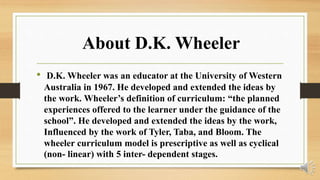
About D.K. Wheeler
• D.K. Wheeler was an educator at the University of Western
Australia in 1967. He developed and extended the ideas by
the work. Wheeler’s definition of curriculum: “the planned
experiences offered to the learner under the guidance of the
school”. He developed and extended the ideas by the work,
Influenced by the work of Tyler, Taba, and Bloom. The
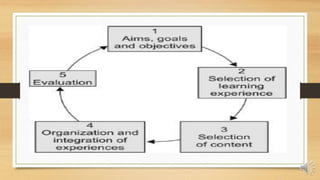
wheeler curriculum model is prescriptive as well as cyclical
(non- linear) with 5 inter- dependent stages.
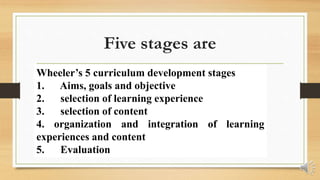
Five stages are
Wheeler’s 5 curriculum development stages
1. Aims, goals and objective
2. selection of learning experience
3. selection of content
4. organization and integration of learning
experiences and content
5. Evaluation
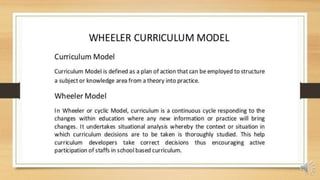
• Wheeler’s cyclical model has the advantage of
flexibility over the linear models: it allows
curriculum specialists to start working at any stage
in the process. The Wheeler model also emphasizes
content selection, and the integration of content in
providing quality learning experiences. This model
focuses on situational analysis: the context in which
the curriculum decisions are taken is considered
important, as this is believed to help make the most
effective decision.
• This model illustrates the dynamic nature of
the process of curriculum development. It goes
on as the needs and interest of society change
and the objective also change. This model has
a feedback mechanism (students can measure
their progress). It also sets the school objective
as a final step in as well as the first. it clearly
calls for the setting up objective.
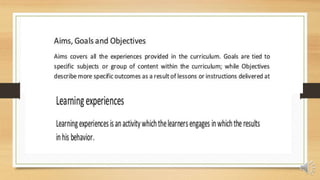
• The first step of model in which aims covers
all the experiences provided in the curriculum.
Goals are tied to specific subjects or group of
content within the curriculum; while
objectives describe more specific outcomes as
result of lesson or instructions delivered at a
classroom. The second step of model is about
learning experiences is an activity which the
leaner engages in which the results in his/her
behavior
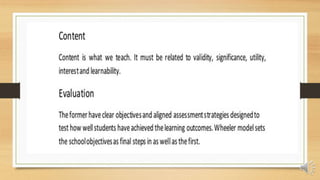
• . The selection content is what teacher teaches.
It must be related to validity, significance,
utility, interest and learnability. The step
Evaluation is about that the former have clear
objective and aligned assessment strategies
designed to test how well students have
achieved the learning outcomes. Wheeler
model sets the school objectives as final steps
in as well as the first
• Wheeler model seems to lack of
procedure between organizing and
integrating learning experience, content
and evaluation. And it advocates is a
time-consuming process that can be
difficult to put into practice in the hectic
conditions in modern education practice.

Wheeler model of curriculum development

  • 1.
  • 2.
    About D.K. Wheeler •D.K. Wheeler was an educator at the University of Western Australia in 1967. He developed and extended the ideas by the work. Wheeler’s definition of curriculum: “the planned experiences offered to the learner under the guidance of the school”. He developed and extended the ideas by the work, Influenced by the work of Tyler, Taba, and Bloom. The wheeler curriculum model is prescriptive as well as cyclical (non- linear) with 5 inter- dependent stages.
  • 3.
    Five stages are Wheeler’s5 curriculum development stages 1. Aims, goals and objective 2. selection of learning experience 3. selection of content 4. organization and integration of learning experiences and content 5. Evaluation
  • 9.
    • Wheeler’s cyclicalmodel has the advantage of flexibility over the linear models: it allows curriculum specialists to start working at any stage in the process. The Wheeler model also emphasizes content selection, and the integration of content in providing quality learning experiences. This model focuses on situational analysis: the context in which the curriculum decisions are taken is considered important, as this is believed to help make the most effective decision.
  • 10.
    • This modelillustrates the dynamic nature of the process of curriculum development. It goes on as the needs and interest of society change and the objective also change. This model has a feedback mechanism (students can measure their progress). It also sets the school objective as a final step in as well as the first. it clearly calls for the setting up objective.
  • 11.
    • The firststep of model in which aims covers all the experiences provided in the curriculum. Goals are tied to specific subjects or group of content within the curriculum; while objectives describe more specific outcomes as result of lesson or instructions delivered at a classroom. The second step of model is about learning experiences is an activity which the leaner engages in which the results in his/her behavior
  • 12.
    • . Theselection content is what teacher teaches. It must be related to validity, significance, utility, interest and learnability. The step Evaluation is about that the former have clear objective and aligned assessment strategies designed to test how well students have achieved the learning outcomes. Wheeler model sets the school objectives as final steps in as well as the first
  • 13.
    • Wheeler modelseems to lack of procedure between organizing and integrating learning experience, content and evaluation. And it advocates is a time-consuming process that can be difficult to put into practice in the hectic conditions in modern education practice.