SUBMITTED TO :-
Dr. Madhu Gupta .
SUBMITTED BY :-
Gunjan Verma
Content :-
1) An introduction to educational research .
2) Steps in educational research .
3) Identification of the problem .
4) Steps in identification of problem .
5) Selection of area .
6) Delimitation of problem .
7) Evaluation of problem .
According to the English Dictionary , the word
research comes from the FRENCH word recherche ,
which means to “ travel through “ or “ survey “ . It
also means “ to search after or to investigate “
Research is a process in which a person observe the
phenomena again and again to collect the data and
he draw some conclusions on the base of that data .
An introduction to educational
research :-
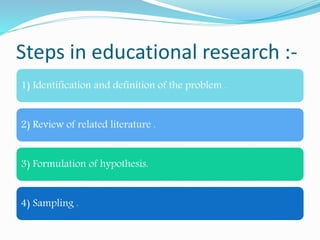
Steps in educational research :-
1) Identification and definition of the problem .
2) Review of related literature .
3) Formulation of hypothesis.
4) Sampling .
Identification of the problem :-
 The first step in the research process is the choice of a
suitable problem for investigation .
The identification of a research problem is a difficult but
an important phase of the entire process .
 A beginner researcher finds the task of identifying a
research problem difficult one .
The REASON may be his limited knowledge of research
process , unpreparedness for identifying the problem ,
unfamiliar with the areas in which research is needed
and the procedure he has to follow .
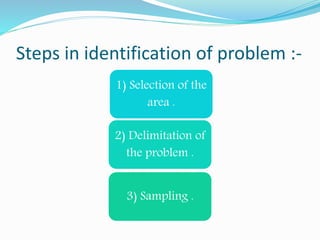
Steps in identification of problem :-
1) Selection of the
area .
2) Delimitation of
the problem .
3) Sampling .
Selection of the area :-
1) Knowing the field or area .
2) Selection of the problem .
1) Knowing the field :-
 It is first necessary for a researcher to choose a
broad field within which he will conduct the study .
The field selected should be one in which researcher
is capable of demonstrating necessary initiative ,
originality and good judgement .
A thorough understanding of the known facts and
ideas of the field is the most important step in
selecting a problem for study .
Periodicals and annual biographies are helpful in
keeping the researcher informed .
2) Selection of the problem :-
 After selecting the broad area , the researcher must
narrow it down to a highly specific research problem
and must state the specific questions .
SOURCES OR ORIGIN OF THE PROBLEM :-
1) Personal experience :- one of the sources of problem
for research is the daily contact of the professional
educator . The classroom teacher for example is in daily
contact with the students .
 The interaction occurs between teacher and pupil,
pupil and pupil , pupil and material , furnishes a rich
Source of questions to be answered through
educational research .
2) PROFESSIONAL LITERATUTRE :-
Extensive and critical reading in a field not only
serves as a check on what has already been done .
 research oriented professional journals .
 The Education Index is the most complete biography
of writings in the field of education .
The Review of Educational Research , a publication of
the American Educational Research Association ,
reviews specific problem area in a three year cycle .
 The Encylopedia of Educational Research, gives a
review of the research in nearly every area of
education and covers 10 years period .
 Dissertation abstracts , The handbook of research
on Teaching .
 Psychological Abstracts and the Sociological
Abstracts are also excellent place to began general
survey .
Other publications are also helpful
The Research Needs in the Study Of education (1968)
• Survey of Research in education (1973, 1979
,1987,1991)
The third Indian Yearbook of Education; Educational
research (1968)
3) PROFESSIONAL CONTACTS :-
Ideas can also came through association with
research oriented colleagues .
Attendance at meetings of research Association , such
as The American Educational Research Association,
offers another opportunity for association with other
professionals who are reporting research problems .
The Symposia ,
Paper reading ,
 Active membership in professional organization
such as :-
The National Education Association, Association for
Supervision and curriculum development , and
Pi Delta Kappa is also conducive to a research
orientation .
These organization are concerned with
the improvement of educational opportunity and are
able to view the problem from a broad perspective .
4) SUGGESTIONS:- Problems may be selected among
the suggestions given by educators and research
workers .
The Journal of Experimental Education,
The Journal of educational Research ,
The Doctors ‘and Masters’ Theses in education ,
Dissertation Abstracts, Psychological Abstract , the
Review of Educational Research ,
Text books, Special assignment, Repots and Papers .
5) Technological and Social changes:-
Use of Hardware and Software in classes ,
The training of teachers through Team-Teaching ,
Microteaching , Simulation , Computers ,
Development of new courses and curriculum for
students .
All these development constantly bring
forth new problems for Research .
Delimitation of problem:-
In this phase , we have to limit and clarify the topic ,
or refine it to make it more easily researchable .
Without refinement , it is difficult to take hold on
problem .
According to whiteny(1964), “To define a problem
means to put a fence around it , to separate it by
careful distinctions from like questions found in
related situation of need .”
3 steps of defining limits in
research
1) STATMENT OF PROBLEM :-
First of all write down the
topic in the form of STATEMENT or a QUESTION
briefly and clearly and this is known as STATEMENT
OF PROBLEM .
2) Then write the OPERATIONAL DEFINATION of the
main words in the topic .
3) At the end , formulate the HYPOTHESES that have to
be tested .
Rules according to Hillway(1964)
Be sure that the topic chosen is neither too vague ,
nor too broad in scope .
To make problem clearer and more understandable ,
state it as a question which requires a definite
answer .
Carefully state the limits of the problems ,
eliminating all aspects and factors which will not be
considered in the study .
Define any special terms that must be used in the
statement of the problem .
Operational definition :-
Through these the researcher tells what are going to
be the meaning in his study of those main words in
the statement of the problem whose scope needs to
be delimit . But the meaning should be in the
accepted concept of the words and not beyond them .
We have to define particulars like Intelligence,
Achievement, Personality , Gender , Socio economic
level etc .
Evaluation of the problem:-
1)IS THE PROBLEM RESEARCHABLE:-
There are certain problems that may not be solved
through the process of research . Like , “Is it good to
provide sex education in the secondary schools?” is
a value question and can be answered only on the
basis of value judgement .
2) IS THE PROBLEM NEW :-
There is no purpose in studying a problem which
has already been investigated by other researchers .
To avoid DUPLICATION , it is essential to examine
very carefully the record of previous studies
completed in one’s field .
The researcher should not select a problem until he
is convinced that it is a NEW problem .
3) IS THE PROBLEM SIGNIFICANT :-
 The question of significance of the problem usually
relates to what a researcher hopes to accomplish in
a particular study .
4) IS THE PROBLEM IS FEASIBLE FOR THE
PARTICULAR :-
a) RESEARCH COMPETENCIES:- The problem should
be in an area in which the researcher is qualified
and competent .
b) INTRESET AND ENTHUSIAM:- The problem should
be one in which the researcher is genuinely
interested and about which he is truly enthusiastic .
c) FINANCIAL CONSIDERATION:- The researcher
Must have an estimate of the expenditure involved in:-
Data gathering equipment,
Printing,
Test material ,
Travel and clerical assistance .
CENTERAL ORGANIZATIONS LIKE :-
The University Grants Commission ,
The National Council of Educational Research and
Training,
The Indian Council of Social Science Research .
Refrences :-
Misra, 2003. An Introduction to Educational Research
.New Delhi : Sumit Enterprises .
Sinha,H.C .1987 . Educational Research . Haryana : Vishal
Publications .
Kaul, L.1988. Methodology of Educational Research .
New Delhi : Vikas Publishing House pvt. Ltd.
Charles, 1988 . Introduction to Educational Research .
New York : Longman Inc.
Chandra , Sharma, 2002. Reaserch In Education . New
Delhi : Atlantic Publishers & Distributiors .
Mertler, Charles, 2011.Introduction to Educational
Research . Pearson Publications .
THANK YOU

Research identification of the problem

  • 1.
    SUBMITTED TO :- Dr.Madhu Gupta . SUBMITTED BY :- Gunjan Verma
  • 2.
    Content :- 1) Anintroduction to educational research . 2) Steps in educational research . 3) Identification of the problem . 4) Steps in identification of problem . 5) Selection of area . 6) Delimitation of problem . 7) Evaluation of problem .
  • 3.
    According to theEnglish Dictionary , the word research comes from the FRENCH word recherche , which means to “ travel through “ or “ survey “ . It also means “ to search after or to investigate “ Research is a process in which a person observe the phenomena again and again to collect the data and he draw some conclusions on the base of that data . An introduction to educational research :-
  • 4.
    Steps in educationalresearch :- 1) Identification and definition of the problem . 2) Review of related literature . 3) Formulation of hypothesis. 4) Sampling .
  • 5.
    Identification of theproblem :-  The first step in the research process is the choice of a suitable problem for investigation . The identification of a research problem is a difficult but an important phase of the entire process .  A beginner researcher finds the task of identifying a research problem difficult one . The REASON may be his limited knowledge of research process , unpreparedness for identifying the problem , unfamiliar with the areas in which research is needed and the procedure he has to follow .
  • 6.
    Steps in identificationof problem :- 1) Selection of the area . 2) Delimitation of the problem . 3) Sampling .
  • 7.
    Selection of thearea :- 1) Knowing the field or area . 2) Selection of the problem .
  • 8.
    1) Knowing thefield :-  It is first necessary for a researcher to choose a broad field within which he will conduct the study . The field selected should be one in which researcher is capable of demonstrating necessary initiative , originality and good judgement . A thorough understanding of the known facts and ideas of the field is the most important step in selecting a problem for study . Periodicals and annual biographies are helpful in keeping the researcher informed .
  • 9.
    2) Selection ofthe problem :-  After selecting the broad area , the researcher must narrow it down to a highly specific research problem and must state the specific questions . SOURCES OR ORIGIN OF THE PROBLEM :- 1) Personal experience :- one of the sources of problem for research is the daily contact of the professional educator . The classroom teacher for example is in daily contact with the students .  The interaction occurs between teacher and pupil, pupil and pupil , pupil and material , furnishes a rich
  • 10.
    Source of questionsto be answered through educational research . 2) PROFESSIONAL LITERATUTRE :- Extensive and critical reading in a field not only serves as a check on what has already been done .  research oriented professional journals .  The Education Index is the most complete biography of writings in the field of education . The Review of Educational Research , a publication of the American Educational Research Association ,
  • 11.
    reviews specific problemarea in a three year cycle .  The Encylopedia of Educational Research, gives a review of the research in nearly every area of education and covers 10 years period .  Dissertation abstracts , The handbook of research on Teaching .  Psychological Abstracts and the Sociological Abstracts are also excellent place to began general survey .
  • 12.
    Other publications arealso helpful The Research Needs in the Study Of education (1968) • Survey of Research in education (1973, 1979 ,1987,1991) The third Indian Yearbook of Education; Educational research (1968)
  • 13.
    3) PROFESSIONAL CONTACTS:- Ideas can also came through association with research oriented colleagues . Attendance at meetings of research Association , such as The American Educational Research Association, offers another opportunity for association with other professionals who are reporting research problems . The Symposia , Paper reading ,
  • 14.
     Active membershipin professional organization such as :- The National Education Association, Association for Supervision and curriculum development , and Pi Delta Kappa is also conducive to a research orientation . These organization are concerned with the improvement of educational opportunity and are able to view the problem from a broad perspective .
  • 15.
    4) SUGGESTIONS:- Problemsmay be selected among the suggestions given by educators and research workers . The Journal of Experimental Education, The Journal of educational Research , The Doctors ‘and Masters’ Theses in education , Dissertation Abstracts, Psychological Abstract , the Review of Educational Research , Text books, Special assignment, Repots and Papers .
  • 16.
    5) Technological andSocial changes:- Use of Hardware and Software in classes , The training of teachers through Team-Teaching , Microteaching , Simulation , Computers , Development of new courses and curriculum for students . All these development constantly bring forth new problems for Research .
  • 17.
    Delimitation of problem:- Inthis phase , we have to limit and clarify the topic , or refine it to make it more easily researchable . Without refinement , it is difficult to take hold on problem . According to whiteny(1964), “To define a problem means to put a fence around it , to separate it by careful distinctions from like questions found in related situation of need .”
  • 18.
    3 steps ofdefining limits in research 1) STATMENT OF PROBLEM :- First of all write down the topic in the form of STATEMENT or a QUESTION briefly and clearly and this is known as STATEMENT OF PROBLEM . 2) Then write the OPERATIONAL DEFINATION of the main words in the topic . 3) At the end , formulate the HYPOTHESES that have to be tested .
  • 19.
    Rules according toHillway(1964) Be sure that the topic chosen is neither too vague , nor too broad in scope . To make problem clearer and more understandable , state it as a question which requires a definite answer . Carefully state the limits of the problems , eliminating all aspects and factors which will not be considered in the study . Define any special terms that must be used in the statement of the problem .
  • 20.
    Operational definition :- Throughthese the researcher tells what are going to be the meaning in his study of those main words in the statement of the problem whose scope needs to be delimit . But the meaning should be in the accepted concept of the words and not beyond them . We have to define particulars like Intelligence, Achievement, Personality , Gender , Socio economic level etc .
  • 21.
    Evaluation of theproblem:- 1)IS THE PROBLEM RESEARCHABLE:- There are certain problems that may not be solved through the process of research . Like , “Is it good to provide sex education in the secondary schools?” is a value question and can be answered only on the basis of value judgement . 2) IS THE PROBLEM NEW :- There is no purpose in studying a problem which has already been investigated by other researchers .
  • 22.
    To avoid DUPLICATION, it is essential to examine very carefully the record of previous studies completed in one’s field . The researcher should not select a problem until he is convinced that it is a NEW problem . 3) IS THE PROBLEM SIGNIFICANT :-  The question of significance of the problem usually relates to what a researcher hopes to accomplish in a particular study .
  • 23.
    4) IS THEPROBLEM IS FEASIBLE FOR THE PARTICULAR :- a) RESEARCH COMPETENCIES:- The problem should be in an area in which the researcher is qualified and competent . b) INTRESET AND ENTHUSIAM:- The problem should be one in which the researcher is genuinely interested and about which he is truly enthusiastic . c) FINANCIAL CONSIDERATION:- The researcher
  • 24.
    Must have anestimate of the expenditure involved in:- Data gathering equipment, Printing, Test material , Travel and clerical assistance . CENTERAL ORGANIZATIONS LIKE :- The University Grants Commission , The National Council of Educational Research and Training, The Indian Council of Social Science Research .
  • 25.
    Refrences :- Misra, 2003.An Introduction to Educational Research .New Delhi : Sumit Enterprises . Sinha,H.C .1987 . Educational Research . Haryana : Vishal Publications . Kaul, L.1988. Methodology of Educational Research . New Delhi : Vikas Publishing House pvt. Ltd. Charles, 1988 . Introduction to Educational Research . New York : Longman Inc. Chandra , Sharma, 2002. Reaserch In Education . New Delhi : Atlantic Publishers & Distributiors . Mertler, Charles, 2011.Introduction to Educational Research . Pearson Publications .
  • 26.