SEED PRIMING
Malik Ghulam Asghar
AG-A-13-71
Presented to
Sir Dr. Nazim Hussain
Sir Hamid Nawaz
Department of Agronomy
Faculty of Agricultural Sciences and Technology
Bahauddin Zakariya University Multan Pakistan
Introduction
 Every seed should be healthy and readily
germinate to produce a vigorous seedling to
ensure better crop yield.
Seeds can retain their high vigor for some time
and thereafter begin to deteriorate losing their
germination capacity, vigor and viability.
(Ellis and Filho, 1992; McDonald, 1999)
Low vigor seeds germinate and emerge poorly
and result in smaller plants as compared to high
vigor seeds.
(Ellis and Roberts, 1981)
Seed Enhancements
“Seed enhancements are the pre germination
treatments that improve the germination rate,
time and seedling growth or facilitate the
delivery of seeds and other material required at
the time of sowing.”
The purpose of seed treatments is to shorten
the time between planting and emergence.
(Black and Peter, 2006)
SEED PRIMING
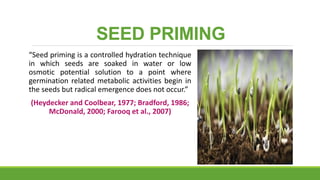
“Seed priming is a controlled hydration technique
in which seeds are soaked in water or low
osmotic potential solution to a point where
germination related metabolic activities begin in
the seeds but radical emergence does not occur.”
(Heydecker and Coolbear, 1977; Bradford, 1986;
McDonald, 2000; Farooq et al., 2007)
Seed Priming Process
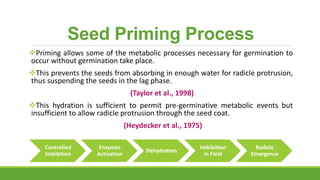
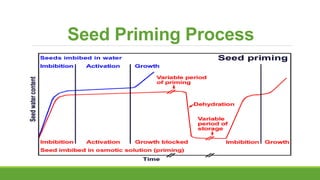
Priming allows some of the metabolic processes necessary for germination to
occur without germination take place.
This prevents the seeds from absorbing in enough water for radicle protrusion,
thus suspending the seeds in the lag phase.
(Taylor et al., 1998)
This hydration is sufficient to permit pre-germinative metabolic events but
insufficient to allow radicle protrusion through the seed coat.
(Heydecker et al., 1975)
Controlled
Imbibition
Enzymes
Activation
Dehydration
Imbibition
in Field
Radicle
Emergence
Seed Priming Process
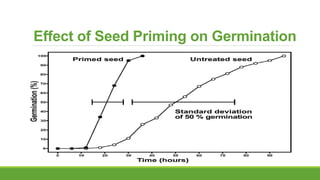
Effect of Seed Priming on Germination
Advantages of Seed Priming
It decreases the time to germination
Increase the rate of germination
emerges from the soil most faster and uniformly
Crops can compete more effectively with weeds
eliminate or greatly reduce the amount of seed-
borne fungi
(Basra et al., 2002, Farooq et al., 2004)
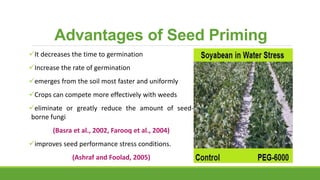
improves seed performance stress conditions.
(Ashraf and Foolad, 2005)
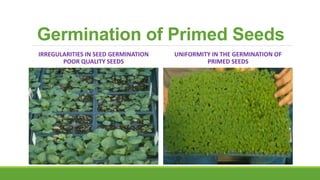
Germination of Primed Seeds
IRREGULARITIES IN SEED GERMINATION
POOR QUALITY SEEDS
UNIFORMITY IN THE GERMINATION OF
PRIMED SEEDS
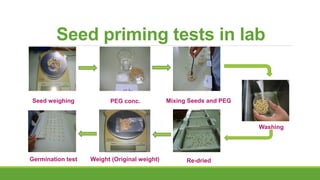
Seed priming tests in lab
Seed weighing PEG conc. Mixing Seeds and PEG
Washing
Re-driedWeight (Original weight)Germination test
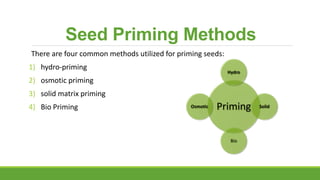
Seed Priming Methods
There are four common methods utilized for priming seeds:
1) hydro-priming
2) osmotic priming
3) solid matrix priming
4) Bio Priming Priming
Hydro
Solid
Bio
Osmotic
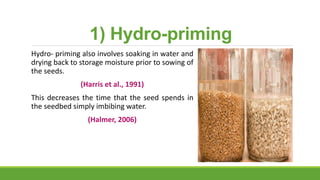
1) Hydro-priming
Hydro- priming also involves soaking in water and
drying back to storage moisture prior to sowing of
the seeds.
(Harris et al., 1991)
This decreases the time that the seed spends in
the seedbed simply imbibing water.
(Halmer, 2006)
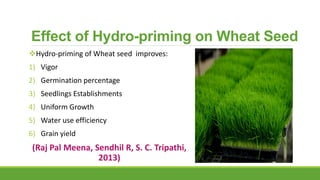
Effect of Hydro-priming on Wheat Seed
Hydro-priming of Wheat seed improves:
1) Vigor
2) Germination percentage
3) Seedlings Establishments
4) Uniform Growth
5) Water use efficiency
6) Grain yield
(Raj Pal Meena, Sendhil R, S. C. Tripathi,
2013)
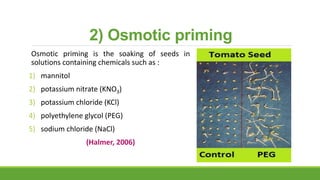
2) Osmotic priming
Osmotic priming is the soaking of seeds in
solutions containing chemicals such as :
1) mannitol
2) potassium nitrate (KNO3)
3) potassium chloride (KCl)
4) polyethylene glycol (PEG)
5) sodium chloride (NaCl)
(Halmer, 2006)
3) Solid matrix priming
Solid matrix priming involves the incubation of seeds in a solid, insoluble matrix,
such as vermiculite, diatomaceous earth, or another highly water absorbent
polymer, with a limited amount of water, allowing for slow imbibition.
(McDonald, 2000)
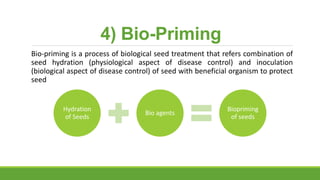
4) Bio-Priming
Bio-priming is a process of biological seed treatment that refers combination of
seed hydration (physiological aspect of disease control) and inoculation
(biological aspect of disease control) of seed with beneficial organism to protect
seed
Hydration
of Seeds
Bio agents
Biopriming
of seeds
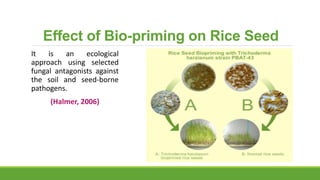
Effect of Bio-priming on Rice Seed
It is an ecological
approach using selected
fungal antagonists against
the soil and seed-borne
pathogens.
(Halmer, 2006)
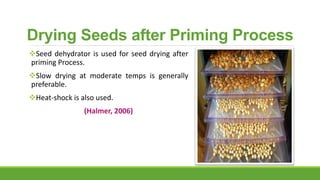
Drying Seeds after Priming Process
Seed dehydrator is used for seed drying after
priming Process.
Slow drying at moderate temps is generally
preferable.
Heat-shock is also used.
(Halmer, 2006)
THANK YOU
Any Question ?

Seed Priming

  • 1.
    SEED PRIMING Malik GhulamAsghar AG-A-13-71 Presented to Sir Dr. Nazim Hussain Sir Hamid Nawaz Department of Agronomy Faculty of Agricultural Sciences and Technology Bahauddin Zakariya University Multan Pakistan
  • 2.
    Introduction  Every seedshould be healthy and readily germinate to produce a vigorous seedling to ensure better crop yield. Seeds can retain their high vigor for some time and thereafter begin to deteriorate losing their germination capacity, vigor and viability. (Ellis and Filho, 1992; McDonald, 1999) Low vigor seeds germinate and emerge poorly and result in smaller plants as compared to high vigor seeds. (Ellis and Roberts, 1981)
  • 3.
    Seed Enhancements “Seed enhancementsare the pre germination treatments that improve the germination rate, time and seedling growth or facilitate the delivery of seeds and other material required at the time of sowing.” The purpose of seed treatments is to shorten the time between planting and emergence. (Black and Peter, 2006)
  • 4.
    SEED PRIMING “Seed primingis a controlled hydration technique in which seeds are soaked in water or low osmotic potential solution to a point where germination related metabolic activities begin in the seeds but radical emergence does not occur.” (Heydecker and Coolbear, 1977; Bradford, 1986; McDonald, 2000; Farooq et al., 2007)
  • 5.
    Seed Priming Process Primingallows some of the metabolic processes necessary for germination to occur without germination take place. This prevents the seeds from absorbing in enough water for radicle protrusion, thus suspending the seeds in the lag phase. (Taylor et al., 1998) This hydration is sufficient to permit pre-germinative metabolic events but insufficient to allow radicle protrusion through the seed coat. (Heydecker et al., 1975) Controlled Imbibition Enzymes Activation Dehydration Imbibition in Field Radicle Emergence
  • 6.
  • 7.
    Effect of SeedPriming on Germination
  • 8.
    Advantages of SeedPriming It decreases the time to germination Increase the rate of germination emerges from the soil most faster and uniformly Crops can compete more effectively with weeds eliminate or greatly reduce the amount of seed- borne fungi (Basra et al., 2002, Farooq et al., 2004) improves seed performance stress conditions. (Ashraf and Foolad, 2005)
  • 9.
    Germination of PrimedSeeds IRREGULARITIES IN SEED GERMINATION POOR QUALITY SEEDS UNIFORMITY IN THE GERMINATION OF PRIMED SEEDS
  • 10.
    Seed priming testsin lab Seed weighing PEG conc. Mixing Seeds and PEG Washing Re-driedWeight (Original weight)Germination test
  • 11.
    Seed Priming Methods Thereare four common methods utilized for priming seeds: 1) hydro-priming 2) osmotic priming 3) solid matrix priming 4) Bio Priming Priming Hydro Solid Bio Osmotic
  • 12.
    1) Hydro-priming Hydro- primingalso involves soaking in water and drying back to storage moisture prior to sowing of the seeds. (Harris et al., 1991) This decreases the time that the seed spends in the seedbed simply imbibing water. (Halmer, 2006)
  • 13.
    Effect of Hydro-primingon Wheat Seed Hydro-priming of Wheat seed improves: 1) Vigor 2) Germination percentage 3) Seedlings Establishments 4) Uniform Growth 5) Water use efficiency 6) Grain yield (Raj Pal Meena, Sendhil R, S. C. Tripathi, 2013)
  • 14.
    2) Osmotic priming Osmoticpriming is the soaking of seeds in solutions containing chemicals such as : 1) mannitol 2) potassium nitrate (KNO3) 3) potassium chloride (KCl) 4) polyethylene glycol (PEG) 5) sodium chloride (NaCl) (Halmer, 2006)
  • 15.
    3) Solid matrixpriming Solid matrix priming involves the incubation of seeds in a solid, insoluble matrix, such as vermiculite, diatomaceous earth, or another highly water absorbent polymer, with a limited amount of water, allowing for slow imbibition. (McDonald, 2000)
  • 16.
    4) Bio-Priming Bio-priming isa process of biological seed treatment that refers combination of seed hydration (physiological aspect of disease control) and inoculation (biological aspect of disease control) of seed with beneficial organism to protect seed Hydration of Seeds Bio agents Biopriming of seeds
  • 17.
    Effect of Bio-primingon Rice Seed It is an ecological approach using selected fungal antagonists against the soil and seed-borne pathogens. (Halmer, 2006)
  • 18.
    Drying Seeds afterPriming Process Seed dehydrator is used for seed drying after priming Process. Slow drying at moderate temps is generally preferable. Heat-shock is also used. (Halmer, 2006)
  • 19.