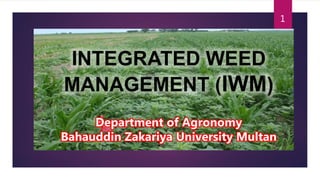
INTEGRATED WEED
MANAGEMENT (IWM)
1
Department of Agronomy
Bahauddin Zakariya University Multan
Introduction:
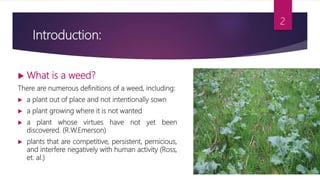
 What is a weed?
There are numerous definitions of a weed, including:
 a plant out of place and not intentionally sown
 a plant growing where it is not wanted
 a plant whose virtues have not yet been
discovered. (R.W.Emerson)
 plants that are competitive, persistent, pernicious,
and interfere negatively with human activity (Ross,
et. al.)
2
Integrated Weed Management
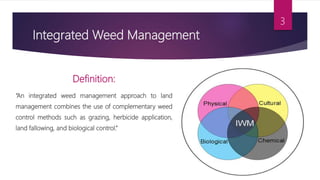
Definition:
“An integrated weed management approach to land
management combines the use of complementary weed
control methods such as grazing, herbicide application,
land fallowing, and biological control.”
3
Importance of Weeds Management
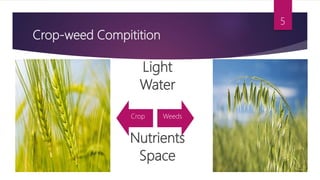
Those plants that interfere with human activity in crop and non-crop areas are considered
weeds. Weeds compete with crops for soil nutrients, water and light; they host insects and
plant pathogens harmful to crop plants, and their root exudates and/or leaf leachates may be
toxic to crop plants. Weeds also hinder crop harvest and increase the costs of such operations.
In addition, at harvest, weed seeds often contaminate the crop produce. Thus, the presence of
weeds in crop areas reduces the efficiency of inputs such as fertilizer and irrigation water,
enhances the density of other pest organisms, and finally severely reduces crop yield and
quality.
(Labrada and Parker 1999)
4
Crop-weed Compitition
Crop Weeds
5
Light
Water
Nutrients
Space
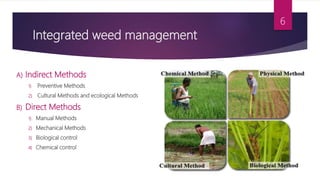
Integrated weed management
A) Indirect Methods
1) Preventive Methods
2) Cultural Methods and ecological Methods
B) Direct Methods
1) Manual Methods
2) Mechanical Methods
3) Biological control
4) Chemical control
6
A) Indirect Methods
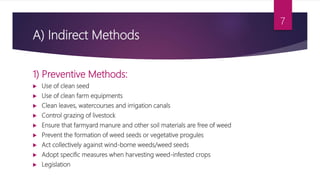
1) Preventive Methods:
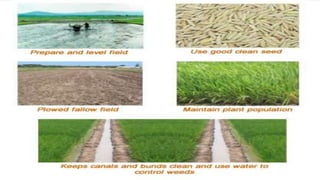
 Use of clean seed
 Use of clean farm equipments
 Clean leaves, watercourses and irrigation canals
 Control grazing of livestock
 Ensure that farmyard manure and other soil materials are free of weed
 Prevent the formation of weed seeds or vegetative progules
 Act collectively against wind-borne weeds/weed seeds
 Adopt specific measures when harvesting weed-infested crops
 Legislation
7
8
2) Cultural Methods:
I. Tillage
I. Preparatory Tillage
II. Seed Preparation
III. Cultivation/harrowing/hoeing/earthing up
II. Rotation
III. Allelopathy
IV. Flooding and drainage
V. Methods of Planting
VI. Planting density
VII. Variety
VIII. Mulching
IX. Planting time
X. Farm Management Practices
9
B) Direct Methods
1) Manual Methods
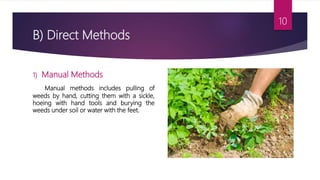
Manual methods includes pulling of
weeds by hand, cutting them with a sickle,
hoeing with hand tools and burying the
weeds under soil or water with the feet.
10
2) Mechanical Methods
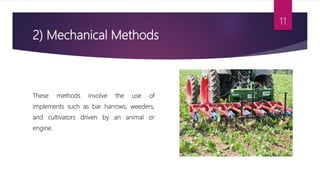
These methods involve the use of
implements such as bar harrows, weeders,
and cultivators driven by an animal or
engine.
11
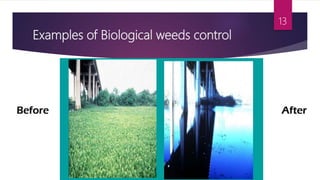
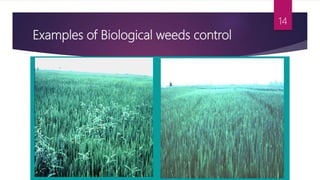
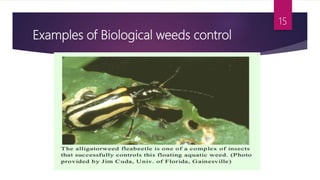
3) Biological control
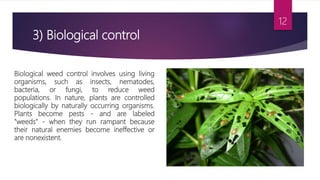
Biological weed control involves using living
organisms, such as insects, nematodes,
bacteria, or fungi, to reduce weed
populations. In nature, plants are controlled
biologically by naturally occurring organisms.
Plants become pests - and are labeled
"weeds" - when they run rampant because
their natural enemies become ineffective or
are nonexistent.
12
Examples of Biological weeds control
13
Examples of Biological weeds control
14
Examples of Biological weeds control
15
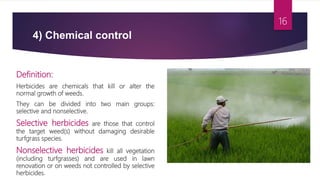
4) Chemical control
Definition:
Herbicides are chemicals that kill or alter the
normal growth of weeds.
They can be divided into two main groups:
selective and nonselective.
Selective herbicides are those that control
the target weed(s) without damaging desirable
turfgrass species.
Nonselective herbicides kill all vegetation
(including turfgrasses) and are used in lawn
renovation or on weeds not controlled by selective
herbicides.
16
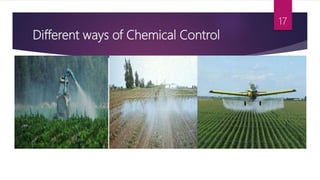
Different ways of Chemical Control
17
THANK YOU !!!
18

Integrated weed management (iwm)

  • 1.
    INTEGRATED WEED MANAGEMENT (IWM) 1 Departmentof Agronomy Bahauddin Zakariya University Multan
  • 2.
    Introduction:  What isa weed? There are numerous definitions of a weed, including:  a plant out of place and not intentionally sown  a plant growing where it is not wanted  a plant whose virtues have not yet been discovered. (R.W.Emerson)  plants that are competitive, persistent, pernicious, and interfere negatively with human activity (Ross, et. al.) 2
  • 3.
    Integrated Weed Management Definition: “Anintegrated weed management approach to land management combines the use of complementary weed control methods such as grazing, herbicide application, land fallowing, and biological control.” 3
  • 4.
    Importance of WeedsManagement Those plants that interfere with human activity in crop and non-crop areas are considered weeds. Weeds compete with crops for soil nutrients, water and light; they host insects and plant pathogens harmful to crop plants, and their root exudates and/or leaf leachates may be toxic to crop plants. Weeds also hinder crop harvest and increase the costs of such operations. In addition, at harvest, weed seeds often contaminate the crop produce. Thus, the presence of weeds in crop areas reduces the efficiency of inputs such as fertilizer and irrigation water, enhances the density of other pest organisms, and finally severely reduces crop yield and quality. (Labrada and Parker 1999) 4
  • 5.
  • 6.
    Integrated weed management A)Indirect Methods 1) Preventive Methods 2) Cultural Methods and ecological Methods B) Direct Methods 1) Manual Methods 2) Mechanical Methods 3) Biological control 4) Chemical control 6
  • 7.
    A) Indirect Methods 1)Preventive Methods:  Use of clean seed  Use of clean farm equipments  Clean leaves, watercourses and irrigation canals  Control grazing of livestock  Ensure that farmyard manure and other soil materials are free of weed  Prevent the formation of weed seeds or vegetative progules  Act collectively against wind-borne weeds/weed seeds  Adopt specific measures when harvesting weed-infested crops  Legislation 7
  • 8.
  • 9.
    2) Cultural Methods: I.Tillage I. Preparatory Tillage II. Seed Preparation III. Cultivation/harrowing/hoeing/earthing up II. Rotation III. Allelopathy IV. Flooding and drainage V. Methods of Planting VI. Planting density VII. Variety VIII. Mulching IX. Planting time X. Farm Management Practices 9
  • 10.
    B) Direct Methods 1)Manual Methods Manual methods includes pulling of weeds by hand, cutting them with a sickle, hoeing with hand tools and burying the weeds under soil or water with the feet. 10
  • 11.
    2) Mechanical Methods Thesemethods involve the use of implements such as bar harrows, weeders, and cultivators driven by an animal or engine. 11
  • 12.
    3) Biological control Biologicalweed control involves using living organisms, such as insects, nematodes, bacteria, or fungi, to reduce weed populations. In nature, plants are controlled biologically by naturally occurring organisms. Plants become pests - and are labeled "weeds" - when they run rampant because their natural enemies become ineffective or are nonexistent. 12
  • 13.
    Examples of Biologicalweeds control 13
  • 14.
    Examples of Biologicalweeds control 14
  • 15.
    Examples of Biologicalweeds control 15
  • 16.
    4) Chemical control Definition: Herbicidesare chemicals that kill or alter the normal growth of weeds. They can be divided into two main groups: selective and nonselective. Selective herbicides are those that control the target weed(s) without damaging desirable turfgrass species. Nonselective herbicides kill all vegetation (including turfgrasses) and are used in lawn renovation or on weeds not controlled by selective herbicides. 16
  • 17.
    Different ways ofChemical Control 17
  • 18.