by:
Gerard B. Hawkins
Managing Director, CEO
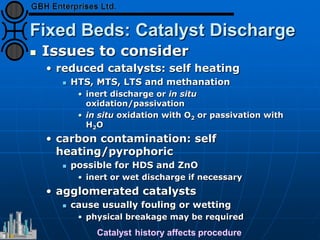
Water-Gas-Shift Reactor
Loading & Unloading
Considerations
Fixed Beds: Catalyst Discharge
 Issues to consider
• reduced catalysts: self heating
 HTS, MTS, LTS and methanation
• inert discharge or in situ
oxidation/passivation
• in situ oxidation with O2 or passivation with
H2O
• carbon contamination: self
heating/pyrophoric
 possible for HDS and ZnO
• inert or wet discharge if necessary
• agglomerated catalysts
 cause usually fouling or wetting
• physical breakage may be required
Catalyst history affects procedure
Fixed Beds: Catalyst Discharge
 Preparation
• select discharge method
• cool and purge reactor
• oxidize or passivate catalyst (if
required)
• water can be a weak oxidant and/or
inerting medium
 beware of evolved H2 hazard
• metal + H2O => metal oxide + H2
 water fills catalyst pores
• slows rate of O2 diffusion
Fixed Beds: Catalyst Discharge
 In situ oxidation with air
• purge all combustibles from process
• cool with steam or nitrogen
 at 600-1000 h-1 space velocity
 to 204 oC (400 oF) for HTS and 177 oC (350
oF) for LTS
• meter 1% air into bed and monitor
exotherm
 31 oC (55 oF)/% air for HTS; 14 oC (25
oF)/% air for LTS or MTS
• Once exotherm stable, slowly increase
air
 up to 3 % initially and monitor exotherm
 hold peak temperature below hardware
limits
Fixed Beds: Catalyst Discharge
 In situ oxidation with air
(cont.)
• continue to increase air level
 keep below vessel or piping temperature
limitations
• oxidation is complete when
 exotherm has passed through bed
 air level is 7-10%
• replace steam or nitrogen flow with air
flow
• cool catalyst in air to discharge
temperature
 below 38 oC (110 oF) for dry methods
 below 93 oC (200 oF) for wet method
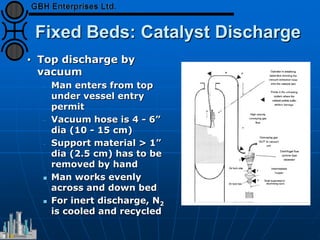
Fixed Beds: Catalyst Discharge
• Top discharge by
vacuum
– Man enters from top
under vessel entry
permit
– Vacuum hose is 4 - 6”
dia (10 - 15 cm)
– Support material > 1”
dia (2.5 cm) has to be
removed by hand
 Man works evenly
across and down bed
 For inert discharge, N2
is cooled and recycled
Fixed Beds: Catalyst Discharge
 Bottom discharge - dry
• most common method
• requires a proper dump chute and
containers (bins or drums) for
discharged catalyst
• keep positive N2 pressure for inert
discharge
 catalyst bins must be inerted
• water hose available in case of heat
generation
 wet catalyst during discharge if required
Fixed Beds: Catalyst Discharge
 Bottom discharge - wet
• less common
• cool catalyst below 93 oC (200 oF)
• ensure suitable isolations for H2O
• fill vessel with water
• dump vessel contents through bottom
drain valve
• remove catalyst through bottom manway
 discharge of wet catalyst is very messy
 water may not completely oxidise the catalyst
Fixed Beds: Catalyst Handling
& Loading
 Vessel inspection
• inspect vessel for stress damage
• thermocouples: check condition if
present
 document T/C locations relative to fixed
point
• eg inlet flange or tangent line
• support grids: check condition if
present
 correct any damaged clips, grid blinding, etc
• reactor clean and dry
Fixed Beds: Catalyst Handling
& Loading
 Pre-loading checks
• ensure vessel is free from rubbish
• bottom manway door and spider in place
• inspect reclaimed support/hold down
materials
 remove broken or extraneous contaminants
• inspect new catalyst
 type and condition
• inspect new support/hold down materials
 type and condition
 ceramic versus alumina
Fixed Beds: Catalyst Handling
& Loading
 Pre-loading checks (cont.)
• appropriate personal protection available
- and is used - inside and outside vessel
 eg dust masks
• for vessel entry
 air tests
 breathing air and/or air movers
 usual stringent vessel entry precautions
 boards to support worker inside
• minimises catalyst damage
Fixed Beds: Catalyst Handling
& Loading
 Loading methods
• manual
 most common by far
• pneumatic
 specialised techniques (eg from Technivac)
 not considered further
• dense loading
 specialised technique (eg from Petroval
DENSICATTM)
 not considered further
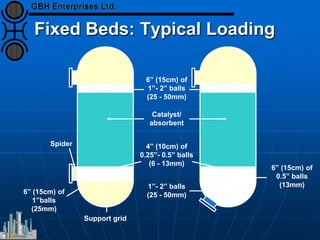
Fixed Beds: Typical Loading
6” (15cm) of
1”- 2” balls
(25 - 50mm)
Catalyst/
absorbent
6” (15cm) of
0.5” balls
(13mm)
4” (10cm) of
0.25”- 0.5” balls
(6 - 13mm)
6” (15cm) of
1”balls
(25mm)
1”- 2” balls
(25 - 50mm)
Support grid
Spider
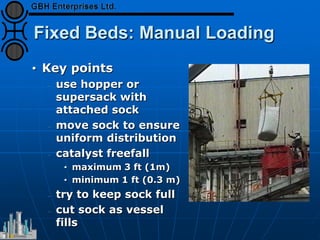
Fixed Beds: Manual Loading
• Key points
– use hopper or
supersack with
attached sock
– move sock to ensure
uniform distribution
– catalyst freefall
• maximum 3 ft (1m)
• minimum 1 ft (0.3 m)
– try to keep sock full
– cut sock as vessel
fills
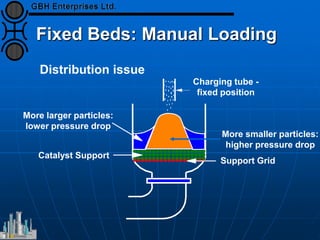
Fixed Beds: Manual Loading
Charging tube -
fixed position
More smaller particles:
higher pressure drop
Support Grid
Catalyst Support
More larger particles:
lower pressure drop
Distribution issue
Water-Gas-Shift Reactor Loading & Unloading Considerations

Water-Gas-Shift Reactor Loading & Unloading Considerations

  • 1.
    by: Gerard B. Hawkins ManagingDirector, CEO Water-Gas-Shift Reactor Loading & Unloading Considerations
  • 2.
    Fixed Beds: CatalystDischarge  Issues to consider • reduced catalysts: self heating  HTS, MTS, LTS and methanation • inert discharge or in situ oxidation/passivation • in situ oxidation with O2 or passivation with H2O • carbon contamination: self heating/pyrophoric  possible for HDS and ZnO • inert or wet discharge if necessary • agglomerated catalysts  cause usually fouling or wetting • physical breakage may be required Catalyst history affects procedure
  • 3.
    Fixed Beds: CatalystDischarge  Preparation • select discharge method • cool and purge reactor • oxidize or passivate catalyst (if required) • water can be a weak oxidant and/or inerting medium  beware of evolved H2 hazard • metal + H2O => metal oxide + H2  water fills catalyst pores • slows rate of O2 diffusion
  • 4.
    Fixed Beds: CatalystDischarge  In situ oxidation with air • purge all combustibles from process • cool with steam or nitrogen  at 600-1000 h-1 space velocity  to 204 oC (400 oF) for HTS and 177 oC (350 oF) for LTS • meter 1% air into bed and monitor exotherm  31 oC (55 oF)/% air for HTS; 14 oC (25 oF)/% air for LTS or MTS • Once exotherm stable, slowly increase air  up to 3 % initially and monitor exotherm  hold peak temperature below hardware limits
  • 5.
    Fixed Beds: CatalystDischarge  In situ oxidation with air (cont.) • continue to increase air level  keep below vessel or piping temperature limitations • oxidation is complete when  exotherm has passed through bed  air level is 7-10% • replace steam or nitrogen flow with air flow • cool catalyst in air to discharge temperature  below 38 oC (110 oF) for dry methods  below 93 oC (200 oF) for wet method
  • 6.
    Fixed Beds: CatalystDischarge • Top discharge by vacuum – Man enters from top under vessel entry permit – Vacuum hose is 4 - 6” dia (10 - 15 cm) – Support material > 1” dia (2.5 cm) has to be removed by hand  Man works evenly across and down bed  For inert discharge, N2 is cooled and recycled
  • 7.
    Fixed Beds: CatalystDischarge  Bottom discharge - dry • most common method • requires a proper dump chute and containers (bins or drums) for discharged catalyst • keep positive N2 pressure for inert discharge  catalyst bins must be inerted • water hose available in case of heat generation  wet catalyst during discharge if required
  • 8.
    Fixed Beds: CatalystDischarge  Bottom discharge - wet • less common • cool catalyst below 93 oC (200 oF) • ensure suitable isolations for H2O • fill vessel with water • dump vessel contents through bottom drain valve • remove catalyst through bottom manway  discharge of wet catalyst is very messy  water may not completely oxidise the catalyst
  • 9.
    Fixed Beds: CatalystHandling & Loading  Vessel inspection • inspect vessel for stress damage • thermocouples: check condition if present  document T/C locations relative to fixed point • eg inlet flange or tangent line • support grids: check condition if present  correct any damaged clips, grid blinding, etc • reactor clean and dry
  • 10.
    Fixed Beds: CatalystHandling & Loading  Pre-loading checks • ensure vessel is free from rubbish • bottom manway door and spider in place • inspect reclaimed support/hold down materials  remove broken or extraneous contaminants • inspect new catalyst  type and condition • inspect new support/hold down materials  type and condition  ceramic versus alumina
  • 11.
    Fixed Beds: CatalystHandling & Loading  Pre-loading checks (cont.) • appropriate personal protection available - and is used - inside and outside vessel  eg dust masks • for vessel entry  air tests  breathing air and/or air movers  usual stringent vessel entry precautions  boards to support worker inside • minimises catalyst damage
  • 12.
    Fixed Beds: CatalystHandling & Loading  Loading methods • manual  most common by far • pneumatic  specialised techniques (eg from Technivac)  not considered further • dense loading  specialised technique (eg from Petroval DENSICATTM)  not considered further
  • 13.
    Fixed Beds: TypicalLoading 6” (15cm) of 1”- 2” balls (25 - 50mm) Catalyst/ absorbent 6” (15cm) of 0.5” balls (13mm) 4” (10cm) of 0.25”- 0.5” balls (6 - 13mm) 6” (15cm) of 1”balls (25mm) 1”- 2” balls (25 - 50mm) Support grid Spider
  • 14.
    Fixed Beds: ManualLoading • Key points – use hopper or supersack with attached sock – move sock to ensure uniform distribution – catalyst freefall • maximum 3 ft (1m) • minimum 1 ft (0.3 m) – try to keep sock full – cut sock as vessel fills
  • 15.
    Fixed Beds: ManualLoading Charging tube - fixed position More smaller particles: higher pressure drop Support Grid Catalyst Support More larger particles: lower pressure drop Distribution issue