LEARNING
DEFINITIONS,
CHARACTERISTICS,
PRINCIPLES,
DOMAINS,
FACTORS INFLUENCING LEARNING,
THEORIES OF LEARNING,
RELATIONSHIP BETWEEN TEACHING
AND LEARNING
DEFINITIONS OF LEARNING
 Learning is the process by which an organism is
satisfying its motivation, adopts and adjusts its
behavior in order to overcome obstacles and
barriers.-Hunter and Hilgard
 Learning is not an addition of experience , nor is
it old experience summed up , rather it is the
synthesis of old and the new experiences which
results in completely new organization or
pattern of experience.-Heidgerken.
DEFINITIONS OF LEARNING(CONTINUED)
 Learning is acquisition of habits, knowledge
and attitudes.It involves new way of doing
things and it operates in an individual ‘s
attempt to overcome obstacles or to readjust
to new situations. It represent progressive
change in behavior.It enables him to satisfy
interest to attain goals.-Crow and Crow
DEFINITIONS OF LEARNING(CONTINUED)
 ‘an activity can be called learning so far as it
develops the individual and makes it
behavior and experiences different from
what that would otherwise have been.-
Woodsworth RH.
 Learning is an enduring change in behavior,
or in the capacity to behave in a given
fashion, which results from practice or other
forms of experience.-Shunk,1996
MAIN FACTORS IN DEFINITIONS OF LEARNING
 Brings change in behaviour usually for
betterment.
 Change takes place through practice and
behaviour and not due to maturation.
 Change in behaviour should be relatively
permanent lasting for years, months or
weeks.
CHARACTERISTICS OF LEARNING:
By yoakman and simpson
1) Learning is adjustment.
2) Learning is purposeful.
3) Learning is experience.
4) Learning is growth.
5) Learning is intelligent.
6) Learning is active.
7) Learning is both individual and social.
8) Learning is-the product of the
environment..
9) Learning affects the conduct of the
CHARACTERISTICS OF LEARNING(CONTINUED)
 Learning helps in making choice.
 Learning helps to bring changes.
 Learning help in continuous professional
development.
 Learning helps keep in tune in with trends
and development in particular fields.
PRINCIPLES OF LEARNING
For effective learning:
 Teacher guidance
 Self discovery/generalization of past
experience.
 Background experience, sufficient mental
maturity, readiness & desire of learner.
 Goal directed provisional trials.
 New has meaning related to old.
 Motivation of learner.
 Provision for transfer.
 No anxiety and mental illness.
10 PRINCIPLES OF LEARNING
By The Joint Task Force on Student
Learning(JTFSL): learning is –
1) A constant interaction between learner
environment.
2) An outcome of stimulation and motivation of
learner.
3) An active process.
4) Ongoing developmental and cumulative
process.
5) An outcome of cooperation and support.
10 PRINCIPLES OF LEARNING(CONTINUED)
By The Joint Task Force on Student
Learning(JTFSL): learning is –
6) An essential influence of environment.
7) Through practice ,feedback and evaluation.
8) A formal as well as an informal act.
9) An individual phenomenon.
10) An act of self awareness.
PRINCIPLES OF LEARNING/LAWS OF LEARNING
Edward Thorndike has developed the first three
laws of learning .
Law of readiness – implies the degree of
preparedness and eagerness to learn.
Law of exercise – things that are most often
repeated are best remembered.
Law of effect – based on the emotional reaction
and motivation of the student. Learning is
strengthened with pleasant or satisfying feeling
while unpleasant feelings tend to do otherwise.
PRINCIPLES OF LEARNING/LAWS OF LEARNING
THE ADDITIONAL THREE LAWS
Law of primacy – learning should be done
correctly for the first time since it is difficult to
“unlearn” or change an incorrectly learned
material.
Law of recency – things that are most
recently learned are often best remembered.
Law of intensity – the more intense
something is taught, the more likely it will be
retained.
PRINCIPLES OF LEARNING/LAWS OF LEARNING
Law of doing /experience
Law of motivation
Law of repetition
Law of association
Law of relevency
DOMAINS OF LEARNING
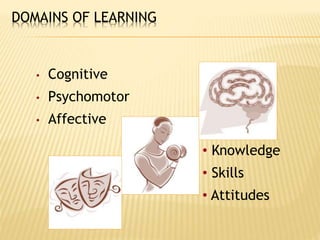
• Cognitive
• Psychomotor
• Affective
• Knowledge
• Skills
• Attitudes
DOMAINS OF LEARNING
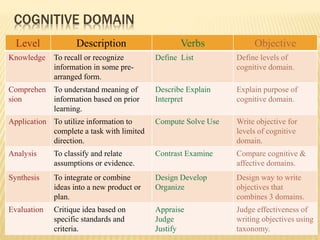
COGNITIVE DOMAIN
BIOHAZARD
COGNITIVE DOMAIN
Level Description Verbs Objective
Knowledge To recall or recognize
information in some pre-
arranged form.
Define List Define levels of
cognitive domain.
Comprehen
sion
To understand meaning of
information based on prior
learning.
Describe Explain
Interpret
Explain purpose of
cognitive domain.
Application To utilize information to
complete a task with limited
direction.
Compute Solve Use Write objective for
levels of cognitive
domain.
Analysis To classify and relate
assumptions or evidence.
Contrast Examine Compare cognitive &
affective domains.
Synthesis To integrate or combine
ideas into a new product or
plan.
Design Develop
Organize
Design way to write
objectives that
combines 3 domains.
Evaluation Critique idea based on
specific standards and
criteria.
Appraise
Judge
Justify
Judge effectiveness of
writing objectives using
taxonomy.
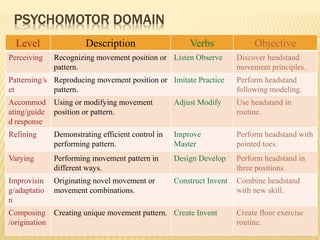
PSYCHOMOTOR DOMAIN
Level Description Verbs Objective
Perceiving Recognizing movement position or
pattern.
Listen Observe Discover headstand
movement principles.
Patterning/s
et
Reproducing movement position or
pattern.
Imitate Practice Perform headstand
following modeling.
Accommod
ating/guide
d response
Using or modifying movement
position or pattern.
Adjust Modify Use headstand in
routine.
Refining Demonstrating efficient control in
performing pattern.
Improve
Master
Perform headstand with
pointed toes.
Varying Performing movement pattern in
different ways.
Design Develop Perform headstand in
three positions.
Improvisin
g/adaptatio
n
Originating novel movement or
movement combinations.
Construct Invent Combine headstand
with new skill.
Composing
/origination
Creating unique movement pattern. Create Invent Create floor exercise
routine.
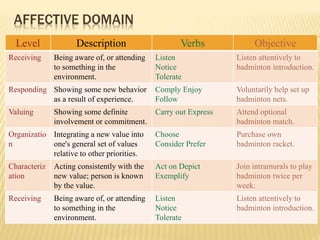
AFFECTIVE DOMAIN
Level Description Verbs Objective
Receiving Being aware of, or attending
to something in the
environment.
Listen
Notice
Tolerate
Listen attentively to
badminton introduction.
Responding Showing some new behavior
as a result of experience.
Comply Enjoy
Follow
Voluntarily help set up
badminton nets.
Valuing Showing some definite
involvement or commitment.
Carry out Express Attend optional
badminton match.
Organizatio
n
Integrating a new value into
one's general set of values
relative to other priorities.
Choose
Consider Prefer
Purchase own
badminton racket.
Characteriz
ation
Acting consistently with the
new value; person is known
by the value.
Act on Depict
Exemplify
Join intramurals to play
badminton twice per
week.
Receiving Being aware of, or attending
to something in the
environment.
Listen
Notice
Tolerate
Listen attentively to
badminton introduction.
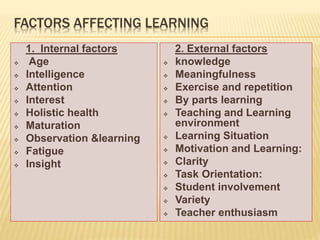
FACTORS AFFECTING LEARNING
1. Internal factors
 Age
 Intelligence
 Attention
 Interest
 Holistic health
 Maturation
 Observation &learning
 Fatigue
 Insight
2. External factors
 knowledge
 Meaningfulness
 Exercise and repetition
 By parts learning
 Teaching and Learning
environment
 Learning Situation
 Motivation and Learning:
 Clarity
 Task Orientation:
 Student involvement
 Variety
 Teacher enthusiasm
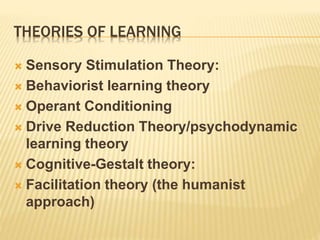
THEORIES OF LEARNING
 Sensory Stimulation Theory:
 Behaviorist learning theory
 Operant Conditioning
 Drive Reduction Theory/psychodynamic
learning theory
 Cognitive-Gestalt theory:
 Facilitation theory (the humanist
approach)
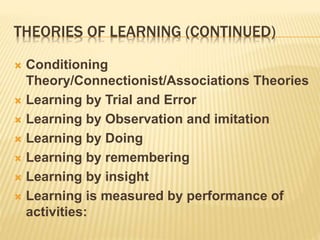
THEORIES OF LEARNING (CONTINUED)
 Conditioning
Theory/Connectionist/Associations Theories
 Learning by Trial and Error
 Learning by Observation and imitation
 Learning by Doing
 Learning by remembering
 Learning by insight
 Learning is measured by performance of
activities:
SENSORY STIMULATION THEORY
Sight,
83.00%
Touch,
1.50%
Taste, 1%
Hearing,
11%
Smell, 4%
Learning through the senses
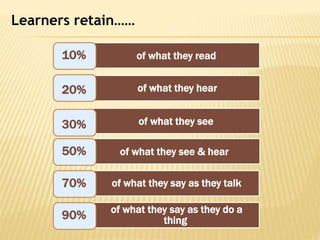
Learners retain……
of what they read
of what they hear
of what they see
of what they see & hear
of what they say as they talk
of what they say as they do a
thing
10%
20%
90%
70%
50%
30%
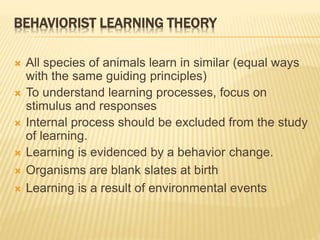
BEHAVIORIST LEARNING THEORY
 All species of animals learn in similar (equal ways
with the same guiding principles)
 To understand learning processes, focus on
stimulus and responses
 Internal process should be excluded from the study
of learning.
 Learning is evidenced by a behavior change.
 Organisms are blank slates at birth
 Learning is a result of environmental events
OPERANT CONDITIONING
 Learning where frequency of a behavior
depends on the consequence that follows
that behavior
 The frequency of behaviour will increase if
the consequence is reinforcing to the
subject.
 The frequency of behaviour will decrease if
the consequence is not reinforcing or
punishing to the subject.
OPERANT CONDITIONING(CONTINUED)
Reinforcement
 Any consequence that
increases the
likelihood of the
behavior it follows.
Punishment
 Any consequence that
decreases the
likelihood of the
behavior it follows
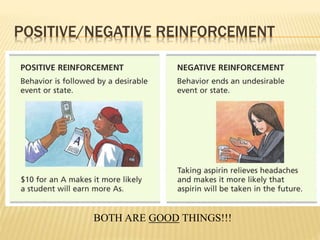
REINFORCEMENT
Positive
reinforcement
 Anything that
increases the
likelihood of a behavior
by following it with a
desirable event or
state
 The subject receives
something they want
(added)
 Will strengthen the
behavior
Negative
reinforcement
 Anything that increases
the likelihood of a
behavior by following it
with the removal of an
undesirable event or
state
 Something the subject
doesn’t like is removed
(subtracted)
 Will strengthen the
behavior.
POSITIVE/NEGATIVE REINFORCEMENT
BOTH ARE GOOD THINGS!!!
PUNISHMENT
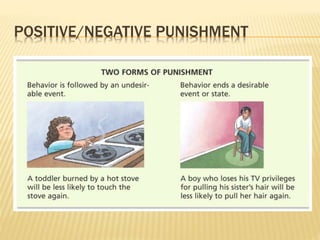
Positive punishment
 Something is added to
the environment you
do NOT like.
 Punishment by
Application
Negative punishment
 Something is taken
away that you DO LIKE.
 Lose a privilege.
 Punishment by
Removal
POSITIVE/NEGATIVE PUNISHMENT
COGNITIVE-GESTALT THEORY:
 Importance is on experience, meaning,
problem-solving and the development of insights
.
 concept -individuals have different needs and
concerns at different times, and that they have
subjective interpretations in different contexts.
 Key to learning and changing is individuals
cognitions(perception, thought, memory, and
ways to processing and structuring information.)
 Eg –short note on orange
FACILITATION THEORY (THE HUMANIST
APPROACH)
 Developer Carl Roger
 Learning will occur by the educator acting as
a facilitator.
 Atmosphere- comfortable not threatened by
the external factors.
THEORIES OF LEARNING (CONTINUED)
 Learning by Trial and Error
 Slow
 Laborious
 Primitive type.
Example: child will learn by imitation and trial and
error method.
 Learning by Observation and imitation`
 Observation promotes attention, discrimination
and recognition.
 Skills are learned by observation method only.
Examples: During demonstration.
THEORIES OF LEARNING (CONTINUED)
 Learning by Doing, eg-nursing procedure.
 Learning by remembering, eg –
memorising events and dates.
 Learning by insight, eg-problem solving.
 Learning is measured by performance of
activities, teachers observation of
students performance in theory and
learning.
RELATIONSHIP BETWEEN TEACHING AND
LEARNING
1. Both teaching & learning may be formal or informal.
2. Both are goal oriented.
3. Good teaching results in good learning.
4. One can observe teaching but not learning.
5. Both teaching and learning require skills, creativity,
and intelligence and operate on definite principles.
6. Good teaching requires good communication skill &
good learning requires good listening skills.
7. Only good learners become good teachers.
THANK YOU

learning in nursing education

  • 1.
  • 2.
    DEFINITIONS OF LEARNING Learning is the process by which an organism is satisfying its motivation, adopts and adjusts its behavior in order to overcome obstacles and barriers.-Hunter and Hilgard  Learning is not an addition of experience , nor is it old experience summed up , rather it is the synthesis of old and the new experiences which results in completely new organization or pattern of experience.-Heidgerken.
  • 3.
    DEFINITIONS OF LEARNING(CONTINUED) Learning is acquisition of habits, knowledge and attitudes.It involves new way of doing things and it operates in an individual ‘s attempt to overcome obstacles or to readjust to new situations. It represent progressive change in behavior.It enables him to satisfy interest to attain goals.-Crow and Crow
  • 4.
    DEFINITIONS OF LEARNING(CONTINUED) ‘an activity can be called learning so far as it develops the individual and makes it behavior and experiences different from what that would otherwise have been.- Woodsworth RH.  Learning is an enduring change in behavior, or in the capacity to behave in a given fashion, which results from practice or other forms of experience.-Shunk,1996
  • 5.
    MAIN FACTORS INDEFINITIONS OF LEARNING  Brings change in behaviour usually for betterment.  Change takes place through practice and behaviour and not due to maturation.  Change in behaviour should be relatively permanent lasting for years, months or weeks.
  • 6.
    CHARACTERISTICS OF LEARNING: Byyoakman and simpson 1) Learning is adjustment. 2) Learning is purposeful. 3) Learning is experience. 4) Learning is growth. 5) Learning is intelligent. 6) Learning is active. 7) Learning is both individual and social. 8) Learning is-the product of the environment.. 9) Learning affects the conduct of the
  • 7.
    CHARACTERISTICS OF LEARNING(CONTINUED) Learning helps in making choice.  Learning helps to bring changes.  Learning help in continuous professional development.  Learning helps keep in tune in with trends and development in particular fields.
  • 8.
    PRINCIPLES OF LEARNING Foreffective learning:  Teacher guidance  Self discovery/generalization of past experience.  Background experience, sufficient mental maturity, readiness & desire of learner.  Goal directed provisional trials.  New has meaning related to old.  Motivation of learner.  Provision for transfer.  No anxiety and mental illness.
  • 9.
    10 PRINCIPLES OFLEARNING By The Joint Task Force on Student Learning(JTFSL): learning is – 1) A constant interaction between learner environment. 2) An outcome of stimulation and motivation of learner. 3) An active process. 4) Ongoing developmental and cumulative process. 5) An outcome of cooperation and support.
  • 10.
    10 PRINCIPLES OFLEARNING(CONTINUED) By The Joint Task Force on Student Learning(JTFSL): learning is – 6) An essential influence of environment. 7) Through practice ,feedback and evaluation. 8) A formal as well as an informal act. 9) An individual phenomenon. 10) An act of self awareness.
  • 11.
    PRINCIPLES OF LEARNING/LAWSOF LEARNING Edward Thorndike has developed the first three laws of learning . Law of readiness – implies the degree of preparedness and eagerness to learn. Law of exercise – things that are most often repeated are best remembered. Law of effect – based on the emotional reaction and motivation of the student. Learning is strengthened with pleasant or satisfying feeling while unpleasant feelings tend to do otherwise.
  • 12.
    PRINCIPLES OF LEARNING/LAWSOF LEARNING THE ADDITIONAL THREE LAWS Law of primacy – learning should be done correctly for the first time since it is difficult to “unlearn” or change an incorrectly learned material. Law of recency – things that are most recently learned are often best remembered. Law of intensity – the more intense something is taught, the more likely it will be retained.
  • 13.
    PRINCIPLES OF LEARNING/LAWSOF LEARNING Law of doing /experience Law of motivation Law of repetition Law of association Law of relevency
  • 14.
    DOMAINS OF LEARNING •Cognitive • Psychomotor • Affective • Knowledge • Skills • Attitudes
  • 15.
  • 16.
    COGNITIVE DOMAIN Level DescriptionVerbs Objective Knowledge To recall or recognize information in some pre- arranged form. Define List Define levels of cognitive domain. Comprehen sion To understand meaning of information based on prior learning. Describe Explain Interpret Explain purpose of cognitive domain. Application To utilize information to complete a task with limited direction. Compute Solve Use Write objective for levels of cognitive domain. Analysis To classify and relate assumptions or evidence. Contrast Examine Compare cognitive & affective domains. Synthesis To integrate or combine ideas into a new product or plan. Design Develop Organize Design way to write objectives that combines 3 domains. Evaluation Critique idea based on specific standards and criteria. Appraise Judge Justify Judge effectiveness of writing objectives using taxonomy.
  • 17.
    PSYCHOMOTOR DOMAIN Level DescriptionVerbs Objective Perceiving Recognizing movement position or pattern. Listen Observe Discover headstand movement principles. Patterning/s et Reproducing movement position or pattern. Imitate Practice Perform headstand following modeling. Accommod ating/guide d response Using or modifying movement position or pattern. Adjust Modify Use headstand in routine. Refining Demonstrating efficient control in performing pattern. Improve Master Perform headstand with pointed toes. Varying Performing movement pattern in different ways. Design Develop Perform headstand in three positions. Improvisin g/adaptatio n Originating novel movement or movement combinations. Construct Invent Combine headstand with new skill. Composing /origination Creating unique movement pattern. Create Invent Create floor exercise routine.
  • 18.
    AFFECTIVE DOMAIN Level DescriptionVerbs Objective Receiving Being aware of, or attending to something in the environment. Listen Notice Tolerate Listen attentively to badminton introduction. Responding Showing some new behavior as a result of experience. Comply Enjoy Follow Voluntarily help set up badminton nets. Valuing Showing some definite involvement or commitment. Carry out Express Attend optional badminton match. Organizatio n Integrating a new value into one's general set of values relative to other priorities. Choose Consider Prefer Purchase own badminton racket. Characteriz ation Acting consistently with the new value; person is known by the value. Act on Depict Exemplify Join intramurals to play badminton twice per week. Receiving Being aware of, or attending to something in the environment. Listen Notice Tolerate Listen attentively to badminton introduction.
  • 19.
    FACTORS AFFECTING LEARNING 1.Internal factors  Age  Intelligence  Attention  Interest  Holistic health  Maturation  Observation &learning  Fatigue  Insight 2. External factors  knowledge  Meaningfulness  Exercise and repetition  By parts learning  Teaching and Learning environment  Learning Situation  Motivation and Learning:  Clarity  Task Orientation:  Student involvement  Variety  Teacher enthusiasm
  • 20.
    THEORIES OF LEARNING Sensory Stimulation Theory:  Behaviorist learning theory  Operant Conditioning  Drive Reduction Theory/psychodynamic learning theory  Cognitive-Gestalt theory:  Facilitation theory (the humanist approach)
  • 21.
    THEORIES OF LEARNING(CONTINUED)  Conditioning Theory/Connectionist/Associations Theories  Learning by Trial and Error  Learning by Observation and imitation  Learning by Doing  Learning by remembering  Learning by insight  Learning is measured by performance of activities:
  • 22.
    SENSORY STIMULATION THEORY Sight, 83.00% Touch, 1.50% Taste,1% Hearing, 11% Smell, 4% Learning through the senses
  • 23.
    Learners retain…… of whatthey read of what they hear of what they see of what they see & hear of what they say as they talk of what they say as they do a thing 10% 20% 90% 70% 50% 30%
  • 24.
    BEHAVIORIST LEARNING THEORY All species of animals learn in similar (equal ways with the same guiding principles)  To understand learning processes, focus on stimulus and responses  Internal process should be excluded from the study of learning.  Learning is evidenced by a behavior change.  Organisms are blank slates at birth  Learning is a result of environmental events
  • 25.
    OPERANT CONDITIONING  Learningwhere frequency of a behavior depends on the consequence that follows that behavior  The frequency of behaviour will increase if the consequence is reinforcing to the subject.  The frequency of behaviour will decrease if the consequence is not reinforcing or punishing to the subject.
  • 26.
    OPERANT CONDITIONING(CONTINUED) Reinforcement  Anyconsequence that increases the likelihood of the behavior it follows. Punishment  Any consequence that decreases the likelihood of the behavior it follows
  • 27.
    REINFORCEMENT Positive reinforcement  Anything that increasesthe likelihood of a behavior by following it with a desirable event or state  The subject receives something they want (added)  Will strengthen the behavior Negative reinforcement  Anything that increases the likelihood of a behavior by following it with the removal of an undesirable event or state  Something the subject doesn’t like is removed (subtracted)  Will strengthen the behavior.
  • 28.
  • 29.
    PUNISHMENT Positive punishment  Somethingis added to the environment you do NOT like.  Punishment by Application Negative punishment  Something is taken away that you DO LIKE.  Lose a privilege.  Punishment by Removal
  • 30.
  • 31.
    COGNITIVE-GESTALT THEORY:  Importanceis on experience, meaning, problem-solving and the development of insights .  concept -individuals have different needs and concerns at different times, and that they have subjective interpretations in different contexts.  Key to learning and changing is individuals cognitions(perception, thought, memory, and ways to processing and structuring information.)  Eg –short note on orange
  • 32.
    FACILITATION THEORY (THEHUMANIST APPROACH)  Developer Carl Roger  Learning will occur by the educator acting as a facilitator.  Atmosphere- comfortable not threatened by the external factors.
  • 33.
    THEORIES OF LEARNING(CONTINUED)  Learning by Trial and Error  Slow  Laborious  Primitive type. Example: child will learn by imitation and trial and error method.  Learning by Observation and imitation`  Observation promotes attention, discrimination and recognition.  Skills are learned by observation method only. Examples: During demonstration.
  • 34.
    THEORIES OF LEARNING(CONTINUED)  Learning by Doing, eg-nursing procedure.  Learning by remembering, eg – memorising events and dates.  Learning by insight, eg-problem solving.  Learning is measured by performance of activities, teachers observation of students performance in theory and learning.
  • 35.
    RELATIONSHIP BETWEEN TEACHINGAND LEARNING 1. Both teaching & learning may be formal or informal. 2. Both are goal oriented. 3. Good teaching results in good learning. 4. One can observe teaching but not learning. 5. Both teaching and learning require skills, creativity, and intelligence and operate on definite principles. 6. Good teaching requires good communication skill & good learning requires good listening skills. 7. Only good learners become good teachers.
  • 36.

Editor's Notes

  • #24 In addition to learning predominately through what we see, having students do return demonstrations (for example, role play and simulations) enhance the student’s retention of what they are learning. (Socony-Vacuum Oil Co. Studies, U.S. Department of Health Education & Welfare, 1994).