Chapter N°19:
Language and Social Variations
LANGUAGE AND WRITTEN
EXPRESSION IV
Student: Soto Valic, Gabriela Rocio
The Study of Language
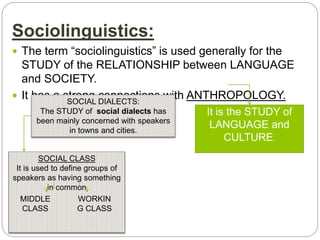
Sociolinguistics:
 The term “sociolinguistics” is used generally for the
STUDY of the RELATIONSHIP between LANGUAGE
and SOCIETY.
 It has a strong connections with ANTHROPOLOGY.
It is the STUDY of
LANGUAGE and
CULTURE.
SOCIAL DIALECTS:
The STUDY of social dialects has
been mainly concerned with speakers
in towns and cities.
SOCIAL CLASS
It is used to define groups of
speakers as having something
in common
MIDDLE
CLASS
WORKIN
G CLASS
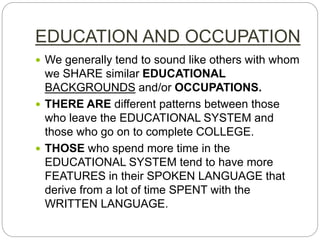
EDUCATION AND OCCUPATION
 We generally tend to sound like others with whom
we SHARE similar EDUCATIONAL
BACKGROUNDS and/or OCCUPATIONS.
 THERE ARE different patterns between those
who leave the EDUCATIONAL SYSTEM and
those who go on to complete COLLEGE.
 THOSE who spend more time in the
EDUCATIONAL SYSTEM tend to have more
FEATURES in their SPOKEN LANGUAGE that
derive from a lot of time SPENT with the
WRITTEN LANGUAGE.
SOCIAL
MARKERS
 It is a FEATURE which occurs frequently in our
SPEECH.
 It MARKS you as a member of a PARTICULAR
SOCIAL GROUP, whether you realize it or not.
 PRONUNCIATION FEATURES:
Example: - The final pronunciation of –ING.
- [h] dropping: It makes the words at and hat
sounds the same.
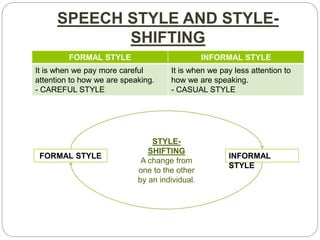
SPEECH STYLE AND STYLE-
SHIFTING
FORMAL STYLE INFORMAL STYLE
It is when we pay more careful
attention to how we are speaking.
- CAREFUL STYLE
It is when we pay less attention to
how we are speaking.
- CASUAL STYLE
FORMAL STYLE INFORMAL
STYLE
STYLE-
SHIFTING
A change from
one to the other
by an individual.
Speech acommodation:
 It is a way of explaining the direction in which certain
individuals CHANGE their speech.
 The speaker modifies his/her speech style toward or away from
the perceived style of the person (s) we’re talking to.
 It is influenced by their perception of their listeners.
 It is used in order to reduce social distance, described as
convergence.
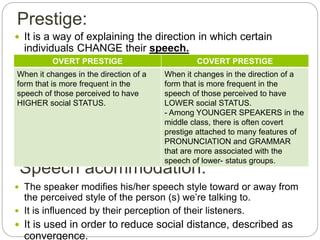
Prestige:
OVERT PRESTIGE COVERT PRESTIGE
When it changes in the direction of a
form that is more frequent in the
speech of those perceived to have
HIGHER social STATUS.
When it changes in the direction of a
form that is more frequent in the
speech of those perceived to have
LOWER social STATUS.
- Among YOUNGER SPEAKERS in the
middle class, there is often covert
prestige attached to many features of
PRONUNCIATION and GRAMMAR
that are more associated with the
speech of lower- status groups.
 It described words or phrases that are used instead of more
everyday terms among young speakers and other groups
with special interests.
 Differences in AGE is another IMPORTANT factor.
SLANG (or colloquial
speech):
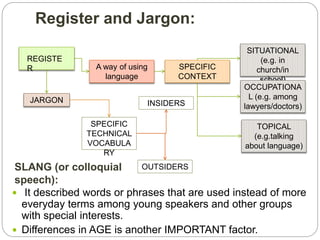
Register and Jargon:
REGISTE
R
JARGON
A way of using
language
SPECIFIC
CONTEXT
SITUATIONAL
(e.g. in
church/in
school)
OCCUPATIONA
L (e.g. among
lawyers/doctors)
TOPICAL
(e.g.talking
about language)
SPECIFIC
TECHNICAL
VOCABULA
RY
INSIDERS
OUTSIDERS
Bibliography
 Yule, G (2016). The Study of Language. Chapters
19. U.K.: CUP.

The study of language. Chapter 19pptx

  • 1.
    Chapter N°19: Language andSocial Variations LANGUAGE AND WRITTEN EXPRESSION IV Student: Soto Valic, Gabriela Rocio The Study of Language
  • 2.
    Sociolinguistics:  The term“sociolinguistics” is used generally for the STUDY of the RELATIONSHIP between LANGUAGE and SOCIETY.  It has a strong connections with ANTHROPOLOGY. It is the STUDY of LANGUAGE and CULTURE. SOCIAL DIALECTS: The STUDY of social dialects has been mainly concerned with speakers in towns and cities. SOCIAL CLASS It is used to define groups of speakers as having something in common MIDDLE CLASS WORKIN G CLASS
  • 3.
    EDUCATION AND OCCUPATION We generally tend to sound like others with whom we SHARE similar EDUCATIONAL BACKGROUNDS and/or OCCUPATIONS.  THERE ARE different patterns between those who leave the EDUCATIONAL SYSTEM and those who go on to complete COLLEGE.  THOSE who spend more time in the EDUCATIONAL SYSTEM tend to have more FEATURES in their SPOKEN LANGUAGE that derive from a lot of time SPENT with the WRITTEN LANGUAGE.
  • 4.
    SOCIAL MARKERS  It isa FEATURE which occurs frequently in our SPEECH.  It MARKS you as a member of a PARTICULAR SOCIAL GROUP, whether you realize it or not.  PRONUNCIATION FEATURES: Example: - The final pronunciation of –ING. - [h] dropping: It makes the words at and hat sounds the same.
  • 5.
    SPEECH STYLE ANDSTYLE- SHIFTING FORMAL STYLE INFORMAL STYLE It is when we pay more careful attention to how we are speaking. - CAREFUL STYLE It is when we pay less attention to how we are speaking. - CASUAL STYLE FORMAL STYLE INFORMAL STYLE STYLE- SHIFTING A change from one to the other by an individual.
  • 6.
    Speech acommodation:  Itis a way of explaining the direction in which certain individuals CHANGE their speech.  The speaker modifies his/her speech style toward or away from the perceived style of the person (s) we’re talking to.  It is influenced by their perception of their listeners.  It is used in order to reduce social distance, described as convergence. Prestige: OVERT PRESTIGE COVERT PRESTIGE When it changes in the direction of a form that is more frequent in the speech of those perceived to have HIGHER social STATUS. When it changes in the direction of a form that is more frequent in the speech of those perceived to have LOWER social STATUS. - Among YOUNGER SPEAKERS in the middle class, there is often covert prestige attached to many features of PRONUNCIATION and GRAMMAR that are more associated with the speech of lower- status groups.
  • 7.
     It describedwords or phrases that are used instead of more everyday terms among young speakers and other groups with special interests.  Differences in AGE is another IMPORTANT factor. SLANG (or colloquial speech): Register and Jargon: REGISTE R JARGON A way of using language SPECIFIC CONTEXT SITUATIONAL (e.g. in church/in school) OCCUPATIONA L (e.g. among lawyers/doctors) TOPICAL (e.g.talking about language) SPECIFIC TECHNICAL VOCABULA RY INSIDERS OUTSIDERS
  • 8.
    Bibliography  Yule, G(2016). The Study of Language. Chapters 19. U.K.: CUP.