Ms. AMANDEEP KAUR
M.M.C.O.N
Definition
 Also known as:- Pyothorax Or Purulent
Pleuritis. The word Empyema comes from the
greek word Empyein, which means :pus –
producing (suppurates).
 Accumulation of Pus in the Pleural cavity.
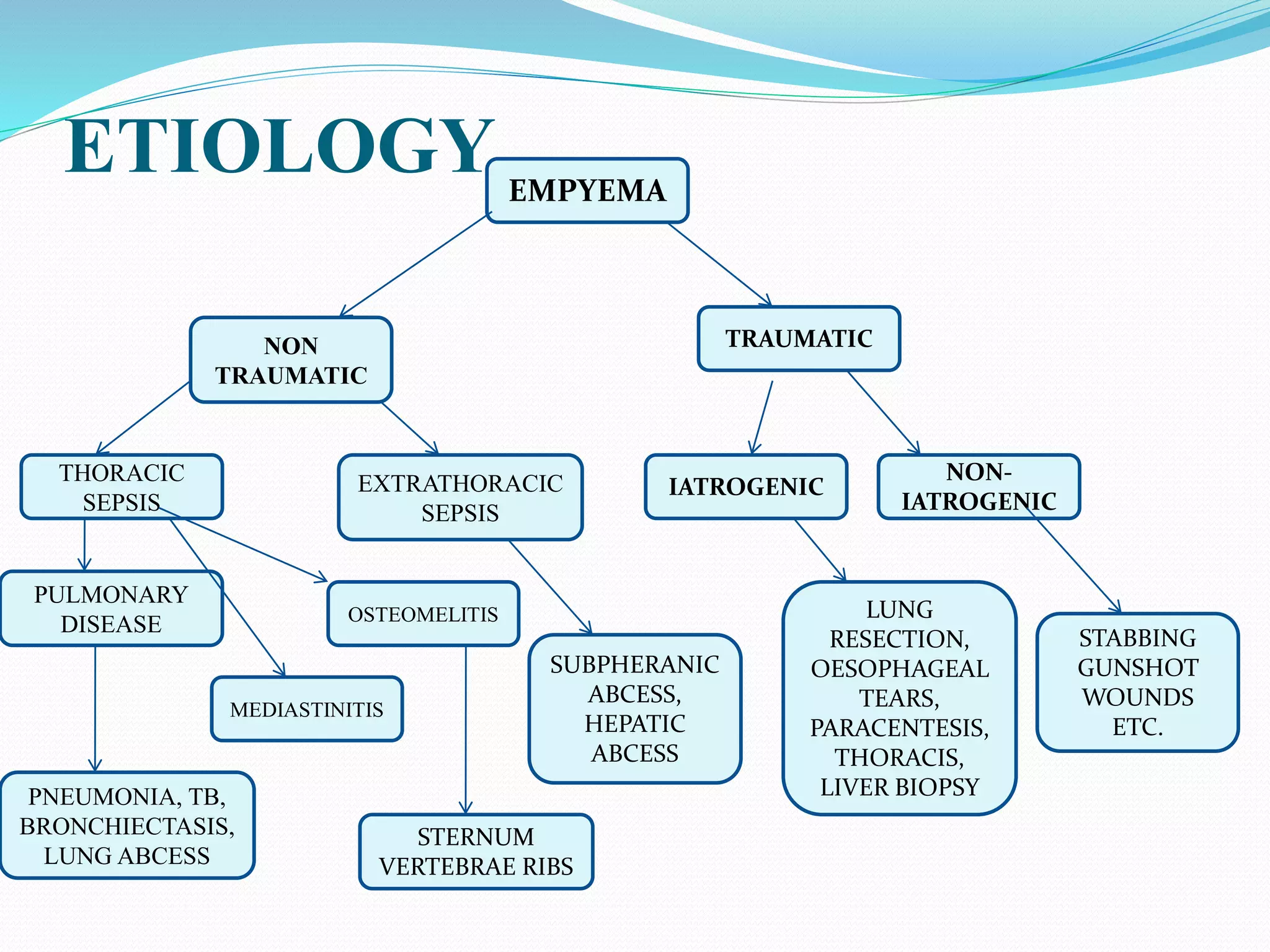
ETIOLOGY EMPYEMA
STABBING
GUNSHOT
WOUNDS
ETC.
NON
TRAUMATIC
EXTRATHORACIC
SEPSIS
THORACIC
SEPSIS
OSTEOMELITIS
MEDIASTINITIS
PULMONARY
DISEASE
PNEUMONIA, TB,
BRONCHIECTASIS,
LUNG ABCESS
NON-
IATROGENIC
LUNG
RESECTION,
OESOPHAGEAL
TEARS,
PARACENTESIS,
THORACIS,
LIVER BIOPSY
IATROGENIC
TRAUMATIC
SUBPHERANIC
ABCESS,
HEPATIC
ABCESS
STERNUM
VERTEBRAE RIBS
ORGANISMS
The most common:
 Staph. aureus .(90% of causes in infants & children)
 Strept. pneuomonie.
 H. influenzae
ETIOLOGY
 Lung diseases: Pneumonia (the most common
cause) Lung abscess.
 Subphrenic abscess (accumulation of infected fluid
between the diaphragm, liver, and spleen)
 Post traumatic.
 Post-operative.
 Blood spread. (post PE)
 Iatrogenic.
RISK FACTOR
 Alcoholism
 Drug use
 HIV infection
 Neoplasm
 Pre-existent pulmonary disease
Pathophysiology
 Presence of Parapneumonic Effusion
 Release of inflammatory mediators
 ↑permeability of the capilliaries
 Attracts WBCs to the site Escape of albumin & other protein
from the capillaries
 ↑ Pleural fluid
 Presence of Free-flowing, Protein Rich Pleural Fluid (Stage I)
 Inflammation worsens
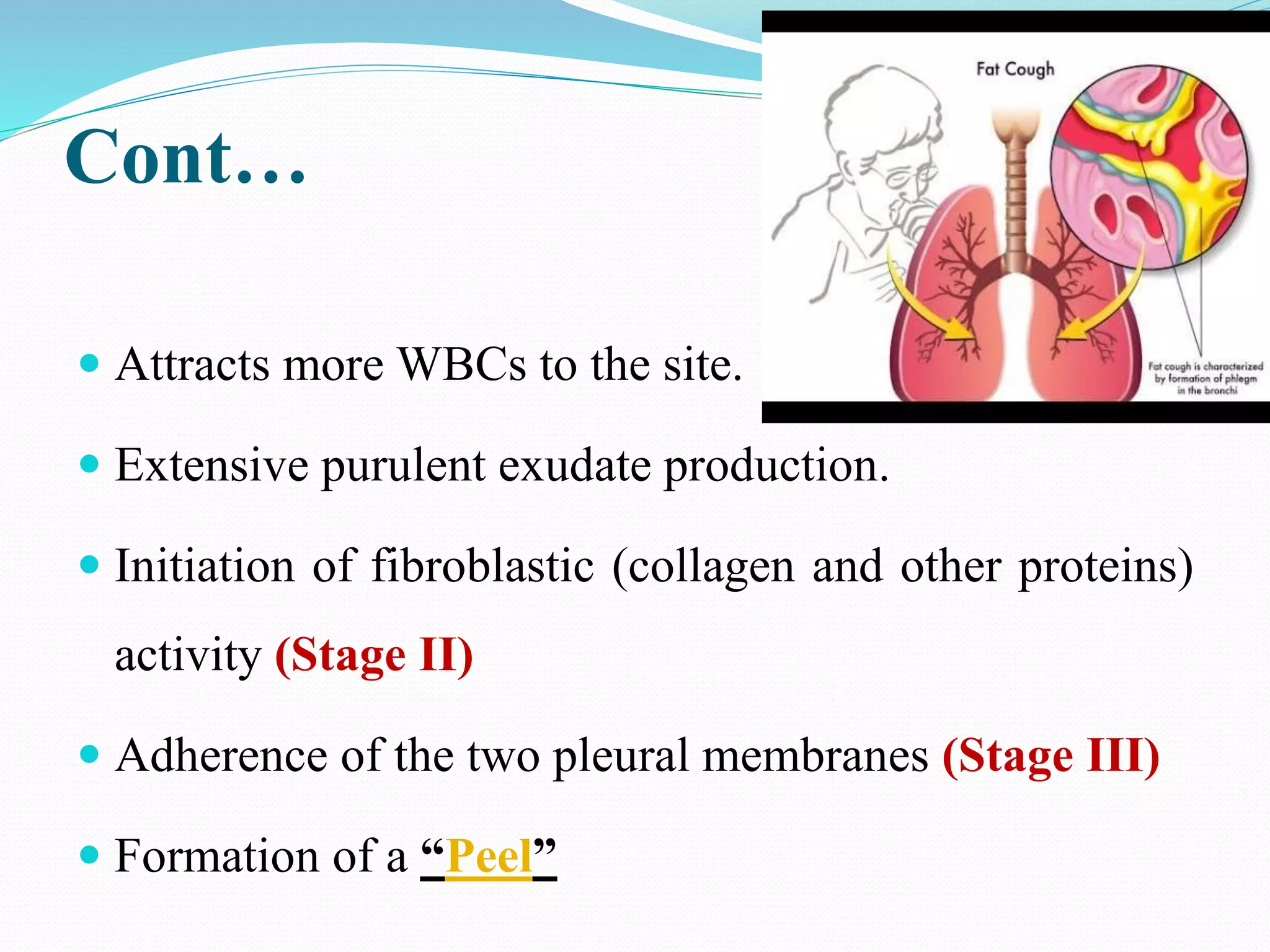
Cont…
 Attracts more WBCs to the site.
 Extensive purulent exudate production.
 Initiation of fibroblastic (collagen and other proteins)
activity (Stage II)
 Adherence of the two pleural membranes (Stage III)
 Formation of a “Peel”
CLINICAL STAGES
 Acute stage :
within the first 2 weeks of the onset.
 Chronic Stage :
after 2 weeks or with the formation of the thick peel
and loculations.
Causes of Chronicity:
 Inadequate Tube Drainage.
 Chronic pulmonary Disease( T.B. or Fungal Infection)
 Immuno-supressed patients.
 Presence of Foreign body within the pleural space.
SYMPTOMS & SIGNS
 Fever
 Cough & Expectoration.
 Pleuretic chest pain.
 Easy fatiguability.
 Loss of weight.
 Night sweating.
COMPLICATIONS
 Rupture into the lung;
Broncho-Pleural fistula
 Spread to the subcutaneous tissue;
Empyema Necessitasis) (extension of an empyema
outward the pleural cavity.)
 Septicaemia & septic shock.
INVESTIGATIONS
 Chest X-ray.
 C-T scan.
 Ultrasonography
 Thoracentesis
Light’s criteria
 Pleural fluid protein: serum protein > O.5 (1-2 g/dL)
 Pleural fluid : serum LDH >0.6 (Lactate dehydrogenase
less than 50% of plasma)
Other minor criteria
 Cholesterol > 45mg/dl (< 45 mg/dL).
 pH <7.2 (7.60-7.64)
 Glucose < 50% serum (similar to that of plasma)
Goals of the treatment
 Treat the infection
 Drain the purulent effusion adequately and
completely
 Re-expand the lung to fill the pleural space
 Eliminate complications and avoid chronicity
Antibiotic treatment
 As soon as the bacteriologic sample are recovered
 Pneumonia
 Amoxicillin, Metronidazole
 Amox-clavulanic acid
 Nosocomial
 Tazobactam or Imipenem
 Aminoglycoside or Quinolone
 Adapted to the laboratory results
British Thoracic Society.
Available techniques
Primary treatment options
 Antibiotics alone;
 Récurrent thoracocentèsis
 Insertion of chest drain alone or in combination with
fibrinolytics
 VATS(Video-Assisted Thoracic Surgery).
 Open decortication:- the operation of removing fibrous
scar tissue that prevents expansion of the lung.
Thoracocentesis
 Big caliber needle
 Mostly diagnosis technique
 Therapeutically used if the liquid remains.
 Theoretically allows pleural lavage
Chest Tube
 As soon as the liquid is thick
 Localization
 free: axillary
 loculated: Chest imaging using
ultrasonography and/or computed
tomography
 Size: 20 à 24
 Bedside
Pleural Lavage
 Isotonic saline
 Modalités
 3 way stopcock
 Directly through the CT: 250 to 500 ml
 Cautiously if suspicion of broncho-pleural fistula
 Timing:
 Immediately after CT placement
 Once a day until the liquid is clear
NOXYFLEX (noxytioline)
 Local disinfectant (formaldéhyde)
 2,5 g diluted in at least 100ml isotonic saline
 Maximum: 5g/day
 Incompatible with iodine polyvidone,chlorhexidin,
chlorine solution, lactic acid
Fibrinolytics
 Urokinase: 100 000 or 300 000 IU conditioning
 Streptokinase: 250000 IU conditioning
 250.000 IU in 10-20 ml isotonic saline
 Don’t evacuate before 24 to 48 heures
 Constantly associated with fever (38-39°C)
 Then evacuate
 Pleural lavage
 clamp 4h ( Chest 1996)
Video-assisted thoracic surgery
 Collection<10 cm: unusual
 Visual control of the CT position
 5 mm introducer, 4 mm optical
 Collection>10 cm
 10 mm introducer
 Two or three ports are made in the chest
 One port is utilised for the camera and the others for
grasping instruments
 Free fluid is evacuated and loculations drained under
thoracoscopic visualisation.
 Fibrinous adhesions are separated and the pleural debris
removed from the pleural lining using endoscopic
grasping forceps or by extensive irrigation and suction.
 Following the procedure, one or two chest drains are then
placed in the portholes.
Local antibiotics
 Usually Rifampin or Colimycin
 Still debated
 Do not replace systemic treatment
Physiotherapy
 Key to a correct evolution
 After CT removal
 Often and for a long time…..
 Decrease surgery
 Decrease long term pain and functionnal limitations
Complications
 Pleural thickening
 Reduced lung function
Nursing Diagnosis
 Impaired Gas Exchange r/t compressed lung
 Acute Pain r/t infection of the pleura
 Risk for Activity Intolerance r/t hypoxia secondary
to empyema
Empyema
Empyema

Empyema

  • 1.
  • 3.
    Definition  Also knownas:- Pyothorax Or Purulent Pleuritis. The word Empyema comes from the greek word Empyein, which means :pus – producing (suppurates).  Accumulation of Pus in the Pleural cavity.
  • 4.
    ETIOLOGY EMPYEMA STABBING GUNSHOT WOUNDS ETC. NON TRAUMATIC EXTRATHORACIC SEPSIS THORACIC SEPSIS OSTEOMELITIS MEDIASTINITIS PULMONARY DISEASE PNEUMONIA, TB, BRONCHIECTASIS, LUNGABCESS NON- IATROGENIC LUNG RESECTION, OESOPHAGEAL TEARS, PARACENTESIS, THORACIS, LIVER BIOPSY IATROGENIC TRAUMATIC SUBPHERANIC ABCESS, HEPATIC ABCESS STERNUM VERTEBRAE RIBS
  • 5.
    ORGANISMS The most common: Staph. aureus .(90% of causes in infants & children)  Strept. pneuomonie.  H. influenzae
  • 6.
    ETIOLOGY  Lung diseases:Pneumonia (the most common cause) Lung abscess.  Subphrenic abscess (accumulation of infected fluid between the diaphragm, liver, and spleen)  Post traumatic.  Post-operative.  Blood spread. (post PE)  Iatrogenic.
  • 7.
    RISK FACTOR  Alcoholism Drug use  HIV infection  Neoplasm  Pre-existent pulmonary disease
  • 8.
    Pathophysiology  Presence ofParapneumonic Effusion  Release of inflammatory mediators  ↑permeability of the capilliaries  Attracts WBCs to the site Escape of albumin & other protein from the capillaries  ↑ Pleural fluid  Presence of Free-flowing, Protein Rich Pleural Fluid (Stage I)  Inflammation worsens
  • 9.
    Cont…  Attracts moreWBCs to the site.  Extensive purulent exudate production.  Initiation of fibroblastic (collagen and other proteins) activity (Stage II)  Adherence of the two pleural membranes (Stage III)  Formation of a “Peel”
  • 10.
    CLINICAL STAGES  Acutestage : within the first 2 weeks of the onset.  Chronic Stage : after 2 weeks or with the formation of the thick peel and loculations.
  • 11.
    Causes of Chronicity: Inadequate Tube Drainage.  Chronic pulmonary Disease( T.B. or Fungal Infection)  Immuno-supressed patients.  Presence of Foreign body within the pleural space.
  • 12.
    SYMPTOMS & SIGNS Fever  Cough & Expectoration.  Pleuretic chest pain.  Easy fatiguability.  Loss of weight.  Night sweating.
  • 13.
    COMPLICATIONS  Rupture intothe lung; Broncho-Pleural fistula  Spread to the subcutaneous tissue; Empyema Necessitasis) (extension of an empyema outward the pleural cavity.)  Septicaemia & septic shock.
  • 14.
    INVESTIGATIONS  Chest X-ray. C-T scan.  Ultrasonography  Thoracentesis
  • 15.
    Light’s criteria  Pleuralfluid protein: serum protein > O.5 (1-2 g/dL)  Pleural fluid : serum LDH >0.6 (Lactate dehydrogenase less than 50% of plasma)
  • 16.
    Other minor criteria Cholesterol > 45mg/dl (< 45 mg/dL).  pH <7.2 (7.60-7.64)  Glucose < 50% serum (similar to that of plasma)
  • 17.
    Goals of thetreatment  Treat the infection  Drain the purulent effusion adequately and completely  Re-expand the lung to fill the pleural space  Eliminate complications and avoid chronicity
  • 18.
    Antibiotic treatment  Assoon as the bacteriologic sample are recovered  Pneumonia  Amoxicillin, Metronidazole  Amox-clavulanic acid  Nosocomial  Tazobactam or Imipenem  Aminoglycoside or Quinolone  Adapted to the laboratory results
  • 19.
  • 20.
  • 21.
    Primary treatment options Antibiotics alone;  Récurrent thoracocentèsis  Insertion of chest drain alone or in combination with fibrinolytics  VATS(Video-Assisted Thoracic Surgery).  Open decortication:- the operation of removing fibrous scar tissue that prevents expansion of the lung.
  • 22.
    Thoracocentesis  Big caliberneedle  Mostly diagnosis technique  Therapeutically used if the liquid remains.  Theoretically allows pleural lavage
  • 23.
    Chest Tube  Assoon as the liquid is thick  Localization  free: axillary  loculated: Chest imaging using ultrasonography and/or computed tomography  Size: 20 à 24  Bedside
  • 24.
    Pleural Lavage  Isotonicsaline  Modalités  3 way stopcock  Directly through the CT: 250 to 500 ml  Cautiously if suspicion of broncho-pleural fistula  Timing:  Immediately after CT placement  Once a day until the liquid is clear
  • 25.
    NOXYFLEX (noxytioline)  Localdisinfectant (formaldéhyde)  2,5 g diluted in at least 100ml isotonic saline  Maximum: 5g/day  Incompatible with iodine polyvidone,chlorhexidin, chlorine solution, lactic acid
  • 26.
    Fibrinolytics  Urokinase: 100000 or 300 000 IU conditioning  Streptokinase: 250000 IU conditioning  250.000 IU in 10-20 ml isotonic saline  Don’t evacuate before 24 to 48 heures  Constantly associated with fever (38-39°C)  Then evacuate  Pleural lavage  clamp 4h ( Chest 1996)
  • 27.
    Video-assisted thoracic surgery Collection<10 cm: unusual  Visual control of the CT position  5 mm introducer, 4 mm optical  Collection>10 cm  10 mm introducer  Two or three ports are made in the chest  One port is utilised for the camera and the others for grasping instruments  Free fluid is evacuated and loculations drained under thoracoscopic visualisation.  Fibrinous adhesions are separated and the pleural debris removed from the pleural lining using endoscopic grasping forceps or by extensive irrigation and suction.  Following the procedure, one or two chest drains are then placed in the portholes.
  • 28.
    Local antibiotics  UsuallyRifampin or Colimycin  Still debated  Do not replace systemic treatment
  • 29.
    Physiotherapy  Key toa correct evolution  After CT removal  Often and for a long time…..  Decrease surgery  Decrease long term pain and functionnal limitations
  • 30.
  • 31.
    Nursing Diagnosis  ImpairedGas Exchange r/t compressed lung  Acute Pain r/t infection of the pleura  Risk for Activity Intolerance r/t hypoxia secondary to empyema