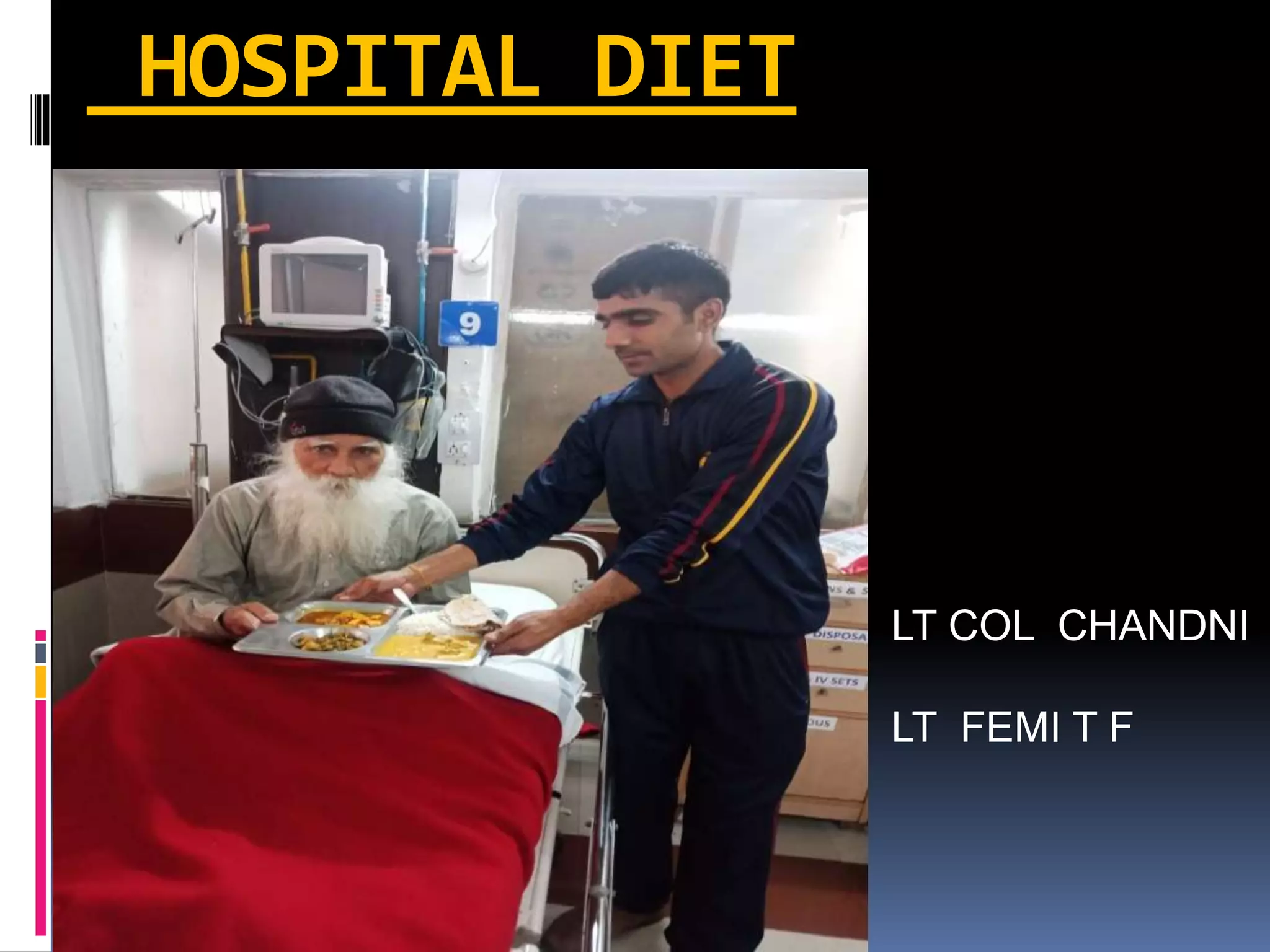
HOSPITAL DIET
LT COL CHANDNI
LT FEMI T F
WHY DIET???
 In an era of Antimicrobial resistance –
immunomodulation & dietary
supplements will be the guide to GOOD
HEALTH
OUR PANACEA…
KEY POINTS
 IMPORTANCE OF NUTRITION
 GOAL OF DIETARY SERVICES
 HOSPITAL DIETS
 NURSES RESPONSIBILITY
MERITS OF A BALANCED DIET
The merits of a balanced diet
include:
•Relaxation to the mind.
•Maintenance of body weight.
•Increase in muscle performance.
•Better workout capacity.
•Regulation of emotions and
•Decrease in lipid levels, such as
triglycerides, cholesterol and so on.
PURPOSE OF DIET MODIFICATION
•To maintain or restore good nutritional status;
•To correct nutritional deficiency that may have
occurred;
•To afford rest to a particular part of the body that
may have been affected by illness or surgery
•To adjust the diet based on the digestive
capability of the client;
•To adjust the diet based on the ability of the client
to metabolize nutrients;
•To treat or prevent edema;
•To eliminate offending food substance
DIETARY SERVICES
Overall goal of the dietary service is to
provide nourishing and appetizing
meals to all patients and personnel as
efficiently and economically as
possible.
HOSPITAL DIETS
HOSPITAL DIET
 The diet served to a
patient during his stay in
the hospital.
 Types of Hospital Diets:-
 ‘O’ Ordinary Diet
 ‘C’ Convalescent Diet
 ‘S’ Subsistence Diet
 ‘N’ No Diet
 ‘F’ Fluid Diet
REGULAR DIET
 To meet the nutritional needs of
adolescents, adults and geriatric phases of
the life span.
 Includes the basic food groups and a
variety of foods
 Provides approximately 3375 calories.
 Designed to provide exceptionally
generous amounts of all recognized
nutrients and meets or exceeds the RDA
for all nutrients tabulated.
ORDINARY ‘O’ DIET
 It usually contains any and all foods
eaten by the person in health.
 It provides recommended allowances
of all nutrients, permits the use of all
foods
This is the most frequently used of all
diets.
 Types – Ordinary Veg, Ordinary
OVO, Ordinary Non -Veg
INTERVALS & INDICATIONS OF
FEEDING
 Three regular meals are taken
 Two snacks
 INDICATIONS
 All ambulatory patients
 When patients condition does
not necessitate a modified diet.
This diet forms the basis of all
modified diets.
CONVALESCENT ‘C’ DIET
 This is high protein diet.
 Foods Included
 All food groups of regular diet
with emphasis on extra milk,
egg, cheese, fish and poultry.
 Protein foods are increased
100-150gms or more per day.
 It may also be planned as soft
or fluid diet when necessary
INTERVALS & INDICATIONS OF FEEDING
 Three large meals and
high protein beverages
are served in between
 Indications
 Protein deficiency
 Before and after surgery
 Burns
 Increased metabolic rate
SUBSISTENCE ‘S’ DIET
• It is the special diet allowance to the
patients when admitted to the
hospital after 1200 hrs till 1800hrs
• Foods Included - All foods
in regular diet but of less ration scale.
• Intervals of feedings
– One full evening meal is served
– Milk and beverages are served in
between
NO ‘N’ DIET
 There is no specific quantity of any item but
substituted by extra as prescribed.
 Food items are demanded according to the
condition of the patient.
 Intervals depend upon type of diet prescribed for
the particular patient
EXTRAS ON ‘N’ DIET
VEGETABLE 170
CONDIMENTS 07
ONION 30
POTATO 110
EGGS OARB
COFFEE OARB
TEA OARB
SUGAR 90
MILK 1640
LIVER 454
NUTRAMUL 57
BISCUIT 57
BREAD 170
ATTA/RICE 170
DAL 60
OIL 30
CHEESE 28
FRESH CREAM 28
BUTTER 28
JAM 28
DALIA 57
SAGO 30
CITRUS FRUIT 230
RAISINS 57
INDICATIONS
 Patients needing special diets
 Burns patient
 Patient recovering from any major
illnesses.
 Small children
FLUID ‘F’ DIET
 Foods included- All liquids
like milk, soups, and
beverages. Egg, fruit juices
are also included
 The diet is free from
cellulose and irritating
condiments.
FLUID DIET
 Clear fluid diet
 Full fluid diet
 Advanced full fluid diet
 Adenoidectomy and
tonsillectomy cold fluid diet
INDICATIONS
 Acute infections
 Gastritis
 After Surgery
 Patients too ill to eat solid
foods
Clear Fluid Diet
 postoperative patient's first feeding
 periods of acute illness
 food intolerance
 To reduce colon fecal matter for
diagnostic procedures.
Clear Fluid Diet….
 limited to fat-free broth, water, fruit drinks
without pulp, fruit ice tea, coffee
substitutes, and sugar. Provides
approximately 1146 calories.
 Below the recommended dietary
allowances (RDA)
 Helps to maintain fluid balance of body.
 Used only for a short time
Full Fluid Diet
 extensive oral surgery,
 facial injuries,
 esophageal strictures,
 carcinomas of the mouth and
esophagus.
Transition between a clear liquid and
a regular diet for the post-surgical
patient.
Full Liquid Diet….
 Milk form the basis.
 juices, strained soups, thinned,
cooked cereals, custards, ice
cream, egg flip, and milk.
 Provides approximately 2000
calories.
Advanced Full Liquid Diet
 This diet may be prescribed to meet the
nutritive requirements of a patient who must
receive a full liquid diet for an extended
period of time
 Who has undergone oral surgery and must
have foods, which can pass through tube.
Diet chart- 2000ml, 1800Kcal
TIME FEED VOL KCAL
0800H 1egg+150ml milk 200 167
1000 Soup+20Gms Butter 200 187
1200 150ml milk+protein-(1 scoop) 200 115
1400 1 eggs+150Ml milk 200 167
1600 Soup+20gms butter 200 187
1800 milk 200 62
2000 1 eggs+150ml milk 200 167
2200 Soup+20gms butter 200 187
0000 150ml milk+fresublin(1scoop) 200 115
0200 1 egg+150ml milk 200 167
0400 Soup+20gms butter 200 187
 This diet contains:
VOLUME: 2000ML
CALORIES: 1800KCAL
PROTEIN: 60GMS
FAT:158GMS
CARBS: 137GMS
ADVANCED FULL LIQUID DIET
High-protein beverages are
served with meals and
between meals.
Provides approximately 4028
calories.
Meets the RDA for all
nutrients tabulated.
an example:
Total 1 ltr diet
 Soyaflour 35 gms
 Besan 35 gms
 Milk 1000 ml
 Rice 30 gms
 Oil 30 gms
 Sugar 100 gms
Tonsillectomy and Adenoidectomy
Cold Liquid Diet
 This diet is used following a tonsillectomy
and adenoidectomy (T&A).
 Provides only cold liquids, which are free of
irritants or acid properties.
 Foods allowed - flavored gelatins, ice cream,
sherbet, and milk. A high protein beverage is
served between meals.
SCALE OF ENTITLEMENT FOR RATION
AUTH: AFI 1/ S/ 70
FOOD ITEM ‘O’
NV
‘O’ OVO ‘O’VEG ‘C’ NV ‘C’ OVO ‘C’VEG SD FD
MILK(ML) 440 640 1080 1100 1300 1740 440 1540
EGGS(NO) 02 04 - 03 05 - - 02
MUTTON(G
)
230 - - 230 - - - -
CHICKEN 340 - - 340 - - - -
FRUIT(G) 230 230 230 230 230 230 - 230
BREAD - - - 170 170 170 - -
JAM - - - 28 28 28 - -
BUTTER - - - 28 28 28 - -
CREAM - -- - 28 28 28 - -
CONTD…
FOOD ITEM O’
NV
O’
OVO
O’VEG ‘C’ NV C’ OVO ‘C’VEG SD FD
ATTA/RICE 600 600 600 260 260 260 230 -
SUGAR 90 92 90 90 90 90 40 90
DAL 60 60 60 60 60 60 30 -
OIL 60 60 60 60 60 60 30 -
VEGETABLE 170 170 170 170 170 170 170 -
POTATO 110 110 110 60 60 60 - -
ONION 60 60 60 60 60 60 - -
SALT 20 20 20 20 20 20 - -
TEA 9 9 9 9 9 9 7 9
CEREAL
A(sago, suji)
- - - 30 30 30 - -
CEREAL
B(oats,
cornflakes ,
dalia)
- - - 57 57 57 - -
CONDIMENT 14 14 14 14 14 14 4 -
DIET AS PER AGE
AGE DIET
0 to 6 months BF
6 months to 5 yrs N/2
5yrs to 10 yrs O/2
Above 10 yrs O diet
Daily Diet sheet IAFM – 1266 duly filled
should be submitted to QM Office/LO
before 12 noon
 Daily Diet sheet IAFM – 1266 duly filled
should be submitted to QM Office/LO before
12 noon
 Monthly Diet sheet – IAFM 1292 should be
maintained and must tally with the daily diet
sheet. Should be summed up and submitted
to the QM Office by 5th of every month.
THERAPEUTIC DIETS
What is therapeutic
diet?
 The modification of normal meal
to treat the indiscriminate health
state of an individual.
THERAPEUTIC DIET
Depending upon the case
•Renal diet
•Cardiac diet
•Hepatic Diet
•Diabetic Diet
•Low calorie or high
calorie diet
•Fat free diet
Renal diet;
 Low potassium foods: apple , cranberries,
pineapple grapes. Cauliflower ,onion, pepper,
radish, lettuce.
 Limit amount of fluids ; candies, chewing
gum etc
 Protein: daily requirement based on stage
and dialysis.
Nutrition for chronic renal
failure
 Low protein and low sodium diet for
chronic renal failure
Nutrient allowance Sedentary workers Moderate workers Heavy workers
Proteins 20 g 30 gm 40 gm
Calories 2040 2197 2363
Sodium 180 mg 215 mg 255 mg
Potassium 1226 mg 1382 mg 1982 mg
Phosphorus 441 mg 586 mg 717 mg
Food to be avoided
 Extra milk or milk products
 Meat, poultry and fish
 Dry fruits
 Extra pulses, cereals, legumes, peas, beans
 Cakes, biscuits and bakery products, jams
 Coca cola, squash, sharbat
 Fruits and fruit juices like lemon, mango, lime,
plums
 Green leafy vegetables if potassium is restricted
CARDIAC DIET
 A healthy-heart diet are to eat food
that help to obtain or maintain
levels of cholesterol and fatty
molecules
- Reduce overall cholesterol/ low
density lipoproteins
- Increase high density lipoproteins
- Reduce other harmful lipids
DASH diet
Is an acronym for Dietary Approach to stop
hypertension
The diet is rich in important nutrients and
fiber but much less sodium
Dash diet recommendations
 Sodium intake 5-10grams
 Calcium rich diary product with low fat
 Include canola or olive oil rich in mono
saturated oils
 Choose whole grains over white flour or pasta
products
 Fresh fruits ,vegetables , legumes, nuts
everyday
Dietary guidelines in diabetes
 Maintain ideal body weight
 Choose simple carbohydrate
 Protein from vegetarian source
 Restriction of fat and oils
 Increase fiber
 Add salad , whole pulses, whole cereals and
sprouts
 Avoid fasting
Nutrition in diabetes mellitus
Foods not allowed:
-Glucose, sugar, honey, all
sweets, chocolates and
candies
Foods to be avoided or
restricted:
-Potatoes, jam, arbi, sweet potatoes,
alcoholic beverages, fried fruits,
paratha, puri, pakoras, dal moth, deep
fried vegetables, dry fruits, saturated
oils
Foods to be used freely:
Green leafy vegetables, tomatoes,
cucumbers, lemon, clear soups, black coffee
and tea without sugar, butter milk
Daily menu for diabetic person
nutrients Sedentary workers Moderate workers Heavy workers
Calories 1300 kcal 1600 kcal 1900 kcal
Protein 60 gm 66 gm 70 gm
CHO 170 gm 223gm 232 gm
Fats 33 gm 39 gm 39 gm
FEVER
Diet in fever
 The nutritional requirements depend on the
nature, severity and duration of the fever,
calories requirement is more.
 Frequent feeding must be given to the client
and fats must be restricted
 Fluid intake must be from 3000-5000 ml in the
form of glucose, fruits juices
 A readily digestible foods must be given
 When fever goes down, bread with milk, milk
puddings or rice dal must be given
Diet in high grade fever
Light diet:
-It must be given 2 hourly and contents must
include milk, barley water, glucose at regular
intervals
-To rebuild body tissues extra proteins must be
given
-Examples milk, egg, curd etc
-Fried foods and diet containing fibers should
be avoided
DIARRHOEA
Diet in diarrhea
 Diarrhoea is increased frequency of loose or
watery stools. It occurs in infectious condition
of colon.
 Fluids should be given quarter to one hourly
frequently
 Oral rehydration solution must be given
OFFICER/OFFR FAMILY PTS IN OD MAY
DRAW FOLLOWING IN LIEU OF ATTA/RICE
Cereal for breakfast +cornfakes/oatmeal/
sago /dalia / semolina 57Gm
Cereal for pudding 30gm
Butter 30Gm
Jam/honey/marmalade 28gm
 Bread 170Gm
DIET MILK
ENTITLED(
ML)
MILK
RETAINED
IN COOK
HOUSE
0700HRS 1000HRS 2100HRS
O DIET NV 440 240(for
curd &tea)
- 200 -
OVOVEG 640 240(for
curd , tea)
- 200 200
O DIETVEG 1080 480(for
curd ,tea)
200 200 200
C DIET NV 1100 400(curd&p
ud)
200 200 200
C DIET OVOVEG 1300 600(for
curd. Pudd
&tea)
200 200 300
C DIETVEG 1740 840 curd,
pd, tea)
300 200 400
F DIET 1540 140(for
curd &tea)
NURSES’S RESPONSIBILITY
NURSES’S RESPONSIBILITY IN DIET
 Assisting patients to obtain nourishment either
through feeding or assisting in feeding.
 Motivating patient to eat.
 Proper planning of diet.
 Assisting patients with special problems about
therapeutic diets.
 Supervising and/or distributing the diet at ward
level.
 Daily ward requisition for diets and extras in
accordance with the instructions.
THANK
YOU
SOME WEIGHT LOSS TIPS for 20
days
 No sugar
 No juices
 No corn products
 No combining proteins and carbohydrates
 All dinners should be cereal free
 Exercise only as much as you can
 Practice portion control
Fruits to avoid
 Bananas
 Leechies
 Chikoos
 Mangoes
 Grapes
 Custard apple
 Pineapple
 Musk melon
Fruits allowed
 Papaya
 Peeches
 Apricots
 Cherries
 Pomegranate
 Guava
 pears
VEGETABLES NOT ALLOWED
 Potatoes
 Jimikand
 Arbi
 Jackfruit
 Beetroot
 Green peas
 carrots
VEGETABLES ALLOWED
 Cabbage
 Cauliflower
 Capsicum
 Mushrooms
 Lady finger
 Spinach
 Kaddu
 Spring onions
 Tinda
 tori

HOSPITAL DIETARY SERVICES latest 1.ppt

  • 1.
    HOSPITAL DIET LT COLCHANDNI LT FEMI T F
  • 2.
    WHY DIET???  Inan era of Antimicrobial resistance – immunomodulation & dietary supplements will be the guide to GOOD HEALTH
  • 3.
  • 5.
    KEY POINTS  IMPORTANCEOF NUTRITION  GOAL OF DIETARY SERVICES  HOSPITAL DIETS  NURSES RESPONSIBILITY
  • 6.
    MERITS OF ABALANCED DIET The merits of a balanced diet include: •Relaxation to the mind. •Maintenance of body weight. •Increase in muscle performance. •Better workout capacity. •Regulation of emotions and •Decrease in lipid levels, such as triglycerides, cholesterol and so on.
  • 7.
    PURPOSE OF DIETMODIFICATION •To maintain or restore good nutritional status; •To correct nutritional deficiency that may have occurred; •To afford rest to a particular part of the body that may have been affected by illness or surgery •To adjust the diet based on the digestive capability of the client; •To adjust the diet based on the ability of the client to metabolize nutrients; •To treat or prevent edema; •To eliminate offending food substance
  • 8.
  • 9.
    Overall goal ofthe dietary service is to provide nourishing and appetizing meals to all patients and personnel as efficiently and economically as possible.
  • 10.
  • 20.
    HOSPITAL DIET  Thediet served to a patient during his stay in the hospital.  Types of Hospital Diets:-  ‘O’ Ordinary Diet  ‘C’ Convalescent Diet  ‘S’ Subsistence Diet  ‘N’ No Diet  ‘F’ Fluid Diet
  • 21.
    REGULAR DIET  Tomeet the nutritional needs of adolescents, adults and geriatric phases of the life span.  Includes the basic food groups and a variety of foods  Provides approximately 3375 calories.  Designed to provide exceptionally generous amounts of all recognized nutrients and meets or exceeds the RDA for all nutrients tabulated.
  • 22.
    ORDINARY ‘O’ DIET It usually contains any and all foods eaten by the person in health.  It provides recommended allowances of all nutrients, permits the use of all foods This is the most frequently used of all diets.  Types – Ordinary Veg, Ordinary OVO, Ordinary Non -Veg
  • 23.
    INTERVALS & INDICATIONSOF FEEDING  Three regular meals are taken  Two snacks  INDICATIONS  All ambulatory patients  When patients condition does not necessitate a modified diet. This diet forms the basis of all modified diets.
  • 24.
    CONVALESCENT ‘C’ DIET This is high protein diet.  Foods Included  All food groups of regular diet with emphasis on extra milk, egg, cheese, fish and poultry.  Protein foods are increased 100-150gms or more per day.  It may also be planned as soft or fluid diet when necessary
  • 25.
    INTERVALS & INDICATIONSOF FEEDING  Three large meals and high protein beverages are served in between  Indications  Protein deficiency  Before and after surgery  Burns  Increased metabolic rate
  • 26.
    SUBSISTENCE ‘S’ DIET •It is the special diet allowance to the patients when admitted to the hospital after 1200 hrs till 1800hrs • Foods Included - All foods in regular diet but of less ration scale. • Intervals of feedings – One full evening meal is served – Milk and beverages are served in between
  • 27.
    NO ‘N’ DIET There is no specific quantity of any item but substituted by extra as prescribed.  Food items are demanded according to the condition of the patient.  Intervals depend upon type of diet prescribed for the particular patient
  • 28.
    EXTRAS ON ‘N’DIET VEGETABLE 170 CONDIMENTS 07 ONION 30 POTATO 110 EGGS OARB COFFEE OARB TEA OARB SUGAR 90 MILK 1640 LIVER 454
  • 29.
    NUTRAMUL 57 BISCUIT 57 BREAD170 ATTA/RICE 170 DAL 60 OIL 30 CHEESE 28 FRESH CREAM 28 BUTTER 28 JAM 28 DALIA 57 SAGO 30 CITRUS FRUIT 230 RAISINS 57
  • 30.
    INDICATIONS  Patients needingspecial diets  Burns patient  Patient recovering from any major illnesses.  Small children
  • 31.
    FLUID ‘F’ DIET Foods included- All liquids like milk, soups, and beverages. Egg, fruit juices are also included  The diet is free from cellulose and irritating condiments.
  • 32.
    FLUID DIET  Clearfluid diet  Full fluid diet  Advanced full fluid diet  Adenoidectomy and tonsillectomy cold fluid diet
  • 33.
    INDICATIONS  Acute infections Gastritis  After Surgery  Patients too ill to eat solid foods
  • 34.
    Clear Fluid Diet postoperative patient's first feeding  periods of acute illness  food intolerance  To reduce colon fecal matter for diagnostic procedures.
  • 35.
    Clear Fluid Diet…. limited to fat-free broth, water, fruit drinks without pulp, fruit ice tea, coffee substitutes, and sugar. Provides approximately 1146 calories.  Below the recommended dietary allowances (RDA)  Helps to maintain fluid balance of body.  Used only for a short time
  • 36.
    Full Fluid Diet extensive oral surgery,  facial injuries,  esophageal strictures,  carcinomas of the mouth and esophagus. Transition between a clear liquid and a regular diet for the post-surgical patient.
  • 37.
    Full Liquid Diet…. Milk form the basis.  juices, strained soups, thinned, cooked cereals, custards, ice cream, egg flip, and milk.  Provides approximately 2000 calories.
  • 38.
    Advanced Full LiquidDiet  This diet may be prescribed to meet the nutritive requirements of a patient who must receive a full liquid diet for an extended period of time  Who has undergone oral surgery and must have foods, which can pass through tube.
  • 39.
    Diet chart- 2000ml,1800Kcal TIME FEED VOL KCAL 0800H 1egg+150ml milk 200 167 1000 Soup+20Gms Butter 200 187 1200 150ml milk+protein-(1 scoop) 200 115 1400 1 eggs+150Ml milk 200 167 1600 Soup+20gms butter 200 187 1800 milk 200 62 2000 1 eggs+150ml milk 200 167 2200 Soup+20gms butter 200 187 0000 150ml milk+fresublin(1scoop) 200 115 0200 1 egg+150ml milk 200 167 0400 Soup+20gms butter 200 187
  • 40.
     This dietcontains: VOLUME: 2000ML CALORIES: 1800KCAL PROTEIN: 60GMS FAT:158GMS CARBS: 137GMS
  • 41.
    ADVANCED FULL LIQUIDDIET High-protein beverages are served with meals and between meals. Provides approximately 4028 calories. Meets the RDA for all nutrients tabulated.
  • 43.
    an example: Total 1ltr diet  Soyaflour 35 gms  Besan 35 gms  Milk 1000 ml  Rice 30 gms  Oil 30 gms  Sugar 100 gms
  • 44.
    Tonsillectomy and Adenoidectomy ColdLiquid Diet  This diet is used following a tonsillectomy and adenoidectomy (T&A).  Provides only cold liquids, which are free of irritants or acid properties.  Foods allowed - flavored gelatins, ice cream, sherbet, and milk. A high protein beverage is served between meals.
  • 45.
    SCALE OF ENTITLEMENTFOR RATION AUTH: AFI 1/ S/ 70 FOOD ITEM ‘O’ NV ‘O’ OVO ‘O’VEG ‘C’ NV ‘C’ OVO ‘C’VEG SD FD MILK(ML) 440 640 1080 1100 1300 1740 440 1540 EGGS(NO) 02 04 - 03 05 - - 02 MUTTON(G ) 230 - - 230 - - - - CHICKEN 340 - - 340 - - - - FRUIT(G) 230 230 230 230 230 230 - 230 BREAD - - - 170 170 170 - - JAM - - - 28 28 28 - - BUTTER - - - 28 28 28 - - CREAM - -- - 28 28 28 - -
  • 46.
    CONTD… FOOD ITEM O’ NV O’ OVO O’VEG‘C’ NV C’ OVO ‘C’VEG SD FD ATTA/RICE 600 600 600 260 260 260 230 - SUGAR 90 92 90 90 90 90 40 90 DAL 60 60 60 60 60 60 30 - OIL 60 60 60 60 60 60 30 - VEGETABLE 170 170 170 170 170 170 170 - POTATO 110 110 110 60 60 60 - - ONION 60 60 60 60 60 60 - - SALT 20 20 20 20 20 20 - - TEA 9 9 9 9 9 9 7 9 CEREAL A(sago, suji) - - - 30 30 30 - - CEREAL B(oats, cornflakes , dalia) - - - 57 57 57 - - CONDIMENT 14 14 14 14 14 14 4 -
  • 47.
    DIET AS PERAGE AGE DIET 0 to 6 months BF 6 months to 5 yrs N/2 5yrs to 10 yrs O/2 Above 10 yrs O diet Daily Diet sheet IAFM – 1266 duly filled should be submitted to QM Office/LO before 12 noon
  • 48.
     Daily Dietsheet IAFM – 1266 duly filled should be submitted to QM Office/LO before 12 noon
  • 52.
     Monthly Dietsheet – IAFM 1292 should be maintained and must tally with the daily diet sheet. Should be summed up and submitted to the QM Office by 5th of every month.
  • 57.
  • 59.
    What is therapeutic diet? The modification of normal meal to treat the indiscriminate health state of an individual.
  • 60.
    THERAPEUTIC DIET Depending uponthe case •Renal diet •Cardiac diet •Hepatic Diet •Diabetic Diet •Low calorie or high calorie diet •Fat free diet
  • 61.
    Renal diet;  Lowpotassium foods: apple , cranberries, pineapple grapes. Cauliflower ,onion, pepper, radish, lettuce.  Limit amount of fluids ; candies, chewing gum etc  Protein: daily requirement based on stage and dialysis.
  • 62.
    Nutrition for chronicrenal failure  Low protein and low sodium diet for chronic renal failure Nutrient allowance Sedentary workers Moderate workers Heavy workers Proteins 20 g 30 gm 40 gm Calories 2040 2197 2363 Sodium 180 mg 215 mg 255 mg Potassium 1226 mg 1382 mg 1982 mg Phosphorus 441 mg 586 mg 717 mg
  • 63.
    Food to beavoided  Extra milk or milk products  Meat, poultry and fish  Dry fruits  Extra pulses, cereals, legumes, peas, beans  Cakes, biscuits and bakery products, jams  Coca cola, squash, sharbat  Fruits and fruit juices like lemon, mango, lime, plums  Green leafy vegetables if potassium is restricted
  • 64.
    CARDIAC DIET  Ahealthy-heart diet are to eat food that help to obtain or maintain levels of cholesterol and fatty molecules - Reduce overall cholesterol/ low density lipoproteins - Increase high density lipoproteins - Reduce other harmful lipids
  • 65.
    DASH diet Is anacronym for Dietary Approach to stop hypertension The diet is rich in important nutrients and fiber but much less sodium
  • 66.
    Dash diet recommendations Sodium intake 5-10grams  Calcium rich diary product with low fat  Include canola or olive oil rich in mono saturated oils  Choose whole grains over white flour or pasta products  Fresh fruits ,vegetables , legumes, nuts everyday
  • 67.
    Dietary guidelines indiabetes  Maintain ideal body weight  Choose simple carbohydrate  Protein from vegetarian source  Restriction of fat and oils  Increase fiber  Add salad , whole pulses, whole cereals and sprouts  Avoid fasting
  • 68.
    Nutrition in diabetesmellitus Foods not allowed: -Glucose, sugar, honey, all sweets, chocolates and candies
  • 69.
    Foods to beavoided or restricted: -Potatoes, jam, arbi, sweet potatoes, alcoholic beverages, fried fruits, paratha, puri, pakoras, dal moth, deep fried vegetables, dry fruits, saturated oils
  • 70.
    Foods to beused freely: Green leafy vegetables, tomatoes, cucumbers, lemon, clear soups, black coffee and tea without sugar, butter milk
  • 71.
    Daily menu fordiabetic person nutrients Sedentary workers Moderate workers Heavy workers Calories 1300 kcal 1600 kcal 1900 kcal Protein 60 gm 66 gm 70 gm CHO 170 gm 223gm 232 gm Fats 33 gm 39 gm 39 gm
  • 73.
  • 74.
    Diet in fever The nutritional requirements depend on the nature, severity and duration of the fever, calories requirement is more.  Frequent feeding must be given to the client and fats must be restricted  Fluid intake must be from 3000-5000 ml in the form of glucose, fruits juices  A readily digestible foods must be given  When fever goes down, bread with milk, milk puddings or rice dal must be given
  • 75.
    Diet in highgrade fever Light diet: -It must be given 2 hourly and contents must include milk, barley water, glucose at regular intervals -To rebuild body tissues extra proteins must be given -Examples milk, egg, curd etc -Fried foods and diet containing fibers should be avoided
  • 76.
  • 77.
    Diet in diarrhea Diarrhoea is increased frequency of loose or watery stools. It occurs in infectious condition of colon.  Fluids should be given quarter to one hourly frequently  Oral rehydration solution must be given
  • 79.
    OFFICER/OFFR FAMILY PTSIN OD MAY DRAW FOLLOWING IN LIEU OF ATTA/RICE Cereal for breakfast +cornfakes/oatmeal/ sago /dalia / semolina 57Gm Cereal for pudding 30gm Butter 30Gm Jam/honey/marmalade 28gm  Bread 170Gm
  • 81.
    DIET MILK ENTITLED( ML) MILK RETAINED IN COOK HOUSE 0700HRS1000HRS 2100HRS O DIET NV 440 240(for curd &tea) - 200 - OVOVEG 640 240(for curd , tea) - 200 200 O DIETVEG 1080 480(for curd ,tea) 200 200 200 C DIET NV 1100 400(curd&p ud) 200 200 200 C DIET OVOVEG 1300 600(for curd. Pudd &tea) 200 200 300 C DIETVEG 1740 840 curd, pd, tea) 300 200 400 F DIET 1540 140(for curd &tea)
  • 82.
  • 83.
    NURSES’S RESPONSIBILITY INDIET  Assisting patients to obtain nourishment either through feeding or assisting in feeding.  Motivating patient to eat.  Proper planning of diet.  Assisting patients with special problems about therapeutic diets.  Supervising and/or distributing the diet at ward level.  Daily ward requisition for diets and extras in accordance with the instructions.
  • 84.
  • 87.
    SOME WEIGHT LOSSTIPS for 20 days  No sugar  No juices  No corn products  No combining proteins and carbohydrates  All dinners should be cereal free  Exercise only as much as you can  Practice portion control
  • 88.
    Fruits to avoid Bananas  Leechies  Chikoos  Mangoes  Grapes  Custard apple  Pineapple  Musk melon
  • 89.
    Fruits allowed  Papaya Peeches  Apricots  Cherries  Pomegranate  Guava  pears
  • 90.
    VEGETABLES NOT ALLOWED Potatoes  Jimikand  Arbi  Jackfruit  Beetroot  Green peas  carrots
  • 91.
    VEGETABLES ALLOWED  Cabbage Cauliflower  Capsicum  Mushrooms  Lady finger  Spinach  Kaddu  Spring onions  Tinda  tori