CHAPTER 5
Dietary
Modification and
Dietary Therapy
The students will be able to:
1. To maintain a good nutritional status.
2. To correct nutrition deficiencies
3. To afford rest to the whole body or to specific
organs affected by the disease.
4. To adjust the food intake to the body’s ability
to metabolize the nutrients during the disease.
5. To bring about the changes in the body weight
whenever necessary.
OBJECTIVES OF DIET THERAPY
DIET AND DIET THERAPY
 is concerned with recovery from illness and
prevention of disease .
 It includes checking a
person's nutrition status, and giving the
right foods or nutrients to treat conditions
such as those caused by diabetes, heart
disease, and cancer.
DIET THERAPY
A. General Diets
B. Diets Modified in Consistency
C. Diets Modified in Composition
TYPES OF DIETS
1. Regular/full diet
2. High fiber diet
3. Vegetarian diet
4. Therapeutic diet
TYPES OF GENERAL DIETS
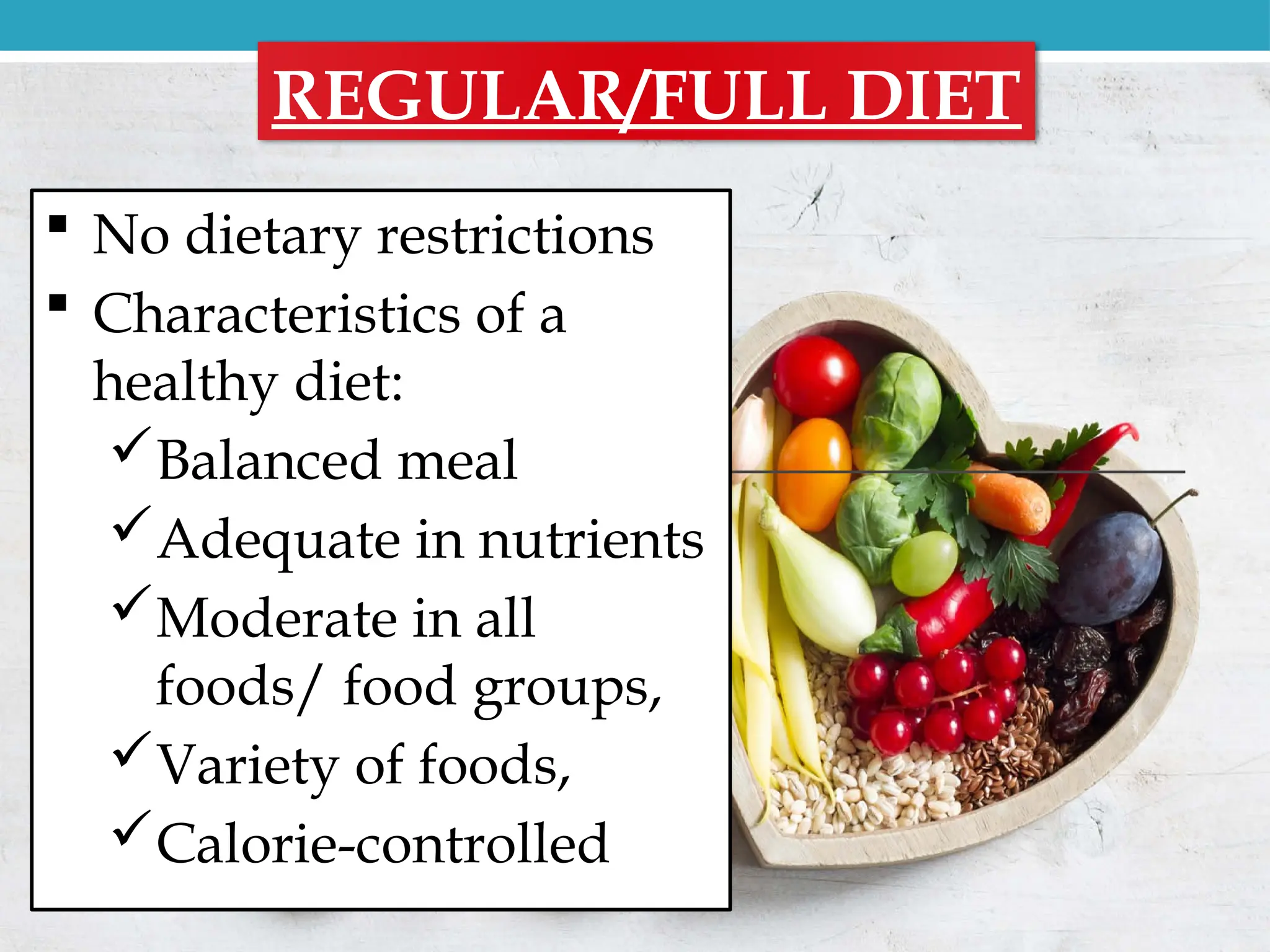
 No dietary restrictions
 Characteristics of a
healthy diet:
Balanced meal
Adequate in nutrients
Moderate in all
foods/ food groups,
Variety of foods,
Calorie-controlled
REGULAR/FULL DIET
 Diet high in non-digestible part of plants, which is fiber.
Fiber is found in fruits, vegetables, whole grains, and
legumes. Insoluble fiber increases stool bulk, decrease
transit time of food in the bowel, and decreases
constipation and the risk of colon cancer.
 Here's a look at how much dietary fiber is found in some
common foods:
Fruits Serving size
Total fiber
(grams)*
Pear 1 medium 5.5
Apple, with skin 1 medium 4.5
Banana 1 medium 3.0
Orange 1 medium 3.0
Strawberries 1 cup 3.0
HIGH FIBER DIET
Vegetables Serving size
Total fiber
(grams)*
Broccoli, boiled 1 cup chopped 5.0
Potato, with skin, baked 1 medium 4.0
Sweet corn, boiled 1 cup 3.5
Cauliflower, raw 1 cup chopped 2.0
Carrot, raw 1 medium 1.5
Grains Serving size
Total fiber
(grams)*
Spaghetti, whole-wheat, cooked 1 cup 6.0
Oatmeal, instant, cooked 1 cup 5.0
Popcorn, air-popped 3 cups 3.5
Brown rice, cooked 1 cup 3.5
Bread, whole-wheat 1 slice 2.0
Other High-fiber Rich foods:
Vegetarian diet
 does not include any
meat, poultry, or seafood.
 It is a meal plan made up
of foods that come mostly
from plants.
 These include:
Vegetables
Fruits
Whole grains
Legumes
Seeds
Nuts
VEGETARIAN DIET
 Vegan: Includes only plant-based foods. No
animal proteins or animal by-products such as
eggs, milk, or honey.
 Lacto-vegetarian: Includes plant foods plus some
or all dairy products.
 Lacto-ovo vegetarian: Includes plant foods, dairy
products, and eggs.
 Semi- or partial vegetarian: Includes plant foods
and may include chicken or fish, dairy products,
and eggs. It does not include red meat.
 Pescatarian: Includes plant foods and seafood.
The different types of vegetarian diets:
a meal plan/ planned diet
Modification of normal diet
Prescribed by a doctor and planned
by a dietician;
Part of the treatment of a medical
condition;
Used to supplement the medical or
surgical treatment
THERAPEUTIC DIETS
DIABETIC DIET
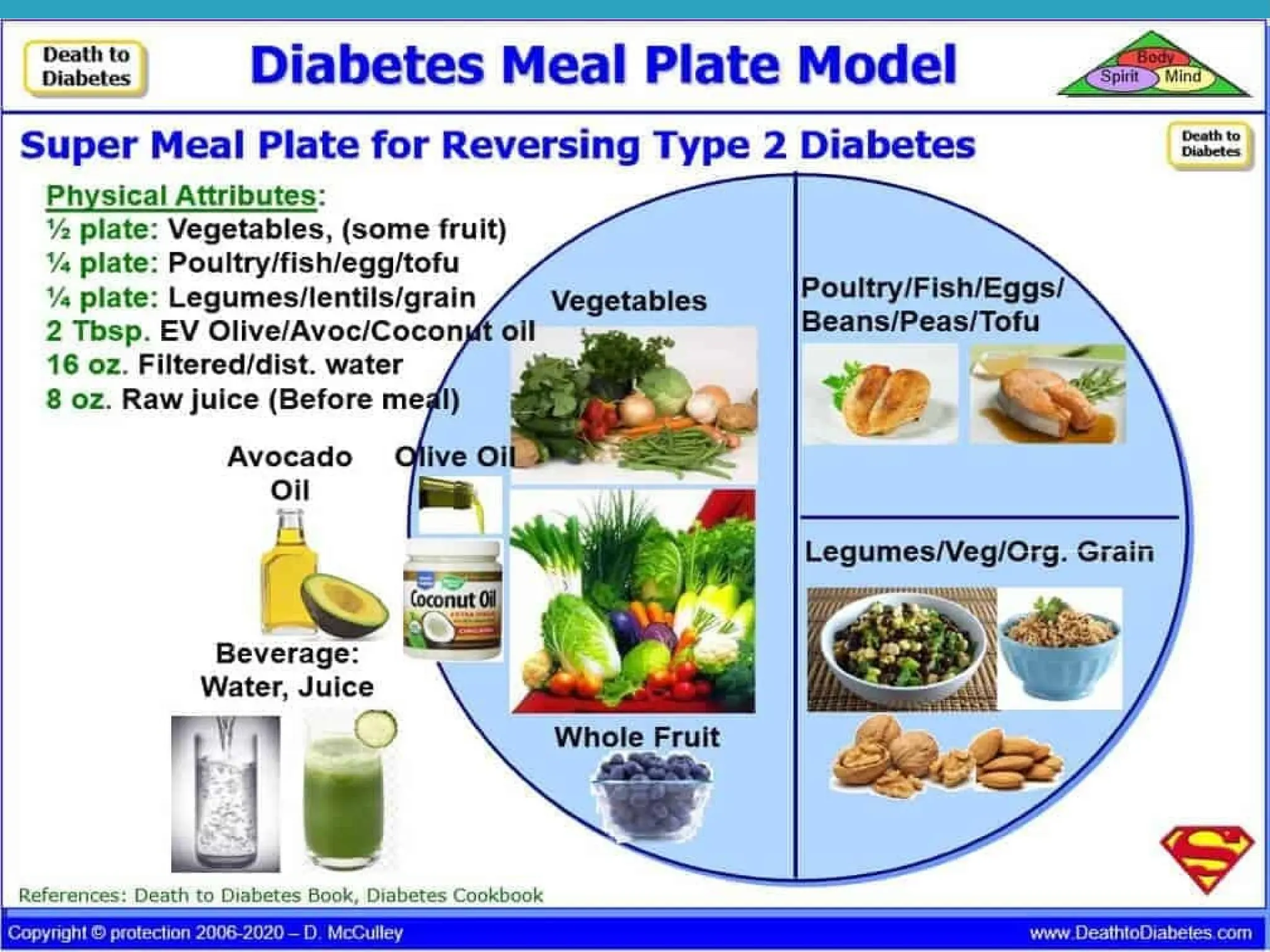
Diet contains exchange lists.
Foods are grouped according to type,
nutrients, and calories.
Pts are allowed a certain number of
items from each exchange list
according to individual needs
RENAL DIET
This diet is for renal/kidney people.
The diet plan is individualized
depending on if the person is on
dialysis.
The diet restricts sodium, potassium,
fluid, and protein specified levels.
Lab work is followed closely.
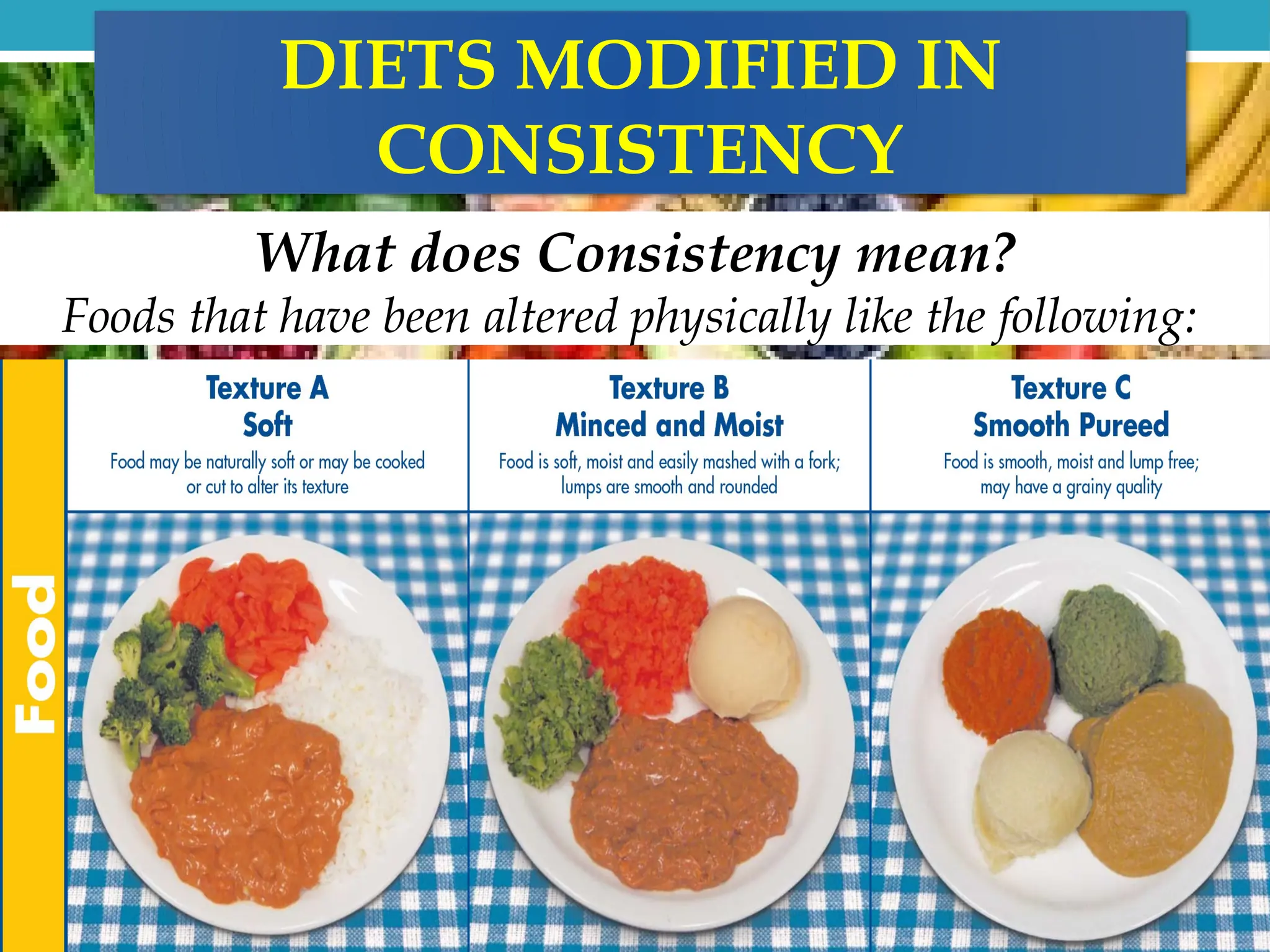
DIETS MODIFIED IN
CONSISTENCY
What does Consistency mean?
Foods that have been altered physically like the following:
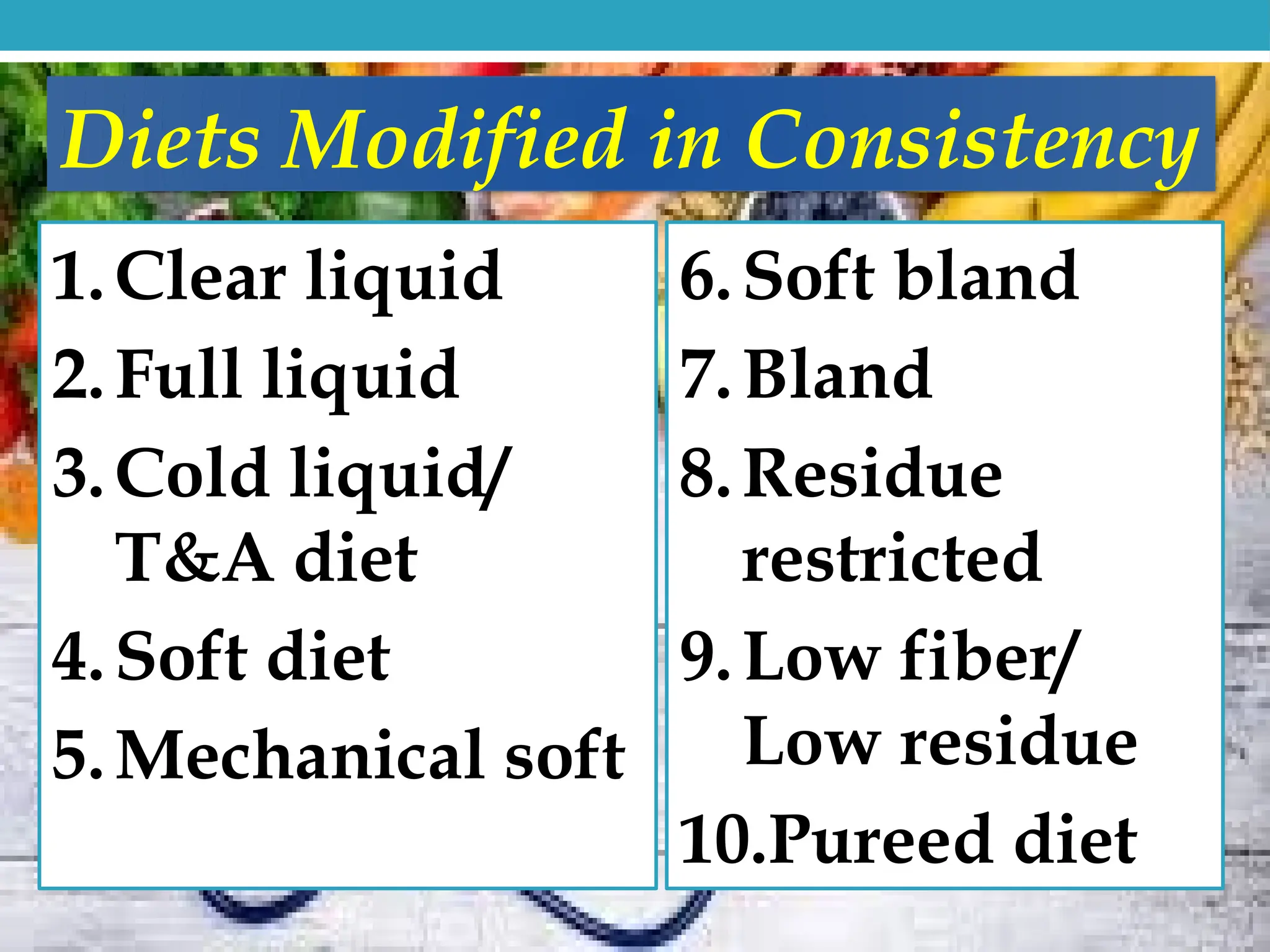
1.Clear liquid
2.Full liquid
3.Cold liquid/
T&A diet
4.Soft diet
5.Mechanical soft
Diets Modified in Consistency
6.Soft bland
7.Bland
8.Residue
restricted
9.Low fiber/
Low residue
10.Pureed diet
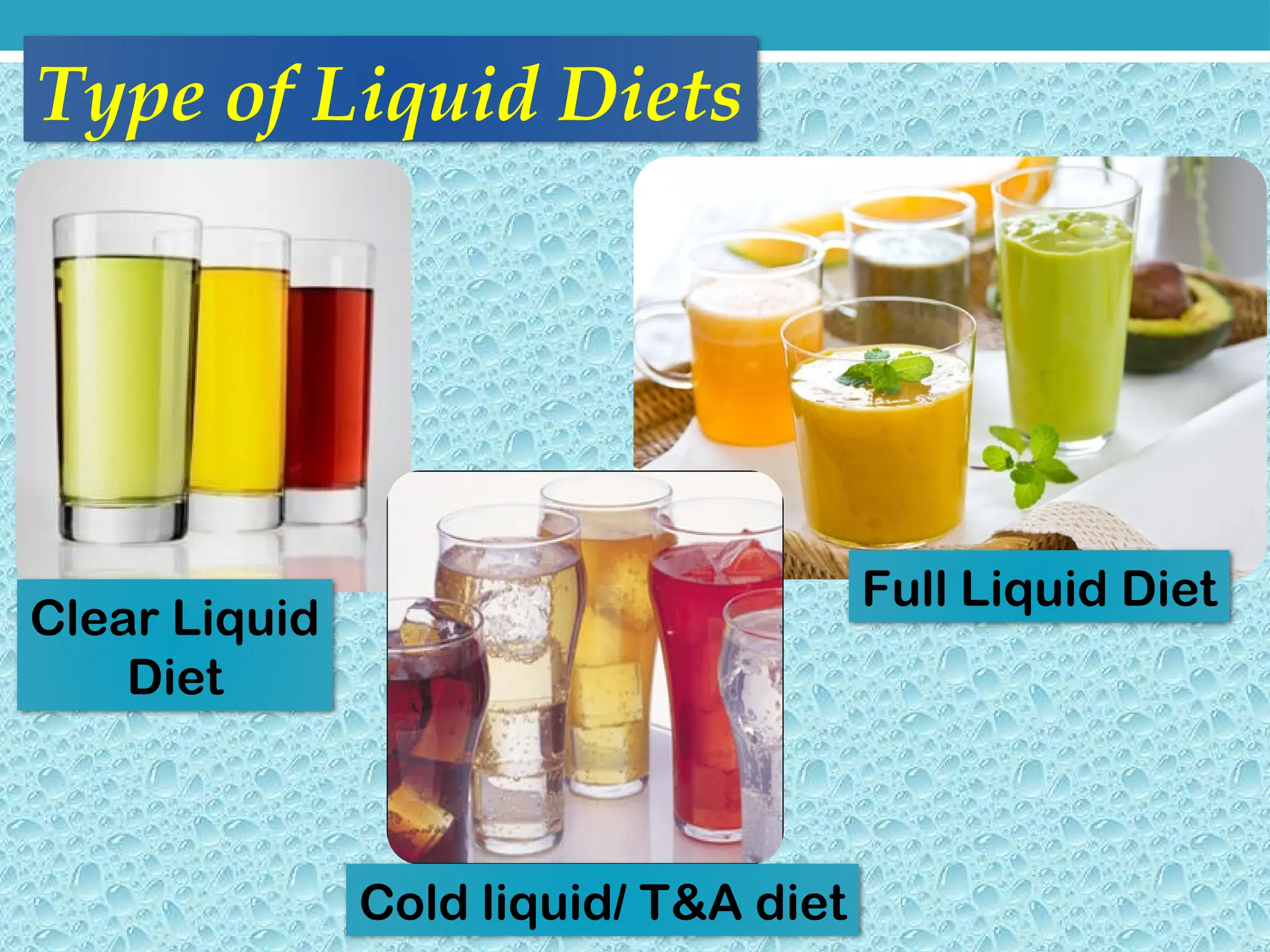
Type of Liquid Diets
Full Liquid Diet
Clear Liquid
Diet
Cold liquid/ T&A diet
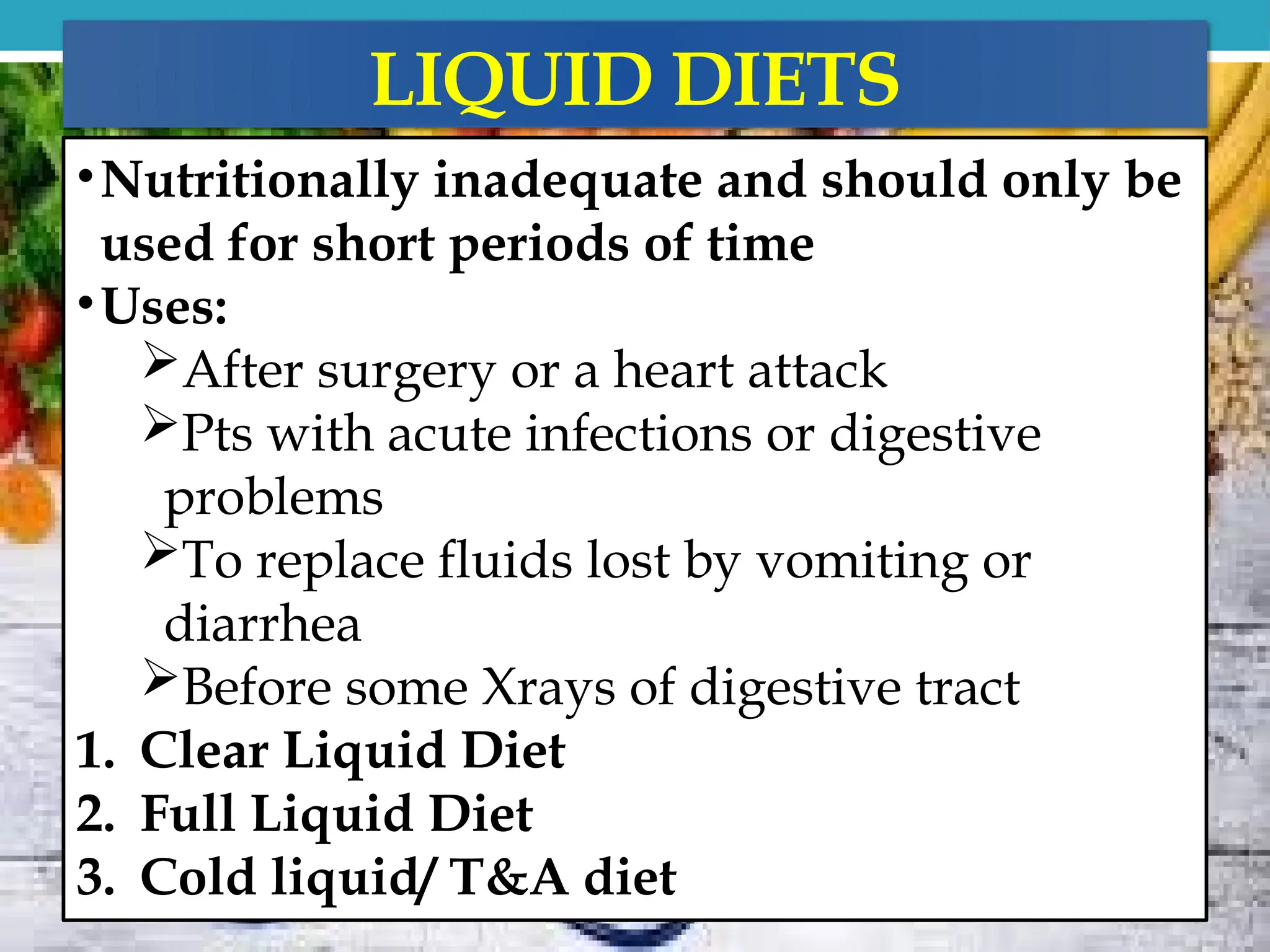
LIQUID DIETS
•Nutritionally inadequate and should only be
used for short periods of time
•Uses:
After surgery or a heart attack
Pts with acute infections or digestive
problems
To replace fluids lost by vomiting or
diarrhea
Before some Xrays of digestive tract
1. Clear Liquid Diet
2. Full Liquid Diet
3. Cold liquid/ T&A diet
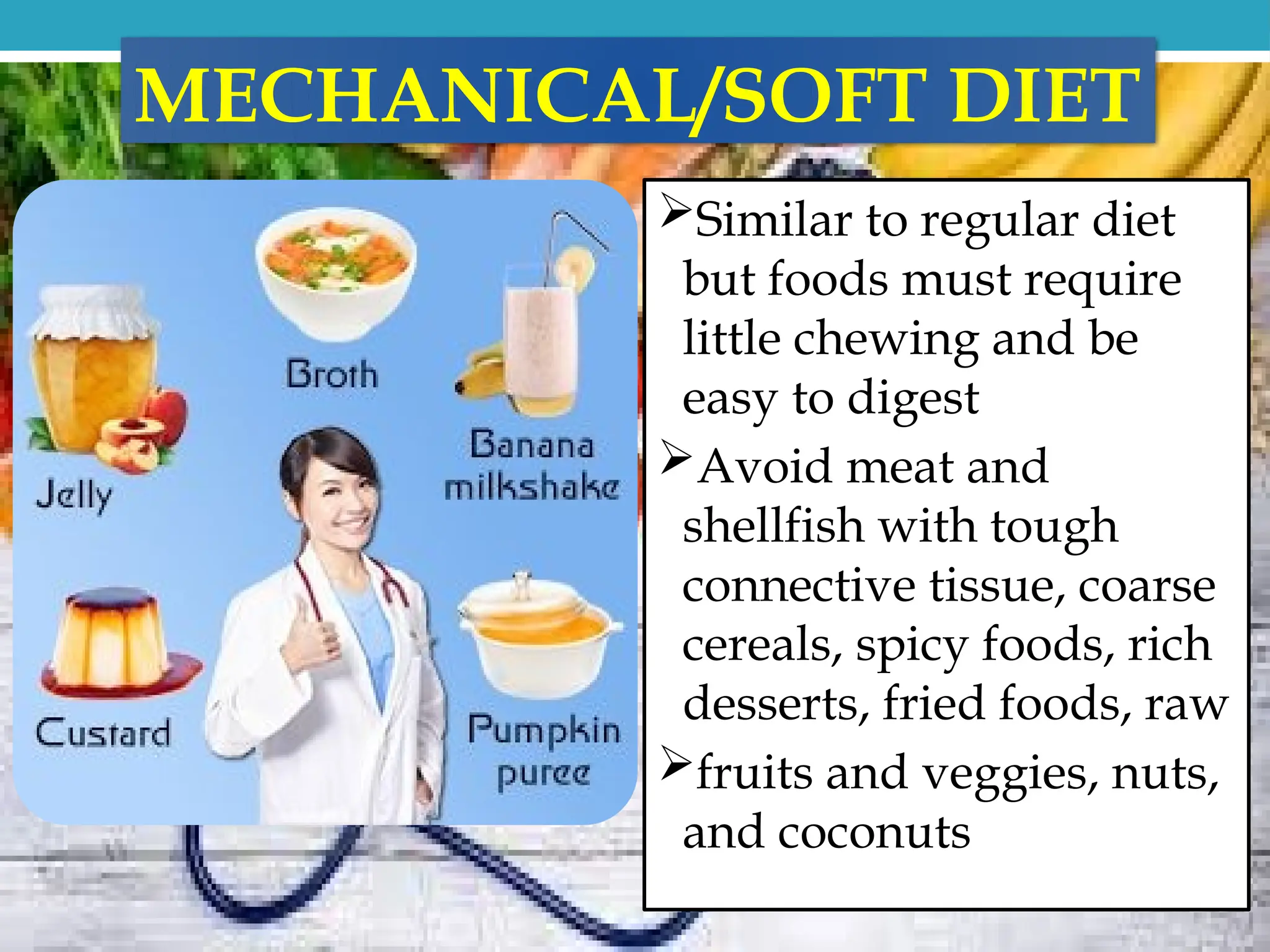
MECHANICAL/SOFT DIET
Similar to regular diet
but foods must require
little chewing and be
easy to digest
Avoid meat and
shellfish with tough
connective tissue, coarse
cereals, spicy foods, rich
desserts, fried foods, raw
fruits and veggies, nuts,
and coconuts
•Consists of easily digested
foods that do not irritate the
digestive tract
•Used for pts with ulcers and
other digestive diseases
•Avoid coarse foods, fried
foods, highly seasoned
foods, pastries, raw fruits
and veggies, alcohol,
carbonated beverages, nuts,
coffee, tea, smoked and
salted meats and fish.
BLAND DIET
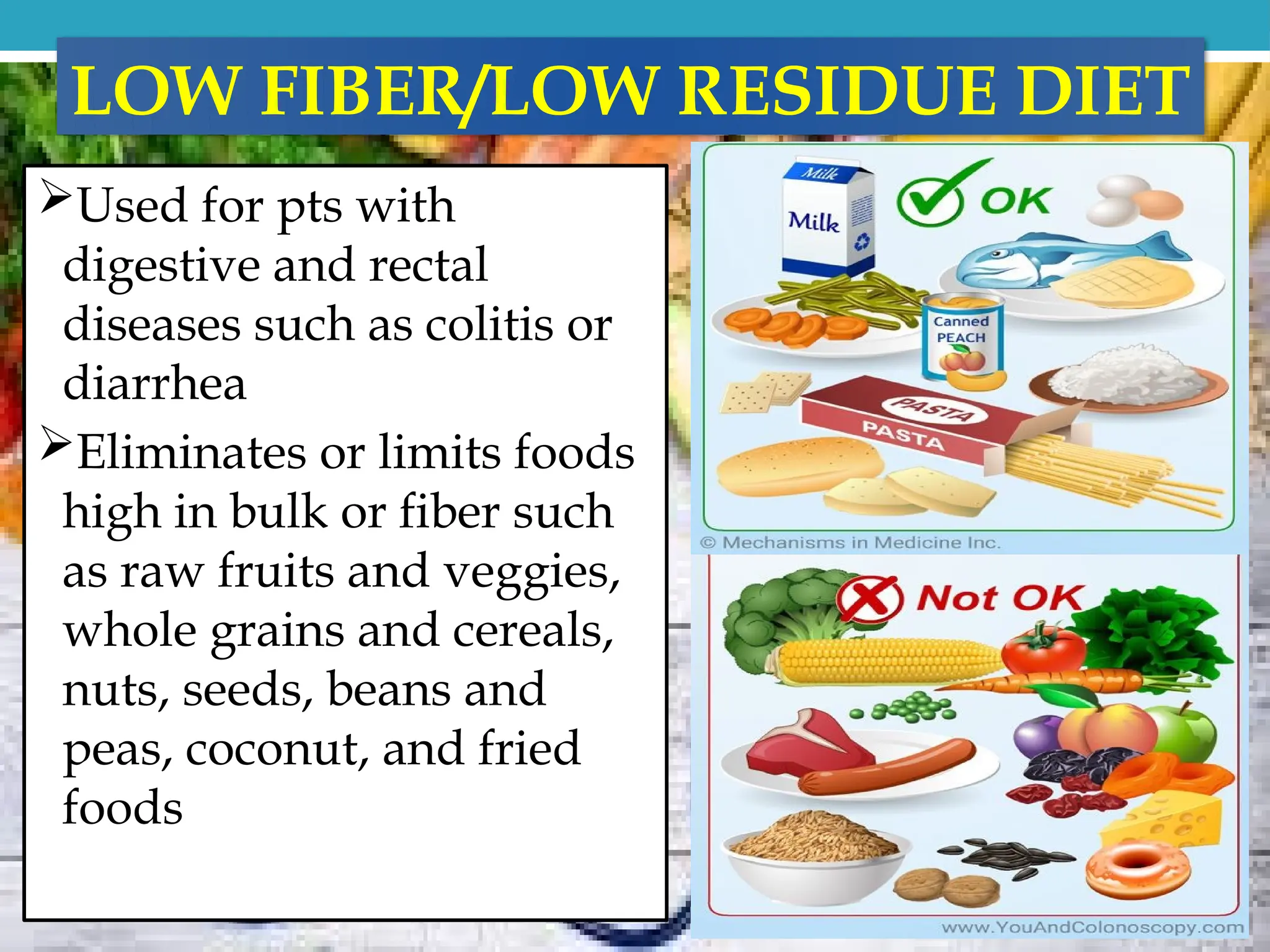
LOW FIBER/LOW RESIDUE DIET
Used for pts with
digestive and rectal
diseases such as colitis or
diarrhea
Eliminates or limits foods
high in bulk or fiber such
as raw fruits and veggies,
whole grains and cereals,
nuts, seeds, beans and
peas, coconut, and fried
foods
PUREED DIET
Changes the regular diet by pureeing it to a
smooth liquid consistency.
Indicated for those with wired jaws extremely poor
dentition in which chewing is inadequate.
Often thinned down so it can pass through a
straw.
For people with chewing or swallowing difficulties
or with the condition of dysphasia.
Foods should be pureed separately.
Avoid nuts, seeds, raw vegetables, and raw fruits.
Nutritionally adequate when offering all food
groups.
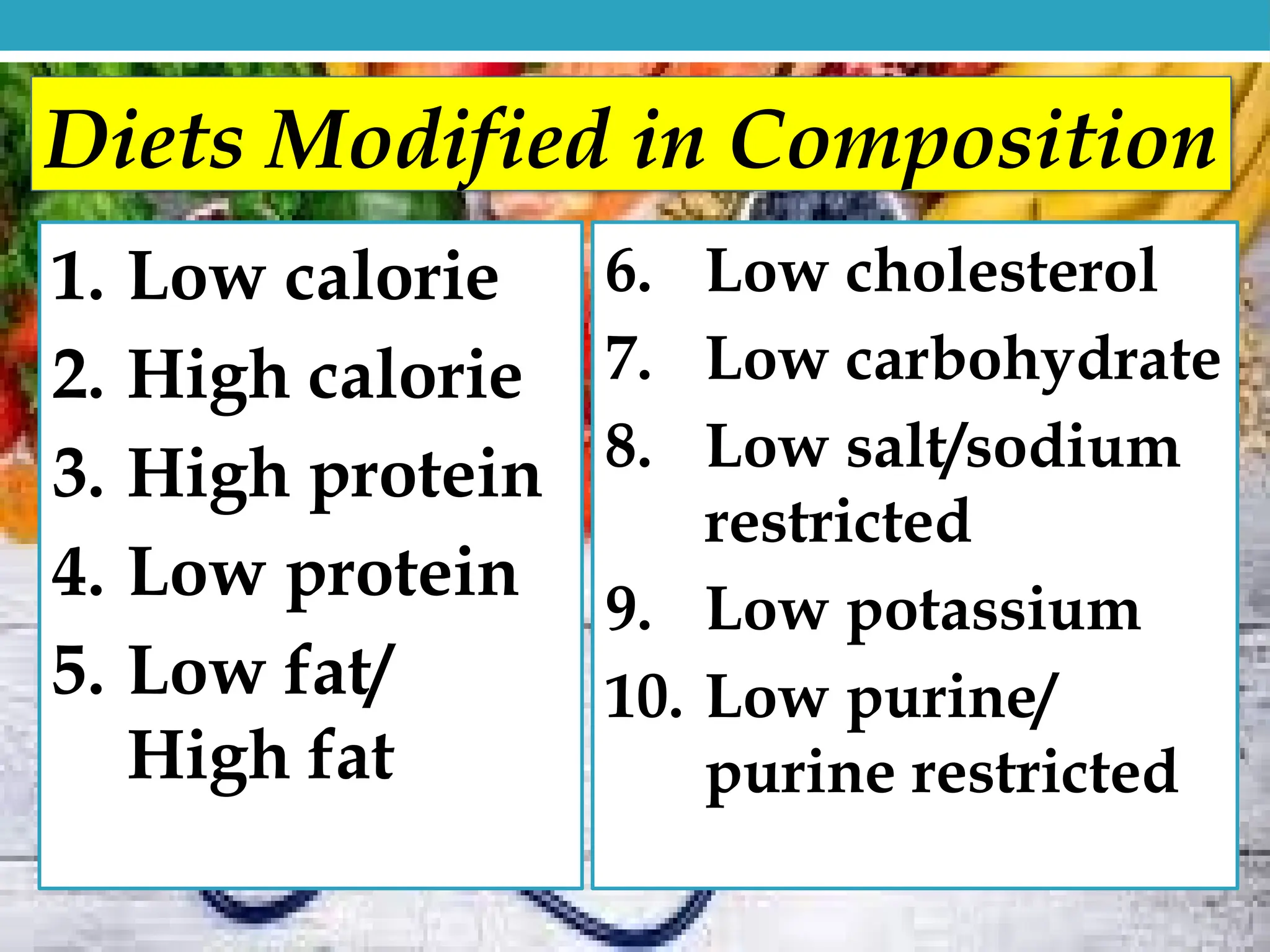
1. Low calorie
2. High calorie
3. High protein
4. Low protein
5. Low fat/
High fat
Diets Modified in Composition
6. Low cholesterol
7. Low carbohydrate
8. Low salt/sodium
restricted
9. Low potassium
10. Low purine/
purine restricted
LOW-CALORIE DIET
Used for pts who are overweight/ obese;
AVOID OR LIMIT high calories foods
such as: Butter, cream, whole milk,
cream soups or gravies, sweet soft
drinks, alcoholic beverages, salad
dressings, fatty meats, candy and rich
desserts
HIGH-CALORIE DIET
Used for pts who are underweight, or who
have anorexia nervosa, hyperthyroidism,
or cancer
Extra proteins and carbs are included;
Avoid high-bulk foods such as green
salads, watermelon and fibrous fruits
Avoid high-fat foods such as fried foods,
rich pastries, and cheese cake because they
digest slowly and spoil appetite
HIGH PROTEIN DIET
 Used for children and adolescents who need
additional growth, pregnant or lactating women,
before and/or after surgery, pts suffering from
burns, fevers, or infections
 Regular diet with added protein rich foods such
as meats, fish, milk, cheese, and egg
LOW PROTEIN DIET
 Used for pts with certain kidney diseases and for
certain allergic conditions
 Regular diet with limited or decreased protein
rich foods
LOW FAT DIET
• Used for pts with gallbladder and liver disease, obesity, and
certain heart diseases;
• AVOID cream, whole milk, cheese, fats, fatty meats, rich
desserts, chocolate, fried foods, salad dressings, nuts, and
coconut
LOW FAT DIET/ HIGH FAT DIET
LOW CHOLESTEROL DIET
Restricts foods containing cholesterol;
Used for pts with atherosclerosis and
heart disease
Limit foods high in saturated fats such
as beef, liver, pork, lamb, egg yolk,
cream, cheese, natural cheeses,
shellfish, whole milk, and coconut and
palm oil products
LOW CARBOHYDRATE DIET
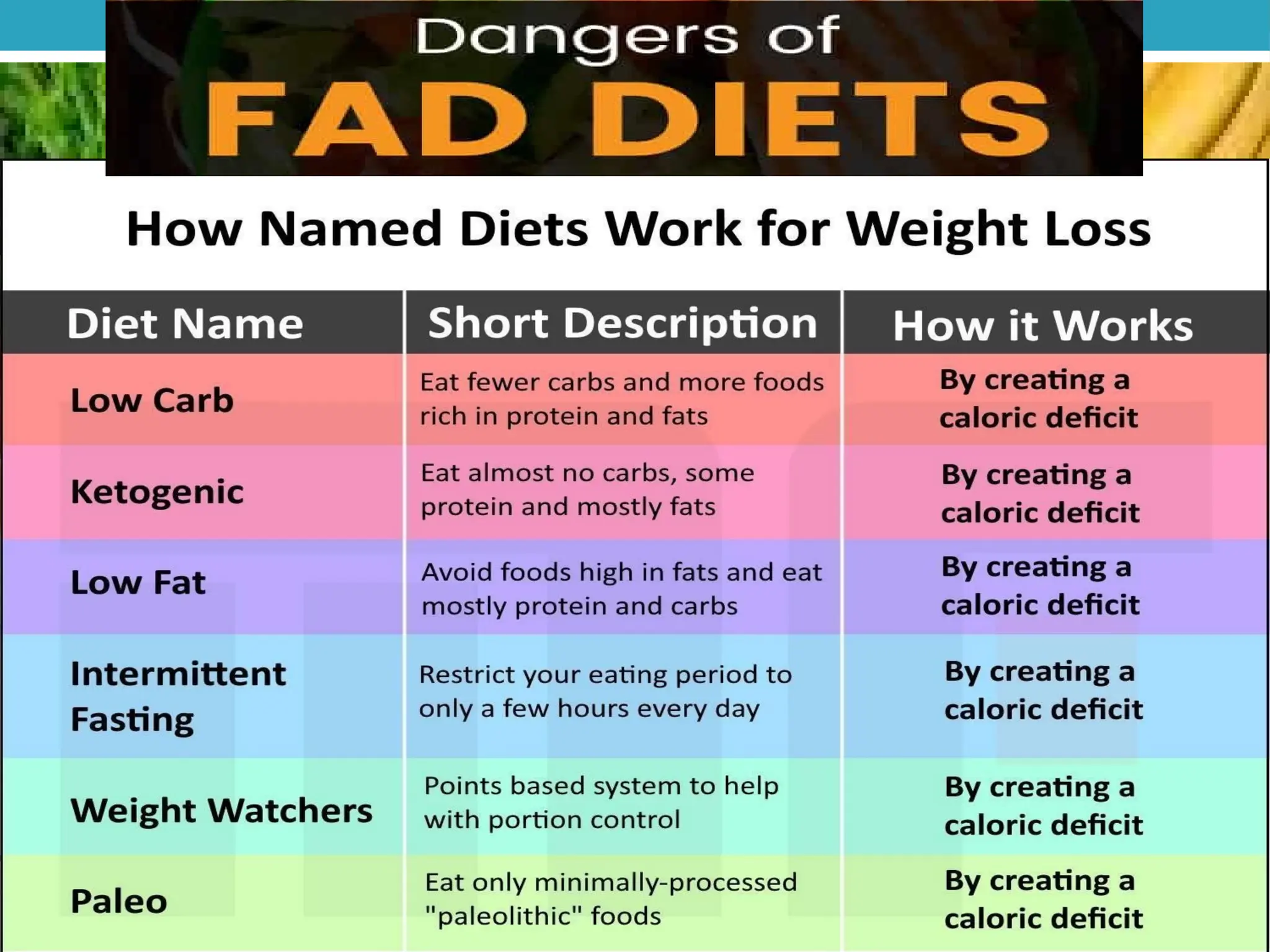
•Dietary programs that restrict carbohydrate
consumption usually for weight control or for the
treatment of obesity.
•Foods high in digestible carbohydrates (e.g.
bread, pasta) are limited or replaced with foods
containing a higher percentage of proteins and
fats (e.g., meat, poultry, fish, shellfish, eggs,
cheese, nuts, seeds, peanuts, and soy products)
and other foods low in carbohydrates (e.g., most
salad vegetables) although other vegetables and
fruits (especially berries) are often allowed.
 Used for pts with cardiovascular diseases
such as hypertension or congestive heart
disease, kidney disease, and edema
 Avoid or limit addition of salt to any food,
smoked meats or fish, processed foods,
pickles, sauerkraut, olives, and processed
cheeses
SODIUM RESTRICTED DIET
(Low Sodium or Low Salt Diet)
LOW POTASSIUM DIET
LOW PURINE/
PURINE RESTRICTED DIET
• A low-purine diet is
an eating plan that
limits foods with
high purine.
• Purines are a natural
substance found in
some foods.
• Purines aren't all bad,
but you want to avoid
high amounts.
• When your body
digests purine, it
produces a waste
product called uric
acid.
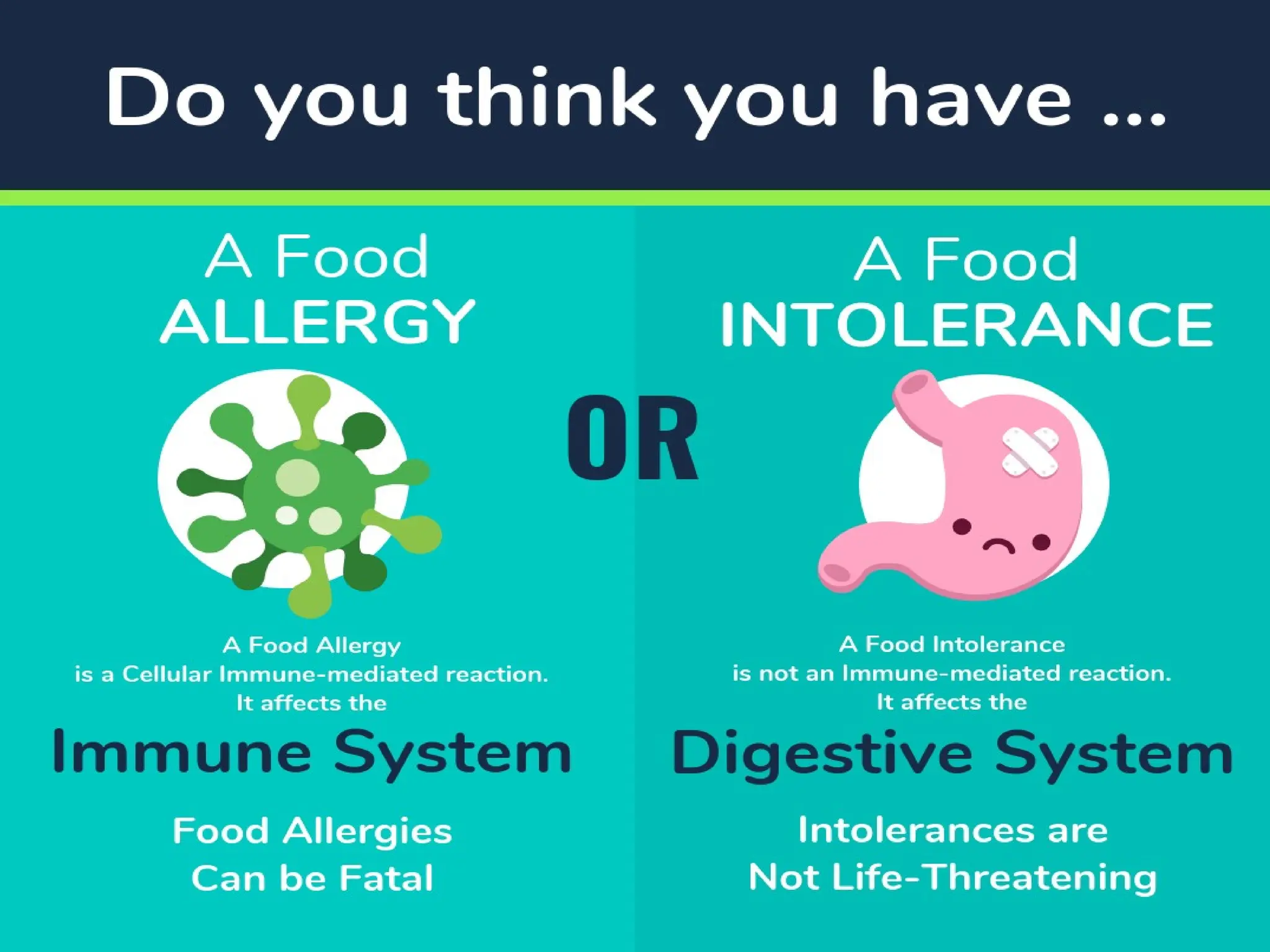
FOOD ALLERGY MODIFICATION
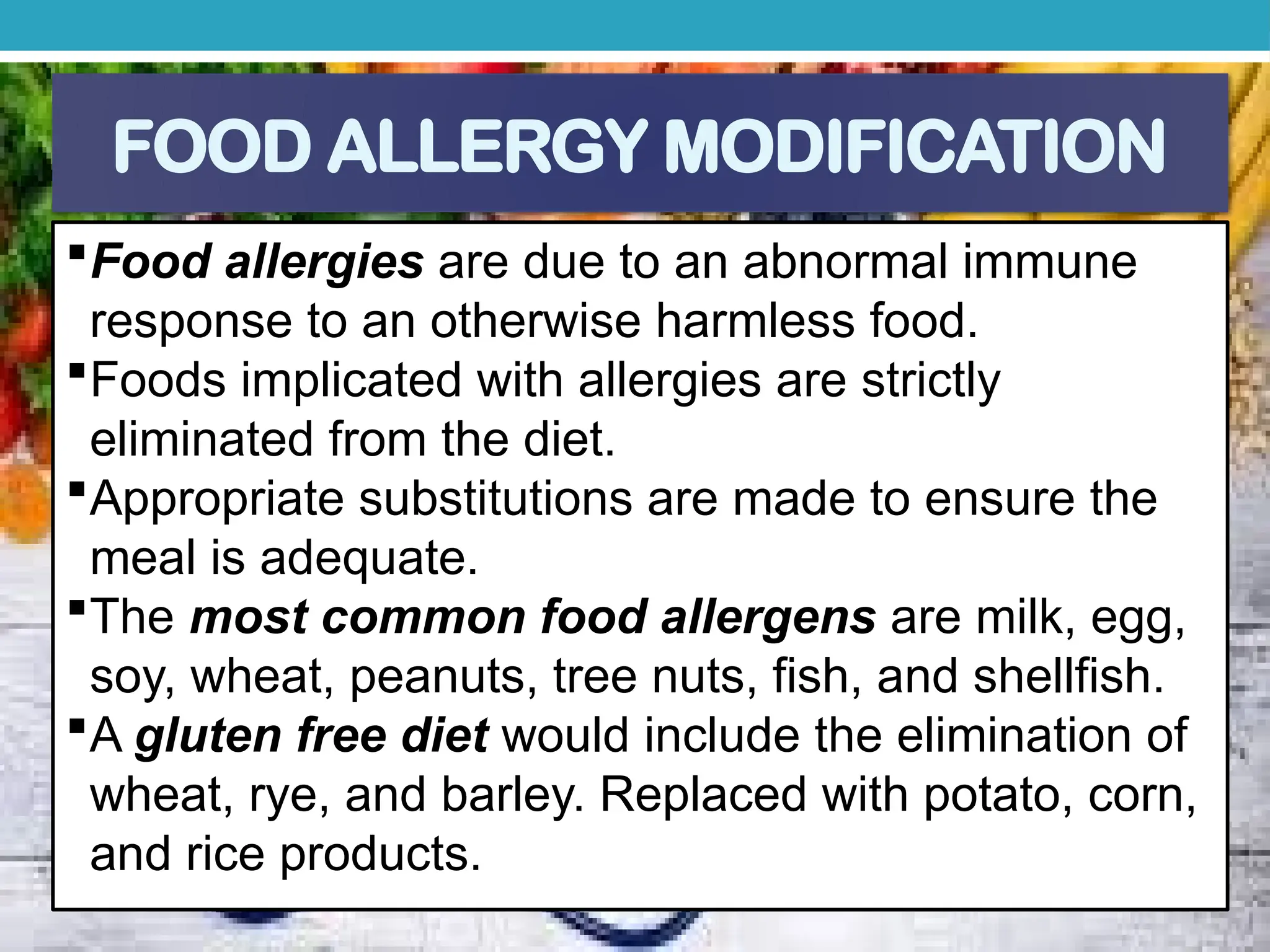
Food allergies are due to an abnormal immune
response to an otherwise harmless food.
Foods implicated with allergies are strictly
eliminated from the diet.
Appropriate substitutions are made to ensure the
meal is adequate.
The most common food allergens are milk, egg,
soy, wheat, peanuts, tree nuts, fish, and shellfish.
A gluten free diet would include the elimination of
wheat, rye, and barley. Replaced with potato, corn,
and rice products.
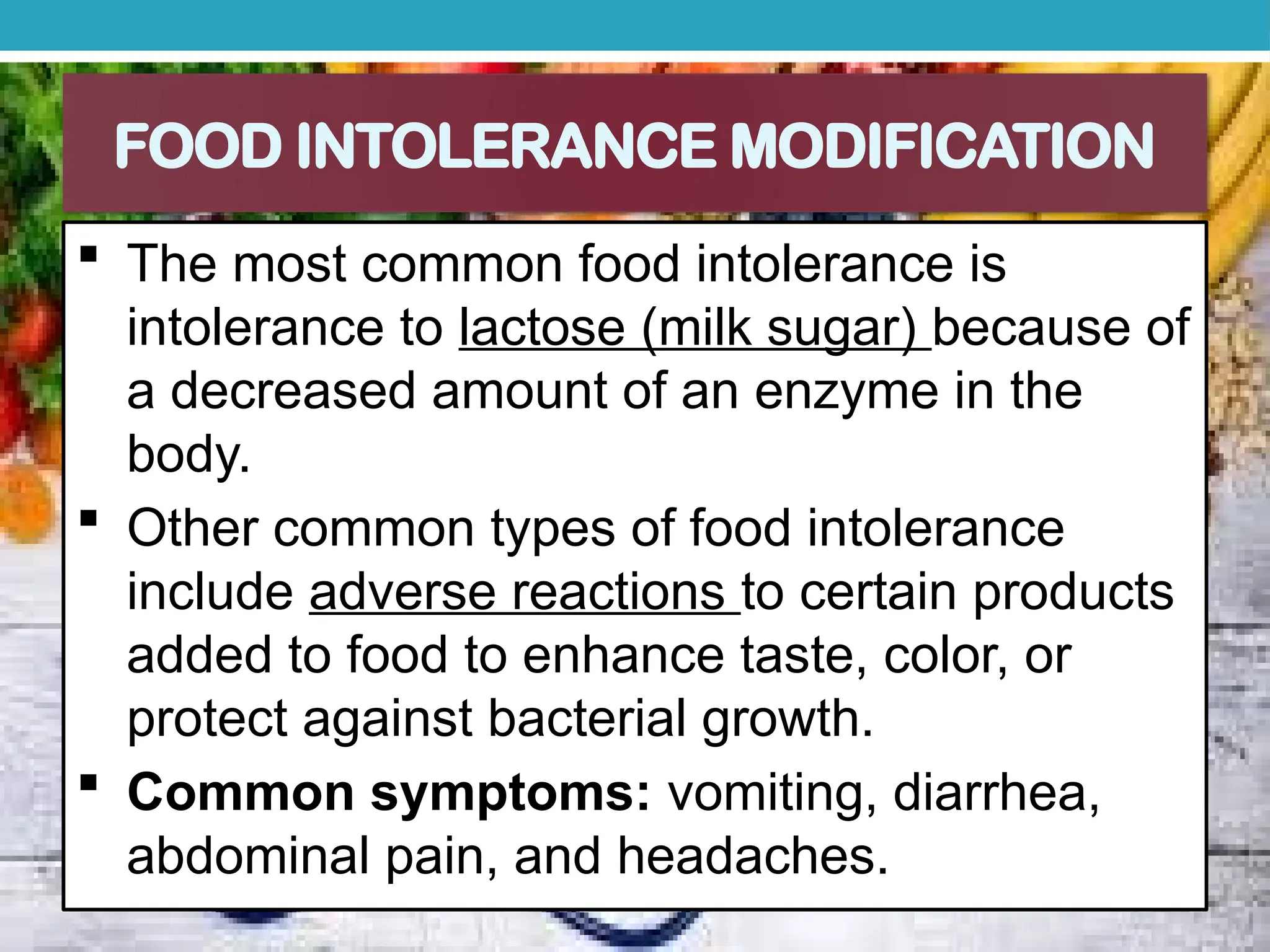
FOOD INTOLERANCE MODIFICATION
 The most common food intolerance is
intolerance to lactose (milk sugar) because of
a decreased amount of an enzyme in the
body.
 Other common types of food intolerance
include adverse reactions to certain products
added to food to enhance taste, color, or
protect against bacterial growth.
 Common symptoms: vomiting, diarrhea,
abdominal pain, and headaches.
TUBE FEEDINGS
Tube feedings are used for
people who cannot take
adequate food or fluids by
mouth.
All or parts of nutritional
needs are met through tube
feedings.
Some people may receive
food by mouth if they can
swallow safely and are
working to be weaned off the
tube feeding.
TUBE FEEDINGS
THE END